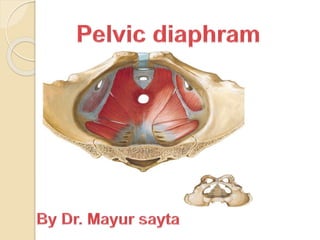
Pelvic Diaphragm
 Levator Ani and coccygeus of both the
side combinely forms pelvic diaphram
 Diaphram seperates the pelvis from
perineum
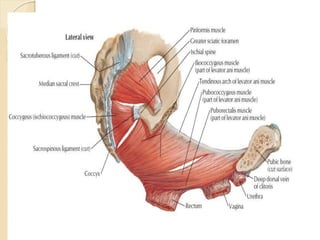
 These is devided into 3 parts
◦ Pubococcygeus
◦ Iliococcygeus
◦ Ischicoccygeus [coccygeus]
Pubococcygeus part
 Having three parts of fibers
◦ Anterior fibers
◦ Middle fibers
◦ Posterior fibers
Anterior fibers
◦ Arise from medial part of the pelvic
surface of the body of the pubis
◦ In male
 Fibers closely surround the prostate known as
levator prostate
◦ In female
 these fibers are arround the vagina and forms
the sphincter vagina
 In both cases anterior fibers inserted
into perineal body
Middle fibers
 The middle fibres constitute the
puborectalis.
 These arise from the lateral part of the
pelvic surface of the body of the pubis.
 They form a loop arround the
anorectal junction
 In female anterior portion of
puborectalis is shorter
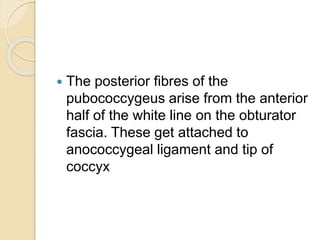
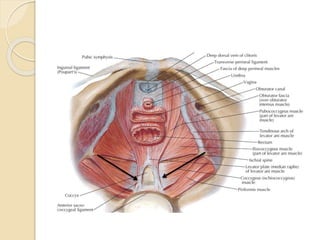
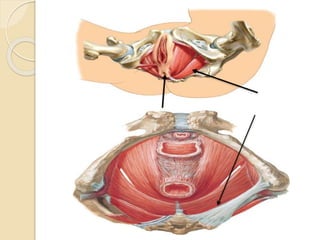
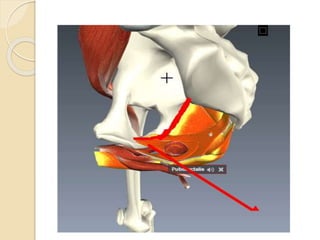
 The posterior fibres of the
pubococcygeus arise from the anterior
half of the white line on the obturator
fascia. These get attached to
anococcygeal ligament and tip of
coccyx
Iliococcygeus Part
 The fibres of this part arise from:
◦ The posterior half of the white line on the
obturator fascia; and
◦ The pelvic surface of the ischial spine.
 They are inserted into the
◦ anococcygeal ligament and into the side
of the last two pieces of coccyx.
The Coccygeus
 This muscle represents
◦ the posterior or ischiococcygeus part of the
pelvic diaphragm.
 It is triangular in shape.
 It is partly muscular and partly tendinous.
 Its fibres arise from
◦ (a) The pelvic surface of the ischial spine,
and
◦ (b) the sacrospinous ligament.
 It is inserted into the side of the coccyx,
and into the fifth sacral vertebra
Nerve Supply
 The levator ani is supplied by
◦ (1) a branch from the fourth sacral
nerve;
◦ (2) a branch either from the inferior
rectal nerve, or from the perineal
division of the pudendal nerve.
 The coccygeus is supplied by a
branch derived from the fourth and
fifth sacral nerves.
Actions of Levators Ani and
Coccygeus
 The levatores ani and coccygeus close the
posterior part of the pelvic outlet.
 2. The levators ani fix the perineal body and
support the pelvic viscera.
 3. During coughing, sneezing, lifting and
other muscular efforts, the levators ani and
coccygei counteract or resist increased intra-
abdominal pressure and help to maintain
continence of the bladder and the rectum.
 In micturition, defaecation and parturition,
a particular pelvic outlet is open,
 but contraction of fibres around other
openings resists increased intra-abdominal
pressure and prevents any prolapse
through the pelvic floor.
 The increase in the intra-abdominal pressure
is momentary in coughing and sneezing and
is more prolonged in yawning, micturition,
defaecation and lifting heavy weights.
 It is most prolonged and intense in
second stage of labour.
 The coccygei pull forwards and
support the coccyx, after it has
been pressed backwards during
defaecation or parturition or child-
birth
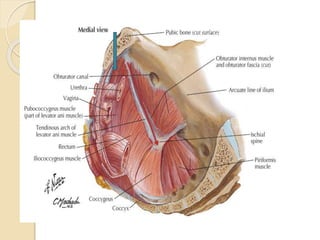
Relations of the Levator Ani
 The superior or pelvic surface is
covered with pelvic fascia which
separates it from the bladder, the
prostate, the rectum and the
peritoneum.
 2. The inferior or perineal surface is
covered with anal fascia and forms the
medial boundary of the ischiorectal
fossa.
 3. The anterior borders of the two
muscles are separated by a triangular
space for the passage of the urethra
and the vagina.
 4. The posterior border is free and
lies against the anterior margin of
the coccygeus
 evolution, the muscles have been
modified to form the pelvic diaphragm
which supports the viscera
 . Such support became necessary
with the adoption of the erect
posture by man.
CLINICAL ANATOMY
 The muscles of the pelvic floor may be
injured during parturition
 . When the perineal body is torn, and
has not been repaired satisfactorily,
the contraction of anterior fibres of
the levator ani increases the normal
gap in the pelvic floor, instead of
decreasing it.
 This results in abnormalities like
cystocoele, or prolapse of the
uterus.
MCQ
1. Part of the pelvic diaphram are all
except
a) Pubococcygeus
b) Iliococcygeus
c) Ishiococcygeous
d) Piriformis
2. Levator ani is supplied by
a) Branch from forth sacral nerve
b) Branch from the inferior rectal nerve
c) Both of them
d) None of them
3. which of the following is not true about
the relations of levator ani
a) Posterior border is lies against coccygeus
b) Anterior borders are joined with each other
c) Inferiorly covered with anal fascia
d) Superior is covered with pelvic fascia
4. Pelvic diaphram helps in all the actions
except
a. Prolapse of uterus
b. Micturation, Defecation
c. Parturation
d. Lifting heavy wight
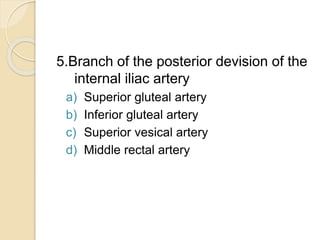
5.Branch of the posterior devision of the
internal iliac artery
a) Superior gluteal artery
b) Inferior gluteal artery
c) Superior vesical artery
d) Middle rectal artery
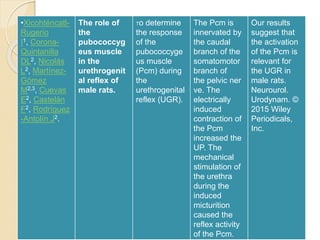
Neurourol Urodyn. 2015 Sep 28. doi: 10.1002/nau.22891•Xicohténcatl-
Rugerio
I1, Corona-
Quintanilla
DL2, Nicolás
L2, Martínez-
Gómez
M2,3, Cuevas
E2, Castelán
F2, Rodríguez
-Antolín J2.
The role of
the
pubococcyg
eus muscle
in the
urethrogenit
al reflex of
male rats.
To determine
the response
of the
pubococcyge
us muscle
(Pcm) during
the
urethrogenital
reflex (UGR).
The Pcm is
innervated by
the caudal
branch of the
somatomotor
branch of
the pelvic ner
ve. The
electrically
induced
contraction of
the Pcm
increased the
UP. The
mechanical
stimulation of
the urethra
during the
induced
micturition
caused the
reflex activity
of the Pcm.
Our results
suggest that
the activation
of the Pcm is
relevant for
the UGR in
male rats.
Neurourol.
Urodynam. ©
2015 Wiley
Periodicals,
Inc.

Pelvic diaphragm ppt

  • 2.
    Pelvic Diaphragm  LevatorAni and coccygeus of both the side combinely forms pelvic diaphram  Diaphram seperates the pelvis from perineum  These is devided into 3 parts ◦ Pubococcygeus ◦ Iliococcygeus ◦ Ischicoccygeus [coccygeus]
  • 5.
    Pubococcygeus part  Havingthree parts of fibers ◦ Anterior fibers ◦ Middle fibers ◦ Posterior fibers
  • 6.
    Anterior fibers ◦ Arisefrom medial part of the pelvic surface of the body of the pubis ◦ In male  Fibers closely surround the prostate known as levator prostate ◦ In female  these fibers are arround the vagina and forms the sphincter vagina  In both cases anterior fibers inserted into perineal body
  • 9.
    Middle fibers  Themiddle fibres constitute the puborectalis.  These arise from the lateral part of the pelvic surface of the body of the pubis.  They form a loop arround the anorectal junction  In female anterior portion of puborectalis is shorter
  • 10.
     The posteriorfibres of the pubococcygeus arise from the anterior half of the white line on the obturator fascia. These get attached to anococcygeal ligament and tip of coccyx
  • 14.
    Iliococcygeus Part  Thefibres of this part arise from: ◦ The posterior half of the white line on the obturator fascia; and ◦ The pelvic surface of the ischial spine.  They are inserted into the ◦ anococcygeal ligament and into the side of the last two pieces of coccyx.
  • 16.
    The Coccygeus  Thismuscle represents ◦ the posterior or ischiococcygeus part of the pelvic diaphragm.  It is triangular in shape.  It is partly muscular and partly tendinous.  Its fibres arise from ◦ (a) The pelvic surface of the ischial spine, and ◦ (b) the sacrospinous ligament.  It is inserted into the side of the coccyx, and into the fifth sacral vertebra
  • 21.
    Nerve Supply  Thelevator ani is supplied by ◦ (1) a branch from the fourth sacral nerve; ◦ (2) a branch either from the inferior rectal nerve, or from the perineal division of the pudendal nerve.  The coccygeus is supplied by a branch derived from the fourth and fifth sacral nerves.
  • 22.
    Actions of LevatorsAni and Coccygeus  The levatores ani and coccygeus close the posterior part of the pelvic outlet.  2. The levators ani fix the perineal body and support the pelvic viscera.  3. During coughing, sneezing, lifting and other muscular efforts, the levators ani and coccygei counteract or resist increased intra- abdominal pressure and help to maintain continence of the bladder and the rectum.
  • 23.
     In micturition,defaecation and parturition, a particular pelvic outlet is open,  but contraction of fibres around other openings resists increased intra-abdominal pressure and prevents any prolapse through the pelvic floor.  The increase in the intra-abdominal pressure is momentary in coughing and sneezing and is more prolonged in yawning, micturition, defaecation and lifting heavy weights.  It is most prolonged and intense in second stage of labour.
  • 24.
     The coccygeipull forwards and support the coccyx, after it has been pressed backwards during defaecation or parturition or child- birth
  • 25.
    Relations of theLevator Ani  The superior or pelvic surface is covered with pelvic fascia which separates it from the bladder, the prostate, the rectum and the peritoneum.  2. The inferior or perineal surface is covered with anal fascia and forms the medial boundary of the ischiorectal fossa.
  • 26.
     3. Theanterior borders of the two muscles are separated by a triangular space for the passage of the urethra and the vagina.  4. The posterior border is free and lies against the anterior margin of the coccygeus
  • 27.
     evolution, themuscles have been modified to form the pelvic diaphragm which supports the viscera  . Such support became necessary with the adoption of the erect posture by man.
  • 28.
    CLINICAL ANATOMY  Themuscles of the pelvic floor may be injured during parturition  . When the perineal body is torn, and has not been repaired satisfactorily, the contraction of anterior fibres of the levator ani increases the normal gap in the pelvic floor, instead of decreasing it.  This results in abnormalities like cystocoele, or prolapse of the uterus.
  • 29.
    MCQ 1. Part ofthe pelvic diaphram are all except a) Pubococcygeus b) Iliococcygeus c) Ishiococcygeous d) Piriformis 2. Levator ani is supplied by a) Branch from forth sacral nerve b) Branch from the inferior rectal nerve c) Both of them d) None of them
  • 30.
    3. which ofthe following is not true about the relations of levator ani a) Posterior border is lies against coccygeus b) Anterior borders are joined with each other c) Inferiorly covered with anal fascia d) Superior is covered with pelvic fascia 4. Pelvic diaphram helps in all the actions except a. Prolapse of uterus b. Micturation, Defecation c. Parturation d. Lifting heavy wight
  • 31.
    5.Branch of theposterior devision of the internal iliac artery a) Superior gluteal artery b) Inferior gluteal artery c) Superior vesical artery d) Middle rectal artery
  • 32.
    Neurourol Urodyn. 2015Sep 28. doi: 10.1002/nau.22891•Xicohténcatl- Rugerio I1, Corona- Quintanilla DL2, Nicolás L2, Martínez- Gómez M2,3, Cuevas E2, Castelán F2, Rodríguez -Antolín J2. The role of the pubococcyg eus muscle in the urethrogenit al reflex of male rats. To determine the response of the pubococcyge us muscle (Pcm) during the urethrogenital reflex (UGR). The Pcm is innervated by the caudal branch of the somatomotor branch of the pelvic ner ve. The electrically induced contraction of the Pcm increased the UP. The mechanical stimulation of the urethra during the induced micturition caused the reflex activity of the Pcm. Our results suggest that the activation of the Pcm is relevant for the UGR in male rats. Neurourol. Urodynam. © 2015 Wiley Periodicals, Inc.