ORAL MUCOSA 
The oral cavity is lined with an uninterrupted mucous 
membrane, which is continuous with the skin near the 
vermilion border of the lips and with the pharyngeal 
mucosa in the region of the soft palate and anterior 
pillars of fauces. 
The epithelium of the oral mucosa originates partly 
from the ECTODERM (lips, vestibule, gingiva, cheeks, 
palate, floor of the mouth), and pertly from the 
endoderm (tongue).
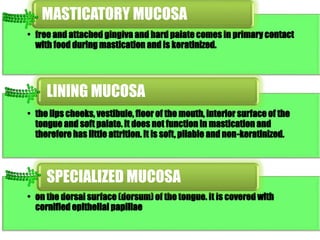
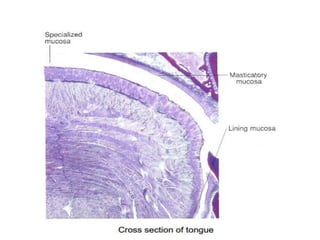
MASTICATORY MUCOSA 
• free and attached gingiva and hard palate comes in primary contact 
with food during mastication and is keratinized. 
LINING MUCOSA 
• the lips cheeks, vestibule, floor of the mouth, interior surface of the 
tongue and soft palate. It does not function in mastication and 
therefore has little attrition. It is soft, pliable and non-keratinized. 
SPECIALIZED MUCOSA 
• on the dorsal surface (dorsum) of the tongue. It is covered with 
cornified epithelial papillae
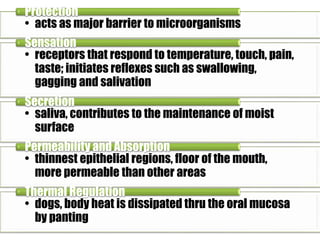
Protection 
• acts as major barrier to microorganisms 
Sensation 
• receptors that respond to temperature, touch, pain, 
taste; initiates reflexes such as swallowing, 
gagging and salivation 
Secretion 
• saliva, contributes to the maintenance of moist 
surface 
Permeability and Absorption 
• thinnest epithelial regions, floor of the mouth, 
more permeable than other areas 
Thermal Regulation 
• dogs, body heat is dissipated thru the oral mucosa 
by panting
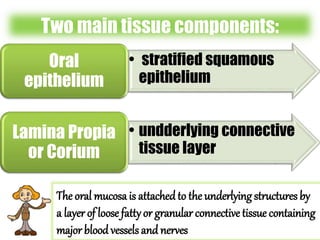
Two main tissue components: 
• stratified squamous 
epithelium 
Oral 
epithelium 
• undderlying connective 
tissue layer 
Lamina Propia 
or Corium 
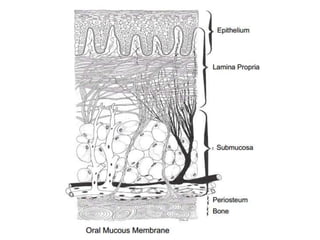
The oral mucosa is attached to the underlying structures by 
a layer of loose fatty or granular connective tissue containing 
major blood vessels and nerves
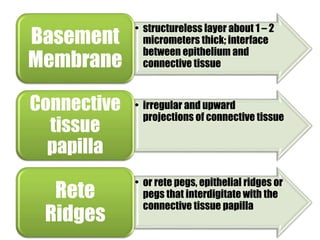
• structureless layer about 1 – 2 
micrometers thick; interface 
between epithelium and 
connective tissue 
Basement 
Membrane 
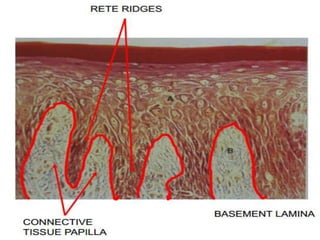
• irregular and upward 
projections of connective tissue 
Connective 
tissue 
papilla 
• or rete pegs, epithelial ridges or 
pegs that interdigitate with the 
connective tissue papilla 
Rete 
Ridges
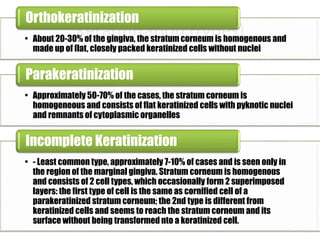
Orthokeratinization 
Keratinization (types) • About 20-30% of the gingiva, the stratum corneumis homogenous and 
made up of flat, closely packed keratinized cells without nuclei 
Parakeratinization 
• Approximately 50-70% of the cases, the stratum corneum is 
homogeneous and consists of flat keratinized cells with pyknotic nuclei 
and remnants of cytoplasmic organelles 
Incomplete Keratinization 
• - Least common type, approximately 7-10% of cases and is seen only in 
the region of the marginal gingiva. Stratum corneum is homogenous 
and consists of 2 cell types, which occasionally form 2 superimposed 
layers: the first type of cell is the same as cornified cell of a 
parakeratinized stratum corneum; the 2nd type is different from 
keratinized cells and seems to reach the stratum corneumand its 
surface without being transformed nto a keratinized cell.
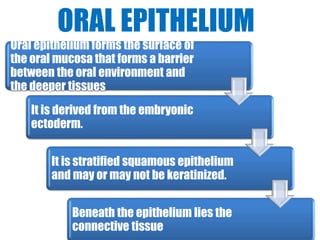
ORAL EPITHELIUM 
Oral epithelium forms the surface of 
the oral mucosa that forms a barrier 
between the oral environment and 
the deeper tissues 
It is derived from the embryonic 
ectoderm. 
It is stratified squamous epithelium 
and may or may not be keratinized. 
Beneath the epithelium lies the 
connective tissue
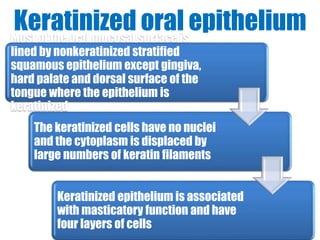
Keratinized oral epithelium 
Most of the oral mucosal surface is 
lined by nonkeratinized stratified 
squamous epithelium except gingiva, 
hard palate and dorsal surface of the 
tongue where the epithelium is 
keratinized 
The keratinized cells have no nuclei 
and the cytoplasm is displaced by 
large numbers of keratin filaments 
Keratinized epithelium is associated 
with masticatory function and have 
four layers of cells
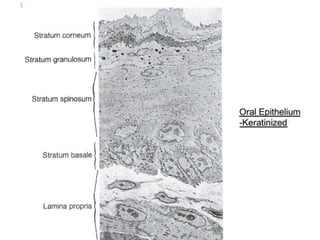
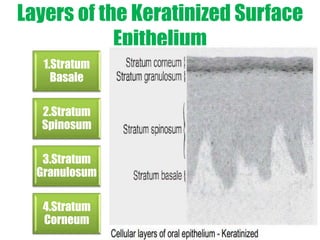
Layers of the Keratinized Surface 
Epithelium 
1.Stratum 
Basale 
2.Stratum 
Spinosum 
3.Stratum 
Granulosum 
4.Stratum 
Corneum
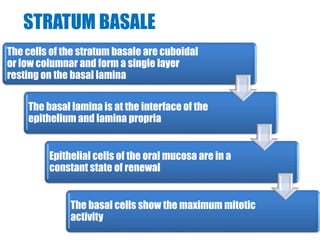
STRATUM BASALE 
The cells of the stratum basale are cuboidal 
or low columnar and form a single layer 
resting on the basal lamina 
The basal lamina is at the interface of the 
epithelium and lamina propria 
Epithelial cells of the oral mucosa are in a 
constant state of renewal 
The basal cells show the maximum mitotic 
activity
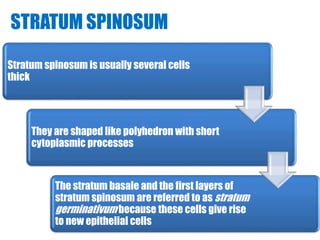
STRATUM SPINOSUM 
Stratum spinosumis usually several cells 
thick 
They are shaped like polyhedron with short 
cytoplasmic processes 
The stratum basale and the first layers of 
stratum spinosumare referred to as stratum 
germinativum because these cells give rise 
to new epithelial cells
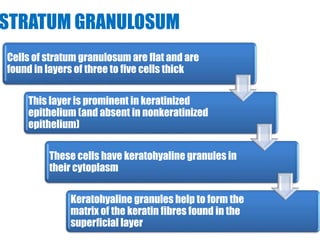
STRATUM GRANULOSUM 
Cells of stratum granulosumare flat and are 
found in layers of three to five cells thick 
This layer is prominent in keratinized 
epithelium (and absent in nonkeratinized 
epithelium) 
These cells have keratohyaline granules in 
their cytoplasm 
Keratohyaline granules help to form the 
matrix of the keratin fibres found in the 
superficial layer
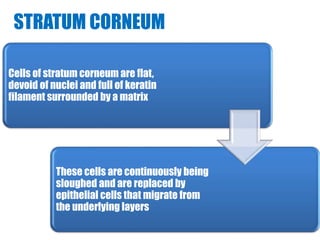
STRATUM CORNEUM 
Cells of stratum corneum are flat, 
devoid of nuclei and full of keratin 
filament surrounded by a matrix 
These cells are continuously being 
sloughed and are replaced by 
epithelial cells that migrate from 
the underlying layers
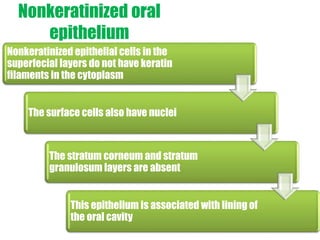
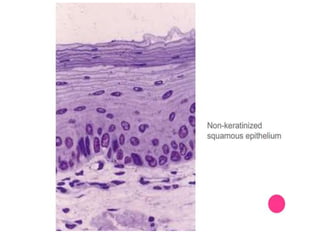
Nonkeratinized oral 
epithelium 
Nonkeratinized epithelial cells in the 
superfecial layers do not have keratin 
filaments in the cytoplasm 
The surface cells also have nuclei 
The stratum corneum and stratum 
granulosumlayers are absent 
This epithelium is associated with lining of 
the oral cavity
Connective tissue 
Connective tissue can be differentiated as 
Lamina Propria and Submucosa 
Lamina propria 
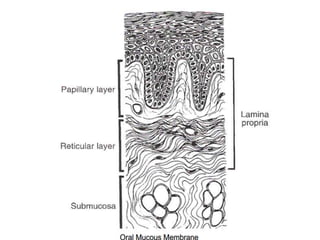
• Lamina propria is the connective tissue layer immediately below 
the epithelium 
Lamina propia can be divided into: 
1)papillary layer - prominent in masticatory mucosa 
2)reticular layer-prominent in lining mucosa 
• Lamina propria consists of blood vessels and cells like 
fibroblasts, cells of blood vessels and lymphatics and nerves 
• Epithelium is avascular, hence its metabolic needs come via 
the vessels of the lamina propria
Submucosa 
• Submucosa lies below the lamina propria and 
serves as an attachment between lamina propria 
and bone or skeletal muscle 
• It is found in the cheeks, lips and parts of the 
palate 
• It consists of large blood vessels, nerves and 
lymphatics and its functions of mucosa are 
nutrition and defensive.
Functional types of Oral Mucosa 
• Lining mucosa covers all soft 
tissues of the oral cavity except the 
gingiva, hard palate and the dorsal 
surface of the tongue 
A) Lining 
mucosa 
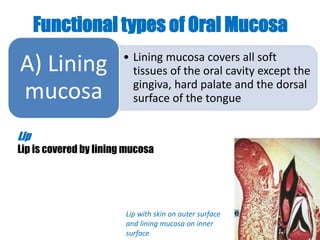
Lip 
Lip is covered by lining mucosa 
Lip with skin on outer surface 
and lining mucosa on inner 
surface
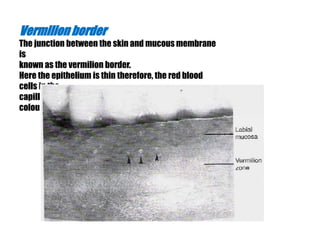
Vermilion border 
The junction between the skin and mucous membrane 
is 
known as the vermilion border. 
Here the epithelium is thin therefore, the red blood 
cells in the 
capillaries show through contributing to the vermilion 
colour
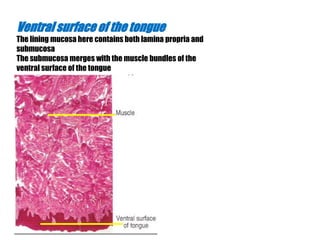
Ventral surface of the tongue 
The lining mucosa here contains both lamina propria and 
submucosa 
The submucosa merges with the muscle bundles of the 
ventral surface of the tongue
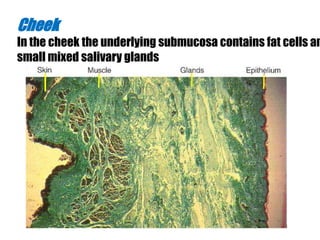
Cheek 
In the cheek the underlying submucosa contains fat cells and 
small mixed salivary glands
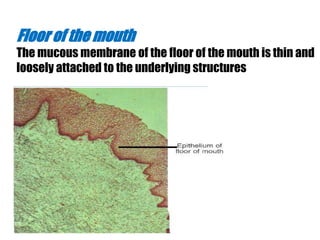
Floor of the mouth 
The mucous membrane of the floor of the mouth is thin and 
loosely attached to the underlying structures
• Masticatory mucosa covers the gingiva and 
hard palate. 
• In edentulous mouth, masticatory mucosa 
covers the chewing surface of the dental 
arches. 
B) 
Masticatory 
mucosa 
Gingiva 
• Gingiva has keratinized or parakeratinzed epithelium with 
no submucosal layer 
• It develops from the union of oral epithelium and reduced 
enamel epithelium of the developing tooth
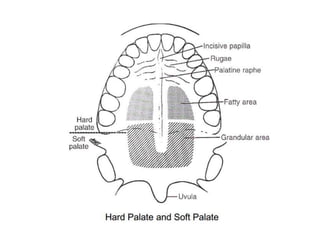
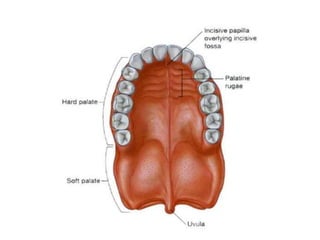
Hard palate 
• The surface of the hard palate that is visible in 
the mouth is 
covered by masticatory mucosa 
• The lateral regions of the posterior part contains 
palatine glands 
• These glands are purely mucous glands 
• The midline of the hard palate is called median 
raphe, where there is no submucosa 
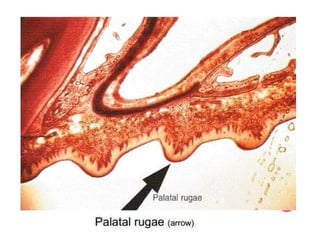
• A series of folds appear in the anterior part of the 
palate 
called rugae
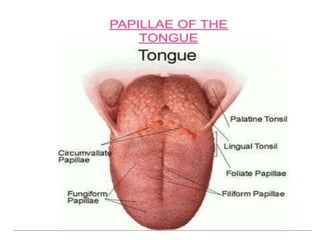
Mucosa of the Tongue 
• Specialized mucosa covers the dorsal surface 
of the body of the tongue 
• The connective tissue binds the epithelium to 
the underlying skeletal muscle 
• The epithelium is modified, keratinized, 
stratified covered with papillae, which can be 
seen by naked eye
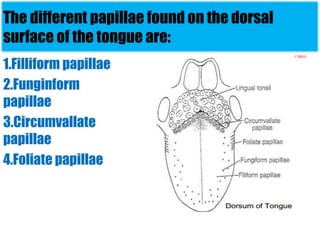
The different papillae found on the dorsal 
surface of the tongue are: 
1.Filliform papillae 
2.Funginform 
papillae 
3.Circumvallate 
papillae 
4.Foliate papillae
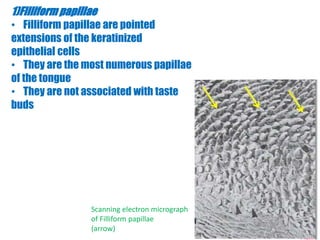
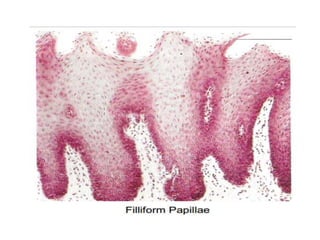
1)Filliform papillae 
• Filliform papillae are pointed 
extensions of the keratinized 
epithelial cells 
• They are the most numerous papillae 
of the tongue 
• They are not associated with taste 
buds 
Scanning electron micrograph 
of Filliform papillae 
(arrow)
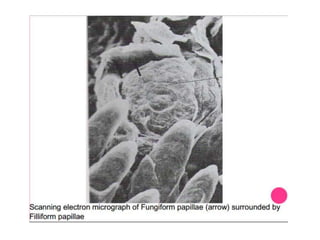
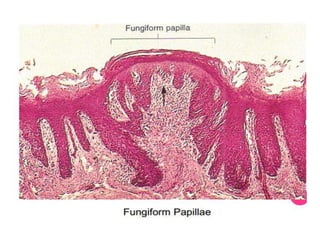
2)Fungiform papillae 
• Fungiform papillae are fewer than the filliform 
papillae and are 
scattered over the dorsal surface of the tongue 
• They are rounded elevations above the 
surface of the tongue 
• They have taste buds on their superior 
surfaces 
The surface of fungiform papillae is not 
keratinized
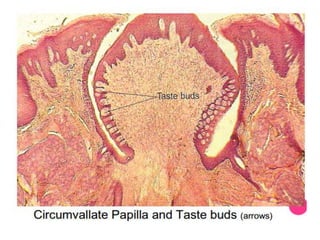
3)Circumvallate papillae 
• The circumvallate papillae are located at the 
junction of the 
anterior two thirds (body) and posterior one thirds 
(base) of 
the tongue 
• There are eight to twelve in number and are bigger 
than 
fungiform papillae 
• Circumvallate papillae are lined with taste buds and 
also 
openings of serous glands 
• The secretion from the serous glands washes away
4) Foliate papillae 
• Foliate papillae are located in the 
furrows along the posterior sides of the 
tongue 
• They may be lined with taste buds 
• They are not prominent in human beings
Oral Mucosa

Oral Mucosa

  • 2.
    ORAL MUCOSA Theoral cavity is lined with an uninterrupted mucous membrane, which is continuous with the skin near the vermilion border of the lips and with the pharyngeal mucosa in the region of the soft palate and anterior pillars of fauces. The epithelium of the oral mucosa originates partly from the ECTODERM (lips, vestibule, gingiva, cheeks, palate, floor of the mouth), and pertly from the endoderm (tongue).
  • 3.
    MASTICATORY MUCOSA •free and attached gingiva and hard palate comes in primary contact with food during mastication and is keratinized. LINING MUCOSA • the lips cheeks, vestibule, floor of the mouth, interior surface of the tongue and soft palate. It does not function in mastication and therefore has little attrition. It is soft, pliable and non-keratinized. SPECIALIZED MUCOSA • on the dorsal surface (dorsum) of the tongue. It is covered with cornified epithelial papillae
  • 5.
    Protection • actsas major barrier to microorganisms Sensation • receptors that respond to temperature, touch, pain, taste; initiates reflexes such as swallowing, gagging and salivation Secretion • saliva, contributes to the maintenance of moist surface Permeability and Absorption • thinnest epithelial regions, floor of the mouth, more permeable than other areas Thermal Regulation • dogs, body heat is dissipated thru the oral mucosa by panting
  • 7.
    Two main tissuecomponents: • stratified squamous epithelium Oral epithelium • undderlying connective tissue layer Lamina Propia or Corium The oral mucosa is attached to the underlying structures by a layer of loose fatty or granular connective tissue containing major blood vessels and nerves
  • 8.
    • structureless layerabout 1 – 2 micrometers thick; interface between epithelium and connective tissue Basement Membrane • irregular and upward projections of connective tissue Connective tissue papilla • or rete pegs, epithelial ridges or pegs that interdigitate with the connective tissue papilla Rete Ridges
  • 13.
    Orthokeratinization Keratinization (types)• About 20-30% of the gingiva, the stratum corneumis homogenous and made up of flat, closely packed keratinized cells without nuclei Parakeratinization • Approximately 50-70% of the cases, the stratum corneum is homogeneous and consists of flat keratinized cells with pyknotic nuclei and remnants of cytoplasmic organelles Incomplete Keratinization • - Least common type, approximately 7-10% of cases and is seen only in the region of the marginal gingiva. Stratum corneum is homogenous and consists of 2 cell types, which occasionally form 2 superimposed layers: the first type of cell is the same as cornified cell of a parakeratinized stratum corneum; the 2nd type is different from keratinized cells and seems to reach the stratum corneumand its surface without being transformed nto a keratinized cell.
  • 14.
    ORAL EPITHELIUM Oralepithelium forms the surface of the oral mucosa that forms a barrier between the oral environment and the deeper tissues It is derived from the embryonic ectoderm. It is stratified squamous epithelium and may or may not be keratinized. Beneath the epithelium lies the connective tissue
  • 16.
    Keratinized oral epithelium Most of the oral mucosal surface is lined by nonkeratinized stratified squamous epithelium except gingiva, hard palate and dorsal surface of the tongue where the epithelium is keratinized The keratinized cells have no nuclei and the cytoplasm is displaced by large numbers of keratin filaments Keratinized epithelium is associated with masticatory function and have four layers of cells
  • 17.
    Layers of theKeratinized Surface Epithelium 1.Stratum Basale 2.Stratum Spinosum 3.Stratum Granulosum 4.Stratum Corneum
  • 18.
    STRATUM BASALE Thecells of the stratum basale are cuboidal or low columnar and form a single layer resting on the basal lamina The basal lamina is at the interface of the epithelium and lamina propria Epithelial cells of the oral mucosa are in a constant state of renewal The basal cells show the maximum mitotic activity
  • 19.
    STRATUM SPINOSUM Stratumspinosumis usually several cells thick They are shaped like polyhedron with short cytoplasmic processes The stratum basale and the first layers of stratum spinosumare referred to as stratum germinativum because these cells give rise to new epithelial cells
  • 20.
    STRATUM GRANULOSUM Cellsof stratum granulosumare flat and are found in layers of three to five cells thick This layer is prominent in keratinized epithelium (and absent in nonkeratinized epithelium) These cells have keratohyaline granules in their cytoplasm Keratohyaline granules help to form the matrix of the keratin fibres found in the superficial layer
  • 21.
    STRATUM CORNEUM Cellsof stratum corneum are flat, devoid of nuclei and full of keratin filament surrounded by a matrix These cells are continuously being sloughed and are replaced by epithelial cells that migrate from the underlying layers
  • 22.
    Nonkeratinized oral epithelium Nonkeratinized epithelial cells in the superfecial layers do not have keratin filaments in the cytoplasm The surface cells also have nuclei The stratum corneum and stratum granulosumlayers are absent This epithelium is associated with lining of the oral cavity
  • 24.
    Connective tissue Connectivetissue can be differentiated as Lamina Propria and Submucosa Lamina propria • Lamina propria is the connective tissue layer immediately below the epithelium Lamina propia can be divided into: 1)papillary layer - prominent in masticatory mucosa 2)reticular layer-prominent in lining mucosa • Lamina propria consists of blood vessels and cells like fibroblasts, cells of blood vessels and lymphatics and nerves • Epithelium is avascular, hence its metabolic needs come via the vessels of the lamina propria
  • 25.
    Submucosa • Submucosalies below the lamina propria and serves as an attachment between lamina propria and bone or skeletal muscle • It is found in the cheeks, lips and parts of the palate • It consists of large blood vessels, nerves and lymphatics and its functions of mucosa are nutrition and defensive.
  • 26.
    Functional types ofOral Mucosa • Lining mucosa covers all soft tissues of the oral cavity except the gingiva, hard palate and the dorsal surface of the tongue A) Lining mucosa Lip Lip is covered by lining mucosa Lip with skin on outer surface and lining mucosa on inner surface
  • 27.
    Vermilion border Thejunction between the skin and mucous membrane is known as the vermilion border. Here the epithelium is thin therefore, the red blood cells in the capillaries show through contributing to the vermilion colour
  • 28.
    Ventral surface ofthe tongue The lining mucosa here contains both lamina propria and submucosa The submucosa merges with the muscle bundles of the ventral surface of the tongue
  • 29.
    Cheek In thecheek the underlying submucosa contains fat cells and small mixed salivary glands
  • 30.
    Floor of themouth The mucous membrane of the floor of the mouth is thin and loosely attached to the underlying structures
  • 31.
    • Masticatory mucosacovers the gingiva and hard palate. • In edentulous mouth, masticatory mucosa covers the chewing surface of the dental arches. B) Masticatory mucosa Gingiva • Gingiva has keratinized or parakeratinzed epithelium with no submucosal layer • It develops from the union of oral epithelium and reduced enamel epithelium of the developing tooth
  • 32.
    Hard palate •The surface of the hard palate that is visible in the mouth is covered by masticatory mucosa • The lateral regions of the posterior part contains palatine glands • These glands are purely mucous glands • The midline of the hard palate is called median raphe, where there is no submucosa • A series of folds appear in the anterior part of the palate called rugae
  • 36.
    Mucosa of theTongue • Specialized mucosa covers the dorsal surface of the body of the tongue • The connective tissue binds the epithelium to the underlying skeletal muscle • The epithelium is modified, keratinized, stratified covered with papillae, which can be seen by naked eye
  • 37.
    The different papillaefound on the dorsal surface of the tongue are: 1.Filliform papillae 2.Funginform papillae 3.Circumvallate papillae 4.Foliate papillae
  • 41.
    1)Filliform papillae •Filliform papillae are pointed extensions of the keratinized epithelial cells • They are the most numerous papillae of the tongue • They are not associated with taste buds Scanning electron micrograph of Filliform papillae (arrow)
  • 43.
    2)Fungiform papillae •Fungiform papillae are fewer than the filliform papillae and are scattered over the dorsal surface of the tongue • They are rounded elevations above the surface of the tongue • They have taste buds on their superior surfaces The surface of fungiform papillae is not keratinized
  • 46.
    3)Circumvallate papillae •The circumvallate papillae are located at the junction of the anterior two thirds (body) and posterior one thirds (base) of the tongue • There are eight to twelve in number and are bigger than fungiform papillae • Circumvallate papillae are lined with taste buds and also openings of serous glands • The secretion from the serous glands washes away
  • 48.
    4) Foliate papillae • Foliate papillae are located in the furrows along the posterior sides of the tongue • They may be lined with taste buds • They are not prominent in human beings