


KIRAN QAMAR KAYANI
2016-AG-1915
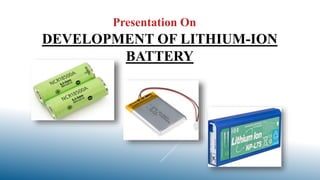
DEVELOPMENT OF LITHIUM-ION
BATTERY
Presentation On
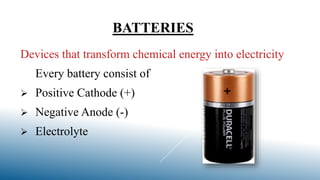
BATTERIES
Devices that transform chemical energy into electricity
• Every battery consist of
 Positive Cathode (+)
 Negative Anode (-)
 Electrolyte
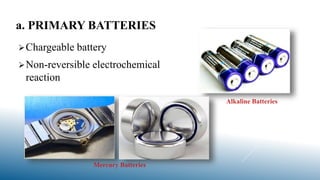
a. PRIMARY BATTERIES
Chargeable battery
Non-reversible electrochemical
reaction
Alkaline Batteries
Mercury Batteries
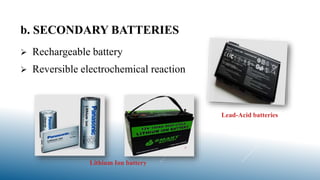
b. SECONDARY BATTERIES
 Rechargeable battery
 Reversible electrochemical reaction
Lead-Acid batteries
Lithium Ion battery
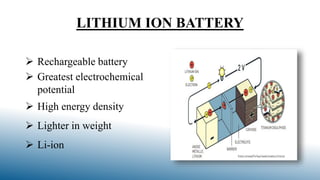
LITHIUM ION BATTERY
 Rechargeable battery
 Greatest electrochemical
potential
 High energy density
 Lighter in weight
 Li-ion
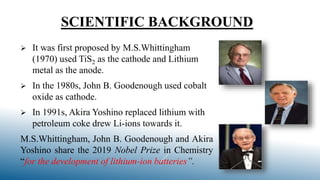
SCIENTIFIC BACKGROUND
 It was first proposed by M.S.Whittingham
(1970) used TiS2 as the cathode and Lithium
metal as the anode.
 In the 1980s, John B. Goodenough used cobalt
oxide as cathode.
 In 1991s, Akira Yoshino replaced lithium with
petroleum coke drew Li-ions towards it.
M.S.Whittingham, John B. Goodenough and Akira
Yoshino share the 2019 Nobel Prize in Chemistry
“for the development of lithium-ion batteries”.
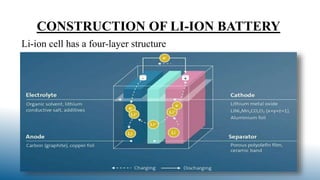
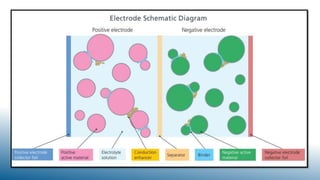
CONSTRUCTION OF LI-ION BATTERY
 Li-ion cell has a four-layer structure
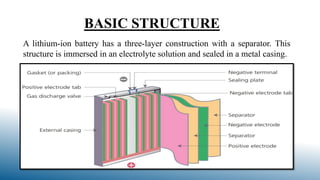
BASIC STRUCTURE
A lithium-ion battery has a three-layer construction with a separator. This
structure is immersed in an electrolyte solution and sealed in a metal casing.
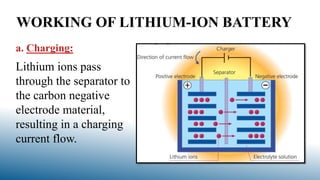
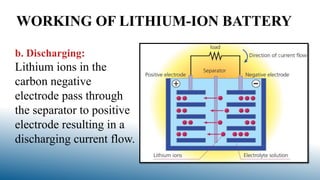
WORKING OF LITHIUM-ION BATTERY
a. Charging:
Lithium ions pass
through the separator to
the carbon negative
electrode material,
resulting in a charging
current flow.
b. Discharging:
Lithium ions in the
carbon negative
electrode pass through
the separator to positive
electrode resulting in a
discharging current flow.
WORKING OF LITHIUM-ION BATTERY
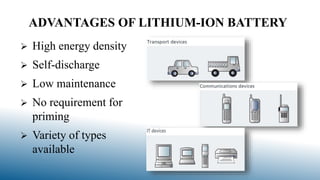
ADVANTAGES OF LITHIUM-ION BATTERY
 High energy density
 Self-discharge
 Low maintenance
 No requirement for
priming
 Variety of types
available
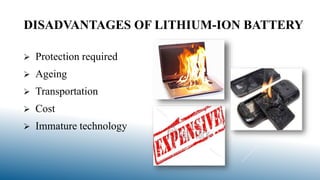
DISADVANTAGES OF LITHIUM-ION BATTERY
 Protection required
 Ageing
 Transportation
 Cost
 Immature technology
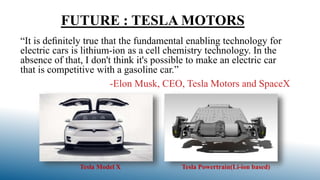
FUTURE : TESLA MOTORS
“It is definitely true that the fundamental enabling technology for
electric cars is lithium-ion as a cell chemistry technology. In the
absence of that, I don't think it's possible to make an electric car
that is competitive with a gasoline car.”
-Elon Musk, CEO, Tesla Motors and SpaceX
Tesla Model X Tesla Powertrain(Li-ion based)
Development of lithium ion battery

Development of lithium ion battery

  • 2.
  • 3.
  • 4.
    BATTERIES Devices that transformchemical energy into electricity • Every battery consist of  Positive Cathode (+)  Negative Anode (-)  Electrolyte
  • 5.
    a. PRIMARY BATTERIES Chargeablebattery Non-reversible electrochemical reaction Alkaline Batteries Mercury Batteries
  • 6.
    b. SECONDARY BATTERIES Rechargeable battery  Reversible electrochemical reaction Lead-Acid batteries Lithium Ion battery
  • 7.
    LITHIUM ION BATTERY Rechargeable battery  Greatest electrochemical potential  High energy density  Lighter in weight  Li-ion
  • 8.
    SCIENTIFIC BACKGROUND  Itwas first proposed by M.S.Whittingham (1970) used TiS2 as the cathode and Lithium metal as the anode.  In the 1980s, John B. Goodenough used cobalt oxide as cathode.  In 1991s, Akira Yoshino replaced lithium with petroleum coke drew Li-ions towards it. M.S.Whittingham, John B. Goodenough and Akira Yoshino share the 2019 Nobel Prize in Chemistry “for the development of lithium-ion batteries”.
  • 9.
    CONSTRUCTION OF LI-IONBATTERY  Li-ion cell has a four-layer structure
  • 10.
    BASIC STRUCTURE A lithium-ionbattery has a three-layer construction with a separator. This structure is immersed in an electrolyte solution and sealed in a metal casing.
  • 12.
    WORKING OF LITHIUM-IONBATTERY a. Charging: Lithium ions pass through the separator to the carbon negative electrode material, resulting in a charging current flow.
  • 13.
    b. Discharging: Lithium ionsin the carbon negative electrode pass through the separator to positive electrode resulting in a discharging current flow. WORKING OF LITHIUM-ION BATTERY
  • 14.
  • 15.
    ADVANTAGES OF LITHIUM-IONBATTERY  High energy density  Self-discharge  Low maintenance  No requirement for priming  Variety of types available
  • 16.
    DISADVANTAGES OF LITHIUM-IONBATTERY  Protection required  Ageing  Transportation  Cost  Immature technology
  • 17.
    FUTURE : TESLAMOTORS “It is definitely true that the fundamental enabling technology for electric cars is lithium-ion as a cell chemistry technology. In the absence of that, I don't think it's possible to make an electric car that is competitive with a gasoline car.” -Elon Musk, CEO, Tesla Motors and SpaceX Tesla Model X Tesla Powertrain(Li-ion based)