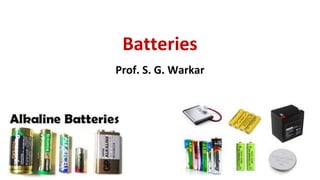
Batteries
Prof. S. G. Warkar
Batteries
• Chemical Energy Electrical Energy
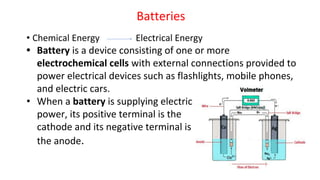
• Battery is a device consisting of one or more
electrochemical cells with external connections provided to
power electrical devices such as flashlights, mobile phones,
and electric cars.
• When a battery is supplying electric
power, its positive terminal is the
cathode and its negative terminal is
the anode.
Batteries
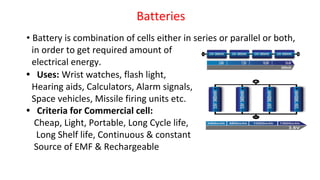
• Battery is combination of cells either in series or parallel or both,
in order to get required amount of
electrical energy.
• Uses: Wrist watches, flash light,
Hearing aids, Calculators, Alarm signals,
Space vehicles, Missile firing units etc.
• Criteria for Commercial cell:
Cheap, Light, Portable, Long Cycle life,
Long Shelf life, Continuous & constant
Source of EMF & Rechargeable
Classification of Batteries
1. Primary Cell: Chemical energy is converted to electrical energy as
long as chemical components are active. Once the reactants
converted to products, no more electricity is produced & Cell is
dead. Thus these are not rechargeable. Ex. Zn-C cell
2. Secondary Cell: Redox reactions converts Chemical energy to
electrical energy and the cell reaction can be reversed by passing
electric current in opposite direction. Thus these are rechargeable.
These cells can be used for number of cycles of discharging &
charging.
Ex. Lead acid battery
Components of Batteries
1. Anode: Contains active material which takes part in
oxidation reaction (Loss of e-
s.)
2. Cathode: Contains active material which takes part in
reduction reaction (Gain of e-
s.)
3. Electrolyte: Helps in migration of ions leading to generation
of electrical energy.
4. Separator: Thin membrane which prevents mixing of
products formed at the electrodes
Operation of Batteries
1. Discharging: As soon as Anode & Cathode are connected to
load, redox reaction occurs spontaneously. Electrons
liberated at Anode flow to the Cathode through external
wire and take part in reduction reaction. This Process is
known as Discharging.
2. Charging: Cell reaction is reversed by passing external
current in opposite direction. This process of conversion of
inactive material to active materials in a cell is called
Charging.
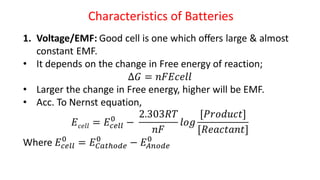
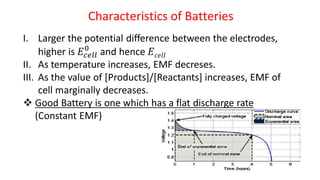
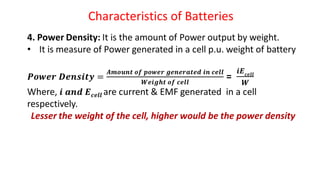
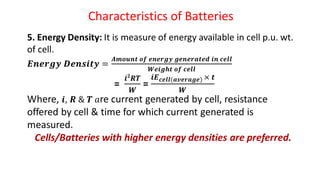
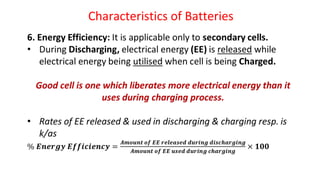
Characteristics of Batteries
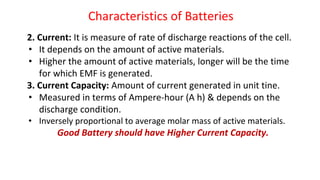
2. Current: It is measure of rate of discharge reactions of the cell.
• It depends on the amount of active materials.
• Higher the amount of active materials, longer will be the time
for which EMF is generated.
3. Current Capacity: Amount of current generated in unit tine.
• Measured in terms of Ampere-hour (A h) & depends on the
discharge condition.
• Inversely proportional to average molar mass of active materials.
Good Battery should have Higher Current Capacity.
Characteristics of Batteries
Lower Cycle life may be due to following reasons:
i. Active materials at the electrodes may whither off due to
rapid charging conditions.
ii. There may be irregular deposition of the products during
discharging, which may result in short circuiting.
iii. Due to overcharging, corrosion may occur resulting in
breaking connections between contact wire & active
materials
Characteristics of Batteries
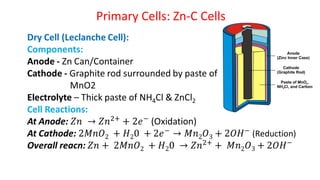
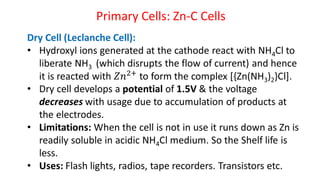
Primary Cells: Zn-C Cells
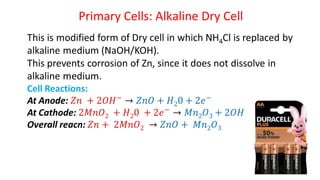
Primary Cells: Alkaline Dry Cell
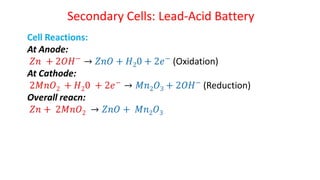
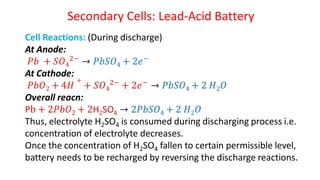
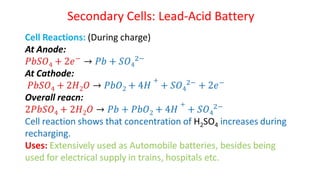
Secondary Cells: Lead-Acid Battery
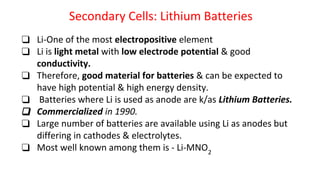
Secondary Cells: Lithium Batteries
❑ Li-One of the most electropositive element
❑ Li is light metal with low electrode potential & good
conductivity.
❑ Therefore, good material for batteries & can be expected to
have high potential & high energy density.
❑ Batteries where Li is used as anode are k/as Lithium Batteries.
❑ Commercialized in 1990.
❑ Large number of batteries are available using Li as anodes but
differing in cathodes & electrolytes.
❑ Most well known among them is - Li-MNO2
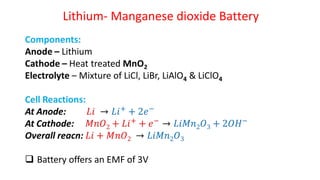
Lithium- Manganese dioxide Battery
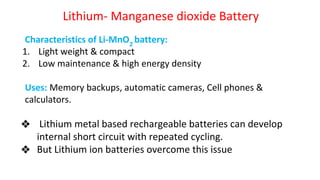
Characteristics of Li-MnO2
battery:
1. Light weight & compact
2. Low maintenance & high energy density
Uses: Memory backups, automatic cameras, Cell phones &
calculators.
❖ Lithium metal based rechargeable batteries can develop
internal short circuit with repeated cycling.
❖ But Lithium ion batteries overcome this issue
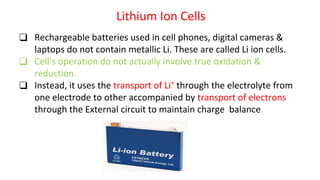
Lithium Ion Cells
❑ Rechargeable batteries used in cell phones, digital cameras &
laptops do not contain metallic Li. These are called Li ion cells.
❑ Cell’s operation do not actually involve true oxidation &
reduction.
❑ Instead, it uses the transport of Li+
through the electrolyte from
one electrode to other accompanied by transport of electrons
through the External circuit to maintain charge balance.
Working - Lithium Ion Cells
1. During charging cycle, an external
voltage forces electrons through
external circuit & causes Li+
ions to
travel from LiCoO2
electrode to the
graphite electrode.
2. During discharge, Li+
ions
spontaneously migrate back to
LiCoO2
electrode & electrons flow
through an external circuit to
balance the charge.
Graphite
Fuel Cells
• Conventionally conversion of chemical energy in fossil fuels
into electrical energy involves no of steps and there is loss of
energy in each step.
• Efficiency of the process is around 40%.
• Fuel cell convert chemical energy directly into electrical energy
through catalytically activated redox reaction.
• Sir William Grove first introduced fuel cell with the ambition
that a fuel cell will cater the power requirements of each
house.
• But the things turned out differently & the modern fuel cell is
the power source for space crafts.
Fuel Cells- Comparison with Galvanic cells
Fuel cells differ from Galvanic cell in following aspects:
1. Fuel cells consists of 2 catalytic electrodes.
2. Active components are Fuel & Oxidant, which are not
prepacked but supplied externally.
3. Environmental friendly, since no pollution.
4. No toxic species are formed during operation.
Advantages of Fuel cell:
1. High Energy conversion (75%)
2. High Energy density
3. Use Inexpensive Fuels
Disadvantages of Fuel cell:
1. Electrodes used are expensive
such as Pt, Ag or noble metal
alloys
2. Power generated is moderate
Fuel Cells
Cell Representation:
Fuel Electrode [A] Electrolyte Electrode [C] Oxidant
Chemical reactions involved at electrodes:
At Anode: Fuel Oxidation product + ne-
At Cathode: Oxidant + ne-
Reduction product
Overall: Fuel + Oxidant Oxidn product + Redn product
Frequently used fuels are hydrogen, methanol, ethanol, hydrazine,
formaldehyde, Carbon monoxide & Alkanes.
Oxidant is pure Oxygen
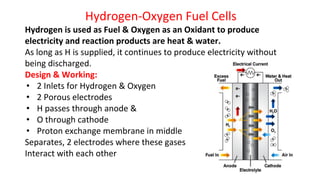
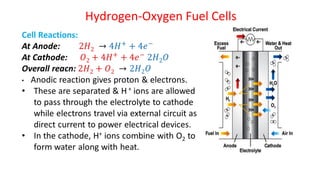
Hydrogen-Oxygen Fuel Cells
Hydrogen is used as Fuel & Oxygen as an Oxidant to produce
electricity and reaction products are heat & water.
As long as H is supplied, it continues to produce electricity without
being discharged.
Design & Working:
• 2 Inlets for Hydrogen & Oxygen
• 2 Porous electrodes
• H passes through anode &
• O through cathode
• Proton exchange membrane in middle
Separates, 2 electrodes where these gases
Interact with each other
Hydrogen-Oxygen Fuel Cells
Advantages of Hydrogen-Oxygen Fuel cell
Lot of benefits using Hydrogen as fuel
1. Emits only water vapour in environment.
2. High Efficiency about 75%.
3. H is lightest element & provides lot of energy, can be transported easily.
4. Easy independent scaling between power & capacity
Disadvantages of Hydrogen-Oxygen Fuel cell
1. H is explosive, so problem during Storage & transport
2. For very good efficiency, it turns out to be very expensive.
3. Additional investment & energy required for compression of H gas
4. Risky, when used in automobiles because high pressure is created
inside the engines.

battery.pdf

  • 1.
  • 2.
    Batteries • Chemical EnergyElectrical Energy • Battery is a device consisting of one or more electrochemical cells with external connections provided to power electrical devices such as flashlights, mobile phones, and electric cars. • When a battery is supplying electric power, its positive terminal is the cathode and its negative terminal is the anode.
  • 3.
    Batteries • Battery iscombination of cells either in series or parallel or both, in order to get required amount of electrical energy. • Uses: Wrist watches, flash light, Hearing aids, Calculators, Alarm signals, Space vehicles, Missile firing units etc. • Criteria for Commercial cell: Cheap, Light, Portable, Long Cycle life, Long Shelf life, Continuous & constant Source of EMF & Rechargeable
  • 4.
    Classification of Batteries 1.Primary Cell: Chemical energy is converted to electrical energy as long as chemical components are active. Once the reactants converted to products, no more electricity is produced & Cell is dead. Thus these are not rechargeable. Ex. Zn-C cell 2. Secondary Cell: Redox reactions converts Chemical energy to electrical energy and the cell reaction can be reversed by passing electric current in opposite direction. Thus these are rechargeable. These cells can be used for number of cycles of discharging & charging. Ex. Lead acid battery
  • 5.
    Components of Batteries 1.Anode: Contains active material which takes part in oxidation reaction (Loss of e- s.) 2. Cathode: Contains active material which takes part in reduction reaction (Gain of e- s.) 3. Electrolyte: Helps in migration of ions leading to generation of electrical energy. 4. Separator: Thin membrane which prevents mixing of products formed at the electrodes
  • 6.
    Operation of Batteries 1.Discharging: As soon as Anode & Cathode are connected to load, redox reaction occurs spontaneously. Electrons liberated at Anode flow to the Cathode through external wire and take part in reduction reaction. This Process is known as Discharging. 2. Charging: Cell reaction is reversed by passing external current in opposite direction. This process of conversion of inactive material to active materials in a cell is called Charging.
  • 7.
  • 8.
  • 9.
    Characteristics of Batteries 2.Current: It is measure of rate of discharge reactions of the cell. • It depends on the amount of active materials. • Higher the amount of active materials, longer will be the time for which EMF is generated. 3. Current Capacity: Amount of current generated in unit tine. • Measured in terms of Ampere-hour (A h) & depends on the discharge condition. • Inversely proportional to average molar mass of active materials. Good Battery should have Higher Current Capacity.
  • 10.
  • 11.
  • 12.
  • 13.
  • 14.
    Characteristics of Batteries LowerCycle life may be due to following reasons: i. Active materials at the electrodes may whither off due to rapid charging conditions. ii. There may be irregular deposition of the products during discharging, which may result in short circuiting. iii. Due to overcharging, corrosion may occur resulting in breaking connections between contact wire & active materials
  • 15.
  • 16.
  • 17.
  • 18.
  • 19.
  • 20.
  • 21.
  • 22.
  • 23.
    Secondary Cells: LithiumBatteries ❑ Li-One of the most electropositive element ❑ Li is light metal with low electrode potential & good conductivity. ❑ Therefore, good material for batteries & can be expected to have high potential & high energy density. ❑ Batteries where Li is used as anode are k/as Lithium Batteries. ❑ Commercialized in 1990. ❑ Large number of batteries are available using Li as anodes but differing in cathodes & electrolytes. ❑ Most well known among them is - Li-MNO2
  • 24.
  • 25.
    Lithium- Manganese dioxideBattery Characteristics of Li-MnO2 battery: 1. Light weight & compact 2. Low maintenance & high energy density Uses: Memory backups, automatic cameras, Cell phones & calculators. ❖ Lithium metal based rechargeable batteries can develop internal short circuit with repeated cycling. ❖ But Lithium ion batteries overcome this issue
  • 26.
    Lithium Ion Cells ❑Rechargeable batteries used in cell phones, digital cameras & laptops do not contain metallic Li. These are called Li ion cells. ❑ Cell’s operation do not actually involve true oxidation & reduction. ❑ Instead, it uses the transport of Li+ through the electrolyte from one electrode to other accompanied by transport of electrons through the External circuit to maintain charge balance.
  • 27.
    Working - LithiumIon Cells 1. During charging cycle, an external voltage forces electrons through external circuit & causes Li+ ions to travel from LiCoO2 electrode to the graphite electrode. 2. During discharge, Li+ ions spontaneously migrate back to LiCoO2 electrode & electrons flow through an external circuit to balance the charge. Graphite
  • 28.
    Fuel Cells • Conventionallyconversion of chemical energy in fossil fuels into electrical energy involves no of steps and there is loss of energy in each step. • Efficiency of the process is around 40%. • Fuel cell convert chemical energy directly into electrical energy through catalytically activated redox reaction. • Sir William Grove first introduced fuel cell with the ambition that a fuel cell will cater the power requirements of each house. • But the things turned out differently & the modern fuel cell is the power source for space crafts.
  • 29.
    Fuel Cells- Comparisonwith Galvanic cells Fuel cells differ from Galvanic cell in following aspects: 1. Fuel cells consists of 2 catalytic electrodes. 2. Active components are Fuel & Oxidant, which are not prepacked but supplied externally. 3. Environmental friendly, since no pollution. 4. No toxic species are formed during operation. Advantages of Fuel cell: 1. High Energy conversion (75%) 2. High Energy density 3. Use Inexpensive Fuels Disadvantages of Fuel cell: 1. Electrodes used are expensive such as Pt, Ag or noble metal alloys 2. Power generated is moderate
  • 30.
    Fuel Cells Cell Representation: FuelElectrode [A] Electrolyte Electrode [C] Oxidant Chemical reactions involved at electrodes: At Anode: Fuel Oxidation product + ne- At Cathode: Oxidant + ne- Reduction product Overall: Fuel + Oxidant Oxidn product + Redn product Frequently used fuels are hydrogen, methanol, ethanol, hydrazine, formaldehyde, Carbon monoxide & Alkanes. Oxidant is pure Oxygen
  • 31.
    Hydrogen-Oxygen Fuel Cells Hydrogenis used as Fuel & Oxygen as an Oxidant to produce electricity and reaction products are heat & water. As long as H is supplied, it continues to produce electricity without being discharged. Design & Working: • 2 Inlets for Hydrogen & Oxygen • 2 Porous electrodes • H passes through anode & • O through cathode • Proton exchange membrane in middle Separates, 2 electrodes where these gases Interact with each other
  • 32.
  • 33.
    Hydrogen-Oxygen Fuel Cells Advantagesof Hydrogen-Oxygen Fuel cell Lot of benefits using Hydrogen as fuel 1. Emits only water vapour in environment. 2. High Efficiency about 75%. 3. H is lightest element & provides lot of energy, can be transported easily. 4. Easy independent scaling between power & capacity Disadvantages of Hydrogen-Oxygen Fuel cell 1. H is explosive, so problem during Storage & transport 2. For very good efficiency, it turns out to be very expensive. 3. Additional investment & energy required for compression of H gas 4. Risky, when used in automobiles because high pressure is created inside the engines.