INTRODUCTION
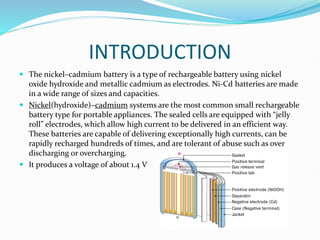
 The nickel–cadmium battery is a type of rechargeable battery using nickel
oxide hydroxide and metallic cadmium as electrodes. Ni-Cd batteries are made
in a wide range of sizes and capacities.
 Nickel(hydroxide)–cadmium systems are the most common small rechargeable
battery type for portable appliances. The sealed cells are equipped with “jelly
roll” electrodes, which allow high current to be delivered in an efficient way.
These batteries are capable of delivering exceptionally high currents, can be
rapidly recharged hundreds of times, and are tolerant of abuse such as over
discharging or overcharging.
 It produces a voltage of about 1.4 V
INVENTIONS AND SCOPE
 Nickel-cadmium (NiCd)
 Invented by Waldemar Jungner in 1899. Developments were slow, but
in 1932, advancements were made to deposit the active materials inside
a porous nickel-plated electrode. Further improvements occurred in
1947 by absorbing the gases generated during charge, which led to the
modern sealed NiCd battery.
 For many years, NiCd was the preferred battery choice for two-way
radios, emergency medical equipment, professional video cameras and
power tools. In the late 1980s, the ultra-high capacity NiCd rocked the
world with capacities that were up to 60 percent higher than the
standard NiCd.
 Since the disposal of battery is hazardous to environment alternative
cells are being used such as paper battery
RECENT TRENDS
The primary trade-off with Ni–Cd batteries is their higher cost and the use of
cadmium. This heavy metal is an environmental hazard, and is highly toxic to
all higher forms of batteries.
Recently, nickel–metal hydride and lithium-ionbatteries have become
commercially available and cheaper, the former type now rivaling Ni–Cd
batteries in cost..
The batteries are more difficult to damage than other batteries, tolerating deep
discharge for long periods.
Ni–Cd batteries typically last longer, in terms of number of charge/discharge
cycles, than other rechargeable batteries such as lead/acid batteries.
Compared to lead–acid batteries, Ni–Cd batteries have a much higher energy
density.
In consumer applications, Ni–Cd batteries compete directly with alkaline
batteries. A Ni–Cd cell has a lower capacity than that of an equivalent alkaline
cell, and costs more.
The capacity of a Ni–Cd battery is not significantly affected by very high discharge
currents.
CELL REPRESENTATION AND
CELL REACTION
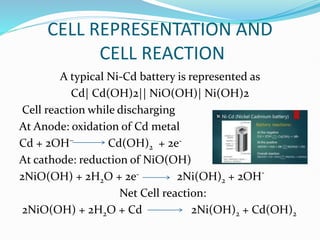
A typical Ni-Cd battery is represented as
Cd| Cd(OH)2|| NiO(OH)| Ni(OH)2
Cell reaction while discharging
At Anode: oxidation of Cd metal
Cd + 2OH
_
Cd(OH)2 + 2e-
At cathode: reduction of NiO(OH)
2NiO(OH) + 2H2O + 2e- 2Ni(OH)2 + 2OH-
Net Cell reaction:
2NiO(OH) + 2H2O + Cd 2Ni(OH)2 + Cd(OH)2
ADVANTAGES
 Fast and simple charging process
 It is compact and lighter than traditional batteries
 It has a longer life than lead storage batteries
 Available in a wide range of sizes and performance
options
 Good low-temperature performance
 Only battery that can be ultra-fast charged with little
stress
LIMITATIONS
 It is rather more expensive than a lead storage battery
 It has a lower energy density value
 Cadmium is a toxic metal. Cannot be disposed of in
landfills
 Memory effect; needs periodic full discharges
 High self-discharge; needs recharging after storage
APPLICATIONS
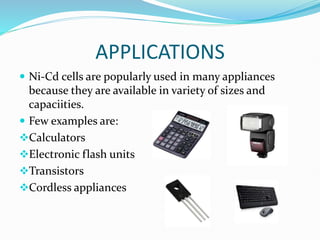
 Ni-Cd cells are popularly used in many appliances
because they are available in variety of sizes and
capaciities.
 Few examples are:
Calculators
Electronic flash units
Transistors
Cordless appliances
Li-ion Battery
DESCRIPTION
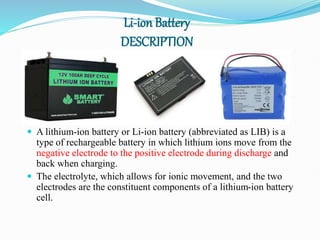
 A lithium-ion battery or Li-ion battery (abbreviated as LIB) is a
type of rechargeable battery in which lithium ions move from the
negative electrode to the positive electrode during discharge and
back when charging.
 The electrolyte, which allows for ionic movement, and the two
electrodes are the constituent components of a lithium-ion battery
cell.
Electrolytes
 Role-
1. Ion conduction between cathode and anode.
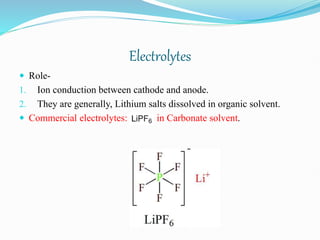
2. They are generally, Lithium salts dissolved in organic solvent.
 Commercial electrolytes: in Carbonate solvent.
Anode Materials
 Requirements:
1. Large capabilites of adsorption.
2. High efficency of charge/discharge.
3. Low reactivity against electrolyte.
4. Fast reaction rate.
5. Low cost
6. Environment friendly
 Commercial anode materials:
Hard Carbon, Graphite
Cathode Materials
 Requirements:
1. A high discharge voltage
2. A high energy capacity
3. A high power density
4. Light weight
5. Low self discharge
6. Environment friendly
 Commercial cathode materials:
LiCoO2, LiFePO4 etc.
Chemical Reactions
 Main essential components...
 Anode: Graphite [carbon] - C(s)
 Cathode: Lithium Cobalt Oxide - LiCoO2
 Electrolyte: Typically a combination of lithium salts - LiPF6, LiBF4,
or LiClO4, in an organic solvent, such as either.
 Separator: The separator is a very thin sheet of micro perforated
plastic. - CH2=CHCl
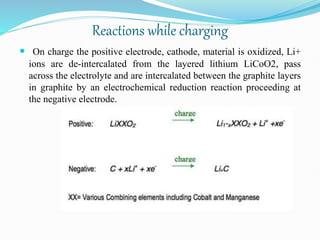
Reactions while charging
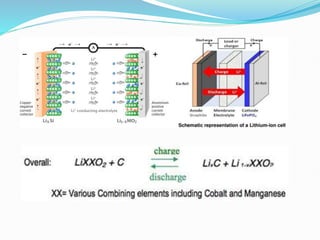
 On charge the positive electrode, cathode, material is oxidized, Li+
ions are de-intercalated from the layered lithium LiCoO2, pass
across the electrolyte and are intercalated between the graphite layers
in graphite by an electrochemical reduction reaction proceeding at
the negative electrode.
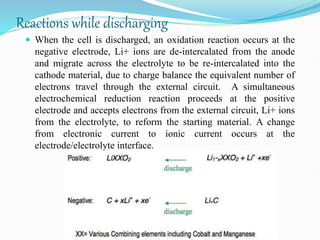
Reactions while discharging
 When the cell is discharged, an oxidation reaction occurs at the
negative electrode, Li+ ions are de-intercalated from the anode
and migrate across the electrolyte to be re-intercalated into the
cathode material, due to charge balance the equivalent number of
electrons travel through the external circuit. A simultaneous
electrochemical reduction reaction proceeds at the positive
electrode and accepts electrons from the external circuit, Li+ ions
from the electrolyte, to reform the starting material. A change
from electronic current to ionic current occurs at the
electrode/electrolyte interface.
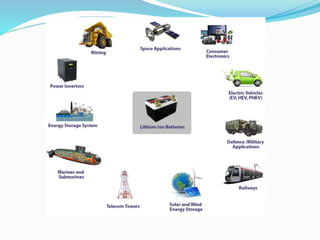
Applications
 Emergency Power Backup Or UPS
 Dependable Electric And Recreational Vehicle Power
 Solar Power Storage
 Reliable And Lightweight Marine Performance
 Solar Power Storage
 Surveillance Or Alarm Systems In Remote Locations
 Personal Freedom With Mobility Equipment
 Portable Power Packs That Eliminate Downtime
Battery semester 1 chemistry for study.pptx

Battery semester 1 chemistry for study.pptx

  • 2.
    INTRODUCTION  The nickel–cadmiumbattery is a type of rechargeable battery using nickel oxide hydroxide and metallic cadmium as electrodes. Ni-Cd batteries are made in a wide range of sizes and capacities.  Nickel(hydroxide)–cadmium systems are the most common small rechargeable battery type for portable appliances. The sealed cells are equipped with “jelly roll” electrodes, which allow high current to be delivered in an efficient way. These batteries are capable of delivering exceptionally high currents, can be rapidly recharged hundreds of times, and are tolerant of abuse such as over discharging or overcharging.  It produces a voltage of about 1.4 V
  • 3.
    INVENTIONS AND SCOPE Nickel-cadmium (NiCd)  Invented by Waldemar Jungner in 1899. Developments were slow, but in 1932, advancements were made to deposit the active materials inside a porous nickel-plated electrode. Further improvements occurred in 1947 by absorbing the gases generated during charge, which led to the modern sealed NiCd battery.  For many years, NiCd was the preferred battery choice for two-way radios, emergency medical equipment, professional video cameras and power tools. In the late 1980s, the ultra-high capacity NiCd rocked the world with capacities that were up to 60 percent higher than the standard NiCd.  Since the disposal of battery is hazardous to environment alternative cells are being used such as paper battery
  • 4.
    RECENT TRENDS The primarytrade-off with Ni–Cd batteries is their higher cost and the use of cadmium. This heavy metal is an environmental hazard, and is highly toxic to all higher forms of batteries. Recently, nickel–metal hydride and lithium-ionbatteries have become commercially available and cheaper, the former type now rivaling Ni–Cd batteries in cost.. The batteries are more difficult to damage than other batteries, tolerating deep discharge for long periods. Ni–Cd batteries typically last longer, in terms of number of charge/discharge cycles, than other rechargeable batteries such as lead/acid batteries. Compared to lead–acid batteries, Ni–Cd batteries have a much higher energy density. In consumer applications, Ni–Cd batteries compete directly with alkaline batteries. A Ni–Cd cell has a lower capacity than that of an equivalent alkaline cell, and costs more. The capacity of a Ni–Cd battery is not significantly affected by very high discharge currents.
  • 5.
    CELL REPRESENTATION AND CELLREACTION A typical Ni-Cd battery is represented as Cd| Cd(OH)2|| NiO(OH)| Ni(OH)2 Cell reaction while discharging At Anode: oxidation of Cd metal Cd + 2OH _ Cd(OH)2 + 2e- At cathode: reduction of NiO(OH) 2NiO(OH) + 2H2O + 2e- 2Ni(OH)2 + 2OH- Net Cell reaction: 2NiO(OH) + 2H2O + Cd 2Ni(OH)2 + Cd(OH)2
  • 6.
    ADVANTAGES  Fast andsimple charging process  It is compact and lighter than traditional batteries  It has a longer life than lead storage batteries  Available in a wide range of sizes and performance options  Good low-temperature performance  Only battery that can be ultra-fast charged with little stress
  • 7.
    LIMITATIONS  It israther more expensive than a lead storage battery  It has a lower energy density value  Cadmium is a toxic metal. Cannot be disposed of in landfills  Memory effect; needs periodic full discharges  High self-discharge; needs recharging after storage
  • 8.
    APPLICATIONS  Ni-Cd cellsare popularly used in many appliances because they are available in variety of sizes and capaciities.  Few examples are: Calculators Electronic flash units Transistors Cordless appliances
  • 9.
    Li-ion Battery DESCRIPTION  Alithium-ion battery or Li-ion battery (abbreviated as LIB) is a type of rechargeable battery in which lithium ions move from the negative electrode to the positive electrode during discharge and back when charging.  The electrolyte, which allows for ionic movement, and the two electrodes are the constituent components of a lithium-ion battery cell.
  • 10.
    Electrolytes  Role- 1. Ionconduction between cathode and anode. 2. They are generally, Lithium salts dissolved in organic solvent.  Commercial electrolytes: in Carbonate solvent.
  • 11.
    Anode Materials  Requirements: 1.Large capabilites of adsorption. 2. High efficency of charge/discharge. 3. Low reactivity against electrolyte. 4. Fast reaction rate. 5. Low cost 6. Environment friendly  Commercial anode materials: Hard Carbon, Graphite
  • 12.
    Cathode Materials  Requirements: 1.A high discharge voltage 2. A high energy capacity 3. A high power density 4. Light weight 5. Low self discharge 6. Environment friendly  Commercial cathode materials: LiCoO2, LiFePO4 etc.
  • 13.
    Chemical Reactions  Mainessential components...  Anode: Graphite [carbon] - C(s)  Cathode: Lithium Cobalt Oxide - LiCoO2  Electrolyte: Typically a combination of lithium salts - LiPF6, LiBF4, or LiClO4, in an organic solvent, such as either.  Separator: The separator is a very thin sheet of micro perforated plastic. - CH2=CHCl
  • 14.
    Reactions while charging On charge the positive electrode, cathode, material is oxidized, Li+ ions are de-intercalated from the layered lithium LiCoO2, pass across the electrolyte and are intercalated between the graphite layers in graphite by an electrochemical reduction reaction proceeding at the negative electrode.
  • 15.
    Reactions while discharging When the cell is discharged, an oxidation reaction occurs at the negative electrode, Li+ ions are de-intercalated from the anode and migrate across the electrolyte to be re-intercalated into the cathode material, due to charge balance the equivalent number of electrons travel through the external circuit. A simultaneous electrochemical reduction reaction proceeds at the positive electrode and accepts electrons from the external circuit, Li+ ions from the electrolyte, to reform the starting material. A change from electronic current to ionic current occurs at the electrode/electrolyte interface.
  • 18.
    Applications  Emergency PowerBackup Or UPS  Dependable Electric And Recreational Vehicle Power  Solar Power Storage  Reliable And Lightweight Marine Performance  Solar Power Storage  Surveillance Or Alarm Systems In Remote Locations  Personal Freedom With Mobility Equipment  Portable Power Packs That Eliminate Downtime