MATERIALS USED IN BATTERIES
MOL-52226 Functional materials
GROUP 5
HAMZA
MADAN
SANTHOSH KUMAR
YASHWANTH
CONTENT
 Introduction
 Primary batteries and applications
 Secondary batteries and applications
 Case study on processing of Li ion battery
 Conclusion
INTRODUCTION
 Alessandro volt invented the first battery in 1745
 In 1898 the first commercial available are sold in united stated by
the Colombia Dry cell
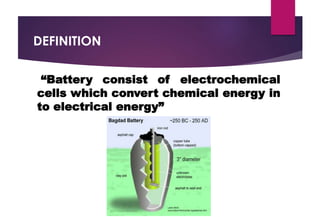
 Through ‘Wilhelm konig’, while doing his archeological studies in
1938 he found some clay pots with iron rods encased with copper
built in 200 BC itself
DEFINITION
“Battery consist of electrochemical
cells which convert chemical energy in
to electrical energy”
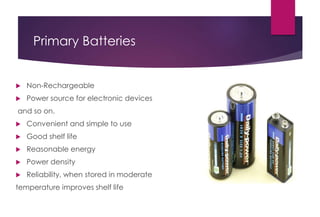
Primary Batteries
 Non-Rechargeable
 Power source for electronic devices
and so on.
 Convenient and simple to use
 Good shelf life
 Reasonable energy
 Power density
 Reliability, when stored in moderate
temperature improves shelf life
Primary Batteries
System Characteristics Applications
Zinc-carbon
(Leclanché), Zinc/MnO2
Common, low-cost primary battery; available in a
variety of sizes
Flashlight, portable radios, toys, novelties, instruments
Magnesium (Mg/MnO2) High-capacity primary battery; long shelf life Formerly used for military receiver-transmitters, and aircraft
emergency transmitters (EPIRBs)
Mercury (Zn/HgO) Highest capacity (by volume) of conventional types;
flat discharge; good shelf life
Hearing aids, medical devices (pacemakers), photography,
detectors, military equipment, but in limited use at present
due to environmental hazard of mercury
Mer-cad (Cd/HgO) Long shelf life; good low- and high-temperature
performance; low energy density
Special applications requiring operation under extreme
temperature conditions and long life; in limited use
Alkaline
(Zn/alkaline/MnO2)
Most popular general-purpose battery; good low-
temperature and high-rate performance; low cost
Most popular primary battery; used in a variety of
portable battery operated equipment
Lithium/ soluble
cathode
High energy density; long shelf life; good
performance over wide temperature range
Wide range of applications requiring high energy density,
long shelf life, e.g., from utility meters to military electronics
applications
Lithium/ solid cathode High energy density; good rate capability and low-
temperature performance; long shelf life;
competitive cost
Replacement for conventional button and cylindrical cell
applications, such as digital cameras
Lithium/ solid
electrolyte
Extremely long shelf life; low-power battery Medical electronics
Table 1: Characteristics and applications [1]
Magnesium Batteries
 Twice the service life or capacity of zinc battery
 Disadvantages – voltage delay and parasitic corrosion
 Potential > 2.8V, but 1.1V is achieved
 Battery chemistry, Mg + 2 MnO2 + H2O  Mn2O3 + Mg (OH) 2
Figure represents
Magnesium batteries
[2]
Zinc Carbon batteries
 Leclanché and zinc chloride systems
 low cost, ready availability, and acceptable performance
 Electrolyte – Ammonium chloride and zinc chloride
 Carbions with Mg2O- Conductivity
 Specific capacity- 75-35 A h/kg
 Basic chemistry Zn + 2MnO2 ZnO.Mn2O3
Figure represents Zinc-Carbon
batteries
[3]
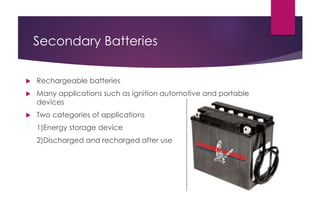
Secondary Batteries
 Rechargeable batteries
 Many applications such as ignition automotive and portable
devices
 Two categories of applications
1)Energy storage device
2)Discharged and recharged after use
Secondary Batteries [4]
System Characteristics Applications
LEAD-ACID:
Automotive Popular, low-cost secondary battery, low
specific-energy, high-rate, and low-
temperature performance; maintenance-
free designs
Automotive SLI, golf carts, lawn mowers, tractors, aircraft,
marine, micro-hybrid vehicles
Traction (motive power) Designed for deep 6-9 h discharge,
cycling service
Industrial trucks, materials handling, electric and hybrid
electric vehicles, special types for submarine power
Stationary Designed for standby float service, long
life, VRLA designs
Emergency power, utilities, telephone, UPS, load levelling,
energy storage, emergency lighting
Portable Sealed, maintenance-free, low cost, good
float capability, moderate cycle life
Portable tools, small appliances and devices, portable
electronic equipment
NICKEL-CADMIUM:
Industrial and FNC Good high-rate, low-temperature
capability, flat voltage, excellent cycle life
Aircraft batteries, industrial and emergency power
applications, communication equipment
Portable Sealed, maintenance-free, good high-rate
low-temperature performance, good
cycle life
Consumer electronics, portable tools, pagers, appliances,
photographic equipment, standby power, memory
backup
NICKEL-METAL
HYDRIDE
Sealed, maintenance-free, higher
capacity than nickel-cadmium batteries;
high energy density and power
Consumer electronics and other portable applications;
hybrid electric vehicles
LITHIUM-ION High specific energy and energy density,
long cycle life; high-power capability
Portable and consumer electronic equipment, electric
vehicles (EVs, HEVs, PHEVs), space applications, electrical
energy storage
Nickel Cadmium batteries
 Nickel oxy hydroxide as positive electrode and Cadmium plate is negative
electrode
 Circuit voltage difference is nearly 1.29 V
 Electrolyte used is KOH (31% by weight) or NaOH, LiOH is added to improve
life cycle and high temperature operations.
 The major advantages are they have a long life line, excellent long - term
storage, and flat discharge profile.
 Disadvantages are the energy density is low and they are expensive than
lead-acid batteries and also contains cadmium which is hazardous
 There are two types of cells  Vented and Recombinant
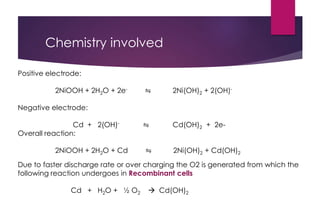
Chemistry involved
Positive electrode:
2NiOOH + 2H2O + 2e- ⇋ 2Ni(OH)2 + 2(OH)-
Negative electrode:
Cd + 2(OH)- ⇋ Cd(OH)2 + 2e-
Overall reaction:
2NiOOH + 2H2O + Cd ⇋ 2Ni(OH)2 + Cd(OH)2
Due to faster discharge rate or over charging the O2 is generated from which the
following reaction undergoes in Recombinant cells
Cd + H2O + ½ O2  Cd(OH)2
Construction of battery
 Considering Aircraft battery design consists of steel case containing
identical, individual cells connected in series
 And the end of the cells of the series are connected to receptacle located
on the outside of the case
[5] [6]
Lithium Ion Batteries
 Li ions exchange between the positive and negative
electrodes
 The major advantages are they are sealed and no
maintenance is required, they have long life cycle, they
have long shelf life, and low self-discharge rate. High power
discharge rate capability
 The major disadvantages are that, they degrade at high
temperatures, capacity loss and potential for thermal
runway when charged, possible venting and possible
thermal runway when crushed, and may become unsafe
when rapid charge at low temperature (< 0 0C).
 higher specific energy (up to 240 Wh/kg)
 energy density (up to 640 Wh/L)
 self-discharge rate is around 2-8% per month
 The working temperature range is at 0 to 45 0C
 Single cell Operating Voltage between 2.5 and 4.3 V
[7]
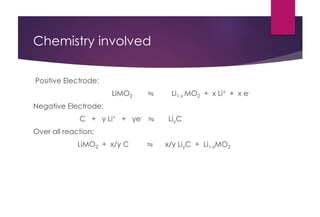
Chemistry involved
Positive Electrode:
LiMO2 ⇋ Li1-x MO2 + x Li+ + x e-
Negative Electrode:
C + y Li+ + ye- ⇋ LiyC
Over all reaction:
LiMO2 + x/y C ⇋ x/y LiyC + Li1-xMO2
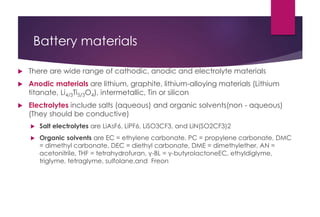
Battery materials
 There are wide range of cathodic, anodic and electrolyte materials
 Anodic materials are lithium, graphite, lithium-alloying materials (Lithium
titanate, Li4/3Ti5/3O4), intermetallic, Tin or silicon
 Electrolytes include salts (aqueous) and organic solvents(non - aqueous)
(They should be conductive)
 Salt electrolytes are LiAsF6, LiPF6, LiSO3CF3, and LiN(SO2CF3)2
 Organic solvents are EC = ethylene carbonate, PC = propylene carbonate, DMC
= dimethyl carbonate, DEC = diethyl carbonate, DME = dimethylether, AN =
acetonitrile, THF = tetrahydrofuran, γ-BL = γ-butyrolactoneEC, ethyldiglyme,
triglyme, tetraglyme, sulfolane,and Freon
Battery materials [7]
Material
Specific
capacity
mAh/g
Comments
LiCoO2 155 Still the most common. Co is expensive.
LiNi1-x-yMnxCoyO2 (NMC) 140-180
Safer and less expensive than LiCoO2. Capacity depends on
upper voltage cut-off.
LiNi0.8Co0.15Al0.05O2 200 About as safe as LiCoO2, high capacity.
LiMn2O4 100-120
Inexpensive, safer than LiCoO2, poor high temperature stability
(but improving with R&D).
LiFePO4 160
Synthesis in inert gas leads to process cost. Very safe. Low
volumetric energy.
Li[Li1/9Ni1/3Mn5/9]O2 275 High specific capacity, R&D scale, low rate capability.
LiNi0.5Mn1.5O4 130 Requires an electrolyte that is stable at a high voltage.
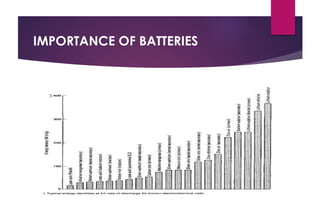
IMPORTANCE OF BATTERIES
Battery Manufacturing Process[11]
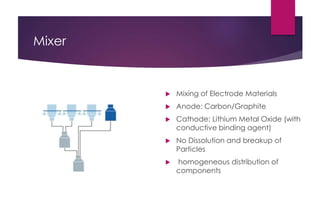
Mixer
 Mixing of Electrode Materials
 Anode: Carbon/Graphite
 Cathode: Lithium Metal Oxide (with
conductive binding agent)
 No Dissolution and breakup of
Particles
 homogeneous distribution of
components
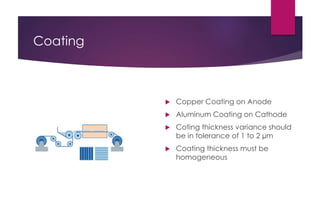
Coating
 Copper Coating on Anode
 Aluminum Coating on Cathode
 Coting thickness variance should
be in tolerance of 1 to 2 µm
 Coating thickness must be
homogeneous
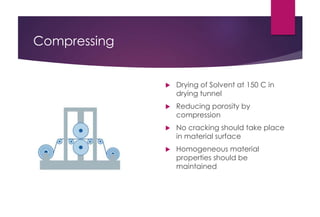
Compressing
 Drying of Solvent at 150 C in
drying tunnel
 Reducing porosity by
compression
 No cracking should take place
in material surface
 Homogeneous material
properties should be
maintained
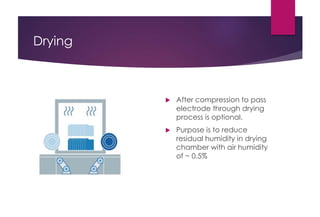
Drying
 After compression to pass
electrode through drying
process is optional.
 Purpose is to reduce
residual humidity in drying
chamber with air humidity
of ~ 0.5%
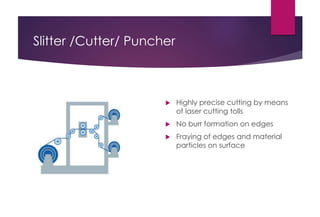
Slitter /Cutter/ Puncher
 Highly precise cutting by means
of laser cutting tolls
 No burr formation on edges
 Fraying of edges and material
particles on surface
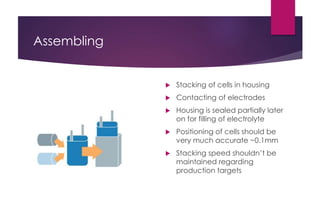
Assembling
 Stacking of cells in housing
 Contacting of electrodes
 Housing is sealed partially later
on for filling of electrolyte
 Positioning of cells should be
very much accurate ~0.1mm
 Stacking speed shouldn’t be
maintained regarding
production targets
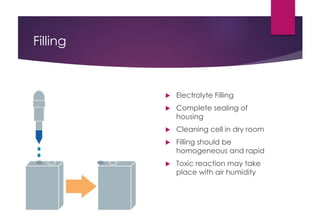
Filling
 Electrolyte Filling
 Complete sealing of
housing
 Cleaning cell in dry room
 Filling should be
homogeneous and rapid
 Toxic reaction may take
place with air humidity
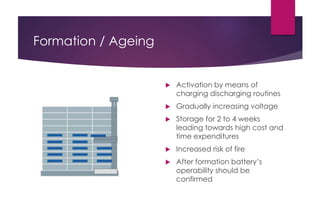
Formation / Ageing
 Activation by means of
charging discharging routines
 Gradually increasing voltage
 Storage for 2 to 4 weeks
leading towards high cost and
time expenditures
 Increased risk of fire
 After formation battery’s
operability should be
confirmed
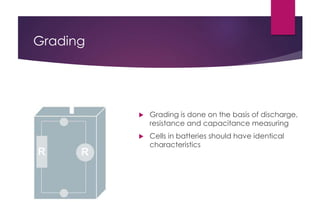
Grading
 Grading is done on the basis of discharge,
resistance and capacitance measuring
 Cells in batteries should have identical
characteristics
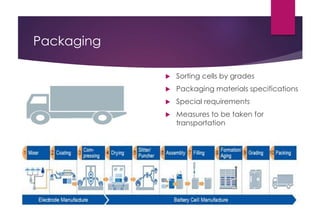
Packaging
 Sorting cells by grades
 Packaging materials specifications
 Special requirements
 Measures to be taken for
transportation
Conclusion
 Primary and secondary batteries.
 Lead Acid batteries, Nickel batteries, Silver Batteries, Alkaline
Manganese batteries, Carbon-zinc and so on.
 Different battery mechanism is studied
 Materials used for the production of cathode and anode is studied.
 Electrode material preparation is explained in the manufacturing
process.
REFERENCES
[1] Thomas Reddy. "Chapter 8 - An Introduction to Primary Batteries". Linden's Handbook of Batteries, Fourth
Edition.McGraw-Hill, © 2011. Books24x7. Web. Apr. 7, 2015. http://common.books24x7.com/toc.aspx?bookid=35916
[2] Thomas Reddy. "Chapter 10 - Magnesium and Aluminium Batteries". Linden's Handbook of Batteries, Fourth Edition.
McGraw-Hill. © 2011. Books24x7. http://common.books24x7.com/toc.aspx?bookid=35916 (accessed April 8, 2015)
[3] Thomas Reddy. "Chapter 9 - Zinc-Carbon Batteries—Leclanché and Zinc Chloride Cell Systems". Linden's Handbook of
Batteries, Fourth Edition. McGraw-Hill, © 2011.Books24x7.Web. Apr.7, 2015.
http://common.books24x7.com/toc.aspx?bookid=35916
[4] Thomas Reddy. "Chapter 15 - An Introduction to Secondary Batteries". Linden's Handbook of Batteries, Fourth
Edition. McGraw-Hill, © 2011. Books24x7. Web. Apr. 9, 2015.http://common.books24x7.com/toc.aspx?bookid=35916
[5] D. Vutetakis, “Batteries,” in Digital Avionics Handbook, Third Edition, CRC Press, 2014, pp. 419–442.
[6] Thomas Reddy. "Chapter 19 - Industrial and Aerospace Nickel-Cadmium Batteries". Linden's Handbook of Batteries,
Fourth Edition. McGraw-Hill, © 2011. Books24x7. Web. Apr. 9, 2015. http://common.books24x7.com/toc.aspx?bookid=35916
[7] Thomas Reddy. "Chapter 26 - Lithium-Ion Batteries”. Linden’s Handbook of Batteries, Fourth Edition. McGraw-Hill, ©
2011. Books24x7. Web. Apr. 9, 2015 http://common.books24x7.com/toc.aspx?bookid=35916
[8] A. Manthiram, “Smart Battery Materials,” in Smart Materials, CRC Press, 2008.
[9] D. Vutetakis, “Batteries,” in Digital Avionics Handbook, Third Edition, CRC Press, 2014, pp. 419–442.
[10] Z. Bakenov and I. Taniguchi, “Cathode Materials for Lithium-Ion Batteries,” in Lithium-Ion Batteries, CRC Press, 2011, pp.
51–96.
[11] http://www.industry.siemens.com/topics/global/en/battery-manufacturing/process/pages/default.aspx
THANK YOU

Battery materials

  • 1.
    MATERIALS USED INBATTERIES MOL-52226 Functional materials GROUP 5 HAMZA MADAN SANTHOSH KUMAR YASHWANTH
  • 2.
    CONTENT  Introduction  Primarybatteries and applications  Secondary batteries and applications  Case study on processing of Li ion battery  Conclusion
  • 3.
    INTRODUCTION  Alessandro voltinvented the first battery in 1745  In 1898 the first commercial available are sold in united stated by the Colombia Dry cell  Through ‘Wilhelm konig’, while doing his archeological studies in 1938 he found some clay pots with iron rods encased with copper built in 200 BC itself
  • 4.
    DEFINITION “Battery consist ofelectrochemical cells which convert chemical energy in to electrical energy”
  • 5.
    Primary Batteries  Non-Rechargeable Power source for electronic devices and so on.  Convenient and simple to use  Good shelf life  Reasonable energy  Power density  Reliability, when stored in moderate temperature improves shelf life
  • 6.
    Primary Batteries System CharacteristicsApplications Zinc-carbon (Leclanché), Zinc/MnO2 Common, low-cost primary battery; available in a variety of sizes Flashlight, portable radios, toys, novelties, instruments Magnesium (Mg/MnO2) High-capacity primary battery; long shelf life Formerly used for military receiver-transmitters, and aircraft emergency transmitters (EPIRBs) Mercury (Zn/HgO) Highest capacity (by volume) of conventional types; flat discharge; good shelf life Hearing aids, medical devices (pacemakers), photography, detectors, military equipment, but in limited use at present due to environmental hazard of mercury Mer-cad (Cd/HgO) Long shelf life; good low- and high-temperature performance; low energy density Special applications requiring operation under extreme temperature conditions and long life; in limited use Alkaline (Zn/alkaline/MnO2) Most popular general-purpose battery; good low- temperature and high-rate performance; low cost Most popular primary battery; used in a variety of portable battery operated equipment Lithium/ soluble cathode High energy density; long shelf life; good performance over wide temperature range Wide range of applications requiring high energy density, long shelf life, e.g., from utility meters to military electronics applications Lithium/ solid cathode High energy density; good rate capability and low- temperature performance; long shelf life; competitive cost Replacement for conventional button and cylindrical cell applications, such as digital cameras Lithium/ solid electrolyte Extremely long shelf life; low-power battery Medical electronics Table 1: Characteristics and applications [1]
  • 7.
    Magnesium Batteries  Twicethe service life or capacity of zinc battery  Disadvantages – voltage delay and parasitic corrosion  Potential > 2.8V, but 1.1V is achieved  Battery chemistry, Mg + 2 MnO2 + H2O  Mn2O3 + Mg (OH) 2 Figure represents Magnesium batteries [2]
  • 8.
    Zinc Carbon batteries Leclanché and zinc chloride systems  low cost, ready availability, and acceptable performance  Electrolyte – Ammonium chloride and zinc chloride  Carbions with Mg2O- Conductivity  Specific capacity- 75-35 A h/kg  Basic chemistry Zn + 2MnO2 ZnO.Mn2O3 Figure represents Zinc-Carbon batteries [3]
  • 9.
    Secondary Batteries  Rechargeablebatteries  Many applications such as ignition automotive and portable devices  Two categories of applications 1)Energy storage device 2)Discharged and recharged after use
  • 10.
    Secondary Batteries [4] SystemCharacteristics Applications LEAD-ACID: Automotive Popular, low-cost secondary battery, low specific-energy, high-rate, and low- temperature performance; maintenance- free designs Automotive SLI, golf carts, lawn mowers, tractors, aircraft, marine, micro-hybrid vehicles Traction (motive power) Designed for deep 6-9 h discharge, cycling service Industrial trucks, materials handling, electric and hybrid electric vehicles, special types for submarine power Stationary Designed for standby float service, long life, VRLA designs Emergency power, utilities, telephone, UPS, load levelling, energy storage, emergency lighting Portable Sealed, maintenance-free, low cost, good float capability, moderate cycle life Portable tools, small appliances and devices, portable electronic equipment NICKEL-CADMIUM: Industrial and FNC Good high-rate, low-temperature capability, flat voltage, excellent cycle life Aircraft batteries, industrial and emergency power applications, communication equipment Portable Sealed, maintenance-free, good high-rate low-temperature performance, good cycle life Consumer electronics, portable tools, pagers, appliances, photographic equipment, standby power, memory backup NICKEL-METAL HYDRIDE Sealed, maintenance-free, higher capacity than nickel-cadmium batteries; high energy density and power Consumer electronics and other portable applications; hybrid electric vehicles LITHIUM-ION High specific energy and energy density, long cycle life; high-power capability Portable and consumer electronic equipment, electric vehicles (EVs, HEVs, PHEVs), space applications, electrical energy storage
  • 11.
    Nickel Cadmium batteries Nickel oxy hydroxide as positive electrode and Cadmium plate is negative electrode  Circuit voltage difference is nearly 1.29 V  Electrolyte used is KOH (31% by weight) or NaOH, LiOH is added to improve life cycle and high temperature operations.  The major advantages are they have a long life line, excellent long - term storage, and flat discharge profile.  Disadvantages are the energy density is low and they are expensive than lead-acid batteries and also contains cadmium which is hazardous  There are two types of cells  Vented and Recombinant
  • 12.
    Chemistry involved Positive electrode: 2NiOOH+ 2H2O + 2e- ⇋ 2Ni(OH)2 + 2(OH)- Negative electrode: Cd + 2(OH)- ⇋ Cd(OH)2 + 2e- Overall reaction: 2NiOOH + 2H2O + Cd ⇋ 2Ni(OH)2 + Cd(OH)2 Due to faster discharge rate or over charging the O2 is generated from which the following reaction undergoes in Recombinant cells Cd + H2O + ½ O2  Cd(OH)2
  • 13.
    Construction of battery Considering Aircraft battery design consists of steel case containing identical, individual cells connected in series  And the end of the cells of the series are connected to receptacle located on the outside of the case [5] [6]
  • 14.
    Lithium Ion Batteries Li ions exchange between the positive and negative electrodes  The major advantages are they are sealed and no maintenance is required, they have long life cycle, they have long shelf life, and low self-discharge rate. High power discharge rate capability  The major disadvantages are that, they degrade at high temperatures, capacity loss and potential for thermal runway when charged, possible venting and possible thermal runway when crushed, and may become unsafe when rapid charge at low temperature (< 0 0C).  higher specific energy (up to 240 Wh/kg)  energy density (up to 640 Wh/L)  self-discharge rate is around 2-8% per month  The working temperature range is at 0 to 45 0C  Single cell Operating Voltage between 2.5 and 4.3 V [7]
  • 15.
    Chemistry involved Positive Electrode: LiMO2⇋ Li1-x MO2 + x Li+ + x e- Negative Electrode: C + y Li+ + ye- ⇋ LiyC Over all reaction: LiMO2 + x/y C ⇋ x/y LiyC + Li1-xMO2
  • 16.
    Battery materials  Thereare wide range of cathodic, anodic and electrolyte materials  Anodic materials are lithium, graphite, lithium-alloying materials (Lithium titanate, Li4/3Ti5/3O4), intermetallic, Tin or silicon  Electrolytes include salts (aqueous) and organic solvents(non - aqueous) (They should be conductive)  Salt electrolytes are LiAsF6, LiPF6, LiSO3CF3, and LiN(SO2CF3)2  Organic solvents are EC = ethylene carbonate, PC = propylene carbonate, DMC = dimethyl carbonate, DEC = diethyl carbonate, DME = dimethylether, AN = acetonitrile, THF = tetrahydrofuran, γ-BL = γ-butyrolactoneEC, ethyldiglyme, triglyme, tetraglyme, sulfolane,and Freon
  • 17.
    Battery materials [7] Material Specific capacity mAh/g Comments LiCoO2155 Still the most common. Co is expensive. LiNi1-x-yMnxCoyO2 (NMC) 140-180 Safer and less expensive than LiCoO2. Capacity depends on upper voltage cut-off. LiNi0.8Co0.15Al0.05O2 200 About as safe as LiCoO2, high capacity. LiMn2O4 100-120 Inexpensive, safer than LiCoO2, poor high temperature stability (but improving with R&D). LiFePO4 160 Synthesis in inert gas leads to process cost. Very safe. Low volumetric energy. Li[Li1/9Ni1/3Mn5/9]O2 275 High specific capacity, R&D scale, low rate capability. LiNi0.5Mn1.5O4 130 Requires an electrolyte that is stable at a high voltage.
  • 18.
  • 19.
  • 20.
    Mixer  Mixing ofElectrode Materials  Anode: Carbon/Graphite  Cathode: Lithium Metal Oxide (with conductive binding agent)  No Dissolution and breakup of Particles  homogeneous distribution of components
  • 21.
    Coating  Copper Coatingon Anode  Aluminum Coating on Cathode  Coting thickness variance should be in tolerance of 1 to 2 µm  Coating thickness must be homogeneous
  • 22.
    Compressing  Drying ofSolvent at 150 C in drying tunnel  Reducing porosity by compression  No cracking should take place in material surface  Homogeneous material properties should be maintained
  • 23.
    Drying  After compressionto pass electrode through drying process is optional.  Purpose is to reduce residual humidity in drying chamber with air humidity of ~ 0.5%
  • 24.
    Slitter /Cutter/ Puncher Highly precise cutting by means of laser cutting tolls  No burr formation on edges  Fraying of edges and material particles on surface
  • 25.
    Assembling  Stacking ofcells in housing  Contacting of electrodes  Housing is sealed partially later on for filling of electrolyte  Positioning of cells should be very much accurate ~0.1mm  Stacking speed shouldn’t be maintained regarding production targets
  • 26.
    Filling  Electrolyte Filling Complete sealing of housing  Cleaning cell in dry room  Filling should be homogeneous and rapid  Toxic reaction may take place with air humidity
  • 27.
    Formation / Ageing Activation by means of charging discharging routines  Gradually increasing voltage  Storage for 2 to 4 weeks leading towards high cost and time expenditures  Increased risk of fire  After formation battery’s operability should be confirmed
  • 28.
    Grading  Grading isdone on the basis of discharge, resistance and capacitance measuring  Cells in batteries should have identical characteristics
  • 29.
    Packaging  Sorting cellsby grades  Packaging materials specifications  Special requirements  Measures to be taken for transportation
  • 30.
    Conclusion  Primary andsecondary batteries.  Lead Acid batteries, Nickel batteries, Silver Batteries, Alkaline Manganese batteries, Carbon-zinc and so on.  Different battery mechanism is studied  Materials used for the production of cathode and anode is studied.  Electrode material preparation is explained in the manufacturing process.
  • 31.
    REFERENCES [1] Thomas Reddy."Chapter 8 - An Introduction to Primary Batteries". Linden's Handbook of Batteries, Fourth Edition.McGraw-Hill, © 2011. Books24x7. Web. Apr. 7, 2015. http://common.books24x7.com/toc.aspx?bookid=35916 [2] Thomas Reddy. "Chapter 10 - Magnesium and Aluminium Batteries". Linden's Handbook of Batteries, Fourth Edition. McGraw-Hill. © 2011. Books24x7. http://common.books24x7.com/toc.aspx?bookid=35916 (accessed April 8, 2015) [3] Thomas Reddy. "Chapter 9 - Zinc-Carbon Batteries—Leclanché and Zinc Chloride Cell Systems". Linden's Handbook of Batteries, Fourth Edition. McGraw-Hill, © 2011.Books24x7.Web. Apr.7, 2015. http://common.books24x7.com/toc.aspx?bookid=35916 [4] Thomas Reddy. "Chapter 15 - An Introduction to Secondary Batteries". Linden's Handbook of Batteries, Fourth Edition. McGraw-Hill, © 2011. Books24x7. Web. Apr. 9, 2015.http://common.books24x7.com/toc.aspx?bookid=35916 [5] D. Vutetakis, “Batteries,” in Digital Avionics Handbook, Third Edition, CRC Press, 2014, pp. 419–442. [6] Thomas Reddy. "Chapter 19 - Industrial and Aerospace Nickel-Cadmium Batteries". Linden's Handbook of Batteries, Fourth Edition. McGraw-Hill, © 2011. Books24x7. Web. Apr. 9, 2015. http://common.books24x7.com/toc.aspx?bookid=35916 [7] Thomas Reddy. "Chapter 26 - Lithium-Ion Batteries”. Linden’s Handbook of Batteries, Fourth Edition. McGraw-Hill, © 2011. Books24x7. Web. Apr. 9, 2015 http://common.books24x7.com/toc.aspx?bookid=35916 [8] A. Manthiram, “Smart Battery Materials,” in Smart Materials, CRC Press, 2008. [9] D. Vutetakis, “Batteries,” in Digital Avionics Handbook, Third Edition, CRC Press, 2014, pp. 419–442. [10] Z. Bakenov and I. Taniguchi, “Cathode Materials for Lithium-Ion Batteries,” in Lithium-Ion Batteries, CRC Press, 2011, pp. 51–96. [11] http://www.industry.siemens.com/topics/global/en/battery-manufacturing/process/pages/default.aspx
  • 32.