


Mesoporous materials
(synthesis & applications)
Contents
 Porous materials
 Classification
 Mesoporous material
 Mechanism of synthesis
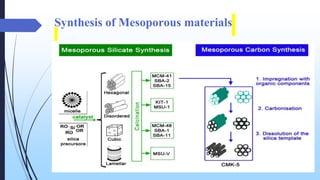
 Synthesis of Mesoporous material
 Applications
Porous materials
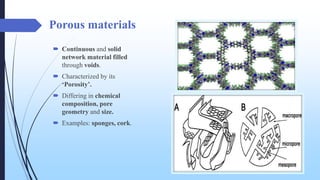
 Continuous and solid
network material filled
through voids.
 Characterized by its
‘Porosity’.
 Differing in chemical
composition, pore
geometry and size.
 Examples: sponges, cork.
Classification
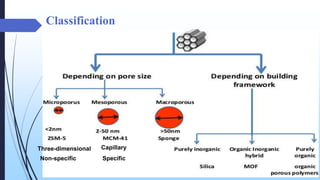
Three-dimensional Capillary
SpecificNon-specific
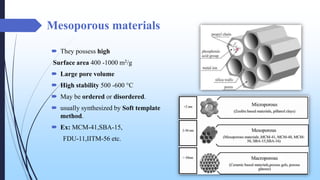
Mesoporous materials
 They possess high
Surface area 400 -1000 m2/g
 Large pore volume
 High stability 500 -600 °C
 May be ordered or disordered.
 usually synthesized by Soft template
method.
 Ex: MCM-41,SBA-15,
FDU-11,IITM-56 etc.
History:
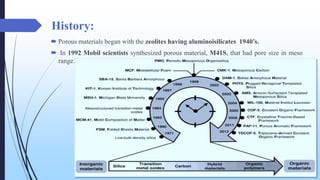
 Porous materials began with the zeolites having aluminoisilicates 1940’s.
 In 1992 Mobil scientists synthesized porous material, M41S, that had pore size in meso
range.
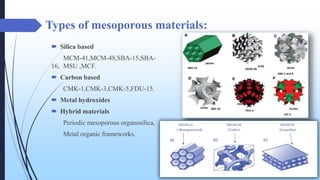
Types of mesoporous materials:
 Silica based
MCM-41,MCM-48,SBA-15,SBA-
16, MSU ,MCF.
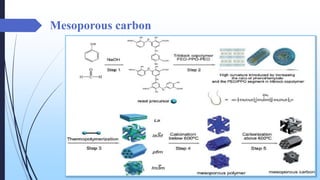
 Carbon based
CMK-1,CMK-3,CMK-5,FDU-15.
 Metal hydroxides
 Hybrid materials
Periodic mesoporous organosilica,
Metal organic frameworks.
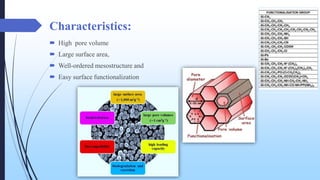
Characteristics:
 High pore volume
 Large surface area,
 Well-ordered mesostructure and
 Easy surface functionalization
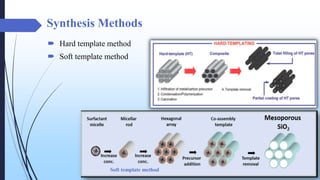
Synthesis Methods
 Hard template method
 Soft template method
Soft template method
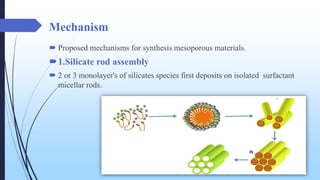
Mechanism
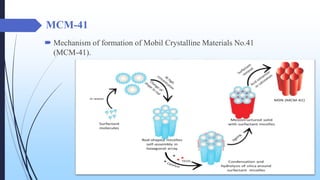
 Proposed mechanisms for synthesis mesoporous materials.
1.Silicate rod assembly
 2 or 3 monolayer's of silicates species first deposits on isolated surfactant
micellar rods.
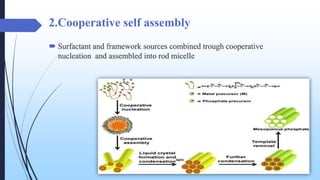
2.Cooperative self assembly
 Surfactant and framework sources combined trough cooperative
nucleation and assembled into rod micelle
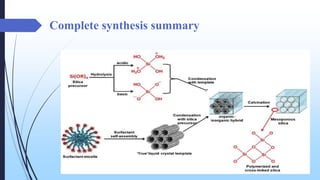
Complete synthesis summary
MCM-41
 Mechanism of formation of Mobil Crystalline Materials No.41
(MCM-41).
Synthesis of Mesoporous materials
Mesoporous carbon
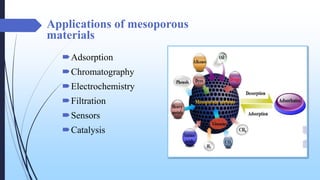
Applications of mesoporous
materials
Adsorption
Chromatography
Electrochemistry
Filtration
Sensors
Catalysis
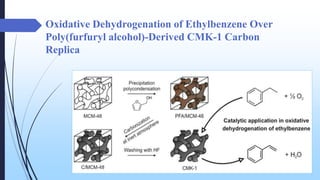
Oxidative Dehydrogenation of Ethylbenzene Over
Poly(furfuryl alcohol)-Derived CMK-1 Carbon
Replica
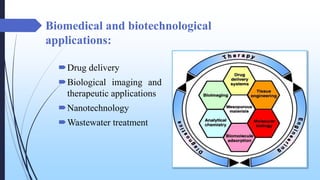
Biomedical and biotechnological
applications:
Drug delivery
Biological imaging and
therapeutic applications
Nanotechnology
Wastewater treatment
Conclusion
 Mesoporous materials have attracted ever-growing attention owing to their unique
structural characteristics such as tunable pore size, controllable morphology, large
surface area, and moderate pore size range with easy access for guest species.
 These remarkable features open up a broad application spectrum of mesoporous
materials, making them promising candidates in catalysis, absorption, membranes
and separation, sensors.
 A key issue for the applicability of these mesoporous materials is associated with
the thermal, and more importantly the hydrothermal and mechanical stabilities.
Mesoporous materials synthesis & applications

Mesoporous materials synthesis & applications

Editor's Notes

  • #5  Most generalized definition of porous materials is continuous and solid network material filled through voids.  A material can be recognized as porous if its internal voids can be filled with gases.
  • #6 Pore type Pore Size Condensation mechanism Type of Adsorption Micropore < 2 nm Tree-dimensional Non-specific Mesopore ≥ 2 ≤ 50 nm Capillary Specific Macropore > 50 nm No condensation -
  • #7 “the overwhelming tendency for solids to minimize void space within their structure” is inherent , porous materials are difficult to make naturally. But Einstein say “ in the middle of difficulty lies opportunity” The above statement was made true by the Mobil scientist in the year of 1992 by successfully synthesizing the Mesoporous materials (MCM-41 and MCM-48) by using soft template strategy. This opened a new area of materials called Mesoporous materials, and still lot of work are fascinating in this field. Meso a Greek prefix – “ in between ” - micro and macro porous system  Mesoporous materials may be ordered or disordered. They possess high  Surface area -400 -1000 m2/g  Large pore volume  High stability -500 -600 °C  They are usually synthesized by the use of Soft template method. Ex: MCM-41,SBA-15,FDU-11,IITM-56 etc.
  • #8 The history of porous materials began with the zeolites having aluminoisilicates framework which was synthesized by the use single template molecule with small pore.
  • #10 high pore volume, large surface area, well-ordered mesostructure and easy surface functionalisation
  • #11 Soft template (endo template) • Uses soft templates like organic molecules . •Good shape , Size and morphology. simple • SBA-15 ,MCM-41 etc Soft template method for synthesis 5/5/2016 Mannu Kaur 13 1. Surfactants. 2. Formation of Micelles. 3. Inorganic precursor . 4. Interaction of Micelles with inorganic precursor. 5. Hydrothermal treatment followed by separation and drying 6. Removal of template. 7. Proposed mechanism Hard template (exo template, nano casting) •Uses inorganic materials like silica, carbon etc •Tedious work up, hard to get good morphology and costly CMK-1 Hard template Synthesis of mesoporous carbons with well-defined mesoporous structure is usually done by hard template method a) Preparation of silica gel with controlled pore structure. b) Impregnation/infiltration of the silica template with monomer or polymer precursors. c) Cross-linking and carbonization of the organic precursors. d) Dissolution of the silica template. 5/5/2016 Mannu Kaur 11
  • #18 The functionalization of MCM-41 and SBA-15, respectively, with amino groups as an effective method to control IBU release. The ionic interaction between the carboxy groups in IBU and the amino groups on the matrix surface allows the release rate of IBU from amino functionalized SMMs to be effectively controlled (SMM=silica mesoporous material). NMR analysis revealed that IBU molecules are tightly linked at the surface because the drug–surface ionic interactions are stronger than the IBU dimer hydrogen bonds.
  • #19 Poly(furfuryl alcohol) was introduced into a pore system of MCM-48 silica by the precipitation polycondensation of furfuryl alcohol (FA). The complete filling of the pores without the deposition of significant amounts of polymer on the external surface of MCM-48 was obtained at the FA/MCM-48 mass ratio close to 1.0. The final structure of carbon replica was formed by subsequent carbonization and extraction of SiO2 with HF. The carbonization temperature strongly influenced the surface composition of the formed carbon replicas. The highest catalytic activity in the oxidative dehydrogenation of ethylbenzene was observed for CMK-1 with the highest concentration of phenol and carbonyl groups, recognized as active sites of the studied reaction.
  • #20 These materials are attractive magnetic probes for biological imaging and therapeutic applications. Core diameter near about 20nm and overall particle diameter near about 50nm, the size is much smaller than size of the cell and is comparable to size of nuclei. When these are coupled with target agent, they serve as nanovectors and interact specifically with biomolecules. Drug carriers with magnetic NPs can respond to an external magnetic field, which makes them good magnetic targeting agents for drug delivery. Drug delivery: The functionalization of MCM-41 and SBA-15, respectively, with amino groups as an effective method to control IBU release. (SMM=silica mesoporous material). CATALYSIS : Various types of reactions are catalyzed using magnetic mesoporous nanocomposites, such as olefin epoxidation, hydrogenation, Knoevenagel reaction. Wastewater treatment: Various organo-functionalized mesoporous materials such as thiols, thioether and amino groups have been reported for metal ion removal and dye adsorption. These materials exhibited highly selective adsorption of Hg2+.