DESIGN OF NEW CATHODE
MATERIALS FOR SECONDARY
LITHIUM BATTERIES

E. Sivanagi Reddy
Index
 Introduction
 Battery – Timeline
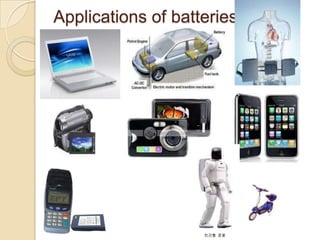
 Applications of batteries
 Secondary Lithium ion battery
 Structure of battery
 Cathode materials
 Advances in cathode materials
 Promising cathode materials
 conclusion
Introduction
   Beginning with the ‘frog-leg experiment’ by
    Galvani (1786), followed by the
    demonstrations of Volta pile by Volta (1792)
    and lead-acid accumulator by Plante
    (1859), several battery chemistries have been
    developed and realized commercially
Battery
 A battery is a transducer that converts
  chemical energy into electrical energy and
  vice versa.
 It contains
   An anode - source
   A cathode - sink
   An electrolyte - the separation of ionic
  transport and electronic transport
Timeline for the major events in the history of batteries
Applications of batteries
Types of batteries
   Primary batteries are disposable because their
    electrochemical reaction cannot be reversed.

      ΔG negative (irreversible)

   Secondary batteries are rechargeable, because their
    electrochemical reaction can be reversed by
    applying a certain voltage to the battery in the
    opposite direction of the discharge.
         ΔG negative, discharge
         ΔG positive, charge
Comparison of the volumetric and
gravimetric energy density with other
batteries
Lithium ion batteries
 The name of “lithium ion battery” was
  given by T. Nagaura and K. Tozawa
 The concept of “lithium ion battery”
  was firstly introduced by Asahi Kasei
  Co. Ltd
 Lithium ion batteries were first proposed
  by M. S. Whittingham in the 1970’s.
  Whittingham used TiS2 as the cathode
  and Lithium metal as the anode.
Lithium ion secondary
Batteries
 The lithium ion battery (LIB) system has been
  most successful in recent development of battery.
 Li is lightest metal and has one of the highest
  standard reduction potentials (-3.0 V)
 Theoretical specific capacity of 3860 Ah/kg in
  comparison with 820 Ah/kg for Zn and 260 Ah/kg
  for Pb
Lithium ion secondary
    batteries
 The first commercial lithium-ion battery was
  released by Sony in 1991
 Battery performance is related not only capacity
  but also to how fast current can be drawn from it:
  specific energy (Wh/Kg), energy density (Wh/cm3)
  and power density (W/Kg)
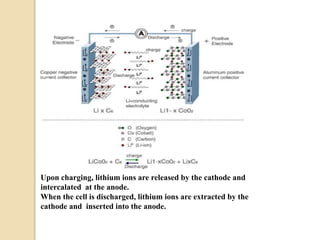
Schematic representation of a Lithium-ion cell
Upon charging, lithium ions are released by the cathode and
intercalated at the anode.
When the cell is discharged, lithium ions are extracted by the
cathode and inserted into the anode.
Advantages of Lithium-ion batteries
 POWER – High energy density means greater power
 in a smaller package.
 ◦ 160% greater than NiMH
 ◦ 220% greater than NiCd
 HIGHER VOLTAGE – a strong current
   allows it to power complex mechanical
   devices.
 LONG SHELF-LIFE – only 5% discharge
  loss per month.
 10% for NiMH, 20% for NiCd
Disadvantages of Lithium-ion batteries
   EXPENSIVE -- 40% more than NiCd
   DELICATE -- battery temperature must be monitored
    from within (which raises the price), and sealed
    particularly well
   REGULATIONS -- when shipping Lithium-ion
    batteries in bulk (which also raises the price)
      ◦ Class 9 miscellaneous hazardous material
      ◦ UN Manual of Tests and Criteria
Electrolytes
     Role
    1) ion conductor between cathode and anode
    2) generally, Lithium salt dissolved in organic solvent
    3) solid electrolyte is also possible if the ion conductivity is high at
        operating temperature.

     Requirement
    1) Inert
    2) High ionic conductivity, low viscosity
    3) low melting point
    4) Appropriate concentration of Lithium salt
    5) Chemical/thermal stability
    6) Low cost
    7) Environmental -friendly, non-toxic

     Commercial electrolytes: LiPF6 in Carbonate solvent
Anode materials
   Requirements
1) Large capability of Lithium adsorption
2) High efficiency of charge/discharge
3) Excellent cyclability
4) Low reactivity against electrolyte
5) Fast reaction rate
6) Low cost
8) Environmental -friendly, non-toxic
  Commercial anode materials:
    Hard Carbon, Graphite
cathodematerials
 One facet of battery research in which there have
  been many interesting discoveries is the area of
  cathodes
 A cathode is the electrode of an electrochemical
  cell at which reduction occurs
 Common cathode materials of Lithium-ion
  batteries are the transition metal oxide based
  compounds such as
  LiCoO2, LiMn2O4, LiNiO2, LiFePO4
Desired characteristics of cathode
materials
   A high discharge voltage
                                          Li
   A high energy capacity                Co
                             c
                                          O
   A long cycle life
   A high power density
   Light weight
                                   a
   Low self-discharge           LiCoO2

   Absence of environmentally
    hazardous elements
Parameters effecting Cathode behavior


 Method of preparation
 Particle size
 Morphology
 Oxygen Deficiency
 Temperature
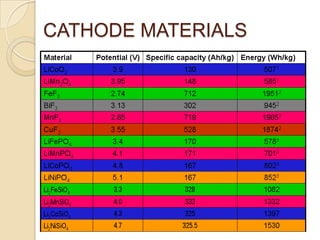
CATHODE MATERIALS
   Layered oxide cathodes
   Spinel oxide cathodes
   Zigzag layered LiMnO2 compound
   Olivine structure of LiMPO4
    Other compounds
CATHODE MATERIALS
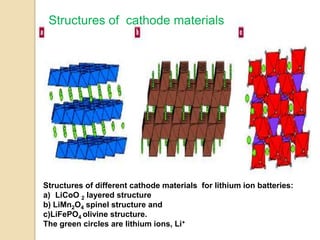
Structures of cathode materials


Structures of different cathode materials for lithium ion batteries:
a) LiCoO 2 layered structure
b) LiMn2O4 spinel structure and
c)LiFePO4 olivine structure.
The green circles are lithium ions, Li+
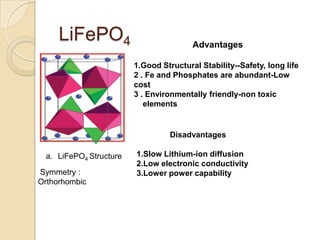
LiFePO4                            Advantages

                        1.Good Structural Stability--Safety, long life
                        2 . Fe and Phosphates are abundant-Low
                        cost
                        3 . Environmentally friendly-non toxic
                           elements


                                  Disadvantages

 a. LiFePO4 Structure   1.Slow Lithium-ion diffusion
                        2.Low electronic conductivity
Symmetry :              3.Lower power capability
Orthorhombic
Capacity ranges with respect to
various cathode materials
Comparison of cathode materials
Ways to Improve Cathode Performance
•   Increasing Energy Density
    • Investigate high voltage cathodes that can deliver all the
      Lithium in the structure will improve energy density
•   Thin nano-plate materials seem to offer more energy at
                                    higher rate
    • 30 nm LiFePO4 nano-plates performed better than thick
       material
•   Meso porous LiMn2O4 is another material where there is
    reduced manganese dissolution
•   Surface Coating of cathodes with either ionically or
    electronically conductive material
    • AlF3 coating on oxide materials is shown to improve
      performance
Recent advances in lithium ion
    battery cathode materials
 Composite Cathode Material for Lithium-ion
  Batteries Based on LiFePO4 System
 Some transition metal (oxy)phosphates and
  vanadium oxides for lithium batteries
 Nanostructured cathode materials
Problems in the usage of Cathode materials
    Raw material cost and environmental impact of
    large-scale cells and mass production
    Production cost of solid-state synthesis using high
    and long heating process
   Oxygen release and heat generation from the
    cathode in a fully charged state
    Sensitivity of safety for charge cutoff voltages
    Sensitivity of cathode performance for
     stoichiometry
    Low practical capacity of the cathode being half
    that of a carbonaceous anode
Next generation cathodes


 Most abundant is iron, with stable trivalent state
 Second most abundant is titanium, with stable
  tetravalent state
 Vanadium, with wide valence change (V 2+ –V 5+ )
 Molybdenum, with wide valence change (Mo 4+ –
  Mo 6+ )
Potential Cathode Materials
1. Olivine based phosphates systems (LiMPO4 where M = Mn, Ni) that
   can deliver more Lithium as compared to the conventional material
   LiCoO2
2. Only very few groups have synthesized LiMnPO4 successfully
   and this system has a potential around 4.3 V
3. LiNiPO4 has a potential around 5.5V. It is believed that Li+ diffusion
   coefficient is quite high in nickel phosphate in the range 10-5 m2/s at
   around room temperature. It should have high thermal stability
   because the oxygen is covalently bound in the structure
4. Novel approaches for synthesis of nanostructured olivine's are required
   to enhance both ionic and electronic conductivity
5. LiMn2O4 may be another potential candidate material if the Mn
   dissolution can be suppressed
     ◦   Mesoporous oxide with coating may stabilize Mn oxide
Structures of some promising materials


Structures of LiFePO4 and FePO4, quartz-like
FePO4, Li3Fe2(PO4)3, Lipscombite
Fe1.33FePO4(OH), LiFePO4(OH), H2VOPO4 and H2MnOPO4, e-VOPO4 and
Li2VOPO4. PO4 tetrahedra are golden, FeO6 and VO6 octahedra are
blue, FeO4 tetrahedra are green and lithium atoms are green
Conclusions and what does the future
 hold
    In present day common Lithium transition compounds such as
    LiCoO2, LiNiO2, LiMn2O4 and LiFePO4 are used as cathode
    material in battery cell production, and they have shown a good
    performance during charge and discharge cycling
   For the future there are still a number of actions of interest to
    further develop the performance of derived LiFePO4/C cathode
    material
   We expect upcoming researches on this new framework will lead to
    better cathode materials for lithium-ion batteries
Li ion batteries

Li ion batteries

  • 1.
    DESIGN OF NEWCATHODE MATERIALS FOR SECONDARY LITHIUM BATTERIES E. Sivanagi Reddy
  • 2.
    Index  Introduction  Battery– Timeline  Applications of batteries  Secondary Lithium ion battery  Structure of battery  Cathode materials  Advances in cathode materials  Promising cathode materials  conclusion
  • 3.
    Introduction  Beginning with the ‘frog-leg experiment’ by Galvani (1786), followed by the demonstrations of Volta pile by Volta (1792) and lead-acid accumulator by Plante (1859), several battery chemistries have been developed and realized commercially
  • 4.
    Battery  A batteryis a transducer that converts chemical energy into electrical energy and vice versa.  It contains An anode - source A cathode - sink An electrolyte - the separation of ionic transport and electronic transport
  • 5.
    Timeline for themajor events in the history of batteries
  • 6.
  • 7.
    Types of batteries  Primary batteries are disposable because their electrochemical reaction cannot be reversed. ΔG negative (irreversible)  Secondary batteries are rechargeable, because their electrochemical reaction can be reversed by applying a certain voltage to the battery in the opposite direction of the discharge. ΔG negative, discharge ΔG positive, charge
  • 8.
    Comparison of thevolumetric and gravimetric energy density with other batteries
  • 10.
    Lithium ion batteries The name of “lithium ion battery” was given by T. Nagaura and K. Tozawa  The concept of “lithium ion battery” was firstly introduced by Asahi Kasei Co. Ltd  Lithium ion batteries were first proposed by M. S. Whittingham in the 1970’s. Whittingham used TiS2 as the cathode and Lithium metal as the anode.
  • 11.
    Lithium ion secondary Batteries The lithium ion battery (LIB) system has been most successful in recent development of battery.  Li is lightest metal and has one of the highest standard reduction potentials (-3.0 V)  Theoretical specific capacity of 3860 Ah/kg in comparison with 820 Ah/kg for Zn and 260 Ah/kg for Pb
  • 12.
    Lithium ion secondary batteries  The first commercial lithium-ion battery was released by Sony in 1991  Battery performance is related not only capacity but also to how fast current can be drawn from it: specific energy (Wh/Kg), energy density (Wh/cm3) and power density (W/Kg)
  • 13.
    Schematic representation ofa Lithium-ion cell
  • 14.
    Upon charging, lithiumions are released by the cathode and intercalated at the anode. When the cell is discharged, lithium ions are extracted by the cathode and inserted into the anode.
  • 15.
    Advantages of Lithium-ionbatteries POWER – High energy density means greater power in a smaller package. ◦ 160% greater than NiMH ◦ 220% greater than NiCd HIGHER VOLTAGE – a strong current allows it to power complex mechanical devices. LONG SHELF-LIFE – only 5% discharge loss per month. 10% for NiMH, 20% for NiCd
  • 16.
    Disadvantages of Lithium-ionbatteries  EXPENSIVE -- 40% more than NiCd  DELICATE -- battery temperature must be monitored from within (which raises the price), and sealed particularly well  REGULATIONS -- when shipping Lithium-ion batteries in bulk (which also raises the price) ◦ Class 9 miscellaneous hazardous material ◦ UN Manual of Tests and Criteria
  • 17.
    Electrolytes  Role 1) ion conductor between cathode and anode 2) generally, Lithium salt dissolved in organic solvent 3) solid electrolyte is also possible if the ion conductivity is high at operating temperature.  Requirement 1) Inert 2) High ionic conductivity, low viscosity 3) low melting point 4) Appropriate concentration of Lithium salt 5) Chemical/thermal stability 6) Low cost 7) Environmental -friendly, non-toxic  Commercial electrolytes: LiPF6 in Carbonate solvent
  • 18.
    Anode materials  Requirements 1) Large capability of Lithium adsorption 2) High efficiency of charge/discharge 3) Excellent cyclability 4) Low reactivity against electrolyte 5) Fast reaction rate 6) Low cost 8) Environmental -friendly, non-toxic  Commercial anode materials: Hard Carbon, Graphite
  • 19.
    cathodematerials  One facetof battery research in which there have been many interesting discoveries is the area of cathodes  A cathode is the electrode of an electrochemical cell at which reduction occurs  Common cathode materials of Lithium-ion batteries are the transition metal oxide based compounds such as LiCoO2, LiMn2O4, LiNiO2, LiFePO4
  • 20.
    Desired characteristics ofcathode materials  A high discharge voltage Li  A high energy capacity Co c O  A long cycle life  A high power density  Light weight a  Low self-discharge LiCoO2  Absence of environmentally hazardous elements
  • 21.
    Parameters effecting Cathodebehavior  Method of preparation  Particle size  Morphology  Oxygen Deficiency  Temperature
  • 22.
    CATHODE MATERIALS  Layered oxide cathodes  Spinel oxide cathodes  Zigzag layered LiMnO2 compound  Olivine structure of LiMPO4  Other compounds
  • 23.
  • 24.
    Structures of cathodematerials Structures of different cathode materials for lithium ion batteries: a) LiCoO 2 layered structure b) LiMn2O4 spinel structure and c)LiFePO4 olivine structure. The green circles are lithium ions, Li+
  • 25.
    LiFePO4 Advantages 1.Good Structural Stability--Safety, long life 2 . Fe and Phosphates are abundant-Low cost 3 . Environmentally friendly-non toxic elements Disadvantages a. LiFePO4 Structure 1.Slow Lithium-ion diffusion 2.Low electronic conductivity Symmetry : 3.Lower power capability Orthorhombic
  • 26.
    Capacity ranges withrespect to various cathode materials
  • 27.
  • 28.
    Ways to ImproveCathode Performance • Increasing Energy Density • Investigate high voltage cathodes that can deliver all the Lithium in the structure will improve energy density • Thin nano-plate materials seem to offer more energy at higher rate • 30 nm LiFePO4 nano-plates performed better than thick material • Meso porous LiMn2O4 is another material where there is reduced manganese dissolution • Surface Coating of cathodes with either ionically or electronically conductive material • AlF3 coating on oxide materials is shown to improve performance
  • 29.
    Recent advances inlithium ion battery cathode materials  Composite Cathode Material for Lithium-ion Batteries Based on LiFePO4 System  Some transition metal (oxy)phosphates and vanadium oxides for lithium batteries  Nanostructured cathode materials
  • 30.
    Problems in theusage of Cathode materials  Raw material cost and environmental impact of large-scale cells and mass production  Production cost of solid-state synthesis using high and long heating process  Oxygen release and heat generation from the cathode in a fully charged state  Sensitivity of safety for charge cutoff voltages  Sensitivity of cathode performance for stoichiometry  Low practical capacity of the cathode being half that of a carbonaceous anode
  • 31.
    Next generation cathodes Most abundant is iron, with stable trivalent state  Second most abundant is titanium, with stable tetravalent state  Vanadium, with wide valence change (V 2+ –V 5+ )  Molybdenum, with wide valence change (Mo 4+ – Mo 6+ )
  • 32.
    Potential Cathode Materials 1.Olivine based phosphates systems (LiMPO4 where M = Mn, Ni) that can deliver more Lithium as compared to the conventional material LiCoO2 2. Only very few groups have synthesized LiMnPO4 successfully and this system has a potential around 4.3 V 3. LiNiPO4 has a potential around 5.5V. It is believed that Li+ diffusion coefficient is quite high in nickel phosphate in the range 10-5 m2/s at around room temperature. It should have high thermal stability because the oxygen is covalently bound in the structure 4. Novel approaches for synthesis of nanostructured olivine's are required to enhance both ionic and electronic conductivity 5. LiMn2O4 may be another potential candidate material if the Mn dissolution can be suppressed ◦ Mesoporous oxide with coating may stabilize Mn oxide
  • 33.
    Structures of somepromising materials Structures of LiFePO4 and FePO4, quartz-like FePO4, Li3Fe2(PO4)3, Lipscombite Fe1.33FePO4(OH), LiFePO4(OH), H2VOPO4 and H2MnOPO4, e-VOPO4 and Li2VOPO4. PO4 tetrahedra are golden, FeO6 and VO6 octahedra are blue, FeO4 tetrahedra are green and lithium atoms are green
  • 34.
    Conclusions and whatdoes the future hold  In present day common Lithium transition compounds such as LiCoO2, LiNiO2, LiMn2O4 and LiFePO4 are used as cathode material in battery cell production, and they have shown a good performance during charge and discharge cycling  For the future there are still a number of actions of interest to further develop the performance of derived LiFePO4/C cathode material  We expect upcoming researches on this new framework will lead to better cathode materials for lithium-ion batteries