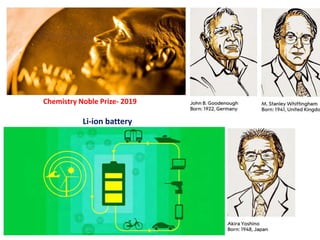
Chemistry Noble Prize- 2019
Li-ion battery
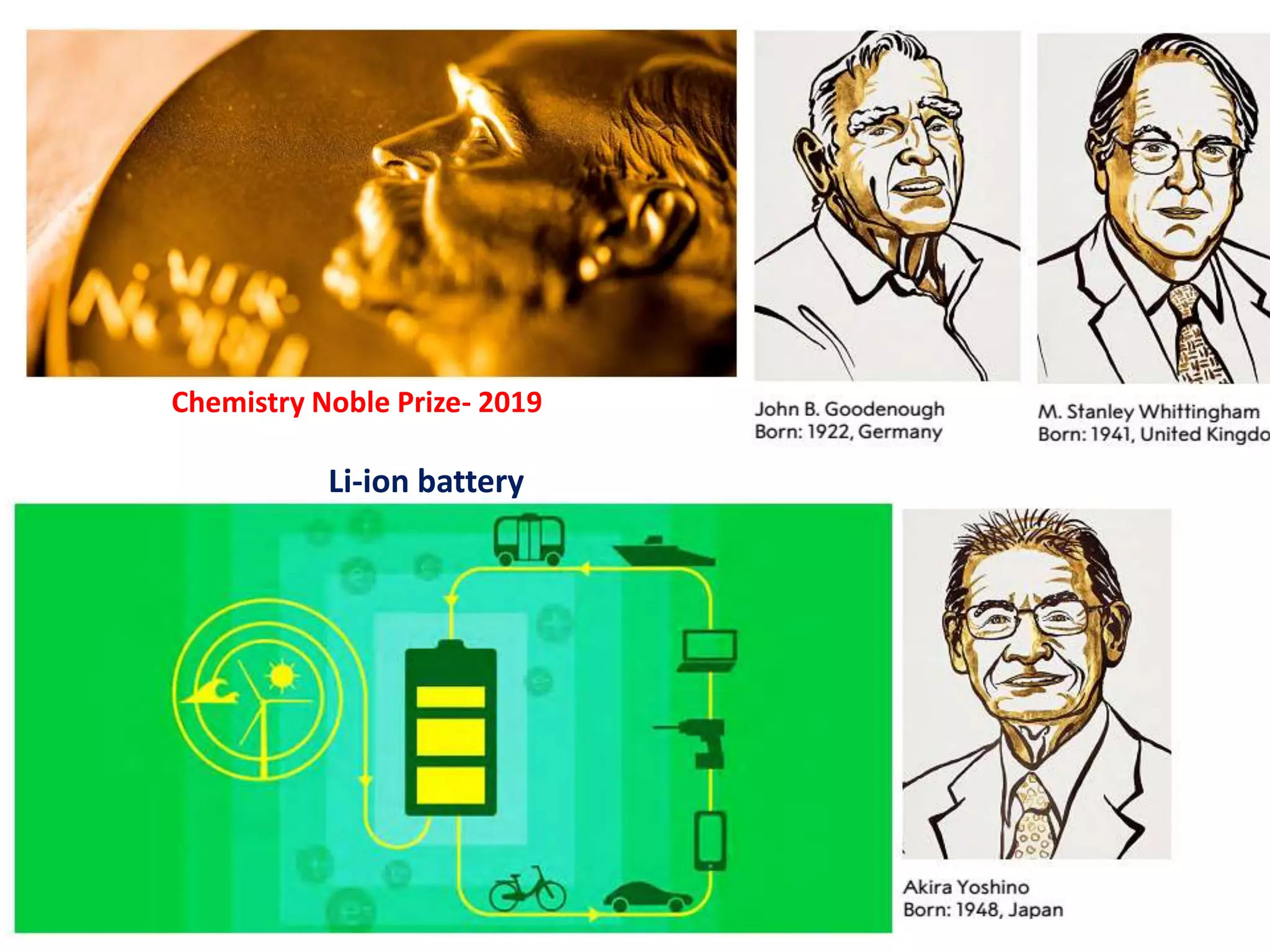
Four components of a battery
1. How Does Battery Work
1. Positive electrode
2. Negative electrode
3. Electrolyte
4. External circuit
Reduction occur at negative and oxidation occur at negative electrodes. Electron flows
from negative to positive electrode and conventional current flows in opposite direction,
Now the external circuit connecting these two electrodes when connected to a load (in
this case light bulb), it results in electrical work.
Working Principle
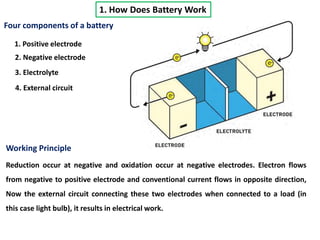
Discharging
2. How Does a Rechargeable Battery Work
Discharging is a spontaneous process when the
two electrodes are connected by an external
wire
Charging
Charging is a non-spontaneous process and
requires External work to be done on this
system. When external electricity is supplied
then the redox process in the electrodes occur
in reverse manner
Supplied electrical
energy
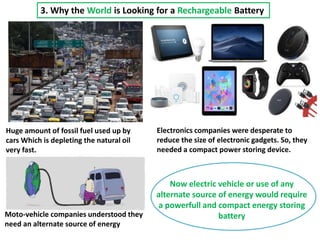
3. Why the World is Looking for a Rechargeable Battery
Huge amount of fossil fuel used up by
cars Which is depleting the natural oil
very fast.
Moto-vehicle companies understood they
need an alternate source of energy
Electronics companies were desperate to
reduce the size of electronic gadgets. So, they
needed a compact power storing device.
Now electric vehicle or use of any
alternate source of energy would require
a powerfull and compact energy storing
battery
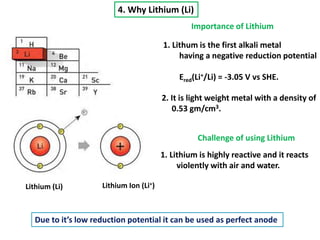
4. Why Lithium (Li)
Lithium (Li) Lithium Ion (Li+)
Importance of Lithium
1. Lithum is the first alkali metal
having a negative reduction potential
Ered(Li+/Li) = -3.05 V vs SHE.
2. It is light weight metal with a density of
0.53 gm/cm3.
Challenge of using Lithium
1. Lithium is highly reactive and it reacts
violently with air and water.
Due to it’s low reduction potential it can be used as perfect anode
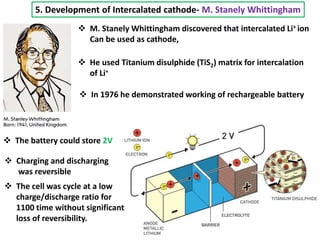
5. Development of Intercalated cathode- M. Stanely Whittingham
 M. Stanely Whittingham discovered that intercalated Li+ ion
Can be used as cathode,
 He used Titanium disulphide (TiS2) matrix for intercalation
of Li+
 In 1976 he demonstrated working of rechargeable battery
 The battery could store 2V
 Charging and discharging
was reversible
 The cell was cycle at a low
charge/discharge ratio for
1100 time without significant
loss of reversibility.
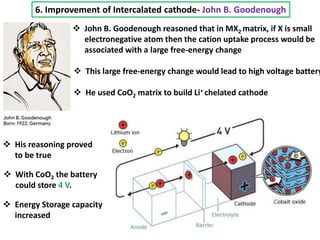
6. Improvement of Intercalated cathode- John B. Goodenough
 John B. Goodenough reasoned that in MX2 matrix, if X is small
electronegative atom then the cation uptake process would be
associated with a large free-energy change
 This large free-energy change would lead to high voltage battery
 He used CoO2 matrix to build Li+ chelated cathode
 His reasoning proved
to be true
 With CoO2 the battery
could store 4 V.
 Energy Storage capacity
increased
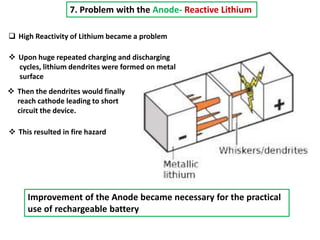
7. Problem with the Anode- Reactive Lithium
 High Reactivity of Lithium became a problem
 Upon huge repeated charging and discharging
cycles, lithium dendrites were formed on metal
surface
 Then the dendrites would finally
reach cathode leading to short
circuit the device.
 This resulted in fire hazard
Improvement of the Anode became necessary for the practical
use of rechargeable battery
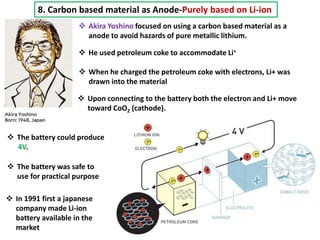
8. Carbon based material as Anode-Purely based on Li-ion
 Akira Yoshino focused on using a carbon based material as a
anode to avoid hazards of pure metallic lithium.
 He used petroleum coke to accommodate Li+
 When he charged the petroleum coke with electrons, Li+ was
drawn into the material
 Upon connecting to the battery both the electron and Li+ move
toward CoO2 (cathode).
 The battery could produce
4V.
 The battery was safe to
use for practical purpose
 In 1991 first a japanese
company made Li-ion
battery available in the
market
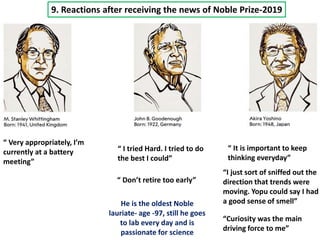
9. Reactions after receiving the news of Noble Prize-2019
“ I tried Hard. I tried to do
the best I could”
“ Don’t retire too early”
He is the oldest Noble
lauriate- age -97, still he goes
to lab every day and is
passionate for science
“ Very appropriately, I’m
currently at a battery
meeting”
“ It is important to keep
thinking everyday”
“I just sort of sniffed out the
direction that trends were
moving. Yopu could say I had
a good sense of smell”
“Curiosity was the main
driving force to me”

Chemistry Noble Prize-2019

  • 1.
    Chemistry Noble Prize-2019 Li-ion battery
  • 2.
    Four components ofa battery 1. How Does Battery Work 1. Positive electrode 2. Negative electrode 3. Electrolyte 4. External circuit Reduction occur at negative and oxidation occur at negative electrodes. Electron flows from negative to positive electrode and conventional current flows in opposite direction, Now the external circuit connecting these two electrodes when connected to a load (in this case light bulb), it results in electrical work. Working Principle
  • 3.
    Discharging 2. How Doesa Rechargeable Battery Work Discharging is a spontaneous process when the two electrodes are connected by an external wire Charging Charging is a non-spontaneous process and requires External work to be done on this system. When external electricity is supplied then the redox process in the electrodes occur in reverse manner Supplied electrical energy
  • 4.
    3. Why theWorld is Looking for a Rechargeable Battery Huge amount of fossil fuel used up by cars Which is depleting the natural oil very fast. Moto-vehicle companies understood they need an alternate source of energy Electronics companies were desperate to reduce the size of electronic gadgets. So, they needed a compact power storing device. Now electric vehicle or use of any alternate source of energy would require a powerfull and compact energy storing battery
  • 5.
    4. Why Lithium(Li) Lithium (Li) Lithium Ion (Li+) Importance of Lithium 1. Lithum is the first alkali metal having a negative reduction potential Ered(Li+/Li) = -3.05 V vs SHE. 2. It is light weight metal with a density of 0.53 gm/cm3. Challenge of using Lithium 1. Lithium is highly reactive and it reacts violently with air and water. Due to it’s low reduction potential it can be used as perfect anode
  • 6.
    5. Development ofIntercalated cathode- M. Stanely Whittingham  M. Stanely Whittingham discovered that intercalated Li+ ion Can be used as cathode,  He used Titanium disulphide (TiS2) matrix for intercalation of Li+  In 1976 he demonstrated working of rechargeable battery  The battery could store 2V  Charging and discharging was reversible  The cell was cycle at a low charge/discharge ratio for 1100 time without significant loss of reversibility.
  • 7.
    6. Improvement ofIntercalated cathode- John B. Goodenough  John B. Goodenough reasoned that in MX2 matrix, if X is small electronegative atom then the cation uptake process would be associated with a large free-energy change  This large free-energy change would lead to high voltage battery  He used CoO2 matrix to build Li+ chelated cathode  His reasoning proved to be true  With CoO2 the battery could store 4 V.  Energy Storage capacity increased
  • 8.
    7. Problem withthe Anode- Reactive Lithium  High Reactivity of Lithium became a problem  Upon huge repeated charging and discharging cycles, lithium dendrites were formed on metal surface  Then the dendrites would finally reach cathode leading to short circuit the device.  This resulted in fire hazard Improvement of the Anode became necessary for the practical use of rechargeable battery
  • 9.
    8. Carbon basedmaterial as Anode-Purely based on Li-ion  Akira Yoshino focused on using a carbon based material as a anode to avoid hazards of pure metallic lithium.  He used petroleum coke to accommodate Li+  When he charged the petroleum coke with electrons, Li+ was drawn into the material  Upon connecting to the battery both the electron and Li+ move toward CoO2 (cathode).  The battery could produce 4V.  The battery was safe to use for practical purpose  In 1991 first a japanese company made Li-ion battery available in the market
  • 10.
    9. Reactions afterreceiving the news of Noble Prize-2019 “ I tried Hard. I tried to do the best I could” “ Don’t retire too early” He is the oldest Noble lauriate- age -97, still he goes to lab every day and is passionate for science “ Very appropriately, I’m currently at a battery meeting” “ It is important to keep thinking everyday” “I just sort of sniffed out the direction that trends were moving. Yopu could say I had a good sense of smell” “Curiosity was the main driving force to me”