VISVESVARAYA TECHNOLOGICAL UNIVERSITY
centre for post graduate studies, Bangalore
seminar
on

High Capacity and High Energy Density Cathode
Materials for Lithium Ion Battery
By

Under the Guidance of

Natraj
USN: 1VW12INT12

Dr. Dinesh R
Special officer, VTU CPGSB
INDEX
Introduction

to Battery – Timeline

Lithium

ion battery

Cathode

materials

Advantages

and Disadvantages of LI-Ion Batteries

Advances

in cathode materials

Promising

cathode materials

Methodologies
References
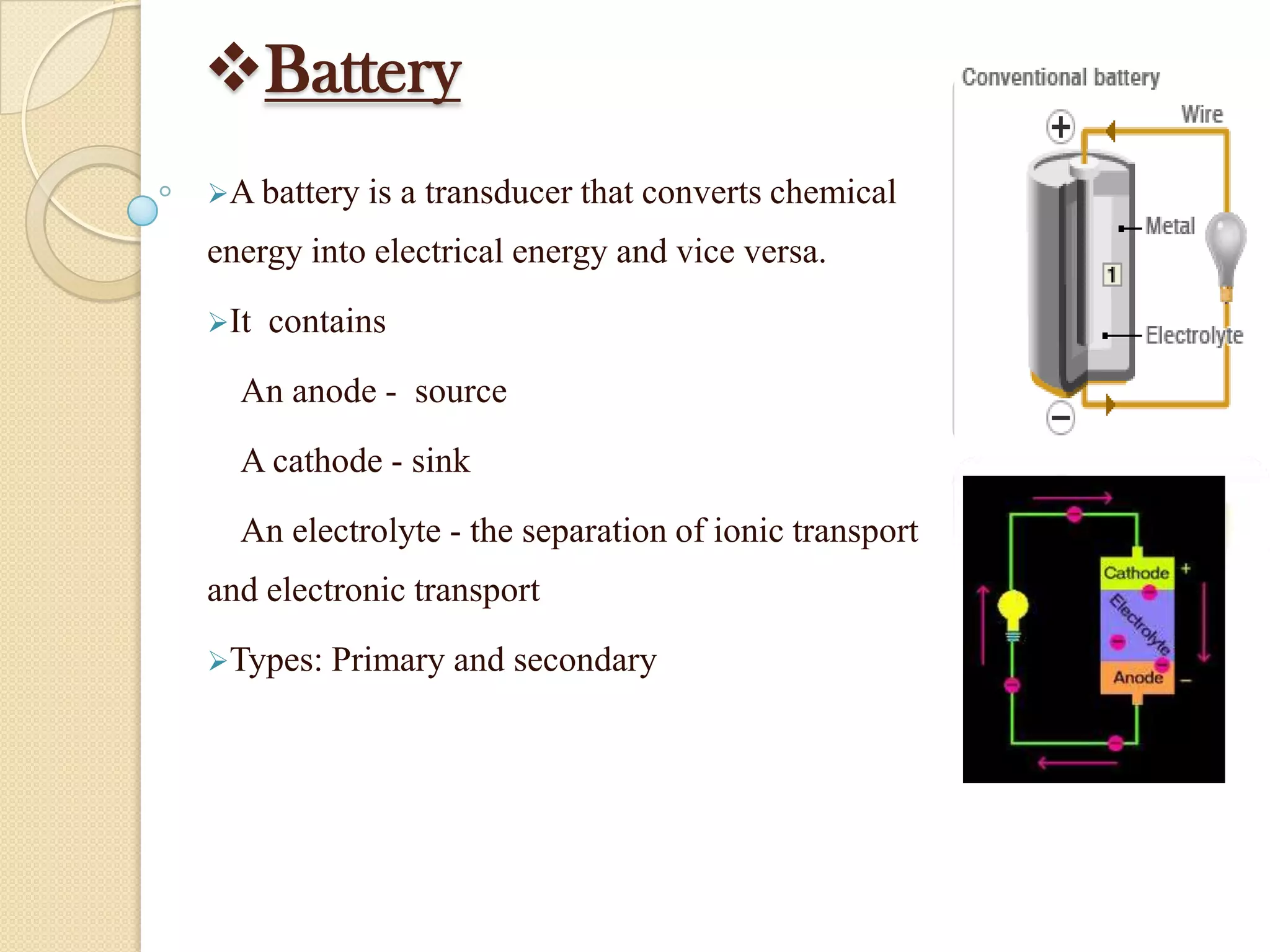
Battery
A battery

is a transducer that converts chemical

energy into electrical energy and vice versa.
It

contains

An anode - source
A cathode - sink
An electrolyte - the separation of ionic transport
and electronic transport
Types: Primary

and secondary
Timeline for the major events in the history of batteries
Introduction to Li-Ion Battery
The

name of “lithium ion battery” was given by T. Nagaura and K.
Tozawa
The

concept of “lithium ion battery” was firstly introduced by Asahi
Kasei Co. Ltd
Lithium ion

batteries were first proposed by M. S. Whittingham in
the 1970’s. Whittingham used TiS2 as the cathode and Lithium metal
as the anode.
The

1991

first commercial lithium-ion battery was released by Sony in
Why Li-Ion Battery?
Li

is lightest metal

one

of the highest standard reduction potentials (-3.0 V)

 Theoretical specific

capacity of 3860 Ah/kg in
comparison with 820 Ah/kg for Zn and 260 Ah/kg for Pb
performance

is related not only capacity but also to how
fast current can be drawn from it: specific energy (Wh/Kg),
energy density (Wh/cm3) and power density (W/Kg)
Schematic representation of a Lithium-ion cell
Advantages of Lithium-ion batteries


POWER – High energy density means greater power in a
smaller package.

◦ 160% greater than NiMH
◦ 220% greater than NiCd


HIGHER VOLTAGE – a strong current allows it to power
complex mechanical devices.



LONG SHELF-LIFE – only 5% discharge loss per month.
10% for NiMH, 20% for NiCd
Disadvantages of Lithium-ion batteries


EXPENSIVE



DELICATE



REGULATIONS
Cathode materials
A

cathode is the electrode of an electrochemical cell at
which reduction occurs
Common

cathode materials of Lithium-ion batteries are
the transition metal oxide based compounds such as
LiCoO2, LiMn2O4, LiNiO2, LiFePO4
characteristics of cathode materials
A high

discharge voltage

A high

energy capacity

A long

cycle life

A high

power density

Light weight
Low

self-discharge
Parameters effecting Cathode behavior
Method of
Particle

preparation

size

Morphology
Temperature
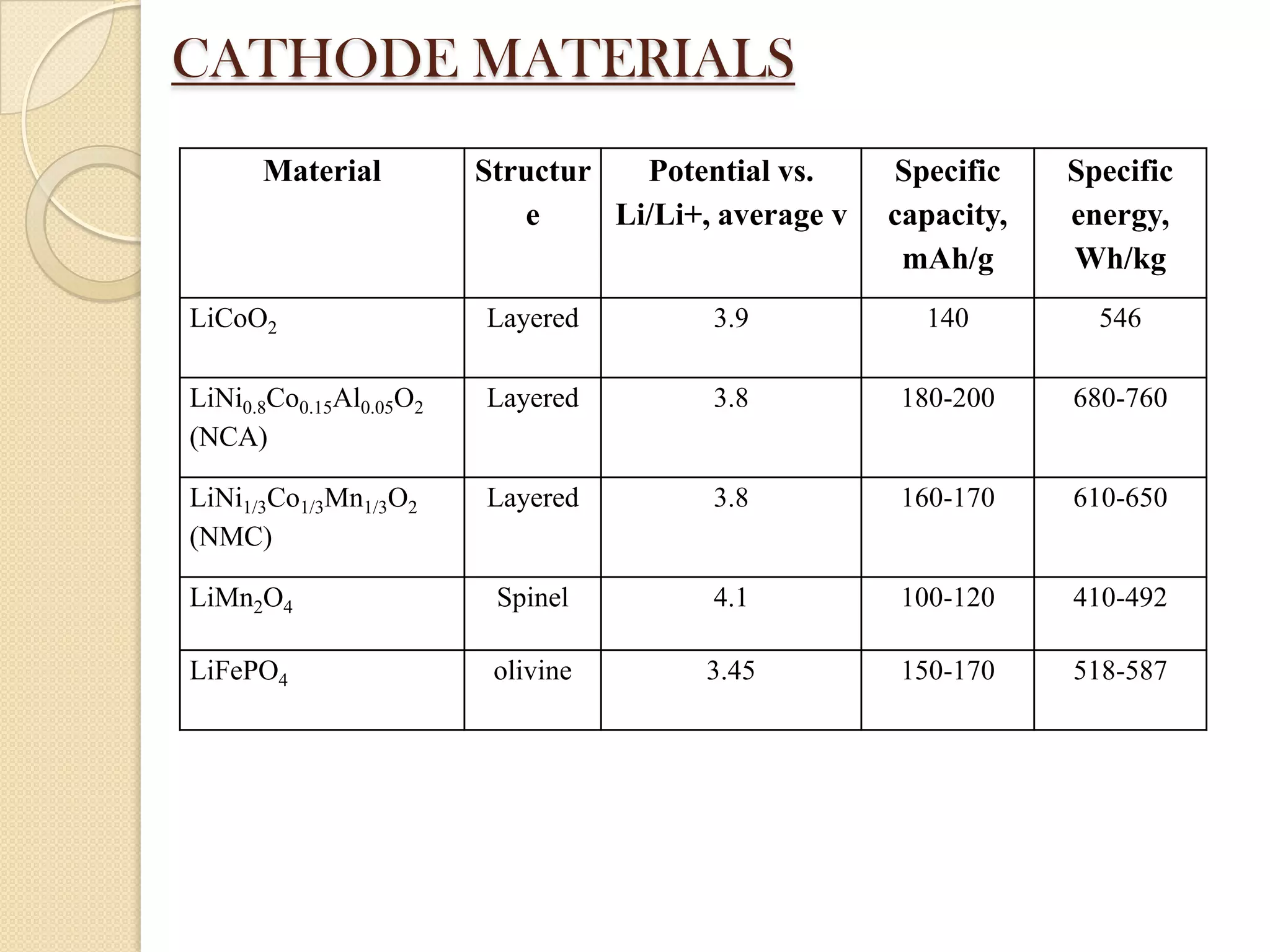
CATHODE MATERIALS
Material

Structur
Potential vs.
e
Li/Li+, average v

Specific
capacity,
mAh/g

Specific
energy,
Wh/kg

LiCoO2

Layered

3.9

140

546

LiNi0.8Co0.15Al0.05O2
(NCA)

Layered

3.8

180-200

680-760

LiNi1/3Co1/3Mn1/3O2
(NMC)

Layered

3.8

160-170

610-650

LiMn2O4

Spinel

4.1

100-120

410-492

LiFePO4

olivine

3.45

150-170

518-587
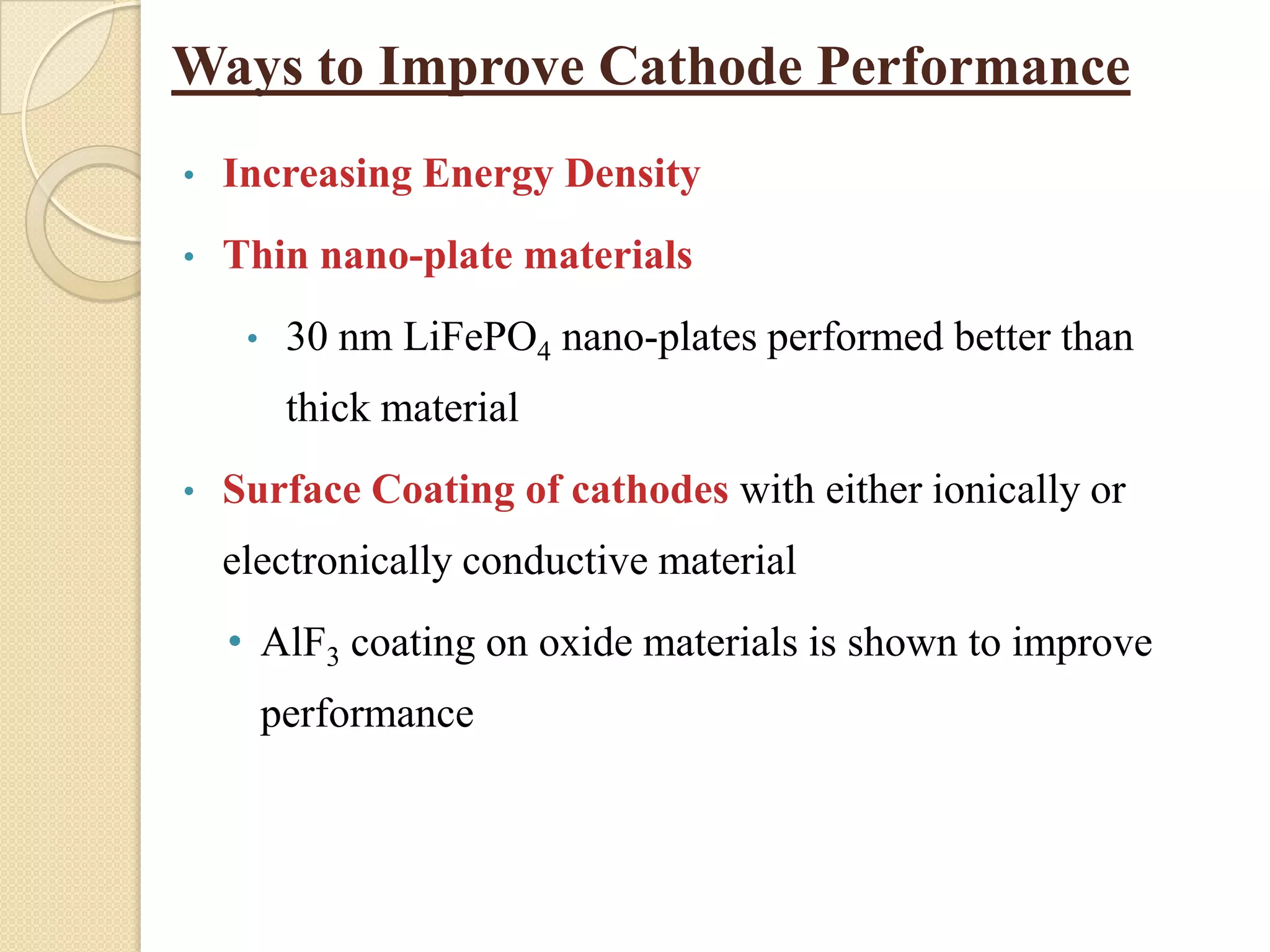
Ways to Improve Cathode Performance
•

Increasing Energy Density

•

Thin nano-plate materials
•

30 nm LiFePO4 nano-plates performed better than
thick material

•

Surface Coating of cathodes with either ionically or

electronically conductive material
• AlF3 coating on oxide materials is shown to improve
performance
Problems in the usage of Cathode materials


Raw material cost



Environmental impact of large-scale cells and mass

production


Production cost of solid-state synthesis using high and long
heating process



Heat generation from the cathode in a fully charged state



Sensitivity of safety for charge cutoff voltages



Low practical capacity of the cathode being half that of a
carbonaceous anode
Methodologies
There are several methods to synthesize the cathode materials of average

particle size and good crystallinity.
Hydrothermal process
Solvothermal process
Supercritical fluid process
Spray pyrolysis process
Conclusions and what does the future hold


In present day common Lithium transition compounds such

as

LiCoO2, LiNiO2, LiMn2O4 and LiFePO4 are used as cathode material in
battery cell production, and they have shown a good performance
during charge and discharge cycling


For the future there are still a number of actions of interest to further
develop the performance of derived LiFePO4/C cathode material



We expect upcoming researches on this new framework will lead to
better cathode materials for lithium-ion batteries
References
•Directed growth of nanoarchitectured LiFePO4 electrode by solvothermal synthesis and their

cathode properties
Authors: Dinesh Rangappa, Koji Sone, Tetsuichi Kudo, Itaru Honma
•Synthesis of LiMn2O4 nanoparticles made by flame spray pyrolysis
Authors: T. J. Patey,ab R. Bu¨ chel,c M. Nakayamab and P. Nova´k*a

•Monodisperse Porous LiFePO4 Microspheres for a High Power Li-Ion Battery Cathode by
Solvothermal process
Authors: Chunwen Sun, Shreyas Rajasekhara, John B. Goodenough,* and Feng Zhou
•Flame spray-pyrolyzed vanadium oxide nanoparticles for lithium battery cathodes
Authors: See-How Ng, Timothy J. Patey et.al
•Rapid one-pot synthesis of LiMPO4 (M = Fe, Mn) colloidal nanocrystals by supercritical
ethanol process
Authors: Dinesh Rangappa,* Koji Sone, Masaki Ichihara, Tetsuichi Kudob and Itaru Honma*
•Recent developments in cathode materials for lithium ion batteries
Author: Jeffrey W. Fergus

more

……. and many
High energy and capacity cathode material for li ion battries

High energy and capacity cathode material for li ion battries

  • 1.
    VISVESVARAYA TECHNOLOGICAL UNIVERSITY centrefor post graduate studies, Bangalore seminar on High Capacity and High Energy Density Cathode Materials for Lithium Ion Battery By Under the Guidance of Natraj USN: 1VW12INT12 Dr. Dinesh R Special officer, VTU CPGSB
  • 2.
    INDEX Introduction to Battery –Timeline Lithium ion battery Cathode materials Advantages and Disadvantages of LI-Ion Batteries Advances in cathode materials Promising cathode materials Methodologies References
  • 3.
    Battery A battery is atransducer that converts chemical energy into electrical energy and vice versa. It contains An anode - source A cathode - sink An electrolyte - the separation of ionic transport and electronic transport Types: Primary and secondary
  • 4.
    Timeline for themajor events in the history of batteries
  • 5.
    Introduction to Li-IonBattery The name of “lithium ion battery” was given by T. Nagaura and K. Tozawa The concept of “lithium ion battery” was firstly introduced by Asahi Kasei Co. Ltd Lithium ion batteries were first proposed by M. S. Whittingham in the 1970’s. Whittingham used TiS2 as the cathode and Lithium metal as the anode. The 1991 first commercial lithium-ion battery was released by Sony in
  • 6.
    Why Li-Ion Battery? Li islightest metal one of the highest standard reduction potentials (-3.0 V)  Theoretical specific capacity of 3860 Ah/kg in comparison with 820 Ah/kg for Zn and 260 Ah/kg for Pb performance is related not only capacity but also to how fast current can be drawn from it: specific energy (Wh/Kg), energy density (Wh/cm3) and power density (W/Kg)
  • 7.
    Schematic representation ofa Lithium-ion cell
  • 8.
    Advantages of Lithium-ionbatteries  POWER – High energy density means greater power in a smaller package. ◦ 160% greater than NiMH ◦ 220% greater than NiCd  HIGHER VOLTAGE – a strong current allows it to power complex mechanical devices.  LONG SHELF-LIFE – only 5% discharge loss per month. 10% for NiMH, 20% for NiCd
  • 9.
    Disadvantages of Lithium-ionbatteries  EXPENSIVE  DELICATE  REGULATIONS
  • 10.
    Cathode materials A cathode isthe electrode of an electrochemical cell at which reduction occurs Common cathode materials of Lithium-ion batteries are the transition metal oxide based compounds such as LiCoO2, LiMn2O4, LiNiO2, LiFePO4
  • 11.
    characteristics of cathodematerials A high discharge voltage A high energy capacity A long cycle life A high power density Light weight Low self-discharge
  • 12.
    Parameters effecting Cathodebehavior Method of Particle preparation size Morphology Temperature
  • 13.
    CATHODE MATERIALS Material Structur Potential vs. e Li/Li+,average v Specific capacity, mAh/g Specific energy, Wh/kg LiCoO2 Layered 3.9 140 546 LiNi0.8Co0.15Al0.05O2 (NCA) Layered 3.8 180-200 680-760 LiNi1/3Co1/3Mn1/3O2 (NMC) Layered 3.8 160-170 610-650 LiMn2O4 Spinel 4.1 100-120 410-492 LiFePO4 olivine 3.45 150-170 518-587
  • 14.
    Ways to ImproveCathode Performance • Increasing Energy Density • Thin nano-plate materials • 30 nm LiFePO4 nano-plates performed better than thick material • Surface Coating of cathodes with either ionically or electronically conductive material • AlF3 coating on oxide materials is shown to improve performance
  • 15.
    Problems in theusage of Cathode materials  Raw material cost  Environmental impact of large-scale cells and mass production  Production cost of solid-state synthesis using high and long heating process  Heat generation from the cathode in a fully charged state  Sensitivity of safety for charge cutoff voltages  Low practical capacity of the cathode being half that of a carbonaceous anode
  • 16.
    Methodologies There are severalmethods to synthesize the cathode materials of average particle size and good crystallinity. Hydrothermal process Solvothermal process Supercritical fluid process Spray pyrolysis process
  • 17.
    Conclusions and whatdoes the future hold  In present day common Lithium transition compounds such as LiCoO2, LiNiO2, LiMn2O4 and LiFePO4 are used as cathode material in battery cell production, and they have shown a good performance during charge and discharge cycling  For the future there are still a number of actions of interest to further develop the performance of derived LiFePO4/C cathode material  We expect upcoming researches on this new framework will lead to better cathode materials for lithium-ion batteries
  • 18.
    References •Directed growth ofnanoarchitectured LiFePO4 electrode by solvothermal synthesis and their cathode properties Authors: Dinesh Rangappa, Koji Sone, Tetsuichi Kudo, Itaru Honma •Synthesis of LiMn2O4 nanoparticles made by flame spray pyrolysis Authors: T. J. Patey,ab R. Bu¨ chel,c M. Nakayamab and P. Nova´k*a •Monodisperse Porous LiFePO4 Microspheres for a High Power Li-Ion Battery Cathode by Solvothermal process Authors: Chunwen Sun, Shreyas Rajasekhara, John B. Goodenough,* and Feng Zhou •Flame spray-pyrolyzed vanadium oxide nanoparticles for lithium battery cathodes Authors: See-How Ng, Timothy J. Patey et.al •Rapid one-pot synthesis of LiMPO4 (M = Fe, Mn) colloidal nanocrystals by supercritical ethanol process Authors: Dinesh Rangappa,* Koji Sone, Masaki Ichihara, Tetsuichi Kudob and Itaru Honma* •Recent developments in cathode materials for lithium ion batteries Author: Jeffrey W. Fergus more ……. and many