NANOMATERIALS FOR
SUPERCAPACITORS
PRESENTED BY: AFFAN SAFEER
REG # 223-FBASE/BSPHY/S12
OUTLINE
 CAPACITOR
 SUPERCAPACITOR
 BASIC CONSTRUCTION OF SUPERCAPCITOR
 WORKING OF SUPERCAPACITOR
 CHARACTERISTICS OF ELECTRODES
 MATERIALS USED FOR ELECTRODE IN SC
 CHARGING OF SUPERCAPACITORS
CAPACITORS
 Capacitor is an electronics component which is used to store charge in the
form of electric potential
 Capacitor is consists of two parallel plate which is separated by a small
distance in few millimeters
 Amount of Charge store in the capacitor is known as capacitance of
capacitors and it’s depend upon dimensions of the capacitors
 The capacitance increase or decrease changing dimensions of the
capacitor and material used in it
SUPERCAPACITORS
 Supercapacitors (SC) are specially designed capacitor which has huge
capacitance value and energy density
 Supercapacitors are belongs to family electrochemical capacitor and it’s
worked on electric double layer (EDL) mechanism
 Supercapacitors can be defined as energy storage device that stores
energy electrostatically by polarizing the electrolytic solution.
BASIC CONSTRUCTION OF SUPERCAPACITORS
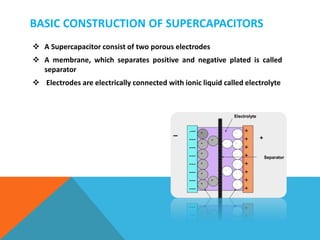
 A Supercapacitor consist of two porous electrodes
 A membrane, which separates positive and negative plated is called
separator
 Electrodes are electrically connected with ionic liquid called electrolyte
WORKING OF SUPERCAPACITORS
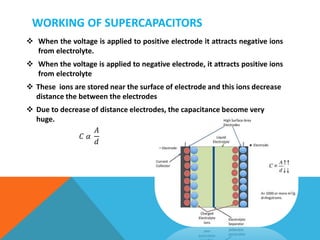
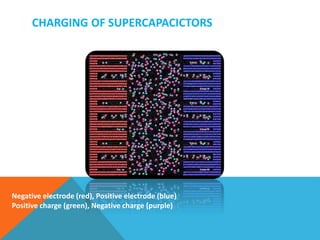
 When the voltage is applied to positive electrode it attracts negative ions
from electrolyte.
 When the voltage is applied to negative electrode, it attracts positive ions
from electrolyte
 These ions are stored near the surface of electrode and this ions decrease
distance the between the electrodes
 Due to decrease of distance electrodes, the capacitance become very
huge.
𝐶 𝛼
𝐴
𝑑
CHARACTERISTICS OF ELECTRODES
 Electrodes used in SC have good conductivity, high temperature stability,
high resistance and high surface areas per unit volume or mass.
 These electrodes made up of pores carbon
 Sizes of pores is in range micropores (less than 2 nm) to mesopores (2-
50 nm)
 Generally the smaller the electrode pores, increases the capacitance and
energy density but decrease the power density
MATERIALS USED FOR ELECTRODE IN SC
 The most commonly used material for electrode in supercapacitors is
Carbon in various forms such as
• Activated carbon
• Carbon aerogel
• Graphite (graphene)
• Carbon nanotubes (CNTs), etc.
MATERIALS USED FOR ELECTRODE IN SC
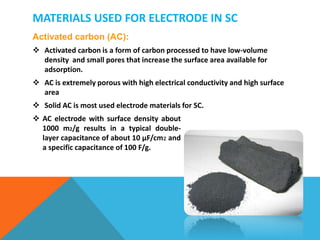
Activated carbon (AC):
 Activated carbon is a form of carbon processed to have low-volume
density and small pores that increase the surface area available for
adsorption.
 AC is extremely porous with high electrical conductivity and high surface
area
 Solid AC is most used electrode materials for SC.
 AC electrode with surface density about
1000 m2/g results in a typical double-
layer capacitance of about 10 μF/cm 𝟐 and
a specific capacitance of 100 F/g.
MATERIALS USED FOR ELECTRODE IN SC
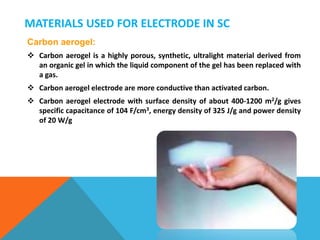
Carbon aerogel:
 Carbon aerogel is a highly porous, synthetic, ultralight material derived from
an organic gel in which the liquid component of the gel has been replaced with
a gas.
 Carbon aerogel electrode are more conductive than activated carbon.
 Carbon aerogel electrode with surface density of about 400-1200 m2/g gives
specific capacitance of 104 F/cm3, energy density of 325 J/g and power density
of 20 W/g
MATERIALS USED FOR ELECTRODE IN SC
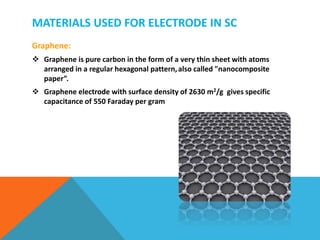
Graphene:
 Graphene is pure carbon in the form of a very thin sheet with atoms
arranged in a regular hexagonal pattern,also called "nanocomposite
paper”.
 Graphene electrode with surface density of 2630 m2/g gives specific
capacitance of 550 Faraday per gram
MATERIALS USED FOR ELECTRODE IN SC
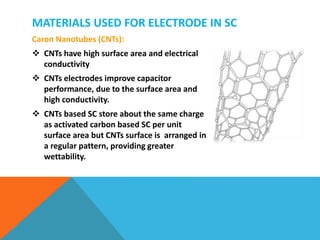
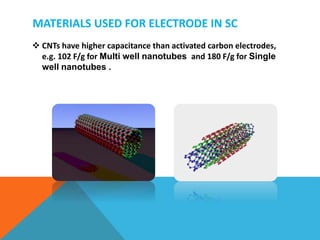
Caron Nanotubes (CNTs):
 CNTs have high surface area and electrical
conductivity
 CNTs electrodes improve capacitor
performance, due to the surface area and
high conductivity.
 CNTs based SC store about the same charge
as activated carbon based SC per unit
surface area but CNTs surface is arranged in
a regular pattern, providing greater
wettability.
MATERIALS USED FOR ELECTRODE IN SC
 CNTs have higher capacitance than activated carbon electrodes,
e.g. 102 F/g for Multi well nanotubes and 180 F/g for Single
well nanotubes .
CHARGING OF SUPERCAPACICTORS
Negative electrode (red), Positive electrode (blue)
Positive charge (green), Negative charge (purple)

Nanomaterials for supercapacitors

  • 1.
    NANOMATERIALS FOR SUPERCAPACITORS PRESENTED BY:AFFAN SAFEER REG # 223-FBASE/BSPHY/S12
  • 2.
    OUTLINE  CAPACITOR  SUPERCAPACITOR BASIC CONSTRUCTION OF SUPERCAPCITOR  WORKING OF SUPERCAPACITOR  CHARACTERISTICS OF ELECTRODES  MATERIALS USED FOR ELECTRODE IN SC  CHARGING OF SUPERCAPACITORS
  • 3.
    CAPACITORS  Capacitor isan electronics component which is used to store charge in the form of electric potential  Capacitor is consists of two parallel plate which is separated by a small distance in few millimeters  Amount of Charge store in the capacitor is known as capacitance of capacitors and it’s depend upon dimensions of the capacitors  The capacitance increase or decrease changing dimensions of the capacitor and material used in it
  • 4.
    SUPERCAPACITORS  Supercapacitors (SC)are specially designed capacitor which has huge capacitance value and energy density  Supercapacitors are belongs to family electrochemical capacitor and it’s worked on electric double layer (EDL) mechanism  Supercapacitors can be defined as energy storage device that stores energy electrostatically by polarizing the electrolytic solution.
  • 5.
    BASIC CONSTRUCTION OFSUPERCAPACITORS  A Supercapacitor consist of two porous electrodes  A membrane, which separates positive and negative plated is called separator  Electrodes are electrically connected with ionic liquid called electrolyte
  • 6.
    WORKING OF SUPERCAPACITORS When the voltage is applied to positive electrode it attracts negative ions from electrolyte.  When the voltage is applied to negative electrode, it attracts positive ions from electrolyte  These ions are stored near the surface of electrode and this ions decrease distance the between the electrodes  Due to decrease of distance electrodes, the capacitance become very huge. 𝐶 𝛼 𝐴 𝑑
  • 7.
    CHARACTERISTICS OF ELECTRODES Electrodes used in SC have good conductivity, high temperature stability, high resistance and high surface areas per unit volume or mass.  These electrodes made up of pores carbon  Sizes of pores is in range micropores (less than 2 nm) to mesopores (2- 50 nm)  Generally the smaller the electrode pores, increases the capacitance and energy density but decrease the power density
  • 8.
    MATERIALS USED FORELECTRODE IN SC  The most commonly used material for electrode in supercapacitors is Carbon in various forms such as • Activated carbon • Carbon aerogel • Graphite (graphene) • Carbon nanotubes (CNTs), etc.
  • 9.
    MATERIALS USED FORELECTRODE IN SC Activated carbon (AC):  Activated carbon is a form of carbon processed to have low-volume density and small pores that increase the surface area available for adsorption.  AC is extremely porous with high electrical conductivity and high surface area  Solid AC is most used electrode materials for SC.  AC electrode with surface density about 1000 m2/g results in a typical double- layer capacitance of about 10 μF/cm 𝟐 and a specific capacitance of 100 F/g.
  • 10.
    MATERIALS USED FORELECTRODE IN SC Carbon aerogel:  Carbon aerogel is a highly porous, synthetic, ultralight material derived from an organic gel in which the liquid component of the gel has been replaced with a gas.  Carbon aerogel electrode are more conductive than activated carbon.  Carbon aerogel electrode with surface density of about 400-1200 m2/g gives specific capacitance of 104 F/cm3, energy density of 325 J/g and power density of 20 W/g
  • 11.
    MATERIALS USED FORELECTRODE IN SC Graphene:  Graphene is pure carbon in the form of a very thin sheet with atoms arranged in a regular hexagonal pattern,also called "nanocomposite paper”.  Graphene electrode with surface density of 2630 m2/g gives specific capacitance of 550 Faraday per gram
  • 12.
    MATERIALS USED FORELECTRODE IN SC Caron Nanotubes (CNTs):  CNTs have high surface area and electrical conductivity  CNTs electrodes improve capacitor performance, due to the surface area and high conductivity.  CNTs based SC store about the same charge as activated carbon based SC per unit surface area but CNTs surface is arranged in a regular pattern, providing greater wettability.
  • 13.
    MATERIALS USED FORELECTRODE IN SC  CNTs have higher capacitance than activated carbon electrodes, e.g. 102 F/g for Multi well nanotubes and 180 F/g for Single well nanotubes .
  • 14.
    CHARGING OF SUPERCAPACICTORS Negativeelectrode (red), Positive electrode (blue) Positive charge (green), Negative charge (purple)

Editor's Notes

  • #6 Separators have to physically separate the two electrodes to prevent a short circuit by direct contact. It can be very thin (a few hundredths of a millimeter) and must be very porous to the conducting ions to minimize ESR.
  • #8  1) Applications with high peak currents require larger pores and low internal losses, while applications requiring high energy density need small pores.
  • #10 ࡐ Activated carbon, also called activated charcoal, activated coal, or carbon activatus, ࡐ A common approximation is that 1 gram has a surface area of roughly 1,000 to 3,000 square meters. ࡐ Solid electrodes are produced from activated carbon powder pressed into the desired shape, forming a block with a wide distribution of pore sizes
  • #11 ࡐ Carbon aerogels are composed of particles with sizes in the nanometer range ࡐ A gel is a solid, jelly-like material that can have properties ranging from soft and weak to hard and tough ࡐ Pyrolysis is a thermochemical decomposition of organic material at elevated temperatures in the absence of oxygen ࡐ Resorcinol (or resorcin) is a dihydroxybenzene. ࡐ carbon aerogel electrode are thin with uniform pore sizes ࡐ Formaldehyde is an organic compound with the formula CH2O or HCHO. It is the simplest aldehyde and is also known by its systematic name methanal.