
Lithium Ion Batteries
By: Z.Mohammadpour
IN THE NAME OF GOD
1

 Lithium-Ion batteries were
first proposed in the 1970s,
but the technology to
successfully create them
wasn’t invented until the
mid 1980s. The first
commercial Lithium-Ion
(Li-ion) battery was
launched by Sony in late
1991.
2

3
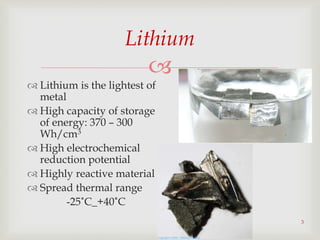
Lithium
 Lithium is the lightest of
metal
 High capacity of storage
of energy: 370 – 300
Wh/cm3
 High electrochemical
reduction potential
 Highly reactive material
 Spread thermal range
-25˚C_+40˚C

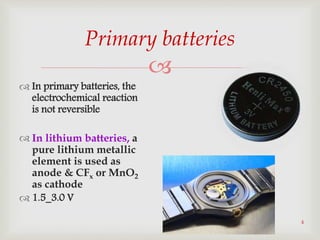
Primary batteries
 In primary batteries, the
electrochemical reaction
is not reversible
 In lithium batteries, a
pure lithium metallic
element is used as
anode & CFx or MnO2
as cathode
 1.5_3.0 V
4

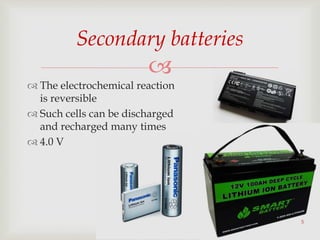
 The electrochemical reaction
is reversible
 Such cells can be discharged
and recharged many times
 4.0 V
Secondary batteries
5
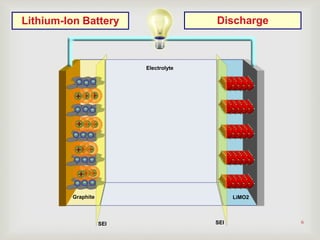
Electrolyte
LiMO2Graphite
SEI SEI
Lithium-Ion Battery Discharge
6
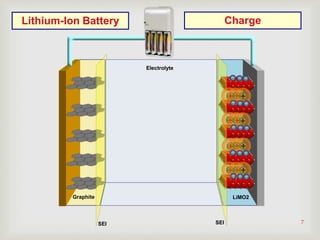
Electrolyte
LiMO2Graphite
SEI SEI
Lithium-Ion Battery Charge
7
8
9
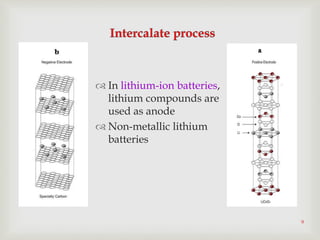
 In lithium-ion batteries,
lithium compounds are
used as anode
 Non-metallic lithium
batteries

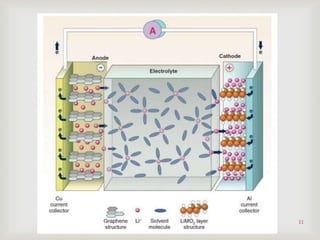
Intercalate process
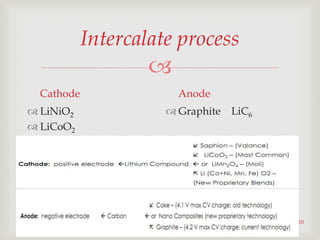
Cathode
 LiNiO2
 LiCoO2
Anode
 Graphite LiC6
10
11

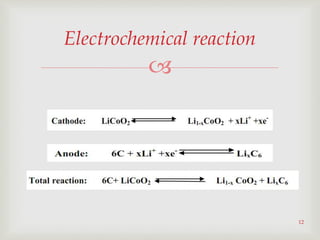
Electrochemical reaction
12

13
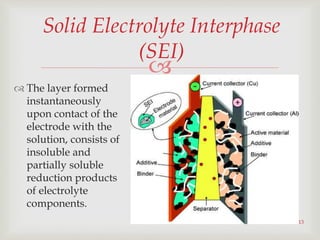
Solid Electrolyte Interphase
(SEI)
 The layer formed
instantaneously
upon contact of the
electrode with the
solution, consists of
insoluble and
partially soluble
reduction products
of electrolyte
components.

14
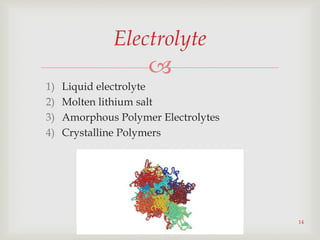
Electrolyte
1) Liquid electrolyte
2) Molten lithium salt
3) Amorphous Polymer Electrolytes
4) Crystalline Polymers

15
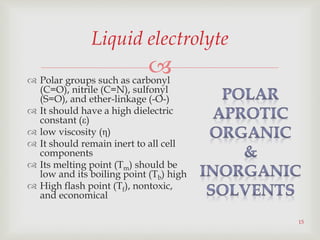
Liquid electrolyte
 Polar groups such as carbonyl
(C=O), nitrile (C=N), sulfonyl
(S=O), and ether-linkage (-O-)
 It should have a high dielectric
constant (ε)
 low viscosity (η)
 It should remain inert to all cell
components
 Its melting point (Tm) should be
low and its boiling point (Tb) high
 High flash point (Tf), nontoxic,
and economical

16
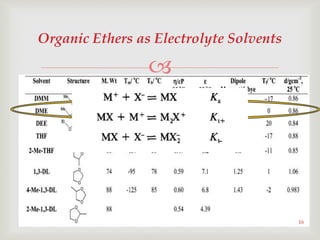
Organic Ethers as Electrolyte Solvents

17
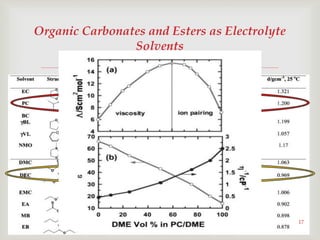
Organic Carbonates and Esters as Electrolyte
Solvents

18
Lithium salt
 Complete dissociation high conductivity
 Oxidative/reductive stability
 Thermal stability (high Tdecomposition)
 Chemical stability towards all cell components

Electrochemical Stability of Electrolyte
Solvents:
19

20
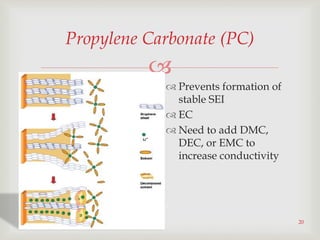
Propylene Carbonate (PC)
 Prevents formation of
stable SEI
 EC
 Need to add DMC,
DEC, or EMC to
increase conductivity

21
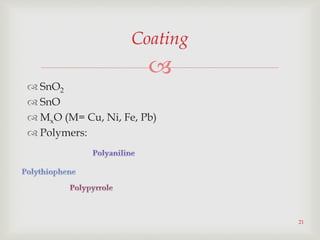
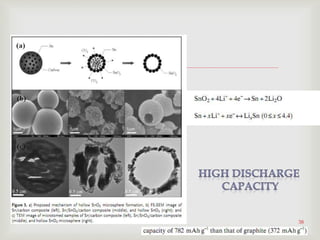
Coating
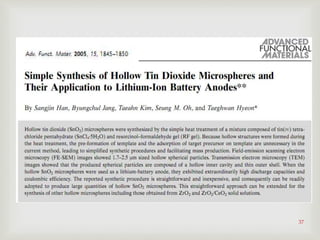
 SnO2
 SnO
 MxO (M= Cu, Ni, Fe, Pb)
 Polymers:

22
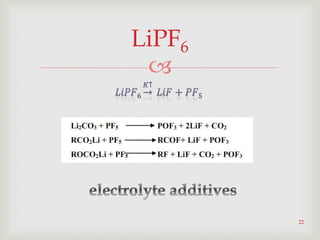
LiPF6

23
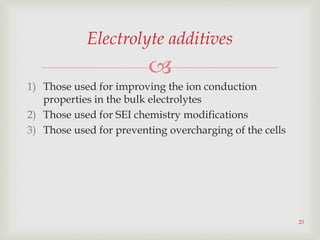
Electrolyte additives
1) Those used for improving the ion conduction
properties in the bulk electrolytes
2) Those used for SEI chemistry modifications
3) Those used for preventing overcharging of the cells

Bulk properties
24

SEI Modification
25

26
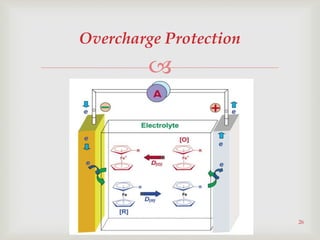
Overcharge Protection
27
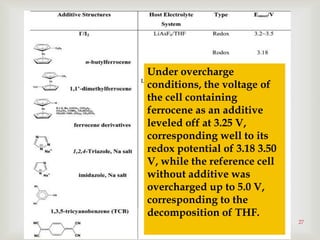
Under overcharge
conditions, the voltage of
the cell containing
ferrocene as an additive
leveled off at 3.25 V,
corresponding well to its
redox potential of 3.18 3.50
V, while the reference cell
without additive was
overcharged up to 5.0 V,
corresponding to the
decomposition of THF.

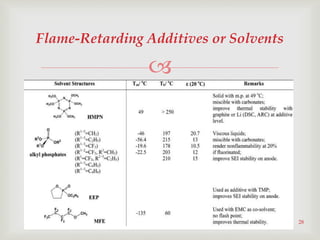
Flame-Retarding Additives or Solvents
28

29
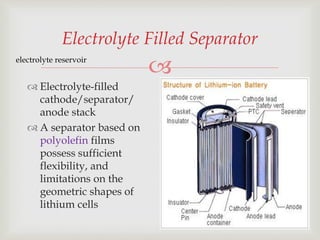
Electrolyte Filled Separator
 Electrolyte-filled
cathode/separator/
anode stack
 A separator based on
polyolefin films
possess sufficient
flexibility, and
limitations on the
geometric shapes of
lithium cells
electrolyte reservoir

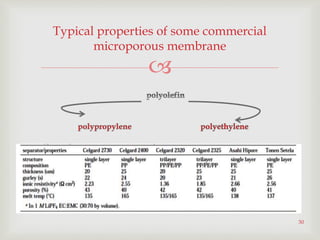
Typical properties of some commercial
microporous membrane
30

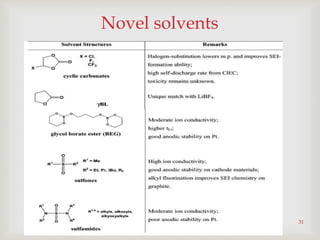
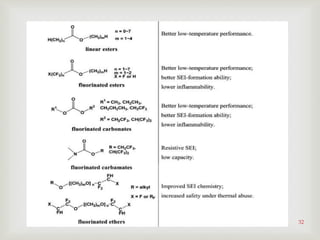
Novel solvents
31

32

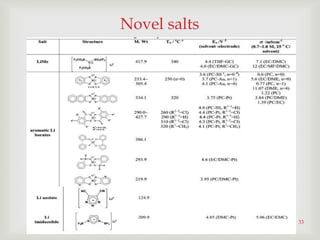
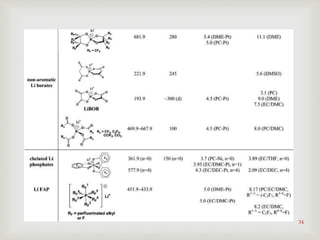
Novel salts
33
34

35
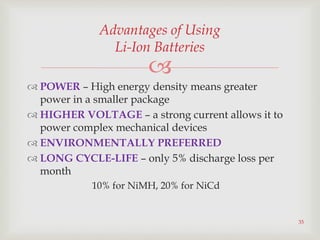
Advantages of Using
Li-Ion Batteries
 POWER – High energy density means greater
power in a smaller package
 HIGHER VOLTAGE – a strong current allows it to
power complex mechanical devices
 ENVIRONMENTALLY PREFERRED
 LONG CYCLE-LIFE – only 5% discharge loss per
month
10% for NiMH, 20% for NiCd

36
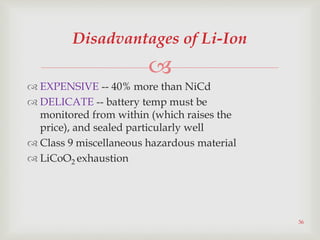
Disadvantages of Li-Ion
 EXPENSIVE -- 40% more than NiCd
 DELICATE -- battery temp must be
monitored from within (which raises the
price), and sealed particularly well
 Class 9 miscellaneous hazardous material
 LiCoO2 exhaustion

37

38

39

40
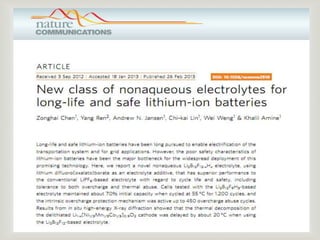
 Li2B12F12-xHx-based electrolytes possess several
advantages over conventional LiPF6-based
electrolyte.
 Graphite/Li1.1[Ni1/3Mn1/3Co1/3]0.9O2 cells using
Li2B12F9H3-based electrolyte, using lithium
difluoro(oxalato)borate as the electrolyte additive

 Kang Xu, Chem. Rev. 2004, 104, 4303−4417
 Zonghai Chen,
 Y. P. Wu, C. Wan, C. Jiang and S. B. Fang, Chemical Industry
Press, Beijing, 2002.
 John R. Owen. Chemical Society Reviews, 1997, volume 26,
259.
 Mohammad Eftekhari, journal of knowledge of science, 16
(1389).
 NATURE COMMUNICATIONS | DOI: 10.1038/ncomms2518
41
References:

42

Lithium ion batteries