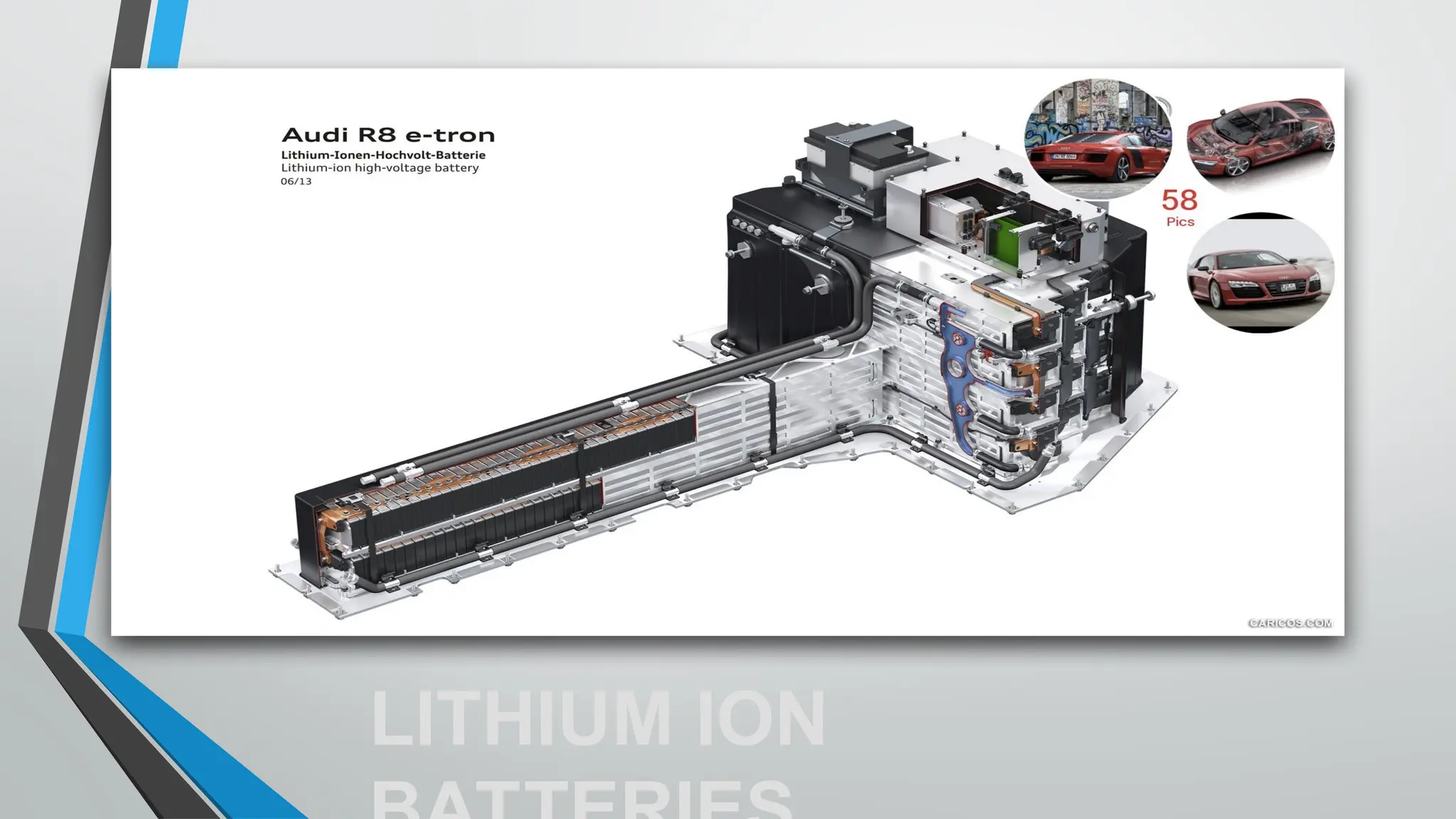
LITHIUM ION
Whatexactlyis Lithium-Ion
Battery?
Batteries definition:
Two or more electrochemical cells, electrically interconnected, each of which
contains two electrodes and an electrolyte. The redox (oxidation-reduction)
reactions that occur at these electrodes convert electrochemical energy into
electrical energy.
In everyday usage, 'battery' is also used to refer to a single cell. The solid-state
batteries are the batteries in which the electrolyte is in solid state, which is
responsible for the conduction of ions from one electrode to other electrode.
In 1800, Alessandro Volta invented the first modern battery.
Typesof
Batteries
Basically, batteries can be classified as two types, primary batteries and
secondary batteries.
Primary batteries
In primary batteries, the electrochemical reaction is not reversible.
During discharging the chemicalcompounds are permanently changed and
electrical energy is released until the original compounds are completely
exhausted.
Thus the cells can be used only once.
Secondary
In secondary batteries, the electrochemical reaction is reversible and the original
chemical compounds can be reconstituted by the application of an electrical
potential between the electrodes injecting energy into the cell.
Such cells can be discharged and recharged many times.
Lithium
Battery
Lithium is the lightest of metals and it can float on water.
The electrochemical properties of lithium are excellent and it is also a highly
reactive material.
These properties gives Lithium the potential to achieve very high energy and
power densities in high-density battery applications such as automotive and
standby power.
Lithium batteries are primary batteries in which lithiun metal (or) lithium
compound acts as a Anode. A lithuim cell can produce voltage from 1.5 V to
about 3 V based
on the types of materials used.
Typesof Lithium based
Batteries
There are two types of lithium-based batteries available.
1.Lithium batteries
2.Lithium-ion batteries
In lithium batteries, a pure lithium metallic element is used as anode. These types
of batteries are not rechargeable.
In lithium-ion batteries, lithium compounds are used as anode.
These batteries are known as re-chargeable batteries. Therefore, Lithium ion
batteries are considered as best than pure Lithium based batteries.
Lithium-Ion
Battery
Li-ion batteries are secondary batteries.
•The battery consists of a anode of Lithium, dissolved as ions, into a carbon.
•The cathode material is made up from Lithium liberating compounds, typically the
three electro-active oxide materials,
• Lithium Cobalt-oxide (LiCoO2 )
• Lithium Manganese-oxide (LiMn2 O4 )
• Lithium Nickel-oxide (LiNiO2)
Lithium-ion batteries are common in home electronics. They are one of the most
popular types of rechargeable batteries for portable electronics, with a high energy
density, tiny memory effect and low self-discharge.
Principle of
Working
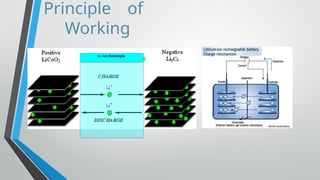
During the charge and discharge processes, lithium ions are inserted or
extracted from interstitial space between atomic layers within the active material
of the battery.
Simply, the Li-ion is transfers between anode and cathode through lithium
Electrolyte.
Since neither the anode nor the cathode materials essentially change, the
operation is safer than that of a Lithium metal battery.
Principle of
Working
Li- ion Electrolyte
Construction of Li-ion
Battery
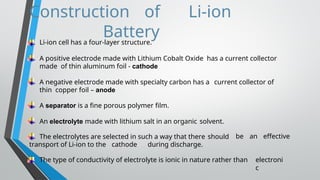
Li-ion cell has a four-layer structure.
A positive electrode made with Lithium Cobalt Oxide has a current collector
made of thin aluminum foil - cathode
A negative electrode made with specialty carbon has a current collector of
thin copper foil – anode
A separator is a fine porous polymer film.
An electrolyte made with lithium salt in an organic solvent.
be an effective
The electrolytes are selected in such a way that there should
transport of Li-ion to the cathode during discharge.
The type of conductivity of electrolyte is ionic in nature rather than electroni
c
Working of Li-ion
Batteries
The traditional batteries are based on galvanic action but Lithium ion secondary
battery depends on an "intercalation" mechanism.
This involves the insertion of lithium ions into the crystalline lattice of the host
electrode without changing its crystal structure.
These electrodes have two key properties. One is the open crystal structure, which
allow the insertion or extraction of lithium ions and the second is the ability to accept
compensating electrons at the same time. Such electrodes are called intercalation
hosts.
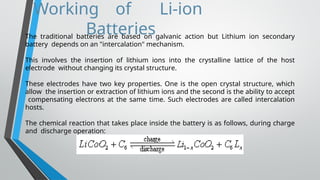
The chemical reaction that takes place inside the battery is as follows, during charge
and discharge operation:
Working of Li-ion
Batteries
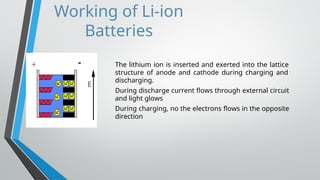
The lithium ion is inserted and exerted into the lattice
structure of anode and cathode during charging and
discharging.
During discharge current flows through external circuit
and light glows
During charging, no the electrons flows in the opposite
direction
Working of Li-Ion
Batteries
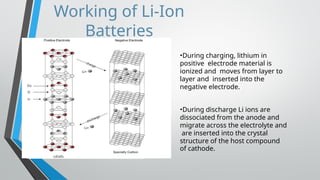
•During charging, lithium in
positive electrode material is
ionized and moves from layer to
layer and inserted into the
negative electrode.
•During discharge Li ions are
dissociated from the anode and
migrate across the electrolyte and
are inserted into the crystal
structure of the host compound
of cathode.
Working of Li-ion
batteries
circui
t
back
and
are
and
forth
•At the same time the compensating electrons travel in the
external accepted by the host to balance the reaction.
•The process is completely reversible. Thus the lithium ionspass
between the electrodes during charging and discharging.
•Because of this reason, the lithium ion batteries are called ‘Rocking chair, ‘Swing’
cells.
•A typical Li-ion battery can store 150 watt-hours of electricity in 1 kilogram of
battery as compared to lead acid batteries can sore only 25 watt-hours of
electricity in one kilogram
•All rechargeable batteries suffer from self-discharge when stored or not in use.
•Normally, there will be a three to five percent of self-discharge in lithium ion
batteries for 30 days of storage.
Advantages of Li-ion
Batteries
• They have high energy density than other rechargeable batteries
• They are less weight
• They produce high voltage out about 4 V as compared with other
batteries.
• They have improved safety, i.e. more resistance to overcharge
• No liquid electrolyte means they are immune from leaking.
• Fast charge and discharge rate
Disadvantages
•They are expensive
•They are not available in standard cell
types.
Applications of Li-ion
Batteries
•The Li-ion batteries are used in cameras, calculators, smart phones and most of the
consumer electronics device.
•They are used in cardiac pacemakers and other implantable device.
•Electric vehicles: Because of their light weight Li-ion batteries are used for
propelling a wide range of electric vehicles such as aircraft, electric cars, Pedelecs,
hybrid vehicles, advanced electric wheelchairs, radio-controlled models, model
aircraft and the Mars Curiosity rover.
•Power tools: Li-ion batteries are used in tools such as cordless drills, sanders, saws
and a variety of garden equipment including whipper-snippers and hedge trimmers.
Future : Tesla
Motors
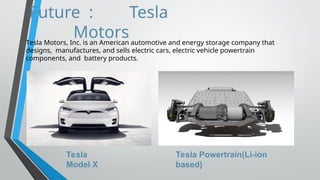
Tesla Motors, Inc. is an American automotive and energy storage company that
designs, manufactures, and sells electric cars, electric vehicle powertrain
components, and battery products.
Tesla
Model X
Tesla Powertrain(Li-ion
based)
Future : Tesla
Motors
• Tesla Motors is named after electrical engineer and physicist Nikola Tesla. The Tesla
Roadster uses an AC motor descended directly from Tesla's original 1882 design.
• The Tesla Roadster, the company's first vehicle, was the first production automobile to
use lithium-ion battery cells and the first production EV with a range greater than 200
miles (320 km) per charge.
• Between 2008 and March 2012, Tesla sold more than 2,250 Roadsters in 31 countries.
Tesla stopped taking orders for the Roadster in the U.S. market in August 2011.
• In December 2012, Tesla employed almost 3,000 full-time employees. By December 31,
2015, this number had grown to 13,058 employees.
• Tesla unveiled the Tesla Model S all-electric sedan on March 26, 2009, and began
• Deliveries in June 2012. First deliveries of the Model X began in September 2015. Global
sales of the Model S passed the 100,000 unit milestone in December 2015, three years
and a half after its introduction.
• The Tesla Model 3, the company's first model aimed for the mass market, was unveiled
in March 2016. One week after the unveiling event, global reservations totaled over
325,000 units, representing potential sales of over US $14 billion.
• “it is definitely true that the fundamental enabling technology for
electric cars is lithium-ion as a cell chemistry technology. In the
absence of that, I don't think it's possible to make an electric car
that is competitive with a gasoline car.”
-Elon Musk, CEO, Tesla Motors and SpaceX
Thank
You

LITHIUM ION BATTERIES UNIT-III-CLASS 2.ppt

  • 1.
  • 2.
    Whatexactlyis Lithium-Ion Battery? Batteries definition: Twoor more electrochemical cells, electrically interconnected, each of which contains two electrodes and an electrolyte. The redox (oxidation-reduction) reactions that occur at these electrodes convert electrochemical energy into electrical energy. In everyday usage, 'battery' is also used to refer to a single cell. The solid-state batteries are the batteries in which the electrolyte is in solid state, which is responsible for the conduction of ions from one electrode to other electrode. In 1800, Alessandro Volta invented the first modern battery.
  • 3.
    Typesof Batteries Basically, batteries canbe classified as two types, primary batteries and secondary batteries. Primary batteries In primary batteries, the electrochemical reaction is not reversible. During discharging the chemicalcompounds are permanently changed and electrical energy is released until the original compounds are completely exhausted. Thus the cells can be used only once. Secondary In secondary batteries, the electrochemical reaction is reversible and the original chemical compounds can be reconstituted by the application of an electrical potential between the electrodes injecting energy into the cell. Such cells can be discharged and recharged many times.
  • 4.
    Lithium Battery Lithium is thelightest of metals and it can float on water. The electrochemical properties of lithium are excellent and it is also a highly reactive material. These properties gives Lithium the potential to achieve very high energy and power densities in high-density battery applications such as automotive and standby power. Lithium batteries are primary batteries in which lithiun metal (or) lithium compound acts as a Anode. A lithuim cell can produce voltage from 1.5 V to about 3 V based on the types of materials used.
  • 5.
    Typesof Lithium based Batteries Thereare two types of lithium-based batteries available. 1.Lithium batteries 2.Lithium-ion batteries In lithium batteries, a pure lithium metallic element is used as anode. These types of batteries are not rechargeable. In lithium-ion batteries, lithium compounds are used as anode. These batteries are known as re-chargeable batteries. Therefore, Lithium ion batteries are considered as best than pure Lithium based batteries.
  • 6.
    Lithium-Ion Battery Li-ion batteries aresecondary batteries. •The battery consists of a anode of Lithium, dissolved as ions, into a carbon. •The cathode material is made up from Lithium liberating compounds, typically the three electro-active oxide materials, • Lithium Cobalt-oxide (LiCoO2 ) • Lithium Manganese-oxide (LiMn2 O4 ) • Lithium Nickel-oxide (LiNiO2) Lithium-ion batteries are common in home electronics. They are one of the most popular types of rechargeable batteries for portable electronics, with a high energy density, tiny memory effect and low self-discharge.
  • 7.
    Principle of Working During thecharge and discharge processes, lithium ions are inserted or extracted from interstitial space between atomic layers within the active material of the battery. Simply, the Li-ion is transfers between anode and cathode through lithium Electrolyte. Since neither the anode nor the cathode materials essentially change, the operation is safer than that of a Lithium metal battery.
  • 8.
  • 9.
    Construction of Li-ion Battery Li-ioncell has a four-layer structure. A positive electrode made with Lithium Cobalt Oxide has a current collector made of thin aluminum foil - cathode A negative electrode made with specialty carbon has a current collector of thin copper foil – anode A separator is a fine porous polymer film. An electrolyte made with lithium salt in an organic solvent. be an effective The electrolytes are selected in such a way that there should transport of Li-ion to the cathode during discharge. The type of conductivity of electrolyte is ionic in nature rather than electroni c
  • 10.
    Working of Li-ion Batteries Thetraditional batteries are based on galvanic action but Lithium ion secondary battery depends on an "intercalation" mechanism. This involves the insertion of lithium ions into the crystalline lattice of the host electrode without changing its crystal structure. These electrodes have two key properties. One is the open crystal structure, which allow the insertion or extraction of lithium ions and the second is the ability to accept compensating electrons at the same time. Such electrodes are called intercalation hosts. The chemical reaction that takes place inside the battery is as follows, during charge and discharge operation:
  • 11.
    Working of Li-ion Batteries Thelithium ion is inserted and exerted into the lattice structure of anode and cathode during charging and discharging. During discharge current flows through external circuit and light glows During charging, no the electrons flows in the opposite direction
  • 12.
    Working of Li-Ion Batteries •Duringcharging, lithium in positive electrode material is ionized and moves from layer to layer and inserted into the negative electrode. •During discharge Li ions are dissociated from the anode and migrate across the electrolyte and are inserted into the crystal structure of the host compound of cathode.
  • 13.
    Working of Li-ion batteries circui t back and are and forth •Atthe same time the compensating electrons travel in the external accepted by the host to balance the reaction. •The process is completely reversible. Thus the lithium ionspass between the electrodes during charging and discharging. •Because of this reason, the lithium ion batteries are called ‘Rocking chair, ‘Swing’ cells. •A typical Li-ion battery can store 150 watt-hours of electricity in 1 kilogram of battery as compared to lead acid batteries can sore only 25 watt-hours of electricity in one kilogram •All rechargeable batteries suffer from self-discharge when stored or not in use. •Normally, there will be a three to five percent of self-discharge in lithium ion batteries for 30 days of storage.
  • 14.
    Advantages of Li-ion Batteries •They have high energy density than other rechargeable batteries • They are less weight • They produce high voltage out about 4 V as compared with other batteries. • They have improved safety, i.e. more resistance to overcharge • No liquid electrolyte means they are immune from leaking. • Fast charge and discharge rate Disadvantages •They are expensive •They are not available in standard cell types.
  • 15.
    Applications of Li-ion Batteries •TheLi-ion batteries are used in cameras, calculators, smart phones and most of the consumer electronics device. •They are used in cardiac pacemakers and other implantable device. •Electric vehicles: Because of their light weight Li-ion batteries are used for propelling a wide range of electric vehicles such as aircraft, electric cars, Pedelecs, hybrid vehicles, advanced electric wheelchairs, radio-controlled models, model aircraft and the Mars Curiosity rover. •Power tools: Li-ion batteries are used in tools such as cordless drills, sanders, saws and a variety of garden equipment including whipper-snippers and hedge trimmers.
  • 16.
    Future : Tesla Motors TeslaMotors, Inc. is an American automotive and energy storage company that designs, manufactures, and sells electric cars, electric vehicle powertrain components, and battery products. Tesla Model X Tesla Powertrain(Li-ion based)
  • 17.
    Future : Tesla Motors •Tesla Motors is named after electrical engineer and physicist Nikola Tesla. The Tesla Roadster uses an AC motor descended directly from Tesla's original 1882 design. • The Tesla Roadster, the company's first vehicle, was the first production automobile to use lithium-ion battery cells and the first production EV with a range greater than 200 miles (320 km) per charge. • Between 2008 and March 2012, Tesla sold more than 2,250 Roadsters in 31 countries. Tesla stopped taking orders for the Roadster in the U.S. market in August 2011. • In December 2012, Tesla employed almost 3,000 full-time employees. By December 31, 2015, this number had grown to 13,058 employees. • Tesla unveiled the Tesla Model S all-electric sedan on March 26, 2009, and began • Deliveries in June 2012. First deliveries of the Model X began in September 2015. Global sales of the Model S passed the 100,000 unit milestone in December 2015, three years and a half after its introduction. • The Tesla Model 3, the company's first model aimed for the mass market, was unveiled in March 2016. One week after the unveiling event, global reservations totaled over 325,000 units, representing potential sales of over US $14 billion.
  • 18.
    • “it isdefinitely true that the fundamental enabling technology for electric cars is lithium-ion as a cell chemistry technology. In the absence of that, I don't think it's possible to make an electric car that is competitive with a gasoline car.” -Elon Musk, CEO, Tesla Motors and SpaceX Thank You