UNIT-5
Mohammad Asif Iqbal
Assistant Professor,
Deptt of ECE,
JETGI, Barabanki
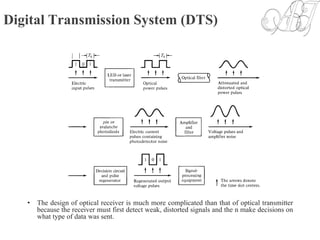
Digital Transmission System (DTS)
• The design of optical receiver is much more complicated than that of optical transmitter
because the receiver must first detect weak, distorted signals and the n make decisions on
what type of data was sent.
Error Sources in DTS
!
)(
)(
0
n
e
NnP
E
h
dttP
h
N
N
n
r


 





is the average number of electron-hole pairs in photodetector,
is the detector quantum efficiency and E is energy received in a time
interval and is photon energy, where is the probability
that n electrons are emitted in an interval .
N

 h )(nPr

[7-
1]
[7-2]
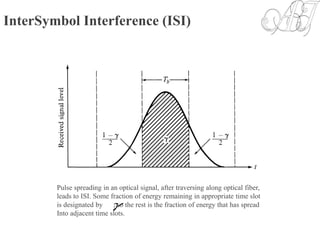
InterSymbol Interference (ISI)
Pulse spreading in an optical signal, after traversing along optical fiber,
leads to ISI. Some fraction of energy remaining in appropriate time slot
is designated by , so the rest is the fraction of energy that has spread
Into adjacent time slots.

Receiver Configuration
The binary digital pulse train incident on the photodetector can be written in the
following form:
t.allforpositiveiswhichshapepulsereceivedtheis)(and
digitmessageththeofparameteramplitudeanisperiod,bitiswhere
)()(
th
nbT
nTthbtP
p
nb
n
bpn


 [7-3]
• In writing down eq. [7-3], we assume the digital pulses with amplitude V
represents bit 1 and 0 represents bit 0. Thus can take two values
corresponding to each binary data. By normalizing the input pulse to
the photodiode to have unit area
represents the energy in the nth pulse.
the mean output current from the photodiode at time t resulting from pulse
train given in eq. [7-3] is (neglecting the DC components arising from dark
current noise):
nb
)(thp



1)( dtthp
nb




n
bpno nTthbMtMP
h
q
ti )()()(


[7-4]
Bit Error Rate (BER)
• Probability of Error= probability that the output voltage is
less than the threshold when a 1 is sent + probability that the
output voltage is more than the threshold when a 0 has been
sent.
b
e
t
e
TB
Bt
N
N
N
t
t
/1
duringedtransmittpulsesof#total
intervalmecertain tiaovererrorof#
ErrorofyProbabilitBER



[7-5]
Probability distributions for received logical 0 and 1 signal pulses.
the different widths of the two distributions are caused by various signal
distortion effects.
thv
edtransmitt0if,exceedstageoutput volequalizerthat theprobablity)0|()(
edtransmitt1if,thanlessistageoutput volequalizerthat theprobablity)1|()(
0
1
vdyypvP
vdyypvP
v
v






[7-6]
• Where are the probabilities that the transmitter sends 0 and 1
respectively.
• For an unbiased transmitter





th
th
v
v
ththe
dyypqdyypq
vPqvPqP
)1|()1|(
)()(
01
0011
[7-7]
01 and qq
5.010  qq
10 1 qq 
Gaussian Distribution
dv
bv
dyypvP
dv
bv
dyypvP
thth
thth
vv
th
v
on
v
th









 






 

2
off
2
off
off
0
2
on
2
on
1
2
)(
exp
2
1
)0|()(
2
)(
exp
2
1
)1|()(


mea
n
mea
n
[7-8]
• If we assume that the probabilities of 0 and 1 pulses are equally likely, then
using eq [7-7] and [7-8] , BER becomes:
Q
Q
Q
dxxQP
Q
e
/2)exp(-
2
1
)
2
(erf1
2
1
)exp(
1
)(BER
2
2/
2









 

[7-9]
dyyx
vbbv
Q
x
thth
 




0
2
on
on
off
off
)exp(
2
)(erf


[7-9]
[7-10]
Approximation of error function
Variation of BER vs Q,
according to eq [7-9].
Special Case
In special case when:
Vbb  onoffonoff ,0&
From eq [7-29], we have: 2/Vvth 
Eq [7-8] becomes:






 )
22
(erf1
2
1
)(


V
Pe
[7-11]
Study example 7-1 pp. 286 of the textbook.
ratio.noise-rms-to-signalpeakis

V
Quantum Limit
• Minimum received power required for a specific BER assuming that the
photodetector has a 100% quantum efficiency and zero dark current. For
such ideal photo-receiver,
• Where is the average number of electron-hole pairs, when the incident
optical pulse energy is E and given by eq [7-1] with 100% quantum
efficiency .
• Eq [7-12] can be derived from eq [7-2] where n=0.
• Note that, in practice the sensitivity of receivers is around 20 dB higher than
quantum limit because of various nonlinear distortions and noise effects in
the transmission link.
)exp()0(1 NPPe  [7-12]
N
)1( 
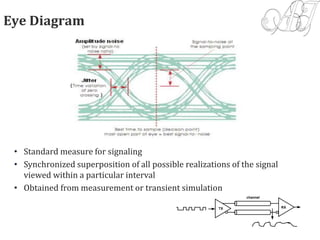
Eye Diagram
• Standard measure for signaling
• Synchronized superposition of all possible realizations of the signal
viewed within a particular interval
• Obtained from measurement or transient simulation
TX RX
channel
Eye Diagram (cont’d)
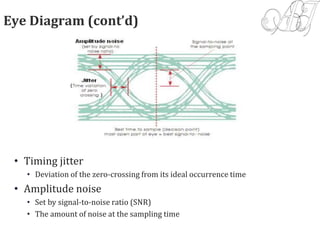
• Timing jitter
• Deviation of the zero-crossing from its ideal occurrence time
• Amplitude noise
• Set by signal-to-noise ratio (SNR)
• The amount of noise at the sampling time
Existing Work
• Eye diagram analysis
• Analytical eye-diagram model [Hashimoto, CICC’07]
• Only consider attenuation and reflection
• Assume perfect match at transmitter end
• Jitter and noise analysis
• Data-dependent jitter model [Buckwalter, MicrowaveSymp’04][Ou’DTS’04]
• Only consider two taps of channel response
• Enumerate all possible input combinations: [00, 01, 10, 11]
• Clock jitter model [Hanumolu’04][Tao’99]
• Clock-data recovery (CDR), DLL, PLL
• Amplitude noise model [Hanumolu’05]
• No general framework to model the jitter and noise and find
out what is the worst possible scenario
Eye Mask
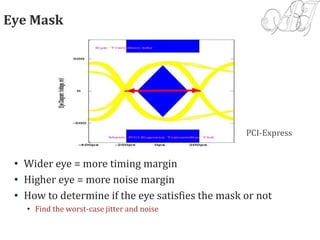
• Wider eye = more timing margin
• Higher eye = more noise margin
• How to determine if the eye satisfies the mask or not
• Find the worst-case jitter and noise
PCI-Express
Contribution
• Formula-based model for jitter and noise
• Use differential signaling as an example
• Utilize multi-conductor transmission line equations
• Can be extended to equalized link
• Consider the pre-emphasis filter at the transmitter end
• Worst-case jitter and noise
• Directly find the worst-case input pattern
• Use efficient mathematical programming algorithms
• No need for time-consuming simulation
• Runtime is not determined by the pattern length
• Adequate length can be used according to channel response
Motivations
• Higher Spectral Efficiency – QPSK / multi-level QAMs
• Higher Data Rates – 40Gbit/s, 100Gbit/s, and even higher
• Higher Receiving Sensitivity
Recent Coherent Optical Communication
• Coherent detection based on DSP
• Local oscillator (LO) laser
• Polarization diversity 90° optical hybrid
• Balanced detectors
• High speed analog to digital convertor (ADC)
• High speed digital signal processing (DSP)
Coherent Optical
Coherent Optical Communications
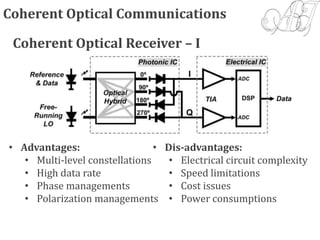
Coherent Optical Receiver – I
• Advantages:
• Multi-level constellations
• High data rate
• Phase managements
• Polarization managements
• Dis-advantages:
• Electrical circuit complexity
• Speed limitations
• Cost issues
• Power consumptions
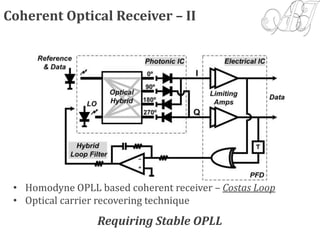
Coherent Optical Receiver – II
• Homodyne OPLL based coherent receiver – Costas Loop
• Optical carrier recovering technique
Requiring Stable OPLL
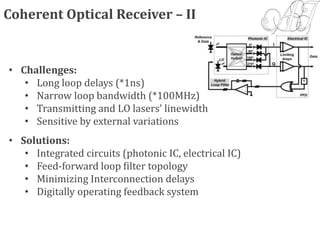
Coherent Optical Receiver – II
• Challenges:
• Long loop delays (*1ns)
• Narrow loop bandwidth (*100MHz)
• Transmitting and LO lasers’ linewidth
• Sensitive by external variations
• Solutions:
• Integrated circuits (photonic IC, electrical IC)
• Feed-forward loop filter topology
• Minimizing Interconnection delays
• Digitally operating feedback system
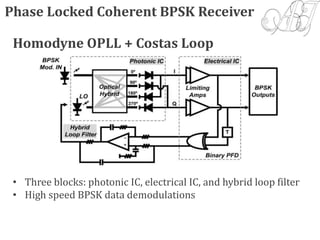
Phase Locked Coherent BPSK Receiver
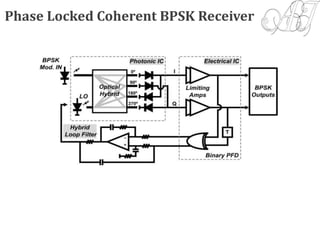
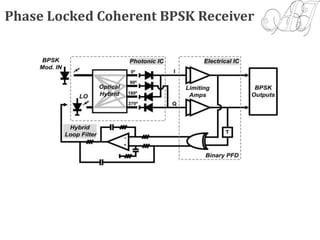
Homodyne OPLL + Costas Loop
• Three blocks: photonic IC, electrical IC, and hybrid loop filter
• High speed BPSK data demodulations
Phase Locked Coherent BPSK Receiver
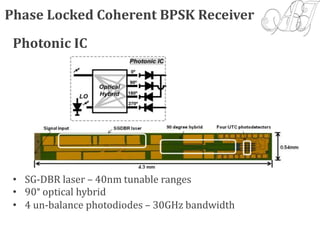
Photonic IC
• SG-DBR laser – 40nm tunable ranges
• 90° optical hybrid
• 4 un-balance photodiodes – 30GHz bandwidth
Phase Locked Coherent BPSK Receiver
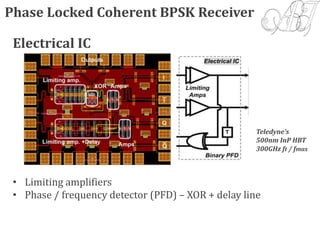
Electrical IC
• Limiting amplifiers
• Phase / frequency detector (PFD) – XOR + delay line
Teledyne’s
500nm InP HBT
300GHz ft / fmax
Phase Locked Coherent BPSK Receiver
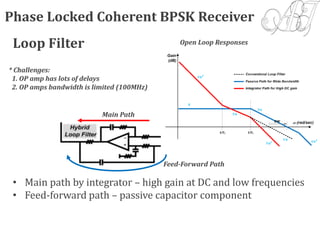
Loop Filter
• Main path by integrator – high gain at DC and low frequencies
• Feed-forward path – passive capacitor component
Main Path
Feed-Forward Path
Open Loop Responses
* Challenges:
1. OP amp has lots of delays
2. OP amps bandwidth is limited (100MHz)
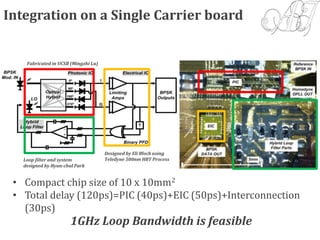
Fabricated in UCSB (Mingzhi Lu)
Designed by Eli Bloch using
Teledyne 500nm HBT ProcessLoop filter and system
designed by Hyun-chul Park
Integration on a Single Carrier board
• Compact chip size of 10 x 10mm2
• Total delay (120ps)=PIC (40ps)+EIC (50ps)+Interconnection
(30ps)
1GHz Loop Bandwidth is feasible
THANK YOU!

OPTICAL COMMUNICATION Unit 5

  • 1.
    UNIT-5 Mohammad Asif Iqbal AssistantProfessor, Deptt of ECE, JETGI, Barabanki
  • 2.
    Digital Transmission System(DTS) • The design of optical receiver is much more complicated than that of optical transmitter because the receiver must first detect weak, distorted signals and the n make decisions on what type of data was sent.
  • 3.
    Error Sources inDTS ! )( )( 0 n e NnP E h dttP h N N n r          is the average number of electron-hole pairs in photodetector, is the detector quantum efficiency and E is energy received in a time interval and is photon energy, where is the probability that n electrons are emitted in an interval . N   h )(nPr  [7- 1] [7-2]
  • 4.
    InterSymbol Interference (ISI) Pulsespreading in an optical signal, after traversing along optical fiber, leads to ISI. Some fraction of energy remaining in appropriate time slot is designated by , so the rest is the fraction of energy that has spread Into adjacent time slots. 
  • 5.
    Receiver Configuration The binarydigital pulse train incident on the photodetector can be written in the following form: t.allforpositiveiswhichshapepulsereceivedtheis)(and digitmessageththeofparameteramplitudeanisperiod,bitiswhere )()( th nbT nTthbtP p nb n bpn    [7-3]
  • 6.
    • In writingdown eq. [7-3], we assume the digital pulses with amplitude V represents bit 1 and 0 represents bit 0. Thus can take two values corresponding to each binary data. By normalizing the input pulse to the photodiode to have unit area represents the energy in the nth pulse. the mean output current from the photodiode at time t resulting from pulse train given in eq. [7-3] is (neglecting the DC components arising from dark current noise): nb )(thp    1)( dtthp nb     n bpno nTthbMtMP h q ti )()()(   [7-4]
  • 7.
    Bit Error Rate(BER) • Probability of Error= probability that the output voltage is less than the threshold when a 1 is sent + probability that the output voltage is more than the threshold when a 0 has been sent. b e t e TB Bt N N N t t /1 duringedtransmittpulsesof#total intervalmecertain tiaovererrorof# ErrorofyProbabilitBER    [7-5]
  • 8.
    Probability distributions forreceived logical 0 and 1 signal pulses. the different widths of the two distributions are caused by various signal distortion effects. thv edtransmitt0if,exceedstageoutput volequalizerthat theprobablity)0|()( edtransmitt1if,thanlessistageoutput volequalizerthat theprobablity)1|()( 0 1 vdyypvP vdyypvP v v       [7-6]
  • 9.
    • Where arethe probabilities that the transmitter sends 0 and 1 respectively. • For an unbiased transmitter      th th v v ththe dyypqdyypq vPqvPqP )1|()1|( )()( 01 0011 [7-7] 01 and qq 5.010  qq 10 1 qq 
  • 10.
    Gaussian Distribution dv bv dyypvP dv bv dyypvP thth thth vv th v on v th                    2 off 2 off off 0 2 on 2 on 1 2 )( exp 2 1 )0|()( 2 )( exp 2 1 )1|()(   mea n mea n [7-8]
  • 11.
    • If weassume that the probabilities of 0 and 1 pulses are equally likely, then using eq [7-7] and [7-8] , BER becomes: Q Q Q dxxQP Q e /2)exp(- 2 1 ) 2 (erf1 2 1 )exp( 1 )(BER 2 2/ 2             [7-9] dyyx vbbv Q x thth       0 2 on on off off )exp( 2 )(erf   [7-9] [7-10]
  • 12.
    Approximation of errorfunction Variation of BER vs Q, according to eq [7-9].
  • 13.
    Special Case In specialcase when: Vbb  onoffonoff ,0& From eq [7-29], we have: 2/Vvth  Eq [7-8] becomes:        ) 22 (erf1 2 1 )(   V Pe [7-11] Study example 7-1 pp. 286 of the textbook. ratio.noise-rms-to-signalpeakis  V
  • 14.
    Quantum Limit • Minimumreceived power required for a specific BER assuming that the photodetector has a 100% quantum efficiency and zero dark current. For such ideal photo-receiver, • Where is the average number of electron-hole pairs, when the incident optical pulse energy is E and given by eq [7-1] with 100% quantum efficiency . • Eq [7-12] can be derived from eq [7-2] where n=0. • Note that, in practice the sensitivity of receivers is around 20 dB higher than quantum limit because of various nonlinear distortions and noise effects in the transmission link. )exp()0(1 NPPe  [7-12] N )1( 
  • 15.
    Eye Diagram • Standardmeasure for signaling • Synchronized superposition of all possible realizations of the signal viewed within a particular interval • Obtained from measurement or transient simulation TX RX channel
  • 16.
    Eye Diagram (cont’d) •Timing jitter • Deviation of the zero-crossing from its ideal occurrence time • Amplitude noise • Set by signal-to-noise ratio (SNR) • The amount of noise at the sampling time
  • 17.
    Existing Work • Eyediagram analysis • Analytical eye-diagram model [Hashimoto, CICC’07] • Only consider attenuation and reflection • Assume perfect match at transmitter end • Jitter and noise analysis • Data-dependent jitter model [Buckwalter, MicrowaveSymp’04][Ou’DTS’04] • Only consider two taps of channel response • Enumerate all possible input combinations: [00, 01, 10, 11] • Clock jitter model [Hanumolu’04][Tao’99] • Clock-data recovery (CDR), DLL, PLL • Amplitude noise model [Hanumolu’05] • No general framework to model the jitter and noise and find out what is the worst possible scenario
  • 18.
    Eye Mask • Widereye = more timing margin • Higher eye = more noise margin • How to determine if the eye satisfies the mask or not • Find the worst-case jitter and noise PCI-Express
  • 19.
    Contribution • Formula-based modelfor jitter and noise • Use differential signaling as an example • Utilize multi-conductor transmission line equations • Can be extended to equalized link • Consider the pre-emphasis filter at the transmitter end • Worst-case jitter and noise • Directly find the worst-case input pattern • Use efficient mathematical programming algorithms • No need for time-consuming simulation • Runtime is not determined by the pattern length • Adequate length can be used according to channel response
  • 20.
    Motivations • Higher SpectralEfficiency – QPSK / multi-level QAMs • Higher Data Rates – 40Gbit/s, 100Gbit/s, and even higher • Higher Receiving Sensitivity Recent Coherent Optical Communication • Coherent detection based on DSP • Local oscillator (LO) laser • Polarization diversity 90° optical hybrid • Balanced detectors • High speed analog to digital convertor (ADC) • High speed digital signal processing (DSP) Coherent Optical
  • 21.
    Coherent Optical Communications CoherentOptical Receiver – I • Advantages: • Multi-level constellations • High data rate • Phase managements • Polarization managements • Dis-advantages: • Electrical circuit complexity • Speed limitations • Cost issues • Power consumptions
  • 22.
    Coherent Optical Receiver– II • Homodyne OPLL based coherent receiver – Costas Loop • Optical carrier recovering technique Requiring Stable OPLL
  • 23.
    Coherent Optical Receiver– II • Challenges: • Long loop delays (*1ns) • Narrow loop bandwidth (*100MHz) • Transmitting and LO lasers’ linewidth • Sensitive by external variations • Solutions: • Integrated circuits (photonic IC, electrical IC) • Feed-forward loop filter topology • Minimizing Interconnection delays • Digitally operating feedback system
  • 24.
    Phase Locked CoherentBPSK Receiver Homodyne OPLL + Costas Loop • Three blocks: photonic IC, electrical IC, and hybrid loop filter • High speed BPSK data demodulations
  • 25.
    Phase Locked CoherentBPSK Receiver Photonic IC • SG-DBR laser – 40nm tunable ranges • 90° optical hybrid • 4 un-balance photodiodes – 30GHz bandwidth
  • 26.
    Phase Locked CoherentBPSK Receiver
  • 27.
    Phase Locked CoherentBPSK Receiver Electrical IC • Limiting amplifiers • Phase / frequency detector (PFD) – XOR + delay line Teledyne’s 500nm InP HBT 300GHz ft / fmax
  • 28.
    Phase Locked CoherentBPSK Receiver
  • 29.
    Phase Locked CoherentBPSK Receiver Loop Filter • Main path by integrator – high gain at DC and low frequencies • Feed-forward path – passive capacitor component Main Path Feed-Forward Path Open Loop Responses * Challenges: 1. OP amp has lots of delays 2. OP amps bandwidth is limited (100MHz)
  • 30.
    Fabricated in UCSB(Mingzhi Lu) Designed by Eli Bloch using Teledyne 500nm HBT ProcessLoop filter and system designed by Hyun-chul Park Integration on a Single Carrier board • Compact chip size of 10 x 10mm2 • Total delay (120ps)=PIC (40ps)+EIC (50ps)+Interconnection (30ps) 1GHz Loop Bandwidth is feasible
  • 31.