Designing Reflective Activities Sanjaya Mishra Designing Reflective Activities Designing Reflective Activities
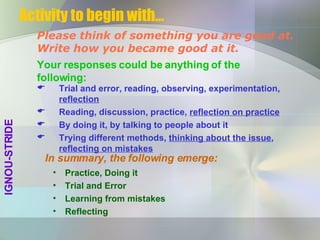
Please think of something you are good at. Write how you became good at it. Trial and error, reading, observing, experimentation,  reflection Reading, discussion, practice,  reflection on practice By doing it, by talking to people about it Trying different methods,  thinking about the issue ,  reflecting on mistakes Your responses could be anything of the following:   IGNOU-STRIDE In summary, the following emerge: Practice, Doing it Trial and Error Learning from mistakes Reflecting Activity to begin with…
Types of Activities Source: Mishra and Gaba (2001)‏ Activities Question-based Reflective Action-based With  immediate  feedback (e.g ITQ)‏ With model  answer/ feedback  at the end (e.g. SAQ)‏ With no  answer  but hints (e.g. Exercises)‏ Things  to do (e.g. Collection  of data)‏ Experiential (e.g. Writing  a note  after  watching  a TV  programme)‏
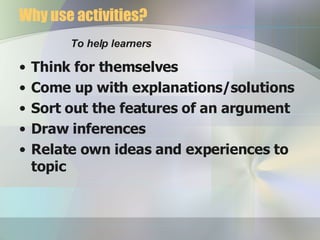
Why use activities? Think for themselves Come up with explanations/solutions Sort out the features of an argument Draw inferences Relate own ideas and experiences to topic To help learners
Be exposed to competing ideas and views Experience those tasks that are typical of the subject Practice important objectives Monitor progress Check their understanding/mastery of the concepts and skills Reflect on implications of their learning Actively use the materials Why use activities? To provide opportunities for learners to:
Importance of Reflection Donald Schon (1983)‏ Reflection-in-action Reflection-on-action David Kolb (1984): Learning Cycle Concrete experience Abstract conceptualization Reflective observation Active experimentation
Dictionary meaning: (n): 1. an instance of reflecting; 2. a thought, idea or opinion formed or a remark made as a result of mediation; 3. consideration of some subject matter, idea or purpose (adj): marked by reflection: thoughtful, deliberate What is Reflection?
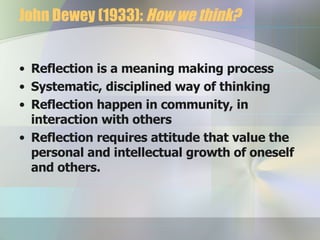
John Dewey (1933):  How we think? Reflection is a meaning making process Systematic, disciplined way of thinking Reflection happen in community, in interaction with others Reflection requires attitude that value the personal and intellectual growth of oneself and others.
J. Mezirow (1977)‏ Non-reflective action Habitual  Thoughtful Introspection Reflective action Context Process Premise
M. Van Manen (1977)‏ Technical Contextual Dialectical
Sparks-Langer et al (1991)‏ Framework for Reflective thinking No descriptive language Simple layperson description Events labeled with appropriate terms Explanation with tradition or personal preference given as rationale Explanation with principle or theory given as rationale Explanation with principle or theory and consideration of context Explanation with consideration of ethical, moral and political issues
J. Moon (1999)‏ Meaningful, reflective, restructured by learner, creative Meaningful, reflective, well structured Meaningful, well integrated ideas linked Reproduction of ideas, ideas not well linked, memorized representation
Reflection is a constructivist way of learning Construction of knowledge by learner Active involvement of the learner Non-linear way of learning Opportunity to apply and question Learning through experiential problem solving Situated and contextual
What is not reflection? Recall Define Identify List All lower order behavioral objectives
Designing Reflective activities Revised Blooms Taxonomy Knowledge Domain Factual Conceptual Procedural Meta-cognitive Cognitive Process Domain x Remember Understand Apply Analyze Evaluate Create
Guidelines/ Components  Use action verbs in the level of  U-A-A-E-C Cover Mezirow’s critical reflection approach – What, how and why type question Provide opportunity for contextualize, theorize, personalize, and generalize
Exercise Develop at least 2 reflective activities in a topic of your choice.

Designing Reflective Activities

  • 1.
    Designing Reflective ActivitiesSanjaya Mishra Designing Reflective Activities Designing Reflective Activities
  • 2.
    Please think ofsomething you are good at. Write how you became good at it. Trial and error, reading, observing, experimentation, reflection Reading, discussion, practice, reflection on practice By doing it, by talking to people about it Trying different methods, thinking about the issue , reflecting on mistakes Your responses could be anything of the following: IGNOU-STRIDE In summary, the following emerge: Practice, Doing it Trial and Error Learning from mistakes Reflecting Activity to begin with…
  • 3.
    Types of ActivitiesSource: Mishra and Gaba (2001)‏ Activities Question-based Reflective Action-based With immediate feedback (e.g ITQ)‏ With model answer/ feedback at the end (e.g. SAQ)‏ With no answer but hints (e.g. Exercises)‏ Things to do (e.g. Collection of data)‏ Experiential (e.g. Writing a note after watching a TV programme)‏
  • 4.
    Why use activities?Think for themselves Come up with explanations/solutions Sort out the features of an argument Draw inferences Relate own ideas and experiences to topic To help learners
  • 5.
    Be exposed tocompeting ideas and views Experience those tasks that are typical of the subject Practice important objectives Monitor progress Check their understanding/mastery of the concepts and skills Reflect on implications of their learning Actively use the materials Why use activities? To provide opportunities for learners to:
  • 6.
    Importance of ReflectionDonald Schon (1983)‏ Reflection-in-action Reflection-on-action David Kolb (1984): Learning Cycle Concrete experience Abstract conceptualization Reflective observation Active experimentation
  • 7.
    Dictionary meaning: (n):1. an instance of reflecting; 2. a thought, idea or opinion formed or a remark made as a result of mediation; 3. consideration of some subject matter, idea or purpose (adj): marked by reflection: thoughtful, deliberate What is Reflection?
  • 8.
    John Dewey (1933): How we think? Reflection is a meaning making process Systematic, disciplined way of thinking Reflection happen in community, in interaction with others Reflection requires attitude that value the personal and intellectual growth of oneself and others.
  • 9.
    J. Mezirow (1977)‏Non-reflective action Habitual Thoughtful Introspection Reflective action Context Process Premise
  • 10.
    M. Van Manen(1977)‏ Technical Contextual Dialectical
  • 11.
    Sparks-Langer et al(1991)‏ Framework for Reflective thinking No descriptive language Simple layperson description Events labeled with appropriate terms Explanation with tradition or personal preference given as rationale Explanation with principle or theory given as rationale Explanation with principle or theory and consideration of context Explanation with consideration of ethical, moral and political issues
  • 12.
    J. Moon (1999)‏Meaningful, reflective, restructured by learner, creative Meaningful, reflective, well structured Meaningful, well integrated ideas linked Reproduction of ideas, ideas not well linked, memorized representation
  • 13.
    Reflection is aconstructivist way of learning Construction of knowledge by learner Active involvement of the learner Non-linear way of learning Opportunity to apply and question Learning through experiential problem solving Situated and contextual
  • 14.
    What is notreflection? Recall Define Identify List All lower order behavioral objectives
  • 15.
    Designing Reflective activitiesRevised Blooms Taxonomy Knowledge Domain Factual Conceptual Procedural Meta-cognitive Cognitive Process Domain x Remember Understand Apply Analyze Evaluate Create
  • 16.
    Guidelines/ Components Use action verbs in the level of U-A-A-E-C Cover Mezirow’s critical reflection approach – What, how and why type question Provide opportunity for contextualize, theorize, personalize, and generalize
  • 17.
    Exercise Develop atleast 2 reflective activities in a topic of your choice.