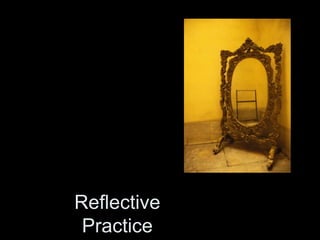
Reflective
Practice
Reflection, Ethics and
Professionality
• “The knowledge and understanding which
should properly inform the professional
consciousness of the competent teacher
is…a kind of moral wisdom or judgement
which is rooted in rational reflection about
educational policies and practices and
what is ethically, as well as instrumentally,
appropriate to achieve them” (Carr, 2000)
What is reflective teaching?
1. Reflecting as looking back…
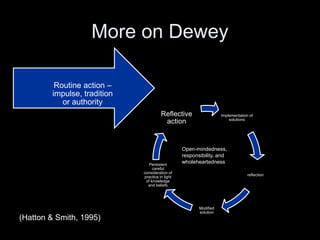
2. “routine” action and “reflective” action
(Dewey, 1933)
3. Reflecting on different views of
teaching
More on Dewey
Routine action –
impulse, tradition
or authority
Implementation of
solutions
reflection
Modified
solution
Persistent
careful
consideration of
practice in light
of knowledge
and beliefs
Reflective
action
(Hatton & Smith, 1995)
Open-mindedness,
responsibility, and
wholeheartedness
Why should teachers be reflective?
Personal and interpersonal (Korthagen
& Wubbles, 1991)
Sociological (Zeichner, 1992)
Technical (Cruikshank, 1987)
Professional (Dobbins, 1996)
Zeichner and Liston’s criteria of
reflection (1987)
TECHNICAL CRITERIA
Did I maintain order?
Did students achieve predetermined objectives?
EDUCATIONAL CRITERIA
In what ways did my teaching context influence teaching
and learning?
How did my teaching meet differing educational goals?
ETHICAL CRITERIA
How does my teaching align with moral and ethical aspects
of teaching and education?
How did power operate in my classroom?
• CRITICAL REFLECTION –
Consciously taking account of wider historic,
cultural and political values of beliefs in
framing and reframing problems to which
solutions are being sought.
Conscious detachment from an activity
followed by a distinct period of detachment
– with a view to explore alternatives which
might be implemented in the future
(Hatton & Smith, 1995)
Valli’s focus possibilities (1993)
Non - reflective
Ethical / Critical
Reflective
Technical
Skill Development Practical Decision Making
Indoctrination Moral Development
Schön’s reflective processes (1983,
1987)
REFLECTION-ON-ACTION
An attempt to understand past events
Planned reflecting
The focus and process of reflection can be
explicit and deliberate
REFLECTION-IN-ACTION
Occurs “on the run”
Problems need to be identified, resolved and
tested almost subconsciously
The focus and process of reflection is usually
tacit
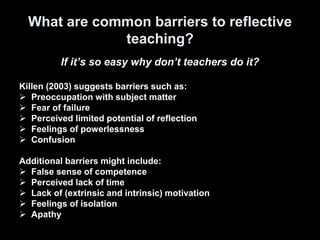
What are common barriers to reflective
teaching?
If it’s so easy why don’t teachers do it?
Killen (2003) suggests barriers such as:
 Preoccupation with subject matter
 Fear of failure
 Perceived limited potential of reflection
 Feelings of powerlessness
 Confusion
Additional barriers might include:
 False sense of competence
 Perceived lack of time
 Lack of (extrinsic and intrinsic) motivation
 Feelings of isolation
 Apathy
Some methods of reflection
• The next section of the lecture will outline
some approaches to reflection…
Modes of reflection - Critical
Dissonance
• The goal of ‘critical dissonance’ or ‘incongruity
based on a critical perspective’ is to interrupt the
potentially conservative influences of student
teachers school-based experiences and instead
help to develop stronger, more critical
perspectives that confront issues of race, class,
power, and gender.
• WHAT CAN YOU DO IN SCHOOLS TO
MAINTAIN A CRITICAL DISONANCE?
Modes of reflection - Collaborative
Resonance
• The goal here is to prolong and intensify
the influences of university and school
experiences, both of which are viewed as
potentially liberalizing. Teachers, from
both the inside (schools) and outside (uni,
research and pre-service teachers) alike
critique the cultures of teaching and
schooling and call into question the
policies and language of schooling that is
taken for granted.
How can teachers reflect on their
teaching?
Portfolios - NSW Institute Professional Standards
Inquiry-oriented supervision
Cross-cultural teaching experiences
Reflectivity training
Journal writing
Action research
Ethnographic studies
Collaboration
Case studies
Analysis of classroom discourse
Microteaching
Killen (2003)
How can teachers use Quality
Teaching as a lens for reflective
teaching?
For classroom practise, ask questions like:
 What am I already doing that is consistent
with the model?
 What needs development or change?
For assessment practise, ask questions like:
 Can you see evidence of all three
dimensions?
 What could you have changed to increase
the intellectual quality, quality learning
environment and significance?
Clarifying Intentions to Achieve
Inclusivity
• Keep track of your thought process
– One way of keeping track of our thought
processing is to note moments when we
experience surprise, especially in the
educational context. This is important
because surprise is one of the reactions we
have when our expectations are violated.
– Identify a moment when you experienced
surprise in a classroom or school. Then
explore these questions:
Surprise…
• 1. Why were your surprised?
• 2. What assumptions did you bring to that
interaction?
• 3. What does the existence of these
assumptions suggest for you as a
participant in the education process?
References
Cruikshank, D. R. (1987). Reflective teaching: The preparation of students of teaching. Reston: VA: Association of Teacher
Educators.
Dewey, J. (1933). How we think. Boston: D.C. Heath.
Dobbins, R. (1996). The challenge of developing a reflective practicum. Asia-Pacific Journal of Teacher Education, 24(3), 269-
280.
Gore, J. M., Williams, C., & Ladwig, J. G. (2006). Pedagogy and teacher induction: A critical moment in professional
development, Paper presented at the American Educational Research Association Annual Meeting. San Francisco.
Hatton, N. & Smith, D. (1995). Reflection in Teacher Education: Towards Definition and Implementation. Retrieved 25th October,
2010, from: http://alex.edfac.usyd.edu.au/localresource/Study1/hattonart.html
Killen, R. (2003). Effective teacing strategies: Lessons from research and practice (Third ed.). Tuggarah, NSW: Social Science
Press.
Korthagen, F., & Wubbles, T. (1991). Characteristics of reflective practitioners: Towards an operationalization of the concept of
reflection: Paper presented at the Annual Meeting of the American Educational Research Association, Chicago.
Schon, D. (1983). The reflective practitioner: How professionals think in action. New York: Basic Books.
Schon, D. (1987). Educating the reflective practitioner: Toward s design for teaching and learning in the professions. San
Francisco: Jossey-Bass.
Valli, L. (1993). Reconsidering technical and and reflective concepts in teacher education. Action in Teacher Education, 15(2), 35-
44.
Zeichner, K. (1992). Connecting genuine teacher development to the struggle for social justice, Issue Paper 92-1. east Lansing,
MI: National Center for Research on Teacher Learning.
Zeichner, K., & Gore, J. M. (1995). Using action research as a vehicle for student teacher reflection: A social reconstructionalist
approach. In S. Noffke & R. Stevenson (Eds.), Educational action research: Becoming practically critical. New York:
Teacher College Press.
Zeichner, K., & Liston, D. (1985). Varieties of discourse in supervisory conferences. Teaching and Teacher Education, 1, 155-174.

Reflective practice

  • 1.
  • 2.
    Reflection, Ethics and Professionality •“The knowledge and understanding which should properly inform the professional consciousness of the competent teacher is…a kind of moral wisdom or judgement which is rooted in rational reflection about educational policies and practices and what is ethically, as well as instrumentally, appropriate to achieve them” (Carr, 2000)
  • 3.
    What is reflectiveteaching? 1. Reflecting as looking back… 2. “routine” action and “reflective” action (Dewey, 1933) 3. Reflecting on different views of teaching
  • 4.
    More on Dewey Routineaction – impulse, tradition or authority Implementation of solutions reflection Modified solution Persistent careful consideration of practice in light of knowledge and beliefs Reflective action (Hatton & Smith, 1995) Open-mindedness, responsibility, and wholeheartedness
  • 5.
    Why should teachersbe reflective? Personal and interpersonal (Korthagen & Wubbles, 1991) Sociological (Zeichner, 1992) Technical (Cruikshank, 1987) Professional (Dobbins, 1996)
  • 6.
    Zeichner and Liston’scriteria of reflection (1987) TECHNICAL CRITERIA Did I maintain order? Did students achieve predetermined objectives? EDUCATIONAL CRITERIA In what ways did my teaching context influence teaching and learning? How did my teaching meet differing educational goals? ETHICAL CRITERIA How does my teaching align with moral and ethical aspects of teaching and education? How did power operate in my classroom?
  • 7.
    • CRITICAL REFLECTION– Consciously taking account of wider historic, cultural and political values of beliefs in framing and reframing problems to which solutions are being sought. Conscious detachment from an activity followed by a distinct period of detachment – with a view to explore alternatives which might be implemented in the future (Hatton & Smith, 1995)
  • 8.
    Valli’s focus possibilities(1993) Non - reflective Ethical / Critical Reflective Technical Skill Development Practical Decision Making Indoctrination Moral Development
  • 9.
    Schön’s reflective processes(1983, 1987) REFLECTION-ON-ACTION An attempt to understand past events Planned reflecting The focus and process of reflection can be explicit and deliberate REFLECTION-IN-ACTION Occurs “on the run” Problems need to be identified, resolved and tested almost subconsciously The focus and process of reflection is usually tacit
  • 10.
    What are commonbarriers to reflective teaching? If it’s so easy why don’t teachers do it? Killen (2003) suggests barriers such as:  Preoccupation with subject matter  Fear of failure  Perceived limited potential of reflection  Feelings of powerlessness  Confusion Additional barriers might include:  False sense of competence  Perceived lack of time  Lack of (extrinsic and intrinsic) motivation  Feelings of isolation  Apathy
  • 11.
    Some methods ofreflection • The next section of the lecture will outline some approaches to reflection…
  • 12.
    Modes of reflection- Critical Dissonance • The goal of ‘critical dissonance’ or ‘incongruity based on a critical perspective’ is to interrupt the potentially conservative influences of student teachers school-based experiences and instead help to develop stronger, more critical perspectives that confront issues of race, class, power, and gender. • WHAT CAN YOU DO IN SCHOOLS TO MAINTAIN A CRITICAL DISONANCE?
  • 13.
    Modes of reflection- Collaborative Resonance • The goal here is to prolong and intensify the influences of university and school experiences, both of which are viewed as potentially liberalizing. Teachers, from both the inside (schools) and outside (uni, research and pre-service teachers) alike critique the cultures of teaching and schooling and call into question the policies and language of schooling that is taken for granted.
  • 14.
    How can teachersreflect on their teaching? Portfolios - NSW Institute Professional Standards Inquiry-oriented supervision Cross-cultural teaching experiences Reflectivity training Journal writing Action research Ethnographic studies Collaboration Case studies Analysis of classroom discourse Microteaching Killen (2003)
  • 15.
    How can teachersuse Quality Teaching as a lens for reflective teaching? For classroom practise, ask questions like:  What am I already doing that is consistent with the model?  What needs development or change? For assessment practise, ask questions like:  Can you see evidence of all three dimensions?  What could you have changed to increase the intellectual quality, quality learning environment and significance?
  • 16.
    Clarifying Intentions toAchieve Inclusivity • Keep track of your thought process – One way of keeping track of our thought processing is to note moments when we experience surprise, especially in the educational context. This is important because surprise is one of the reactions we have when our expectations are violated. – Identify a moment when you experienced surprise in a classroom or school. Then explore these questions:
  • 17.
    Surprise… • 1. Whywere your surprised? • 2. What assumptions did you bring to that interaction? • 3. What does the existence of these assumptions suggest for you as a participant in the education process?
  • 18.
    References Cruikshank, D. R.(1987). Reflective teaching: The preparation of students of teaching. Reston: VA: Association of Teacher Educators. Dewey, J. (1933). How we think. Boston: D.C. Heath. Dobbins, R. (1996). The challenge of developing a reflective practicum. Asia-Pacific Journal of Teacher Education, 24(3), 269- 280. Gore, J. M., Williams, C., & Ladwig, J. G. (2006). Pedagogy and teacher induction: A critical moment in professional development, Paper presented at the American Educational Research Association Annual Meeting. San Francisco. Hatton, N. & Smith, D. (1995). Reflection in Teacher Education: Towards Definition and Implementation. Retrieved 25th October, 2010, from: http://alex.edfac.usyd.edu.au/localresource/Study1/hattonart.html Killen, R. (2003). Effective teacing strategies: Lessons from research and practice (Third ed.). Tuggarah, NSW: Social Science Press. Korthagen, F., & Wubbles, T. (1991). Characteristics of reflective practitioners: Towards an operationalization of the concept of reflection: Paper presented at the Annual Meeting of the American Educational Research Association, Chicago. Schon, D. (1983). The reflective practitioner: How professionals think in action. New York: Basic Books. Schon, D. (1987). Educating the reflective practitioner: Toward s design for teaching and learning in the professions. San Francisco: Jossey-Bass. Valli, L. (1993). Reconsidering technical and and reflective concepts in teacher education. Action in Teacher Education, 15(2), 35- 44. Zeichner, K. (1992). Connecting genuine teacher development to the struggle for social justice, Issue Paper 92-1. east Lansing, MI: National Center for Research on Teacher Learning. Zeichner, K., & Gore, J. M. (1995). Using action research as a vehicle for student teacher reflection: A social reconstructionalist approach. In S. Noffke & R. Stevenson (Eds.), Educational action research: Becoming practically critical. New York: Teacher College Press. Zeichner, K., & Liston, D. (1985). Varieties of discourse in supervisory conferences. Teaching and Teacher Education, 1, 155-174.