Critical Reflection
Dr Linda Rush
Vice Dean (Teacher Education)
Learning Outcomes
 To critically explore the concept of reflection
  and its application within learning and teaching


 To appraise reflective frameworks which
  facilitate critical levels of reflection
Feelings about reflection


 What are your feelings about reflection ?
Concept Analysis
In pairs


 Mindmap the term “reflection”
 From the mindmap create categories or
  emerging themes
 From the categories construct a sentence which
  offers your definition of reflection
Definitions of Reflection
 The consensus is that reflection is a term
  frequently used, but inadequately defined (Atkins
 and Murphy 1993, Reid 1993, James and Clarke 1994, Lyons
 1999)

 Difficulties are caused by a lack of clarity and
  commonly understood terminology (Reid 1993,
 Teekman 2000, Carroll et al 2000)

 How easy did you find it?
Working definition….?
 “A process of reviewing an experience of
  practice in order to describe, analyse, evaluate
  and so inform learning about practice” (Reid
 1995:305)

 It is both “a loosely used concept, easily
  assimilated into spontaneous everyday action”
  (How many of you feel you do it already?) and
  “a complex, difficult to explain and perplexing
  phenomenon” (Fitzgerald & Chapman in Burns & Bulman
 2000:3)
Where did it come from?
 Dewey (1933) – viewed reflective thinking and
  reflection as an experiential learning technique.
 Defined reflection as :

 An active persistent and careful consideration of
 any belief or supposed form of knowledge, in the
 light of the grounds that support it and the
 further conclusion to which it tends
 Reflection or reflective thinking here is seen as
  problem solving
Hatton and Smith (1995)

 View reflective thinking as ‘an active and
  deliberative cognitive process, involving
  sequences of interconnected ideas which take
  account of underlying beliefs and knowledge.
 Reflective thinking generally addresses practical
  problems, allowing for doubt and perplexity
  before possible solutions are reached.’
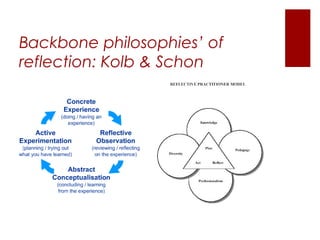
Backbone philosophies’ of
reflection: Kolb & Schon
Are
definitions
important?
The issues?
 Reflection is not a “panacea” (Scanlon and
  Chermonas 1997, Burns and Bulman 2000) but it is a way
  of learning more about our work (Kember at al 2001)

 Research tends to be small scale

 Schon’s work is attractive because it “focuses on
  practice and values experience” (Burns and Bulman
  2000:1)

 Moral and ethical dimensions (Hargreaves 1997)
What can a reflective
strategy do?
 Alter the focus from routinely doing to the
  development of an ability to look critically at
  practice (Driscoll 1994)
 Raising consciousness
 Perspective transformation
 Framing and reframing (Glaze 2001) as an
  innovative way of analysing problems
 Deconstruction and reconstruction (Ghaye and
 Lilleyman 1997)

 Knowing where you are on your internal map
 (Hunt 2001)
So, why can it be complex?
 Some people are more naturally reflective than
  others, but reflection is a skill which can be
  learnt, practised and refined … (L’Aiguille 1994)

 Verbal reflection is spontaneous, written
  reflection requires some practice (Gannon et al
 2001)

 Frameworks help to structure reflections,
  challenge assumptions, transform perspectives
Critical reflection and
critical thinking
Brookfield (1987) key components of critical
  thinking:-
 Identifying and challenging assumptions
 Imagining and exploring alternative ways of
  thinking and acting
Atkins (2000 in Burns and Bulman p30)
 Take place during the critical analysis element of
  a reflective framework
Reflective Frameworks
 Aid learning from experience
 Help to move from “tacit knowing, to more
  conscious and explicit knowing” (Ghaye and
 Lilleyman 1997:16)

 Movement away from “inertia”
 Adds “new and relevant” meaning to
  professional practice
 Have significance for future action
Types of Frameworks
 Structured -Johns guided reflection (1995) Smyth
  (1991)
 Hierarchical - Mezirow’s seven levels of reflection
  (1981), Goodman’s three levels (1984)
 Iterative - cyclical, Gibbs (1988), Atkins and
  Murphy (1994), Boud et al 1985)
 Synthetic - Louden (1991), Interests and Forms
  (outcomes and characteristics)
 Holistic - Ghaye et al (1996) 5 types of reflection-
  on-practice and 5 reflective cycles in a matrix
Using a reflective framework
in reflective writing
 Description - demonstrates clear understanding
  of the relevant and important issues, well
  structured and concise
 Feelings - beneath the surface.
 Demands “emotional intelligence”
 The ability to recognise and manage emotions in
  yourself and others (Mortiboys 2002)
Critical Analysis
 Critical Analysis -Identify and illuminate existing
  knowledge of relevance, challenge assumptions,
  explore alternatives. Separate the whole into its
  component parts
Synthesis
 “The integration of the new knowledge, feelings
  or attitudes with previous knowledge, feelings or
  attitudes. This is necessary in order to develop a
  fresh insight or a new perspective on a situation
  and learn from it” (Atkins 2002:46)
 Martin (1999) suggests contemporary staff need
  to manage paradox and be constantly adaptive
 Evaluation: the ability to make a judgement
  about the value of something, looking back…
  but it is also future orientated
Reflection and teaching
 Scanlon and Chermonas (1997) suggest that to
  teach reflectively, we must be reflective
  ourselves
 Strategies?
 ALS (McGill and Beaty 1995)
 Reflective journals (Bolton 2001)
 Portfolio development
 Reflective conversations with peers (Richert 1990)
Problems with Reflection?
 “lack of motivation to complete what can be a
  time consuming task”
 “uncertainty in what was expected”
 “making practice visible to others carries a
  degree of risk of criticism and challenge that
  may not have been experienced before”
  (Stanley and Ramage 2004:95)
Reflection and teaching
 Scanlon and Chermonas (1997) suggest that to
  teach reflectively, we must be reflective
  ourselves
 Strategies?
 ALS (McGill and Beaty 1995)
 Reflective journals (Bolton 2001)
 Portfolio development
 Reflective conversations with peers (Richert 1990)
Now What? - Review
 The purpose of reflection is to learn and extend
  personal practice and knowledge base (Hull and
 Redfern 1996)

 What is your stance? Which reflective framework
  suits your learning style?

 Engage with opportunities for observations (think
  mirrors)

 Engage with the theory, be prepared to take on
  new perspectives and insights.
A thought for the future…
 A fully functioning person is an ever changing
  person….personal growth is marked by a degree
  of disorganisation followed by reorganisation
  which necessitates acceptance of self (based
  on Rogers, and Martin 1999)

Critical Reflection

  • 1.
    Critical Reflection Dr LindaRush Vice Dean (Teacher Education)
  • 2.
    Learning Outcomes  Tocritically explore the concept of reflection and its application within learning and teaching  To appraise reflective frameworks which facilitate critical levels of reflection
  • 3.
    Feelings about reflection What are your feelings about reflection ?
  • 4.
    Concept Analysis In pairs Mindmap the term “reflection”  From the mindmap create categories or emerging themes  From the categories construct a sentence which offers your definition of reflection
  • 5.
    Definitions of Reflection The consensus is that reflection is a term frequently used, but inadequately defined (Atkins and Murphy 1993, Reid 1993, James and Clarke 1994, Lyons 1999)  Difficulties are caused by a lack of clarity and commonly understood terminology (Reid 1993, Teekman 2000, Carroll et al 2000)  How easy did you find it?
  • 6.
    Working definition….?  “Aprocess of reviewing an experience of practice in order to describe, analyse, evaluate and so inform learning about practice” (Reid 1995:305)  It is both “a loosely used concept, easily assimilated into spontaneous everyday action” (How many of you feel you do it already?) and “a complex, difficult to explain and perplexing phenomenon” (Fitzgerald & Chapman in Burns & Bulman 2000:3)
  • 7.
    Where did itcome from?  Dewey (1933) – viewed reflective thinking and reflection as an experiential learning technique.  Defined reflection as : An active persistent and careful consideration of any belief or supposed form of knowledge, in the light of the grounds that support it and the further conclusion to which it tends  Reflection or reflective thinking here is seen as problem solving
  • 8.
    Hatton and Smith(1995)  View reflective thinking as ‘an active and deliberative cognitive process, involving sequences of interconnected ideas which take account of underlying beliefs and knowledge.  Reflective thinking generally addresses practical problems, allowing for doubt and perplexity before possible solutions are reached.’
  • 9.
  • 10.
  • 11.
    The issues?  Reflectionis not a “panacea” (Scanlon and Chermonas 1997, Burns and Bulman 2000) but it is a way of learning more about our work (Kember at al 2001)  Research tends to be small scale  Schon’s work is attractive because it “focuses on practice and values experience” (Burns and Bulman 2000:1)  Moral and ethical dimensions (Hargreaves 1997)
  • 12.
    What can areflective strategy do?  Alter the focus from routinely doing to the development of an ability to look critically at practice (Driscoll 1994)  Raising consciousness  Perspective transformation  Framing and reframing (Glaze 2001) as an innovative way of analysing problems  Deconstruction and reconstruction (Ghaye and Lilleyman 1997)  Knowing where you are on your internal map (Hunt 2001)
  • 13.
    So, why canit be complex?  Some people are more naturally reflective than others, but reflection is a skill which can be learnt, practised and refined … (L’Aiguille 1994)  Verbal reflection is spontaneous, written reflection requires some practice (Gannon et al 2001)  Frameworks help to structure reflections, challenge assumptions, transform perspectives
  • 14.
    Critical reflection and criticalthinking Brookfield (1987) key components of critical thinking:-  Identifying and challenging assumptions  Imagining and exploring alternative ways of thinking and acting Atkins (2000 in Burns and Bulman p30)  Take place during the critical analysis element of a reflective framework
  • 15.
    Reflective Frameworks  Aidlearning from experience  Help to move from “tacit knowing, to more conscious and explicit knowing” (Ghaye and Lilleyman 1997:16)  Movement away from “inertia”  Adds “new and relevant” meaning to professional practice  Have significance for future action
  • 16.
    Types of Frameworks Structured -Johns guided reflection (1995) Smyth (1991)  Hierarchical - Mezirow’s seven levels of reflection (1981), Goodman’s three levels (1984)  Iterative - cyclical, Gibbs (1988), Atkins and Murphy (1994), Boud et al 1985)  Synthetic - Louden (1991), Interests and Forms (outcomes and characteristics)  Holistic - Ghaye et al (1996) 5 types of reflection- on-practice and 5 reflective cycles in a matrix
  • 17.
    Using a reflectiveframework in reflective writing  Description - demonstrates clear understanding of the relevant and important issues, well structured and concise  Feelings - beneath the surface.  Demands “emotional intelligence”  The ability to recognise and manage emotions in yourself and others (Mortiboys 2002)
  • 18.
    Critical Analysis  CriticalAnalysis -Identify and illuminate existing knowledge of relevance, challenge assumptions, explore alternatives. Separate the whole into its component parts
  • 19.
    Synthesis  “The integrationof the new knowledge, feelings or attitudes with previous knowledge, feelings or attitudes. This is necessary in order to develop a fresh insight or a new perspective on a situation and learn from it” (Atkins 2002:46)  Martin (1999) suggests contemporary staff need to manage paradox and be constantly adaptive  Evaluation: the ability to make a judgement about the value of something, looking back… but it is also future orientated
  • 20.
    Reflection and teaching Scanlon and Chermonas (1997) suggest that to teach reflectively, we must be reflective ourselves  Strategies?  ALS (McGill and Beaty 1995)  Reflective journals (Bolton 2001)  Portfolio development  Reflective conversations with peers (Richert 1990)
  • 21.
    Problems with Reflection? “lack of motivation to complete what can be a time consuming task”  “uncertainty in what was expected”  “making practice visible to others carries a degree of risk of criticism and challenge that may not have been experienced before” (Stanley and Ramage 2004:95)
  • 22.
    Reflection and teaching Scanlon and Chermonas (1997) suggest that to teach reflectively, we must be reflective ourselves  Strategies?  ALS (McGill and Beaty 1995)  Reflective journals (Bolton 2001)  Portfolio development  Reflective conversations with peers (Richert 1990)
  • 23.
    Now What? -Review  The purpose of reflection is to learn and extend personal practice and knowledge base (Hull and Redfern 1996)  What is your stance? Which reflective framework suits your learning style?  Engage with opportunities for observations (think mirrors)  Engage with the theory, be prepared to take on new perspectives and insights.
  • 24.
    A thought forthe future…  A fully functioning person is an ever changing person….personal growth is marked by a degree of disorganisation followed by reorganisation which necessitates acceptance of self (based on Rogers, and Martin 1999)