What is reflective teaching? 
• Reflective teaching means looking at what you do in the classroom and 
giving it a meaning by attaching the why question to what you go 
through. 
• You also empower your students to ask these why questions to their 
classroom experiences. 
• You start by recognizing that you and your students are key persons in 
learning environment. 
• Your being in the classroom must make sense to you and your students. 
• Your relived/recalled experiences as a teacher and those of your 
students are explored and evaluated to let you fulfill your mission and 
vision in the teaching profession.
Richards (1990) argues that reflective teaching is 
a move beyond the ordinary to a 
higher level of awareness of how teaching and 
take place. This demands that you and your 
students be involved in a process of self 
observation and self evaluation. 
Thus, you and your students must gather 
information on your practice and experiences. 
This information is organized, analysed and 
interpreted to identify what 
beliefs, assumptions and values are attached to 
your practices and experiences.
You and your students end up recognising, 
examining and ruminating what you do as a 
teacher and students, respectively. 
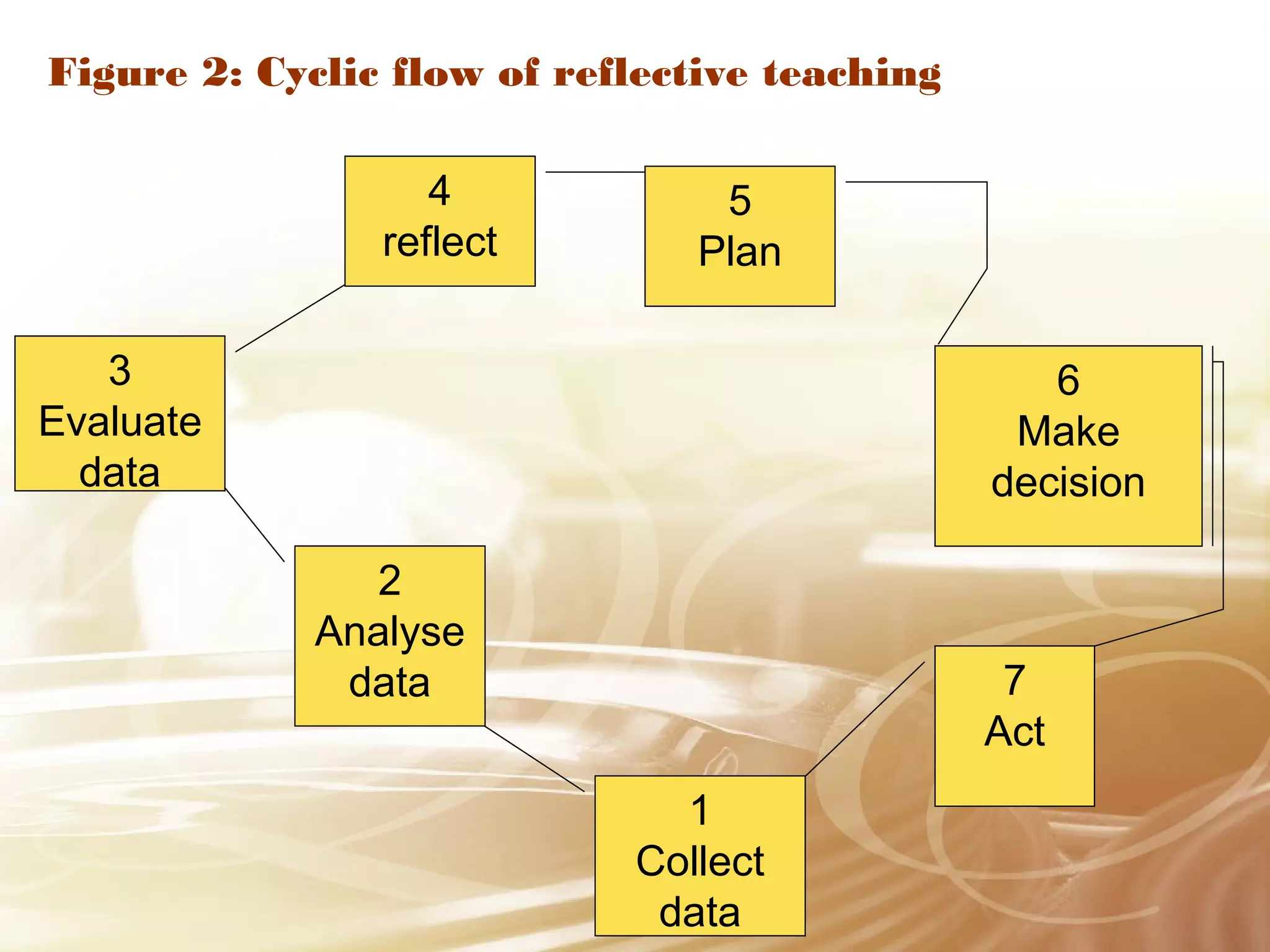
We may envision what is happening in Figure 
2. You and your students must place yourself 
at every step of the figure because what is 
happening is about you and your practice 
and experience.
Figure 2: Cyclic flow of reflective teaching 
1 
Collect 
data 
2 
Analyse 
data 
3 
Evaluate 
data 
4 
reflect 
5 
Plan 
6 
Make 
decision 
7 
Act
Why reflective teaching? 
Reflective teaching informs you that you are in charge of your 
teaching/learning and that you have a major contribution to 
make towards its success. 
This is why your behaviour must not be taken for granted as 
it needs to be continuously evaluated to let your practice and 
experiences be meaningful. 
To you the teacher,reflective teaching is a deliberate move to 
allow you think critically of your teaching practice so that your 
students can maximize their learning. 
Thus,through a change oriented activity, you contribute highly 
to your professional development. 
Richards (1990) argues that experience alone is insufficient 
for professional growth, but experience coupled with 
reflection is a powerful impetus for teacher development.
Reflective teaching is a mark of a concerned teacher who is 
skilled enough to examine his/her beliefs, values and 
assumptions behind the teaching practice. 
The insights derived from this exercise are used to improve 
your practice. 
According to Bailey (1997) reflective teaching is about a skilled 
teaching of knowing what to do. 
You examine your work so that you consider alternative ways 
of as certaining that your students learn. 
This takes place through searching for deeper understanding 
of your teaching. 
So, you are able to monitor, critique and defend that which 
you implement and how you implement it.
It is possible that reflective teaching may turn you to be a 
researcher because of its dimension of self inquiry. 
Through self inquiry, much of what is unknown becomes clear 
so that you end up improving your practice and planning. 
Thus,your personal experiences are turned into stories which 
can be shared with your peers. 
In this manner, reflective teaching is a professional alternative 
to action research. 
It is a personal means of conducting your own ongoing 
professional life by solving problems in a systematic manner.
What are you doing in reflective teaching? You 
are integrating theory and practice. 
By making use of constructivist approach you 
address issues which emanate from your 
practice and experience. You are able to do 
this because you care about your profession 
which prepares young people for life in the 
society. 
Is this your self fulfilling prophecy? If so, then 
reflective teaching is an intrinsic motivational 
device to your work.
How is reflective teaching effected? 
In the first place there must be something which calls for 
your reflection. Attention 
to the issue of concern is important. The expectation is that 
you must 
gather information on what is of concern. This is step one 
of reflective teaching. 
There are various ways of collecting the information. They 
include:
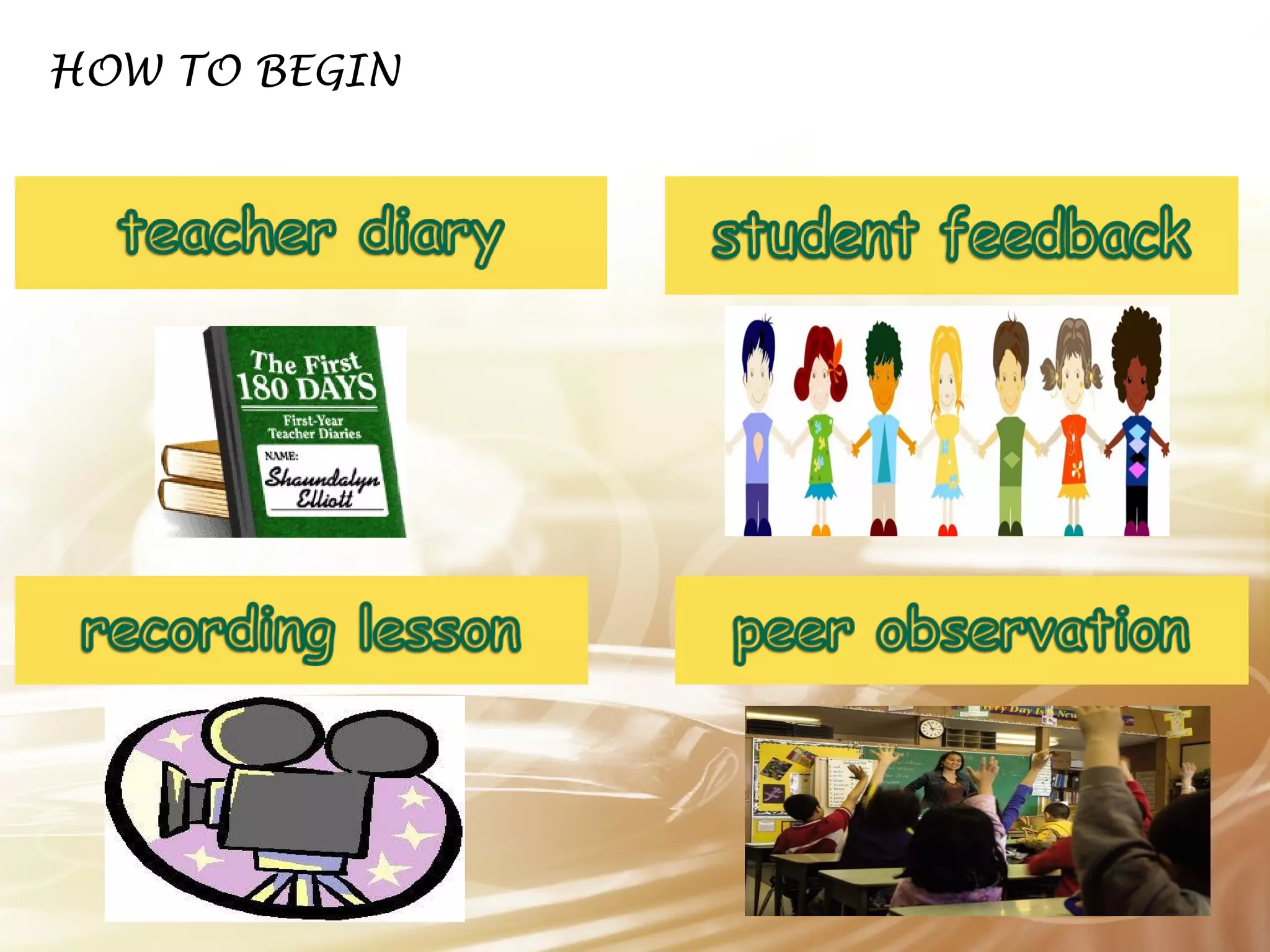
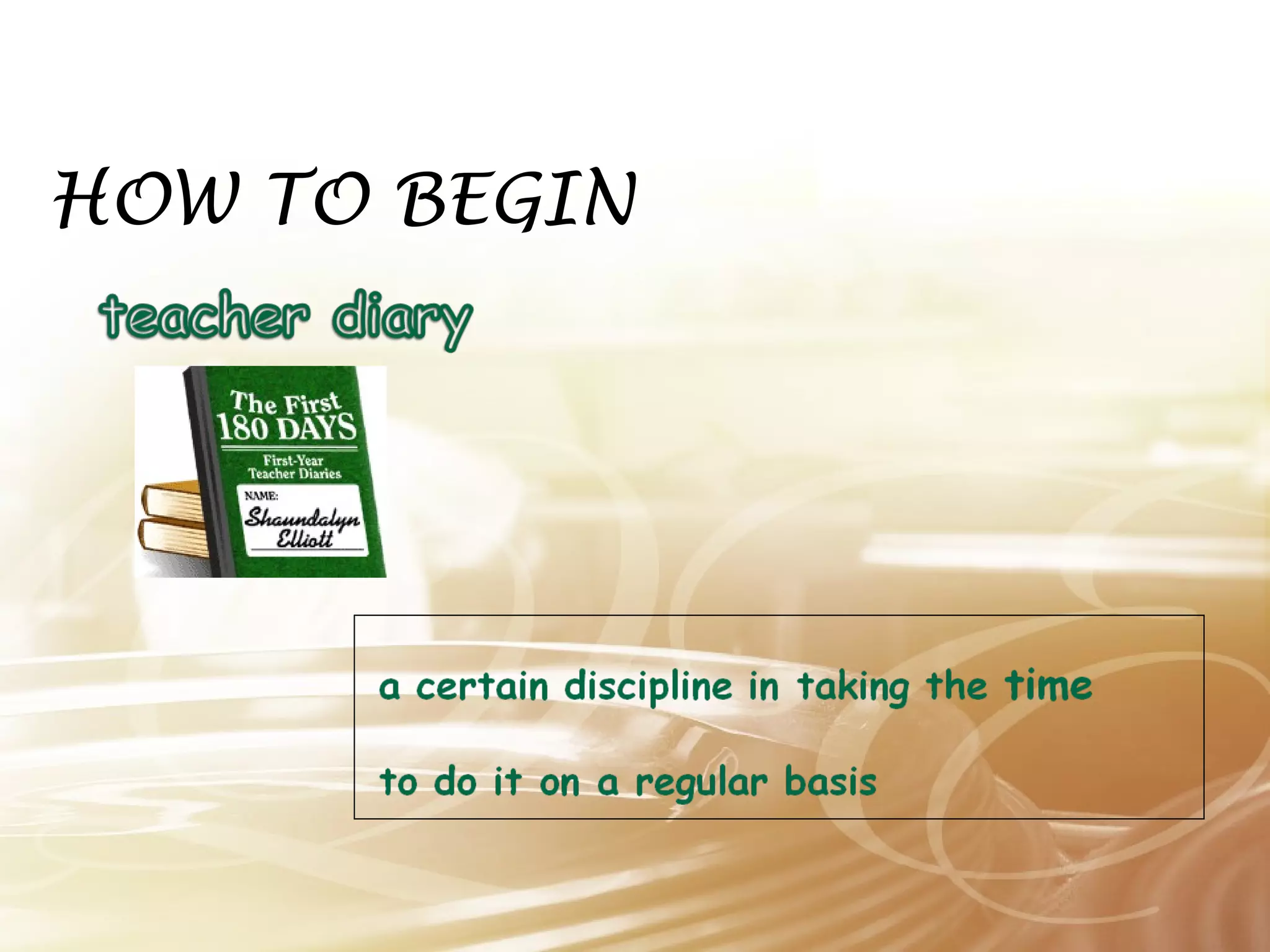
 Keeping of a journal which is a form of diary of your experiences. 
You will need to keep a record of experiences which have 
happened. This makes it be phenomenological in nature. It has to 
be done consistently if the information will be of any worth. It is an 
activity whereby the teacher takes notes of the situation he/she is 
undergoing. These notes are in form of personal statements 
focusing on feelings, opinions and perceptions about others with 
whom the teacher comes in contact with during the course of 
his/her practice (Fraenkel and Wallen, 1992). What one records is 
not for public access. It is a personal record of letting out ones 
feelings and skills keeping them private. They are generally put 
down on daily basis for purpose of hoping to improve practice by 
later consultation of the records. 
Journal writing is an opportunity for you to use the process of 
writing to describe and explore your teaching and learning 
practices.According Fraenkel and Wallen (1992) journal keeping 
is one of the tools under use to promote teachers development of 
reflective thinking. The writing engages you in a deeper level of 
awareness and response to teaching than you would obtain by 
merely discussing teaching in terms of teaching procedures and 
lesson plans.
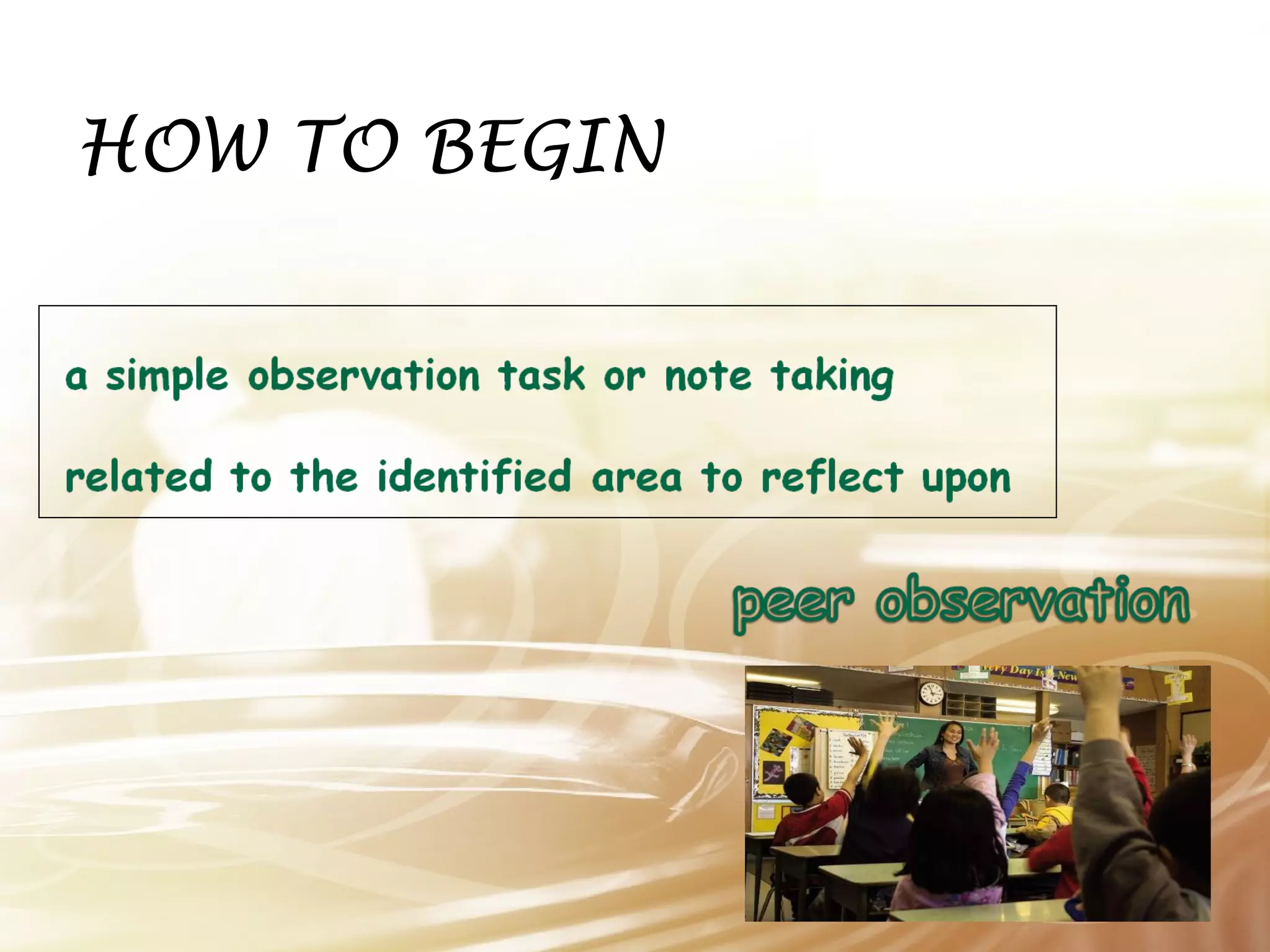
 Peer mentoring takes form of you observing a mentor’s practice or 
the mentor observes your practice and a record is made for feedback 
purposes (Arther, Davision and Moss, 1997). The focus of attention 
may be on how to keep students lively in a class discussion. One 
way of doing it is 
by being a non participant observer of classroom practice. This is an 
act of attending to an area of interest by being present to look at and 
listen to what is happening in a focused manner. This is opposite to 
participant observation where you penetrate the class to learn what 
is there to be learn. In non participant observation you just observe 
without getting Insert involved; text 
the observation is done from sidelines. You 
describe the scene here 
in your own way; the students, the teacher and 
the dialogue events without ignoring the obvious. You do all that to 
attach meaning to the teacher’s practice.
Recording of your lessons through either audio or 
video or even by use of paper and pencil. For instance, 
you can use a tape recorder to tap the types of 
questions students pose in a mathematics lesson. 
These recorded experiences become the focus of what 
to reflect upon. 
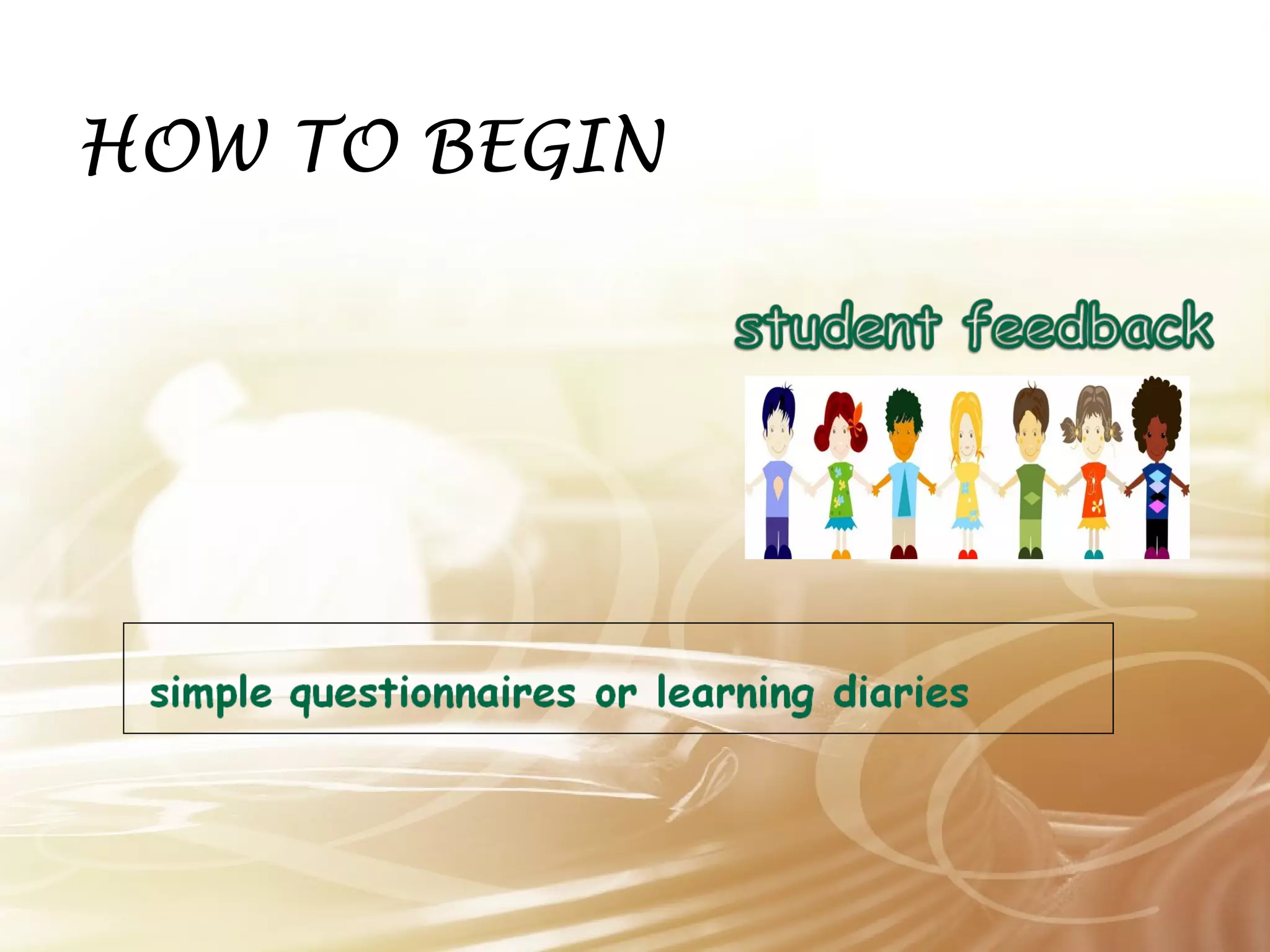
Feedback from your students. This can be done 
through ordinary questioning. It may be a little 
advanced by you giving questionnaires to students. 
Their responses become data targeting their 
perspectives towards what you may have to choose 
as a way forward.
The other steps which follow each other are: 
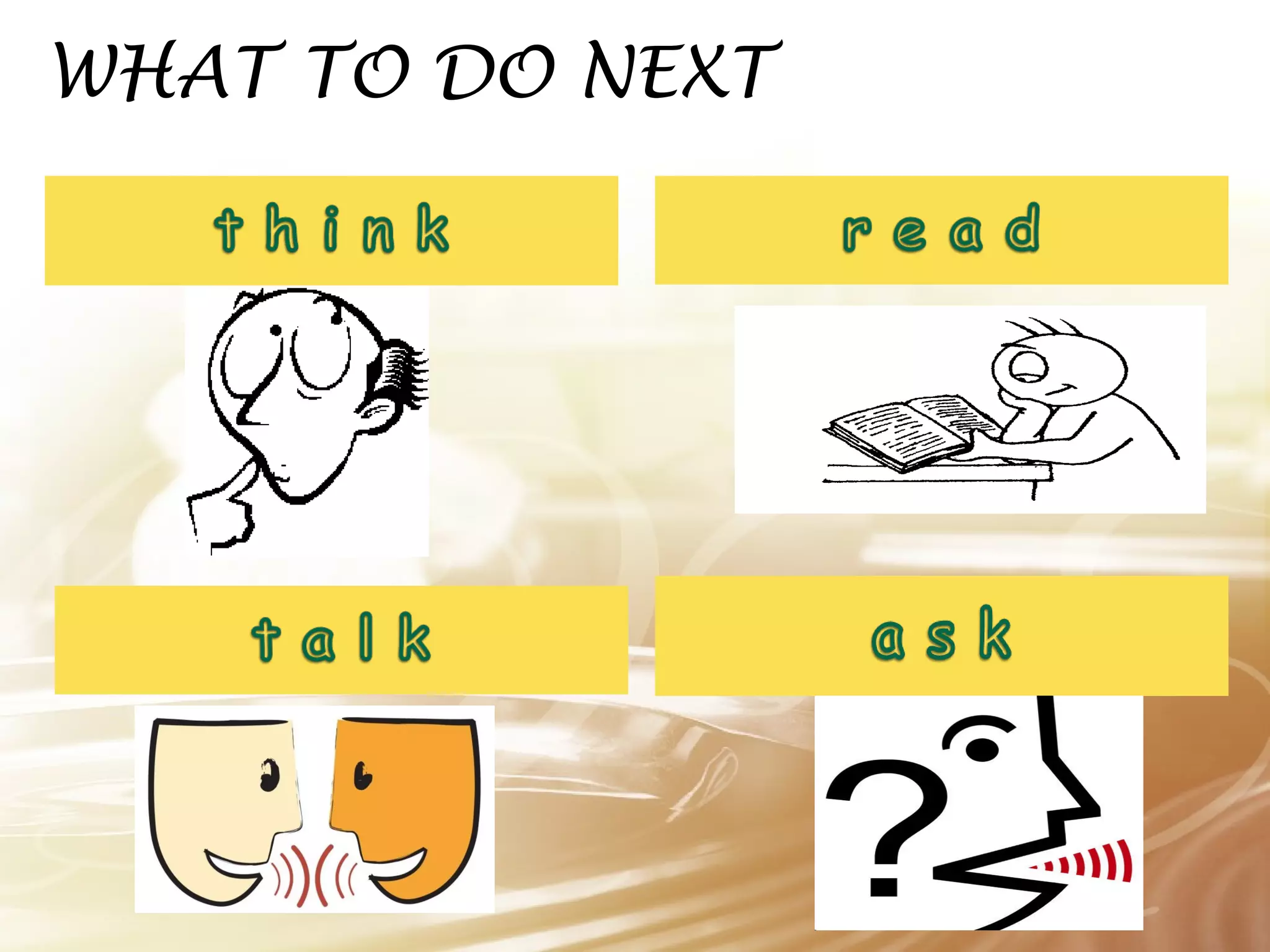
Critically think about the patterns arising from the specific 
record. You are engaged in searching for understanding by 
asking questions about what and why practices. These 
questions let you not take anything in the classroom practice 
for granted. Together with critical thinking are dimensions 
like heuristic, creative and insightful thinking which stress on 
how you solve and deal with issues at hand. Insightful 
thinking lets you to be rationally informed of what is 
happening, while creative thinking is about imaginative and 
original ideas and ways of doing things by identifying 
alternatives.
Refer to an expert who may be a peer or a 
mentor to have a discussion with him/her 
about emerging issues of your practice. 
This lets you be open minded to broaden 
your perspectives as you pose to him/her 
questions which make the stories 
memorable. 
Read as a way to find out more about the 
patterns emerging from the collected 
information. This keeps you informed.
Associate with colleagues in a meeting, 
seminar, conference or workshop. 
Attend seminars, workshops and 
conferences which provide new 
perspectives to emerging issues about your 
practice.
The final step is about you deciding on what to 
do. The aspect of decision making seems to 
suggest that there are alternatives and their 
implications. Implement the change if need 
be as a way of enhancing your professional 
development. At this point, the process of 
reflection begins again, as it is cyclic.
THE STEPS 
• How to begin 
• What to do next
HOW TO BEGIN
HOW TO BEGIN
HOW TO BEGIN
HOW TO BEGIN
HOW TO BEGIN
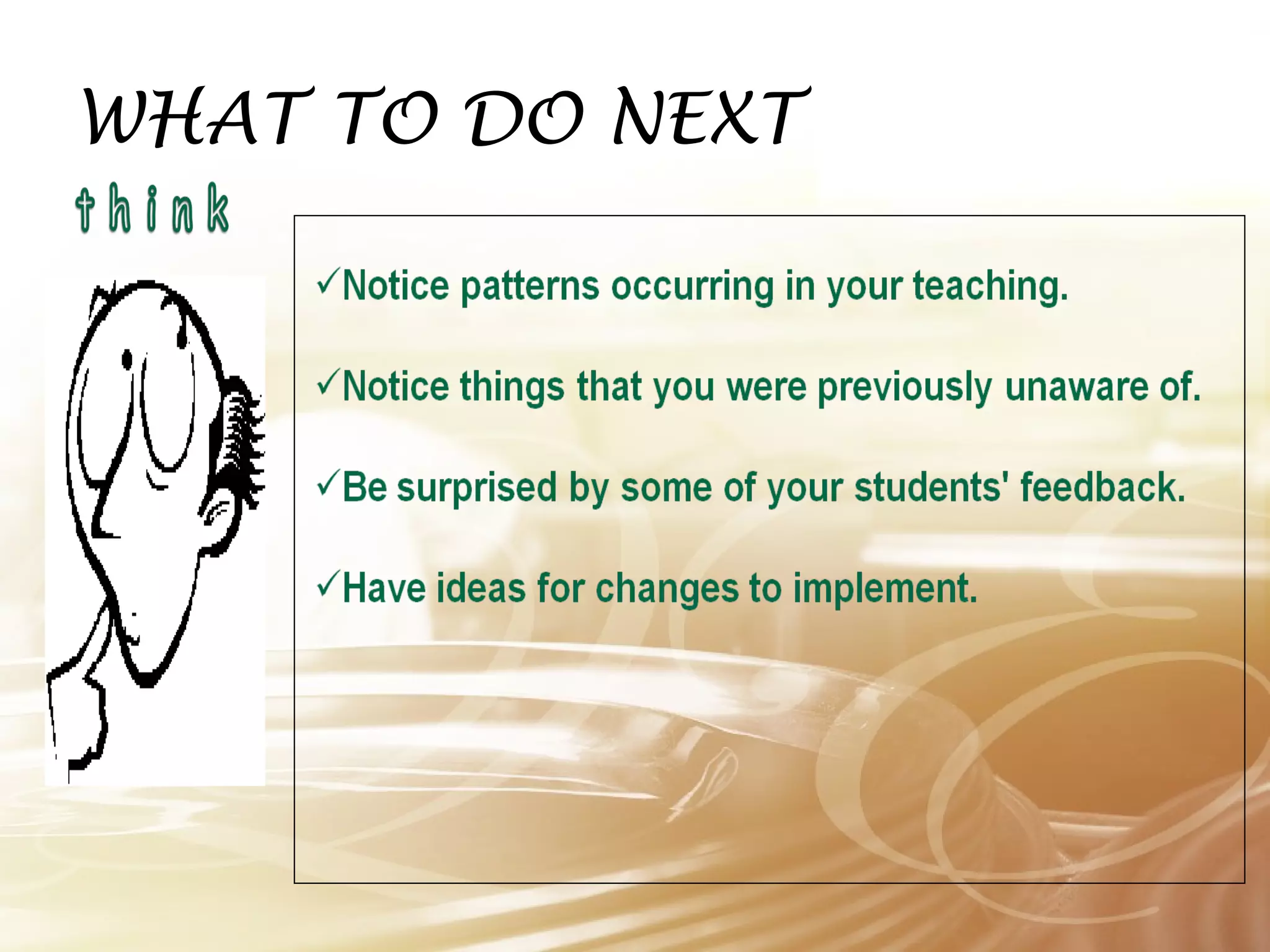
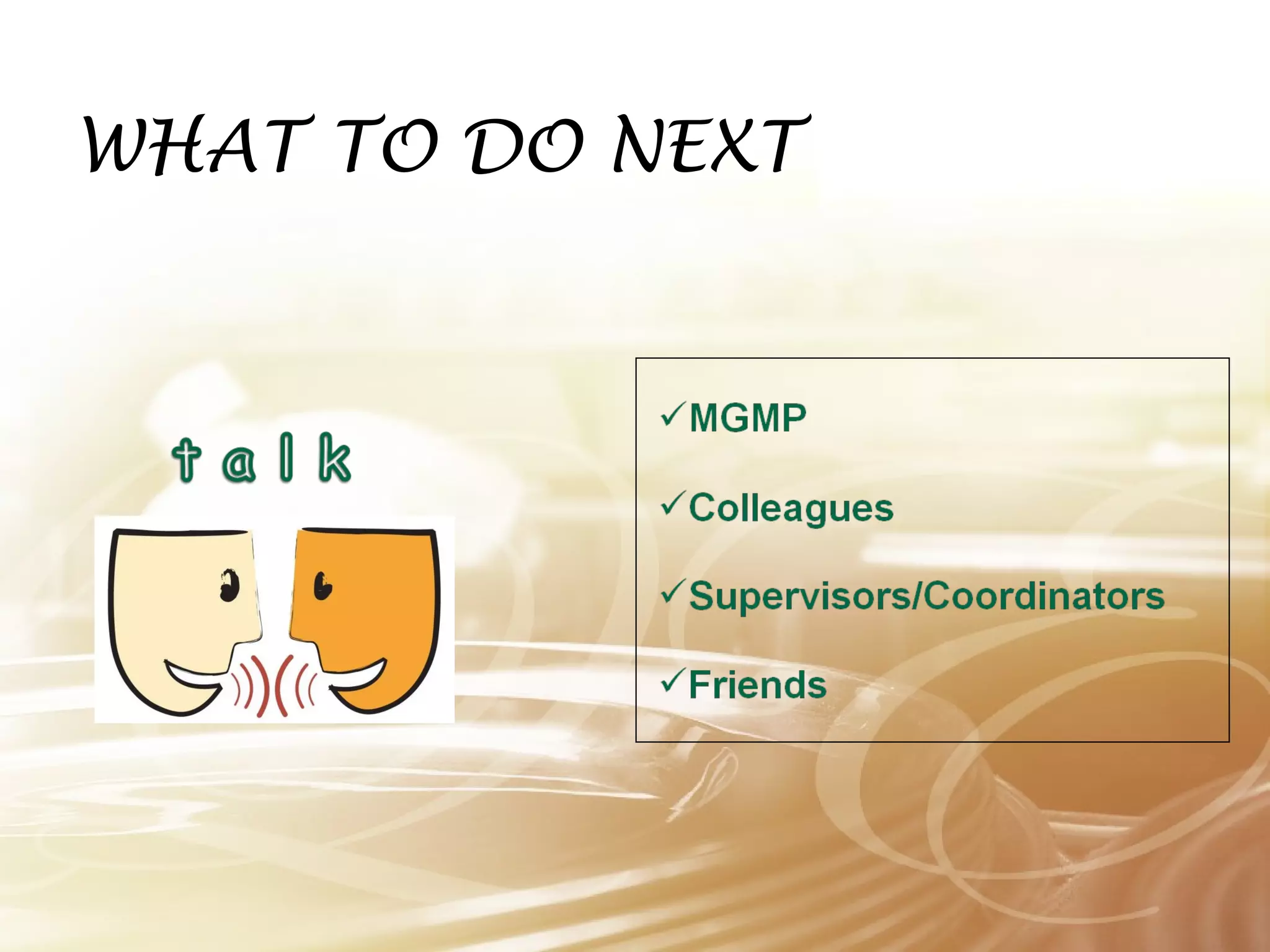
WHAT TO DO NEXT
WHAT TO DO NEXT
WHAT TO DO NEXT
WHAT TO DO NEXT
WHAT TO DO NEXTXT 
Question posted on websites/journals 
Trainings
Reflective Teaching

Reflective Teaching

  • 2.
    What is reflectiveteaching? • Reflective teaching means looking at what you do in the classroom and giving it a meaning by attaching the why question to what you go through. • You also empower your students to ask these why questions to their classroom experiences. • You start by recognizing that you and your students are key persons in learning environment. • Your being in the classroom must make sense to you and your students. • Your relived/recalled experiences as a teacher and those of your students are explored and evaluated to let you fulfill your mission and vision in the teaching profession.
  • 3.
    Richards (1990) arguesthat reflective teaching is a move beyond the ordinary to a higher level of awareness of how teaching and take place. This demands that you and your students be involved in a process of self observation and self evaluation. Thus, you and your students must gather information on your practice and experiences. This information is organized, analysed and interpreted to identify what beliefs, assumptions and values are attached to your practices and experiences.
  • 4.
    You and yourstudents end up recognising, examining and ruminating what you do as a teacher and students, respectively. We may envision what is happening in Figure 2. You and your students must place yourself at every step of the figure because what is happening is about you and your practice and experience.
  • 5.
    Figure 2: Cyclicflow of reflective teaching 1 Collect data 2 Analyse data 3 Evaluate data 4 reflect 5 Plan 6 Make decision 7 Act
  • 6.
    Why reflective teaching? Reflective teaching informs you that you are in charge of your teaching/learning and that you have a major contribution to make towards its success. This is why your behaviour must not be taken for granted as it needs to be continuously evaluated to let your practice and experiences be meaningful. To you the teacher,reflective teaching is a deliberate move to allow you think critically of your teaching practice so that your students can maximize their learning. Thus,through a change oriented activity, you contribute highly to your professional development. Richards (1990) argues that experience alone is insufficient for professional growth, but experience coupled with reflection is a powerful impetus for teacher development.
  • 7.
    Reflective teaching isa mark of a concerned teacher who is skilled enough to examine his/her beliefs, values and assumptions behind the teaching practice. The insights derived from this exercise are used to improve your practice. According to Bailey (1997) reflective teaching is about a skilled teaching of knowing what to do. You examine your work so that you consider alternative ways of as certaining that your students learn. This takes place through searching for deeper understanding of your teaching. So, you are able to monitor, critique and defend that which you implement and how you implement it.
  • 8.
    It is possiblethat reflective teaching may turn you to be a researcher because of its dimension of self inquiry. Through self inquiry, much of what is unknown becomes clear so that you end up improving your practice and planning. Thus,your personal experiences are turned into stories which can be shared with your peers. In this manner, reflective teaching is a professional alternative to action research. It is a personal means of conducting your own ongoing professional life by solving problems in a systematic manner.
  • 9.
    What are youdoing in reflective teaching? You are integrating theory and practice. By making use of constructivist approach you address issues which emanate from your practice and experience. You are able to do this because you care about your profession which prepares young people for life in the society. Is this your self fulfilling prophecy? If so, then reflective teaching is an intrinsic motivational device to your work.
  • 10.
    How is reflectiveteaching effected? In the first place there must be something which calls for your reflection. Attention to the issue of concern is important. The expectation is that you must gather information on what is of concern. This is step one of reflective teaching. There are various ways of collecting the information. They include:
  • 11.
     Keeping ofa journal which is a form of diary of your experiences. You will need to keep a record of experiences which have happened. This makes it be phenomenological in nature. It has to be done consistently if the information will be of any worth. It is an activity whereby the teacher takes notes of the situation he/she is undergoing. These notes are in form of personal statements focusing on feelings, opinions and perceptions about others with whom the teacher comes in contact with during the course of his/her practice (Fraenkel and Wallen, 1992). What one records is not for public access. It is a personal record of letting out ones feelings and skills keeping them private. They are generally put down on daily basis for purpose of hoping to improve practice by later consultation of the records. Journal writing is an opportunity for you to use the process of writing to describe and explore your teaching and learning practices.According Fraenkel and Wallen (1992) journal keeping is one of the tools under use to promote teachers development of reflective thinking. The writing engages you in a deeper level of awareness and response to teaching than you would obtain by merely discussing teaching in terms of teaching procedures and lesson plans.
  • 12.
     Peer mentoringtakes form of you observing a mentor’s practice or the mentor observes your practice and a record is made for feedback purposes (Arther, Davision and Moss, 1997). The focus of attention may be on how to keep students lively in a class discussion. One way of doing it is by being a non participant observer of classroom practice. This is an act of attending to an area of interest by being present to look at and listen to what is happening in a focused manner. This is opposite to participant observation where you penetrate the class to learn what is there to be learn. In non participant observation you just observe without getting Insert involved; text the observation is done from sidelines. You describe the scene here in your own way; the students, the teacher and the dialogue events without ignoring the obvious. You do all that to attach meaning to the teacher’s practice.
  • 13.
    Recording of yourlessons through either audio or video or even by use of paper and pencil. For instance, you can use a tape recorder to tap the types of questions students pose in a mathematics lesson. These recorded experiences become the focus of what to reflect upon. Feedback from your students. This can be done through ordinary questioning. It may be a little advanced by you giving questionnaires to students. Their responses become data targeting their perspectives towards what you may have to choose as a way forward.
  • 14.
    The other stepswhich follow each other are: Critically think about the patterns arising from the specific record. You are engaged in searching for understanding by asking questions about what and why practices. These questions let you not take anything in the classroom practice for granted. Together with critical thinking are dimensions like heuristic, creative and insightful thinking which stress on how you solve and deal with issues at hand. Insightful thinking lets you to be rationally informed of what is happening, while creative thinking is about imaginative and original ideas and ways of doing things by identifying alternatives.
  • 15.
    Refer to anexpert who may be a peer or a mentor to have a discussion with him/her about emerging issues of your practice. This lets you be open minded to broaden your perspectives as you pose to him/her questions which make the stories memorable. Read as a way to find out more about the patterns emerging from the collected information. This keeps you informed.
  • 16.
    Associate with colleaguesin a meeting, seminar, conference or workshop. Attend seminars, workshops and conferences which provide new perspectives to emerging issues about your practice.
  • 17.
    The final stepis about you deciding on what to do. The aspect of decision making seems to suggest that there are alternatives and their implications. Implement the change if need be as a way of enhancing your professional development. At this point, the process of reflection begins again, as it is cyclic.
  • 18.
    THE STEPS •How to begin • What to do next
  • 19.
  • 20.
  • 21.
  • 22.
  • 23.
  • 24.
  • 25.
  • 26.
  • 27.
  • 28.
    WHAT TO DONEXTXT Question posted on websites/journals Trainings