UNIT 5: INTRODUCTION TO REFLECTION
AND TYPES OF REFLECTION
Tanzela Bashir
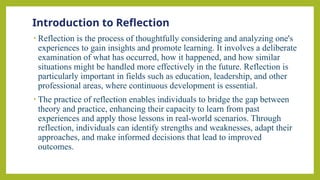
Introduction to Reflection
• Reflection is the process of thoughtfully considering and analyzing one's
experiences to gain insights and promote learning. It involves a deliberate
examination of what has occurred, how it happened, and how similar
situations might be handled more effectively in the future. Reflection is
particularly important in fields such as education, leadership, and other
professional areas, where continuous development is essential.
• The practice of reflection enables individuals to bridge the gap between
theory and practice, enhancing their capacity to learn from past
experiences and apply those lessons in real-world scenarios. Through
reflection, individuals can identify strengths and weaknesses, adapt their
approaches, and make informed decisions that lead to improved
outcomes.
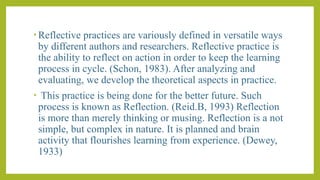
• Reflective practices are variously defined in versatile ways
by different authors and researchers. Reflective practice is
the ability to reflect on action in order to keep the learning
process in cycle. (Schon, 1983). After analyzing and
evaluating, we develop the theoretical aspects in practice.
• This practice is being done for the better future. Such
process is known as Reflection. (Reid.B, 1993) Reflection
is more than merely thinking or musing. Reflection is a not
simple, but complex in nature. It is planned and brain
activity that flourishes learning from experience. (Dewey,
1933)
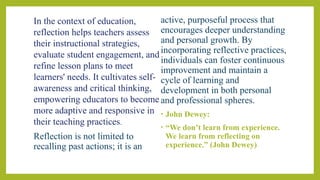
In the context of education,
reflection helps teachers assess
their instructional strategies,
evaluate student engagement, and
refine lesson plans to meet
learners' needs. It cultivates self-
awareness and critical thinking,
empowering educators to become
more adaptive and responsive in
their teaching practices.
Reflection is not limited to
recalling past actions; it is an
active, purposeful process that
encourages deeper understanding
and personal growth. By
incorporating reflective practices,
individuals can foster continuous
improvement and maintain a
cycle of learning and
development in both personal
and professional spheres.
• John Dewey:
• “We don’t learn from experience.
We learn from reflecting on
experience.” (John Dewey)
According to John Dewey
• According to John Dewey "The increased, enhanced and
accelerated power of control is reflection. Although reflection starts
with uneasiness, distress and anxiety but ultimately leads a person
to balanced state.
• The reflective thought and process basically transforms the doubt
into clarity, inconsistency into consistency and unpleasant
experiences into the pleasant experiences. No doubt that it takes
time to enable the thoughts to reach at the required balanced level.
(Dewey, How We Think, 1933).
The reflective thought process takes time because it emerges in
phases.
1. suggestion and ideas that he/she confronts with a problem.
2. "Elaboration" is the second stage. Soon after confronting problem the individual recalls the
previous experiences, its pros and corns, negative and positive effects.
3. In the light of the elaboration, the person sets the "Hypotheses". What happened why and how
and what best choice was at that time.
4. When a person come across with the same experience or same to some extent he then,
compares the existing problem and its hypotheses with the previously learnt experience and its
hypotheses. This stage of "Comparing Hypotheses" enables him to come to some better
conclusion.
5. After carefully examining all the hypotheses, he is now ready for the final stage
"Taking Action". This action is now a well thought of and based on reflective thinking process.
Types of Reflection
• Reflection can be categorized into several types, each serving a distinct
purpose. These types help in systematically analyzing experiences,
which supports ongoing learning and professional development.
• 1 Descriptive Reflection
• 2 Analytical Reflection
• 3 Critical Reflection
• 4 Evaluative Reflection
Descriptive Reflection
• Descriptive Reflection involves recalling and describing events or experiences in
detail. This type of reflection focuses on what happened without delving into the
deeper meaning or implications. It provides a foundation for understanding the
sequence of events and allows for a factual recounting of experiences.
Descriptive reflection answers questions like:
• What happened?
• Who was involved?
• When and where did it take place?
• Example: A teacher reflects on a lesson by describing the activities, student
reactions, and outcomes without analyzing the reasons behind the responses or
the effectiveness of the teaching methods.
Analytical Reflection
• Analytical Reflection goes beyond mere description by exploring the
reasons and processes behind actions and events. This type encourages
examining the "how" and "why" aspects, allowing for a deeper
understanding of one’s decisions and practices.
• Analytical reflection helps identify factors influencing actions and
highlights areas for improvement.
• Example: A teacher not only recounts a lesson but also analyzes why
certain students engaged more than others, identifying potential reasons
like instructional methods, student interests, or external factors.
Critical Reflection
• Critical Reflection challenges one's underlying beliefs, assumptions, and values that
influence actions. It involves a deeper examination of social, cultural, and ethical
implications, encouraging a more comprehensive understanding of one's role and
responsibilities.
• This type of reflection promotes transformative learning(occurs when an individual
experiences a significant structural change in the way they perceive and understand the world around
them.) by questioning personal biases and exploring alternative perspectives. What is
an example of transformative education?
• One of the most common transformative learning examples is gaining knowledge of
the responsibilities involved and obtaining practical experience of the role of a senior
member that is in a position that you desire to be in. Learn more about job shadowing.
• Example: A teacher critically reflects on the inclusivity of their teaching approach,
questioning whether they unconsciously favor certain student groups and considering
ways to promote equality and diversity in the classroom.
Evaluative Reflection
• Evaluative Reflection assesses the effectiveness and outcomes of an
experience or action. It involves making judgments about what worked
well, what didn’t, and why. This type of reflection focuses on
evaluating success and identifying specific improvements for future
practice.
• Example: After completing a training session, a teacher evaluates its
success by reflecting on students' engagement and performance,
identifying strengths in their approach, and recognizing areas where
adjustments are needed.

Unit 5 critical thinking and reflective practice.pptx

  • 1.
    UNIT 5: INTRODUCTIONTO REFLECTION AND TYPES OF REFLECTION Tanzela Bashir
  • 2.
    Introduction to Reflection •Reflection is the process of thoughtfully considering and analyzing one's experiences to gain insights and promote learning. It involves a deliberate examination of what has occurred, how it happened, and how similar situations might be handled more effectively in the future. Reflection is particularly important in fields such as education, leadership, and other professional areas, where continuous development is essential. • The practice of reflection enables individuals to bridge the gap between theory and practice, enhancing their capacity to learn from past experiences and apply those lessons in real-world scenarios. Through reflection, individuals can identify strengths and weaknesses, adapt their approaches, and make informed decisions that lead to improved outcomes.
  • 3.
    • Reflective practicesare variously defined in versatile ways by different authors and researchers. Reflective practice is the ability to reflect on action in order to keep the learning process in cycle. (Schon, 1983). After analyzing and evaluating, we develop the theoretical aspects in practice. • This practice is being done for the better future. Such process is known as Reflection. (Reid.B, 1993) Reflection is more than merely thinking or musing. Reflection is a not simple, but complex in nature. It is planned and brain activity that flourishes learning from experience. (Dewey, 1933)
  • 4.
    In the contextof education, reflection helps teachers assess their instructional strategies, evaluate student engagement, and refine lesson plans to meet learners' needs. It cultivates self- awareness and critical thinking, empowering educators to become more adaptive and responsive in their teaching practices. Reflection is not limited to recalling past actions; it is an active, purposeful process that encourages deeper understanding and personal growth. By incorporating reflective practices, individuals can foster continuous improvement and maintain a cycle of learning and development in both personal and professional spheres. • John Dewey: • “We don’t learn from experience. We learn from reflecting on experience.” (John Dewey)
  • 5.
    According to JohnDewey • According to John Dewey "The increased, enhanced and accelerated power of control is reflection. Although reflection starts with uneasiness, distress and anxiety but ultimately leads a person to balanced state. • The reflective thought and process basically transforms the doubt into clarity, inconsistency into consistency and unpleasant experiences into the pleasant experiences. No doubt that it takes time to enable the thoughts to reach at the required balanced level. (Dewey, How We Think, 1933).
  • 6.
    The reflective thoughtprocess takes time because it emerges in phases. 1. suggestion and ideas that he/she confronts with a problem. 2. "Elaboration" is the second stage. Soon after confronting problem the individual recalls the previous experiences, its pros and corns, negative and positive effects. 3. In the light of the elaboration, the person sets the "Hypotheses". What happened why and how and what best choice was at that time. 4. When a person come across with the same experience or same to some extent he then, compares the existing problem and its hypotheses with the previously learnt experience and its hypotheses. This stage of "Comparing Hypotheses" enables him to come to some better conclusion. 5. After carefully examining all the hypotheses, he is now ready for the final stage "Taking Action". This action is now a well thought of and based on reflective thinking process.
  • 7.
    Types of Reflection •Reflection can be categorized into several types, each serving a distinct purpose. These types help in systematically analyzing experiences, which supports ongoing learning and professional development. • 1 Descriptive Reflection • 2 Analytical Reflection • 3 Critical Reflection • 4 Evaluative Reflection
  • 8.
    Descriptive Reflection • DescriptiveReflection involves recalling and describing events or experiences in detail. This type of reflection focuses on what happened without delving into the deeper meaning or implications. It provides a foundation for understanding the sequence of events and allows for a factual recounting of experiences. Descriptive reflection answers questions like: • What happened? • Who was involved? • When and where did it take place? • Example: A teacher reflects on a lesson by describing the activities, student reactions, and outcomes without analyzing the reasons behind the responses or the effectiveness of the teaching methods.
  • 9.
    Analytical Reflection • AnalyticalReflection goes beyond mere description by exploring the reasons and processes behind actions and events. This type encourages examining the "how" and "why" aspects, allowing for a deeper understanding of one’s decisions and practices. • Analytical reflection helps identify factors influencing actions and highlights areas for improvement. • Example: A teacher not only recounts a lesson but also analyzes why certain students engaged more than others, identifying potential reasons like instructional methods, student interests, or external factors.
  • 10.
    Critical Reflection • CriticalReflection challenges one's underlying beliefs, assumptions, and values that influence actions. It involves a deeper examination of social, cultural, and ethical implications, encouraging a more comprehensive understanding of one's role and responsibilities. • This type of reflection promotes transformative learning(occurs when an individual experiences a significant structural change in the way they perceive and understand the world around them.) by questioning personal biases and exploring alternative perspectives. What is an example of transformative education? • One of the most common transformative learning examples is gaining knowledge of the responsibilities involved and obtaining practical experience of the role of a senior member that is in a position that you desire to be in. Learn more about job shadowing. • Example: A teacher critically reflects on the inclusivity of their teaching approach, questioning whether they unconsciously favor certain student groups and considering ways to promote equality and diversity in the classroom.
  • 11.
    Evaluative Reflection • EvaluativeReflection assesses the effectiveness and outcomes of an experience or action. It involves making judgments about what worked well, what didn’t, and why. This type of reflection focuses on evaluating success and identifying specific improvements for future practice. • Example: After completing a training session, a teacher evaluates its success by reflecting on students' engagement and performance, identifying strengths in their approach, and recognizing areas where adjustments are needed.