DESINED BY
SANA MIR
ANEELA NAZAR
FOZIA RIAZ
SIR NAEEM BALOCH
UNIVERSTIY OF SUFISUM AND
MODERN SCIENCE BHIT SHAH
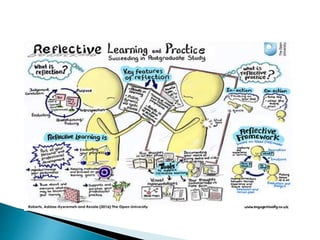
 What is reflection
 What is reflective practices
 What is reflective thinking
 Reflective practices as skills
 Types of reflection
 Critical reflection
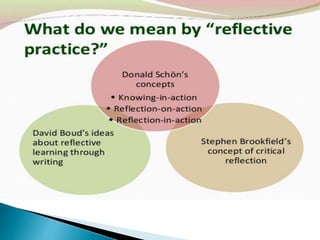
 Dewey (1910) said that reflective practice
‘enable us to direct our action with foresight
….. It enables us to know what we are about
when we act; schon(1983) expanded this to
include two aspects; reflection-in-action and
reflection-on-action
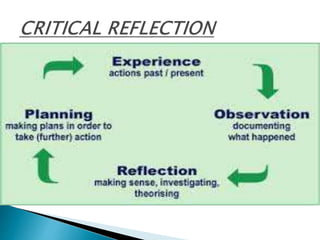
 Critical reflection is a reasoning process to
make meaning of an experience .
 Critical reflection is descriptive , analytical,
and critical
 And can be articulated in a number of ways.
 Such as a written from
 Orally, or as an artistic expression .
 Reflective practice is, in its simplest from,
thinking about or reflective on .
 What you do,
 It is closely linked to the concept of learning.
 From experience, in that you think about
 What you did, and what happened,
 And decide from that what you,
 Would do differently next time.
 Thinking about what has happened is part of
being human. However, the difference
between causal ‘thinking’ and’ reflective
practices
 Is that reflective practice requires a conscious
effort to think about events, and develop
insight in to them.
 Once you get into the habit of using reflective
practice, you will probably find is use find it
useful both at work and at home.
 Reflective practice is an active .
 Dynamic action based and ethical set of
skills.
 Placed in real time and dealing with real .
 Complex and difficult situation.
 Reflective listening is hearing and
understanding , and then letting the other .
 Know that he or she is being heard and
understood.
 It requires responding actively to another.
 While keeping your attention focused
completely on the speaker .
 In reflective listening, you do .
1. Focus your thoughts and develop ideas .
2. Develop your voice and again confidence.
3. Experiment with idea and ask question .
4. Organise your thinking through exploring
and mapping complex issue.
5. Develop your conceptual and analytical skill.
 Reflective thinking involves ‘‘consideration of
the larger context , the meaning , and the
implication of an experience or action .
 In other words , reflection doesn’t just mean
jotting down what you did or plan to do .
 It means considering why what you did or
plan to do matters ; it means writing to help
you better understand something ; it mean
exploring emotion, feelings, reactions, and
knowledges ; and it can even mean
catharsis.
• Level of understanding self-assessment
posters. …….
• Student goal setting . ……….
• Self-monitoring goal sheets . ……..
• My year in first grade – monthly informal
assessment . …….
• Study habits inventory and analysis-Reflective
learning activity . ………
• Who Am I and what will do with my life . …..
 Reflective practices is the ability to reflect on
one’s actions so as to engage in a process of
continuous learning .
 According to one definition it involves ‘paying
critical attention to the practical values and
theories which inform everyday actions.
 By examining practice reflectively and
reflectively .
1. Reflect on your experience . Think about
what you did , thought and felt at the time .
2. Reflect on your learning . Analyze your
experience and compare to the model or
principles that you want to follow .
3. Apply to your practice . Apply your learning
to your practice
 Reflective listening is hearing and
understanding, and then letting the other.
 Know that he or she is being heard and
understood .
 It require responding actively to another.
 While keeping your attention focused
completely on the speaker .
 In reflective listening, you do.
 Better understanding of our strengths and
weaknesses .
 Acknowledgement of our fears.
 Identification of possible inadequacies or
areas for improvement .
1. Reflect on your experience. Think about
what you did , thought, and felt at the time.
2. Reflect on your learning. Analyze your
experience and compare to the models or
principles that you want to follow. ….
3. Apply to your practice. Apply your learning
to your practice .
It also treat reflection as an integral part of
such learning . According to kolb (1984) , the
process of learning follows a pattern or cycle
consisting of four stages , one of which
involves what kolb refers to as reflective
observation
 Self awareness; thinking of yourself, your
experiences and your view of the world.
 Self improvement; learning from experience
and wanting to improve some areas of your
life.
 Empowerment; putting you in control of
making changes and behaving in a different
way.
1. Characterized by quite thought or
contemplation .
2. Capable or reflecting . A reflective surface .
3. Produced by reflection .
 Reflective is an adjective that can describe a
person who thinks through, or a surface that
reflective light or sound , like the reflective
lettering on a stop sign. ……
 A reflective person is a little different-he or
she might have great insight due to taking
the time to time carefully about things.
Broody, cogitative, contemplative, meditative,
melancholy, musing, pensive, ruminant,
ruminative, thoughtful . Worlds related to
reflective . Introspective , retrospective, self-
Reflective . Earnest , grave, sedate, serious,
serious-minded, severe, sober, solemn,
somber, ( or sombre ) , weighty
Reflective thinking helps learners develop
higher- order thinking skills by promoting
learners to
1. Related new knowledge to prior
understanding ,
2. Think in both abstract and conceptual
terms,
3. Apply specific strategies in novel tasks, and
4. Understanding their own thinking and
learning strategies.
 Two main types of reflection are often
referred to –reflection-in-action and
reflection-on-action. The most obvious
difference in is terms of when they happen .
 This is the reflection that take place whilst
you are involved in the situation, often a
patient interaction .
 Reflection-in-action involves using analysis
of observation, listening and/or touch or
‘feel’ to problem solve .
 It there fore sounds a lot like clinical
reasoning-where reflection differs is that the
problem solving leads to a change in the
practitioner’s view of self, values and beliefs.
 this type of reflection involves a stepping
back from the situation, meaning that it
happens at some time after the situation has
occurred. Therefore it demands a time
commitment something that is often a
challenge.
 Despite this, it has an important place in
professional development.
 Critical reflection is a reasoning process to
make meaning of an experience .
 Critical reflection is descriptive, analytical,
and critical, and can be articulated in a
number of ways such as in written from,
orally, or as an artistic expression.
 In short, this process adds depth and breadth
to an experience and builds connection
between course content and the experience.
 https;//www.utc. edu >think achive vt.c edu
 http;//www. Skills you need
 http;//www. Huwaii. Edu>intrels>com
 https;//www.quality research international
com
 https;//www.latrobib.lguides com
 https;//www.em.m.wikipedia. Org>wiki
 https;//www.synonms.com>reflect
 https;//www.merriam-webster.com
 https;//www.dictionary.reverso.net>to+be
 https;//www.vocabulary.com>refle
 https;//www.open.edu>ocontent>view
 https;//www.learm.solent .ac.uk>mod>view
 https;//www.maxwell.syr.edu>cmc
 https;//www.keith web.com
 https//www.skills for learning .leads
beckett.ac.uk
YOU

critical thinking usms bhit shah

  • 1.
  • 2.
    SIR NAEEM BALOCH UNIVERSTIYOF SUFISUM AND MODERN SCIENCE BHIT SHAH
  • 3.
     What isreflection  What is reflective practices  What is reflective thinking  Reflective practices as skills  Types of reflection  Critical reflection
  • 4.
     Dewey (1910)said that reflective practice ‘enable us to direct our action with foresight ….. It enables us to know what we are about when we act; schon(1983) expanded this to include two aspects; reflection-in-action and reflection-on-action
  • 5.
     Critical reflectionis a reasoning process to make meaning of an experience .  Critical reflection is descriptive , analytical, and critical  And can be articulated in a number of ways.  Such as a written from  Orally, or as an artistic expression .
  • 7.
     Reflective practiceis, in its simplest from, thinking about or reflective on .  What you do,  It is closely linked to the concept of learning.  From experience, in that you think about  What you did, and what happened,  And decide from that what you,  Would do differently next time.
  • 9.
     Thinking aboutwhat has happened is part of being human. However, the difference between causal ‘thinking’ and’ reflective practices  Is that reflective practice requires a conscious effort to think about events, and develop insight in to them.  Once you get into the habit of using reflective practice, you will probably find is use find it useful both at work and at home.
  • 10.
     Reflective practiceis an active .  Dynamic action based and ethical set of skills.  Placed in real time and dealing with real .  Complex and difficult situation.
  • 12.
     Reflective listeningis hearing and understanding , and then letting the other .  Know that he or she is being heard and understood.  It requires responding actively to another.  While keeping your attention focused completely on the speaker .  In reflective listening, you do .
  • 13.
    1. Focus yourthoughts and develop ideas . 2. Develop your voice and again confidence. 3. Experiment with idea and ask question . 4. Organise your thinking through exploring and mapping complex issue. 5. Develop your conceptual and analytical skill.
  • 14.
     Reflective thinkinginvolves ‘‘consideration of the larger context , the meaning , and the implication of an experience or action .  In other words , reflection doesn’t just mean jotting down what you did or plan to do .  It means considering why what you did or plan to do matters ; it means writing to help you better understand something ; it mean exploring emotion, feelings, reactions, and knowledges ; and it can even mean catharsis.
  • 15.
    • Level ofunderstanding self-assessment posters. ……. • Student goal setting . ………. • Self-monitoring goal sheets . …….. • My year in first grade – monthly informal assessment . ……. • Study habits inventory and analysis-Reflective learning activity . ……… • Who Am I and what will do with my life . …..
  • 16.
     Reflective practicesis the ability to reflect on one’s actions so as to engage in a process of continuous learning .  According to one definition it involves ‘paying critical attention to the practical values and theories which inform everyday actions.  By examining practice reflectively and reflectively .
  • 17.
    1. Reflect onyour experience . Think about what you did , thought and felt at the time . 2. Reflect on your learning . Analyze your experience and compare to the model or principles that you want to follow . 3. Apply to your practice . Apply your learning to your practice
  • 18.
     Reflective listeningis hearing and understanding, and then letting the other.  Know that he or she is being heard and understood .  It require responding actively to another.  While keeping your attention focused completely on the speaker .  In reflective listening, you do.
  • 19.
     Better understandingof our strengths and weaknesses .  Acknowledgement of our fears.  Identification of possible inadequacies or areas for improvement .
  • 20.
    1. Reflect onyour experience. Think about what you did , thought, and felt at the time. 2. Reflect on your learning. Analyze your experience and compare to the models or principles that you want to follow. …. 3. Apply to your practice. Apply your learning to your practice .
  • 21.
    It also treatreflection as an integral part of such learning . According to kolb (1984) , the process of learning follows a pattern or cycle consisting of four stages , one of which involves what kolb refers to as reflective observation
  • 22.
     Self awareness;thinking of yourself, your experiences and your view of the world.  Self improvement; learning from experience and wanting to improve some areas of your life.  Empowerment; putting you in control of making changes and behaving in a different way.
  • 23.
    1. Characterized byquite thought or contemplation . 2. Capable or reflecting . A reflective surface . 3. Produced by reflection .
  • 24.
     Reflective isan adjective that can describe a person who thinks through, or a surface that reflective light or sound , like the reflective lettering on a stop sign. ……  A reflective person is a little different-he or she might have great insight due to taking the time to time carefully about things.
  • 25.
    Broody, cogitative, contemplative,meditative, melancholy, musing, pensive, ruminant, ruminative, thoughtful . Worlds related to reflective . Introspective , retrospective, self- Reflective . Earnest , grave, sedate, serious, serious-minded, severe, sober, solemn, somber, ( or sombre ) , weighty
  • 26.
    Reflective thinking helpslearners develop higher- order thinking skills by promoting learners to 1. Related new knowledge to prior understanding , 2. Think in both abstract and conceptual terms, 3. Apply specific strategies in novel tasks, and 4. Understanding their own thinking and learning strategies.
  • 27.
     Two maintypes of reflection are often referred to –reflection-in-action and reflection-on-action. The most obvious difference in is terms of when they happen .
  • 28.
     This isthe reflection that take place whilst you are involved in the situation, often a patient interaction .  Reflection-in-action involves using analysis of observation, listening and/or touch or ‘feel’ to problem solve .  It there fore sounds a lot like clinical reasoning-where reflection differs is that the problem solving leads to a change in the practitioner’s view of self, values and beliefs.
  • 29.
     this typeof reflection involves a stepping back from the situation, meaning that it happens at some time after the situation has occurred. Therefore it demands a time commitment something that is often a challenge.  Despite this, it has an important place in professional development.
  • 30.
     Critical reflectionis a reasoning process to make meaning of an experience .  Critical reflection is descriptive, analytical, and critical, and can be articulated in a number of ways such as in written from, orally, or as an artistic expression.  In short, this process adds depth and breadth to an experience and builds connection between course content and the experience.
  • 31.
     https;//www.utc. edu>think achive vt.c edu  http;//www. Skills you need  http;//www. Huwaii. Edu>intrels>com  https;//www.quality research international com  https;//www.latrobib.lguides com  https;//www.em.m.wikipedia. Org>wiki  https;//www.synonms.com>reflect  https;//www.merriam-webster.com  https;//www.dictionary.reverso.net>to+be  https;//www.vocabulary.com>refle  https;//www.open.edu>ocontent>view
  • 32.
     https;//www.learm.solent .ac.uk>mod>view https;//www.maxwell.syr.edu>cmc  https;//www.keith web.com  https//www.skills for learning .leads beckett.ac.uk
  • 33.