Reflection
■ Important element of personal and professional development
■ Broadens practitioner’s views
■ Improves practitioner’s methodology
■ Releases some of the emotional burden
■ “Reflection” as a process seems to be somewhere around the notion of
learning and thinking. According to Moon (2004, p.82) reflection is a
form of mental processing – like a form of thinking- that we may use to
fulfil a purpose or to achieve some anticipated outcome or we may
simply “be reflective” and then an outcome can be unexpected.
Reflection is applied to relatively complicated, ill-structured ideas for
which there is not an obvious solution and is largely based on the further
processing of knowledge and understanding that we already possess.
Reflective practice
■ “Reflective practice” came into use particularly as a result of the work of
Donald Schön (1983, 1987). Reflective practice emphasizes the use of
reflection in professional or other complex activities as a means of coping
with situations that are ill-structured and/ or unpredictable (Lyons,
1999). It can be divided into two separate functions: reflection in action
and reflection on action.
Reflection in action
“Reflecting on what you are doing while you are doing it”
■ Thinking on what you are doing
■ Receiving immediate feedback
■ Calling on previous experiences
■ Drawing upon theories in use
■ Changing actions if it is needed
“thinking on our feet”  With the reflection in action the practitioner
builds new understandings which inform actions as the system is unfolding.
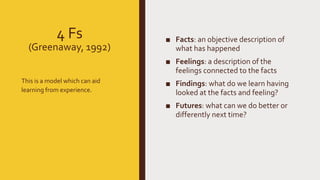
4 Fs
(Greenaway, 1992)
■ Facts: an objective description of
what has happened
■ Feelings: a description of the
feelings connected to the facts
■ Findings: what do we learn having
looked at the facts and feeling?
■ Futures: what can we do better or
differently next time?
This is a model which can aid
learning from experience.
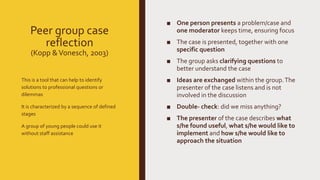
Peer group case
reflection
(Kopp &Vonesch, 2003)
■ One person presents a problem/case and
one moderator keeps time, ensuring focus
■ The case is presented, together with one
specific question
■ The group asks clarifying questions to
better understand the case
■ Ideas are exchanged within the group.The
presenter of the case listens and is not
involved in the discussion
■ Double- check: did we miss anything?
■ The presenter of the case describes what
s/he found useful, what s/he would like to
implement and how s/he would like to
approach the situation
This is a tool that can help to identify
solutions to professional questions or
dilemmas
It is characterized by a sequence of defined
stages
A group of young people could use it
without staff assistance
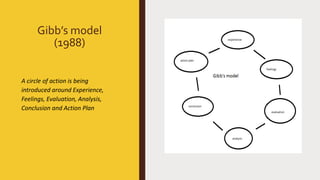
Gibb’s model
(1988)
A circle of action is being
introduced around Experience,
Feelings, Evaluation, Analysis,
Conclusion and Action Plan
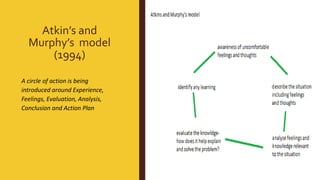
Atkin’s and
Murphy’s model
(1994)
A circle of action is being
introduced around Experience,
Feelings, Evaluation, Analysis,
Conclusion and Action Plan
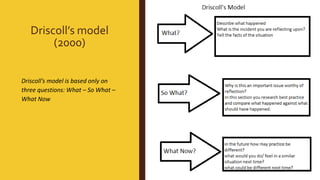
Driscoll’s model
(2000)
Driscoll’s model is based only on
three questions: What – So What –
What Now
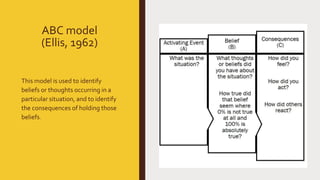
This model is used to identify
beliefs or thoughts occurring in a
particular situation, and to identify
the consequences of holding those
beliefs.
ABC model
(Ellis, 1962)
FinalThoughts
Reflection is regarded wrongly as a one-man’s show; a set of eyes and a set
of ears decode a message and analyze an action from a specific angle only.
Taking time to analyze what happened is beneficial for the individual;
involving others in this process, though, sets other perspectives to the
analysis by combining angles and understandings of our surroundings.
Bibliography
 Atkins, S. and Murphy, K. (1994) Reflective Practice in Nursing Standard 8(39) 49-56
 Churchill, R., Moore, T. H., Caldwell, D., Davies, P., Jones, H., Furukawa, T. A., Lewis, G., &
Hunot, V. (2010). Cognitive behavioural therapies versus other psychological therapies for
depression. The Cochrane database of systematic reviews, (9), CD008698.
https://doi.org/10.1002/14651858.CD008698
 Driscoll, J. (2000) Practicing Clinical Supervision, Edinburgh: Baldiere Tindall
 Foreman, E. I., & Pollard, C. (2016). Cognitive Behavioural Therapy (CBT): Your Toolkit to
Modify Mood, Overcome Obstructions and Improve Your Life. Icon Books.
 Gibbs, G. (1988) Learning by doing: a guide to teaching and learning methods, London: Further
Education Unit
 Lyons, J. (1999) Reflective Education for Professional Practice: discovering knowledge from
experience, Nurse Education Today, 19, 29-34
 Moon, J. (2004) A handbook of reflective and experiential learning. Theory and Practice, New

Reflection | STARTUP

  • 1.
    Reflection ■ Important elementof personal and professional development ■ Broadens practitioner’s views ■ Improves practitioner’s methodology ■ Releases some of the emotional burden
  • 2.
    ■ “Reflection” asa process seems to be somewhere around the notion of learning and thinking. According to Moon (2004, p.82) reflection is a form of mental processing – like a form of thinking- that we may use to fulfil a purpose or to achieve some anticipated outcome or we may simply “be reflective” and then an outcome can be unexpected. Reflection is applied to relatively complicated, ill-structured ideas for which there is not an obvious solution and is largely based on the further processing of knowledge and understanding that we already possess.
  • 3.
    Reflective practice ■ “Reflectivepractice” came into use particularly as a result of the work of Donald Schön (1983, 1987). Reflective practice emphasizes the use of reflection in professional or other complex activities as a means of coping with situations that are ill-structured and/ or unpredictable (Lyons, 1999). It can be divided into two separate functions: reflection in action and reflection on action.
  • 4.
    Reflection in action “Reflectingon what you are doing while you are doing it” ■ Thinking on what you are doing ■ Receiving immediate feedback ■ Calling on previous experiences ■ Drawing upon theories in use ■ Changing actions if it is needed “thinking on our feet”  With the reflection in action the practitioner builds new understandings which inform actions as the system is unfolding.
  • 5.
    4 Fs (Greenaway, 1992) ■Facts: an objective description of what has happened ■ Feelings: a description of the feelings connected to the facts ■ Findings: what do we learn having looked at the facts and feeling? ■ Futures: what can we do better or differently next time? This is a model which can aid learning from experience.
  • 6.
    Peer group case reflection (Kopp&Vonesch, 2003) ■ One person presents a problem/case and one moderator keeps time, ensuring focus ■ The case is presented, together with one specific question ■ The group asks clarifying questions to better understand the case ■ Ideas are exchanged within the group.The presenter of the case listens and is not involved in the discussion ■ Double- check: did we miss anything? ■ The presenter of the case describes what s/he found useful, what s/he would like to implement and how s/he would like to approach the situation This is a tool that can help to identify solutions to professional questions or dilemmas It is characterized by a sequence of defined stages A group of young people could use it without staff assistance
  • 7.
    Gibb’s model (1988) A circleof action is being introduced around Experience, Feelings, Evaluation, Analysis, Conclusion and Action Plan
  • 8.
    Atkin’s and Murphy’s model (1994) Acircle of action is being introduced around Experience, Feelings, Evaluation, Analysis, Conclusion and Action Plan
  • 9.
    Driscoll’s model (2000) Driscoll’s modelis based only on three questions: What – So What – What Now
  • 10.
    This model isused to identify beliefs or thoughts occurring in a particular situation, and to identify the consequences of holding those beliefs. ABC model (Ellis, 1962)
  • 11.
    FinalThoughts Reflection is regardedwrongly as a one-man’s show; a set of eyes and a set of ears decode a message and analyze an action from a specific angle only. Taking time to analyze what happened is beneficial for the individual; involving others in this process, though, sets other perspectives to the analysis by combining angles and understandings of our surroundings.
  • 12.
    Bibliography  Atkins, S.and Murphy, K. (1994) Reflective Practice in Nursing Standard 8(39) 49-56  Churchill, R., Moore, T. H., Caldwell, D., Davies, P., Jones, H., Furukawa, T. A., Lewis, G., & Hunot, V. (2010). Cognitive behavioural therapies versus other psychological therapies for depression. The Cochrane database of systematic reviews, (9), CD008698. https://doi.org/10.1002/14651858.CD008698  Driscoll, J. (2000) Practicing Clinical Supervision, Edinburgh: Baldiere Tindall  Foreman, E. I., & Pollard, C. (2016). Cognitive Behavioural Therapy (CBT): Your Toolkit to Modify Mood, Overcome Obstructions and Improve Your Life. Icon Books.  Gibbs, G. (1988) Learning by doing: a guide to teaching and learning methods, London: Further Education Unit  Lyons, J. (1999) Reflective Education for Professional Practice: discovering knowledge from experience, Nurse Education Today, 19, 29-34  Moon, J. (2004) A handbook of reflective and experiential learning. Theory and Practice, New