FACTS
EEE-B
Batch-5
INTRODUCTION
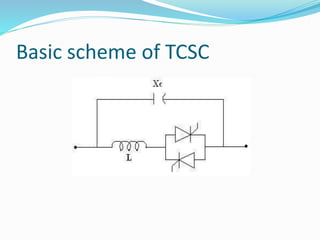
 The TCSC concept is that capacitor is inserted directly
in series with the transmission line and the thyristor
controlled inductor is mounted directly in parallel
with the capacitor.
 Thus no interfacing equipment like high voltage
transformer is required.
 So TCSC is more economic than some other
challenging FACTS technologies.
TCSC
Thyristor controlled series capacitor is a series FACTS
device. TCSC is a capacitive reactance compensator.
It is a more effective and provides suitable solutions due to
flexible control of thyristor. TCSC is connected in series
with the transmission line conductors.
Basic scheme of TCSC
TCSC
 TCSC plays vital roles in the operation and control of power
systems such as
1. Enhancing power flow
2. limiting fault current
3. Enhancing transient
4. Dynamic stability
Uses of TCSC
 Increase power transmission capability
 Improve system stability
 Reduce system losses
 Improve voltage profile of the lines
TCSC
Thyristor-controlled series compensation (TCSC)
introduces a number of important new benefits in the
application of series capacitors
• Mitigation of subsynchronous resonance risks
• Damping of active power oscillations
• Post-contingency stability improvement
• Dynamic power flow control
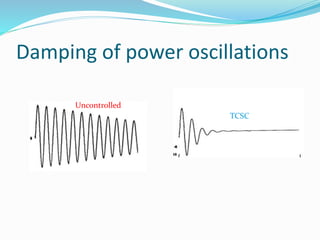
Damping of power oscillations
 Oscillations of active power in power transmission
systems may arise in corridors between generating
areas as a result of poor damping of the
interconnection, particularly during heavy power
transfer. Such oscillations can be excited by a number
of reasons such as line faults or a sudden change of
generator output.
Damping of power oscillations
Uncontrolled
TCSC
Operating modes of TCSC
 Blocking mode
 Bypass mode
 Capacitive boost mode(Capacitive vernier mode)
 Inductive boost mode(Inductive vernier mode)
Modes of TCSC
Cont…
 In case of blocked operating mode, the thyristor valve is not triggered
and the thyristor are kept in non- conducting state.
 In case of bypass mode, as the thyristors are fully conducting, most of
the line current flows through thyristors and hence TCSC has small net
inductive reactance.
 In Vernier control, thyristors are conducted in such a manner that a
controlled amount of inductive current can circulate through the
capacitor, thereby increasing effective capacitive/inductive reactance of
the module.
Advantages of TCSC
 Increase power transmission capability
 Improve system stability
 Reduce system losses
 Improve voltage profile of the lines
 Optimize power flow between parallel lines
 Damping of the power swings from local and inter area
oscillations
Application of TCSC
 Accurately regulating the power flow on a
transmission line
 Damping inter area power oscillations,
 Mitigating subsynchronous resonance (SSR)
 Improving transient stability
Tcsc ppt

Tcsc ppt

  • 1.
  • 2.
    INTRODUCTION  The TCSCconcept is that capacitor is inserted directly in series with the transmission line and the thyristor controlled inductor is mounted directly in parallel with the capacitor.  Thus no interfacing equipment like high voltage transformer is required.  So TCSC is more economic than some other challenging FACTS technologies.
  • 3.
    TCSC Thyristor controlled seriescapacitor is a series FACTS device. TCSC is a capacitive reactance compensator. It is a more effective and provides suitable solutions due to flexible control of thyristor. TCSC is connected in series with the transmission line conductors.
  • 4.
  • 5.
    TCSC  TCSC playsvital roles in the operation and control of power systems such as 1. Enhancing power flow 2. limiting fault current 3. Enhancing transient 4. Dynamic stability
  • 6.
    Uses of TCSC Increase power transmission capability  Improve system stability  Reduce system losses  Improve voltage profile of the lines
  • 7.
    TCSC Thyristor-controlled series compensation(TCSC) introduces a number of important new benefits in the application of series capacitors • Mitigation of subsynchronous resonance risks • Damping of active power oscillations • Post-contingency stability improvement • Dynamic power flow control
  • 8.
    Damping of poweroscillations  Oscillations of active power in power transmission systems may arise in corridors between generating areas as a result of poor damping of the interconnection, particularly during heavy power transfer. Such oscillations can be excited by a number of reasons such as line faults or a sudden change of generator output.
  • 9.
    Damping of poweroscillations Uncontrolled TCSC
  • 10.
    Operating modes ofTCSC  Blocking mode  Bypass mode  Capacitive boost mode(Capacitive vernier mode)  Inductive boost mode(Inductive vernier mode)
  • 11.
  • 12.
    Cont…  In caseof blocked operating mode, the thyristor valve is not triggered and the thyristor are kept in non- conducting state.  In case of bypass mode, as the thyristors are fully conducting, most of the line current flows through thyristors and hence TCSC has small net inductive reactance.  In Vernier control, thyristors are conducted in such a manner that a controlled amount of inductive current can circulate through the capacitor, thereby increasing effective capacitive/inductive reactance of the module.
  • 13.
    Advantages of TCSC Increase power transmission capability  Improve system stability  Reduce system losses  Improve voltage profile of the lines  Optimize power flow between parallel lines  Damping of the power swings from local and inter area oscillations
  • 14.
    Application of TCSC Accurately regulating the power flow on a transmission line  Damping inter area power oscillations,  Mitigating subsynchronous resonance (SSR)  Improving transient stability