Design Challenges in
Embedded Systems
G. Mahalakshmi Malini, AP/ECE
Avinashilingam Institute for Home Science and Higher Education for Women, School of Engineering
Department of Electronics and Communication Engineering
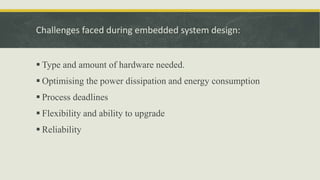
Challenges faced during embedded system design:
 Type and amount of hardware needed.
 Optimising the power dissipation and energy consumption
 Process deadlines
 Flexibility and ability to upgrade
 Reliability
Challenges in embedded system design
Type and amount of
hardware
Hardware based on SoC or VLSI design has very high NRE cost
and hardware design on a circuit board depends on available
chips.
Power dissipation Power is energy dissipated per second
Energy Consumption Energy consumption per unit talk time in a phone needs to be
controlled so that battery requires 24-hour battery charging after
the 4 hours of talk during the day.
Process deadlines Meeting the deadline of all processes in the system while keeping
the memory, power dissipation, processor clock rate and cost at
minimum is a challenge.
Flexibility Flexibility in design at little cost overhead is a challenge.
Ability to upgrade Ability to upgrade the design while keeping the cost minimum
Challenges in Embedded Challenges in Embedded System Design:
Optimizing the Design System Design: Optimizing the Design
Metrics
 Power dissipation, physical size, number of gates and engineering,
prototype development and manufacturing costs.
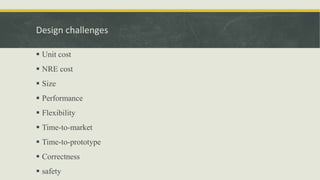
Design challenges
 Unit cost
 NRE cost
 Size
 Performance
 Flexibility
 Time-to-market
 Time-to-prototype
 Correctness
 safety
Unit cost and NRE cost
 Unit Cost: the monetary cost of manufacturing each copy of the system,
excluding NRE cost.
 NRE cost (Non-Recurring engineering cost): the one-time monetary cost of
designing the system.
size
 The physical space required by the system
 Individually or part of a system
Cost and type of hardware needed
 Optimizing the microprocessors, ASIPs and single purpose processors in
the system.
 Hardware software participation
 How much H/W How much S/W?
 Optimization – according to the performance, power dissipation, cost and
other design metrics the system.
 Optimizing hardware (memory RAM, ROM or internal and external flash
or secondary memory in the system, peripherals and devices internal and
external to the system, ports and buses in the system and power source or
battery in the system)
Considering design metrics
 Power dissipation
 Physical size, number of gates and engineering
 Prototype development and manufacturing costs.
Power dissipation optimizing
 Clock rate reduction
 Operating voltage reduction
 Wait, stop and cache disable instructions
 Disabling or controlling certain units when not needed is one method of
saving power during execution.
 Small size, low weight
 Real time/ reactive operation
Deadlines
 Challenging is reducing cost by meeting the deadline of all processes in the
system while keeping the memory, power dissipation, processor clock rate.
Flexibility
 Different versions of a product for marketing
 The ability to change the functionality of the system without incurring
heavy NRE cost
 Upgrading and releasing advanced versions
Reliability and safety
 Designing reliable product
 Testing, verification and validation is a challenge
 Assured safety
Testing
 Find errors and to validate that the implemented product is as per the
specifications and requirements to get reliable product.
verification
 Ensure specific functions are correctly implemented
Time-to-prototype, Time-to-market
 The time needed to build a working version of the system.
 The time required to develop a system to the point that it can be released
and sold to customers.
Maintainability
 The ability to modify the system after its initial release
 Correctness, safety
Validation
 To ensure that the system that has been created is a s per requirements
agreed upon at the analysis phase, and to ensure its quality
Summary
 Discussed the different challenges in embedded system design
 Explained the need for optimization in design and production
 Discussed the importance of power utilization and minimization

Design challenges in embedded systems

  • 1.
    Design Challenges in EmbeddedSystems G. Mahalakshmi Malini, AP/ECE Avinashilingam Institute for Home Science and Higher Education for Women, School of Engineering Department of Electronics and Communication Engineering
  • 2.
    Challenges faced duringembedded system design:  Type and amount of hardware needed.  Optimising the power dissipation and energy consumption  Process deadlines  Flexibility and ability to upgrade  Reliability
  • 3.
    Challenges in embeddedsystem design Type and amount of hardware Hardware based on SoC or VLSI design has very high NRE cost and hardware design on a circuit board depends on available chips. Power dissipation Power is energy dissipated per second Energy Consumption Energy consumption per unit talk time in a phone needs to be controlled so that battery requires 24-hour battery charging after the 4 hours of talk during the day. Process deadlines Meeting the deadline of all processes in the system while keeping the memory, power dissipation, processor clock rate and cost at minimum is a challenge. Flexibility Flexibility in design at little cost overhead is a challenge. Ability to upgrade Ability to upgrade the design while keeping the cost minimum
  • 4.
    Challenges in EmbeddedChallenges in Embedded System Design: Optimizing the Design System Design: Optimizing the Design Metrics  Power dissipation, physical size, number of gates and engineering, prototype development and manufacturing costs.
  • 5.
    Design challenges  Unitcost  NRE cost  Size  Performance  Flexibility  Time-to-market  Time-to-prototype  Correctness  safety
  • 6.
    Unit cost andNRE cost  Unit Cost: the monetary cost of manufacturing each copy of the system, excluding NRE cost.  NRE cost (Non-Recurring engineering cost): the one-time monetary cost of designing the system.
  • 7.
    size  The physicalspace required by the system  Individually or part of a system
  • 8.
    Cost and typeof hardware needed  Optimizing the microprocessors, ASIPs and single purpose processors in the system.  Hardware software participation  How much H/W How much S/W?  Optimization – according to the performance, power dissipation, cost and other design metrics the system.
  • 9.
     Optimizing hardware(memory RAM, ROM or internal and external flash or secondary memory in the system, peripherals and devices internal and external to the system, ports and buses in the system and power source or battery in the system)
  • 10.
    Considering design metrics Power dissipation  Physical size, number of gates and engineering  Prototype development and manufacturing costs.
  • 11.
    Power dissipation optimizing Clock rate reduction  Operating voltage reduction  Wait, stop and cache disable instructions  Disabling or controlling certain units when not needed is one method of saving power during execution.  Small size, low weight  Real time/ reactive operation
  • 12.
    Deadlines  Challenging isreducing cost by meeting the deadline of all processes in the system while keeping the memory, power dissipation, processor clock rate.
  • 13.
    Flexibility  Different versionsof a product for marketing  The ability to change the functionality of the system without incurring heavy NRE cost  Upgrading and releasing advanced versions
  • 14.
    Reliability and safety Designing reliable product  Testing, verification and validation is a challenge  Assured safety
  • 15.
    Testing  Find errorsand to validate that the implemented product is as per the specifications and requirements to get reliable product.
  • 16.
    verification  Ensure specificfunctions are correctly implemented
  • 17.
    Time-to-prototype, Time-to-market  Thetime needed to build a working version of the system.  The time required to develop a system to the point that it can be released and sold to customers.
  • 18.
    Maintainability  The abilityto modify the system after its initial release  Correctness, safety
  • 19.
    Validation  To ensurethat the system that has been created is a s per requirements agreed upon at the analysis phase, and to ensure its quality
  • 20.
    Summary  Discussed thedifferent challenges in embedded system design  Explained the need for optimization in design and production  Discussed the importance of power utilization and minimization