Embedded Systems
Chapter 1:Embedded Architecture
BY
AMRUTA CHINTAWAR
Friday, September 04, 2015 By AMRUTA CHINTAWAR 1
Embedded Architecture
Friday, September 04, 2015 By AMRUTA CHINTAWAR 2
• Embedded computers
• Characteristics
• Applications
• Challenges
• Embedded memories
• ES design process
• Requirement specifications
• Architecture
• H/W and S/W components
• System Integration
• Design examples
Definition
• Embedded computing system: any
device that includes a programmable
computer but is not itself a general-
purpose computer.
• System has a S/W embedded into
Computer H/W, which makes the
system dedicated for an application
or specific part of an application or
product or part of a larger system.
Friday, September 04, 2015 By AMRUTA CHINTAWAR 3
Definition
• Embedded systems (ES) = information
processing systems embedded into a
larger product
• Main reason for buying is not information
processing
Friday, September 04, 2015 By AMRUTA CHINTAWAR 4
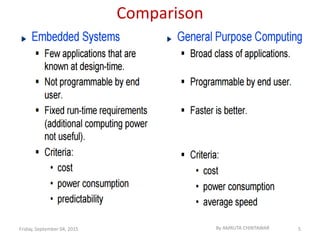
Comparison
Friday, September 04, 2015 By AMRUTA CHINTAWAR 5
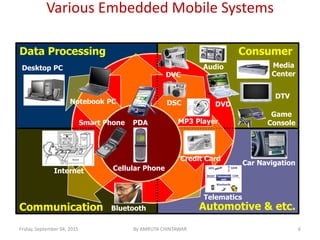
Various Embedded Mobile Systems
Desktop PC
Data Processing Consumer
Communication Automotive & etc.
DTV
Media
Center
Game
Console
DSC
DVC
Car Navigation
DVD
Telematics
MP3 Player
Credit Card
Cellular Phone
Notebook PC
Internet
Smart Phone PDA
Bluetooth
Audio
Friday, September 04, 2015 6By AMRUTA CHINTAWAR
Examples
• Biomedical Instrumentation: ECG Recorder, Blood cell
recorder, patient monitor system
• Communication system: pagers, cellular phones, cable TV
terminals, fax and transreceiver, video games and so on.
• Peripheral controllers of a computer –keyboard controller,
DRAM controller, Printer Controller, LAN controller, Disk
drive Controller
Friday, September 04, 2015 By AMRUTA CHINTAWAR 7
Examples
Friday, September 04, 2015 By AMRUTA CHINTAWAR 8
• Industrial Instrumentation- Process controller,
DC motor controller, robotic system, CNC
machines controller, close loop engine
controller, industrial moisture recorder cum
controller
• Scientific –digital storage system, CRT display
controller, spectrum analyzer.
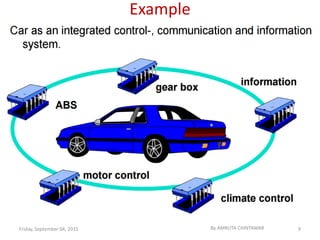
Example
Friday, September 04, 2015 By AMRUTA CHINTAWAR 9
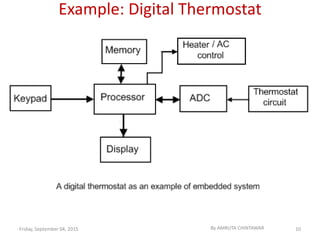
Example: Digital Thermostat
Friday, September 04, 2015 By AMRUTA CHINTAWAR 10
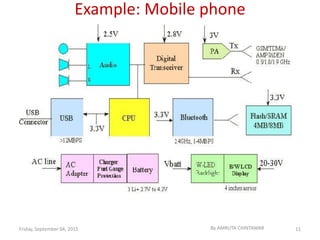
Example: Mobile phone
Friday, September 04, 2015 By AMRUTA CHINTAWAR 11
Characteristics
• Dedicated and sophisticated functionality
• Low manufacturing cost, low power
• Complex Algorithm
• GUI, other user interface
• Reliability
• Real Time operations
-latencies
-Deadlines
• Multirate Operations
-Audio
-Vedio
Friday, September 04, 2015 By AMRUTA CHINTAWAR 12
Design Metrics/Goals
• Reliability
• Power Consumption
• Cost :NRE cost & Manufacturing cost
• Weight/size
• Time: time to prototype & time to market
• Flexibility
• Performance
• Debuggability
• Safty & maintaince
• Maximum usage of resources
Friday, September 04, 2015 By AMRUTA CHINTAWAR 13
Challenges
• How much hardware do we need?
– How big is the CPU? Memory?
• How do we meet our deadlines?
– Faster hardware or cleverer software?
• How do we minimize power?
– Turn off unnecessary logic? Reduce memory accesses?
• Does it really work?
– Is the specification correct?
– Does the implementation meet the spec?
– Reliability in safety-critical systems
Friday, September 04, 2015 By AMRUTA CHINTAWAR 14
Challenges
• How do we work on the system?
– Complex testing
• How do we test for real-time characteristics?
• How do we test on real data?
– Limited observability and controllability
– Restricted development environments
• What is our development platform?
Friday, September 04, 2015 By AMRUTA CHINTAWAR 15
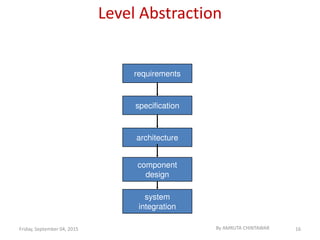
Level Abstraction
Friday, September 04, 2015 By AMRUTA CHINTAWAR 16
requirements
specification
architecture
component
design
system
integration
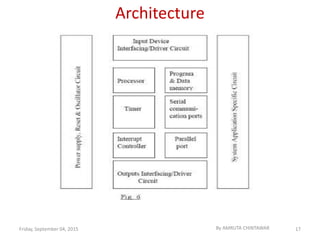
Architecture
Friday, September 04, 2015 By AMRUTA CHINTAWAR 17
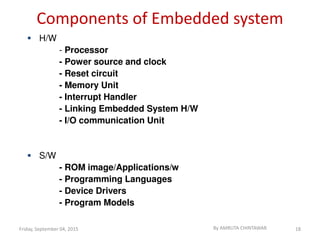
Components of Embedded system
Friday, September 04, 2015 By AMRUTA CHINTAWAR 18
 H/W
- Processor
- Power source and clock
- Reset circuit
- Memory Unit
- Interrupt Handler
- Linking Embedded System H/W
- I/O communication Unit
 S/W
- ROM image/Applications/w
- Programming Languages
- Device Drivers
- Program Models
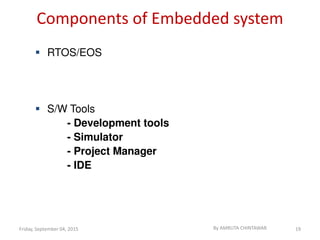
Components of Embedded system
Friday, September 04, 2015 By AMRUTA CHINTAWAR 19
 RTOS/EOS
 S/W Tools
- Development tools
- Simulator
- Project Manager
- IDE
Types of Cores
Friday, September 04, 2015 By AMRUTA CHINTAWAR 20
Requirments
-Able to solve complex Algorithm
- Meet Deadlines
- No.of Bits to be operated
- Bus Width
- Clock Frequency
- Performance(MIPS/MFLOPS)
Types of Cores
Friday, September 04, 2015 By AMRUTA CHINTAWAR 21
 GPP: General Purpose Processor
-Microprocessors
-Embedded Processors
 ASIP: Application Specific Instruction Processor
-Micro controller
-Embedded Micro controller
-DSP and media Processor
-Network Processor
 SPP: Single Purpose Processor
-Coprocessors eg:Math-coprocessor
-Accelerators eg:java acce
-Controllers eg:DMA
Types of Cores
Friday, September 04, 2015 By AMRUTA CHINTAWAR 22
 ASIC/VLSI chip: Application specific
Integrated circuit
-GPP/ASIP integrated with analog
circuits on VLSI chip using EDA tools.
 ASSP:Application Specific System
Processor
-set top box
-Mpeg
-HD tv
eg:vedio Processors
 Multicore Processors/Multiprocessor
using GPP
eg:Embedded firewall cum
Router
Power Sources,Clock and Reset Circuit
Friday, September 04, 2015 By AMRUTA CHINTAWAR 23
 Power supply
-Own supply
-Supply from System
-Charge Pumps
 Clock
-External Clock supply
-Oscillator
-RTC
 Reset
-Power On
-External/Internal Reset
-WDT
-BOR
Memory Unit,Interrupt Handlers
Friday, September 04, 2015 By AMRUTA CHINTAWAR 24
Memory
 ROM/EPROM/FLASH (internal/External)
 RAM
 Caches
Interrupt Handler
 External port interrupt
 I/O,Timer, RTC, interrupts
 S/W Interrupt/Exceptions
Linking ES H/W
 Multiplexers
 Decodes
I/O communication Unit
Friday, September 04, 2015 By AMRUTA CHINTAWAR 25
 I/O,O/P devices
-Sensors,
-actuators
-converters
-keypads
-displays
 Buses
-Parallel Buses
-serial buses
S/W-ROM Image, Programming
Language
Friday, September 04, 2015 By AMRUTA CHINTAWAR 26
 ROM Image
-Final Machine s/w
-Can be compressed code or data
-Distinct ROM image in distinct ES
 Programming Languages
-Machine
-Assembly
-High Level
S/W-Device Driver, Managers
Friday, September 04, 2015 By AMRUTA CHINTAWAR 27
It connects external H/w with Processor
 Controlling
 Receiving
 Sending
Part of OS
 Manages device
 Initializing
 Testing
 Detecting
 Allocating port addresses
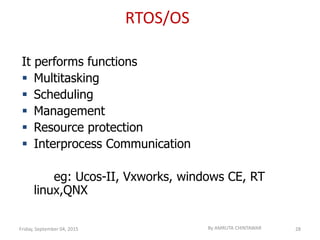
RTOS/OS
Friday, September 04, 2015 By AMRUTA CHINTAWAR 28
It performs functions
 Multitasking
 Scheduling
 Management
 Resource protection
 Interprocess Communication
eg: Ucos-II, Vxworks, windows CE, RT
linux,QNX
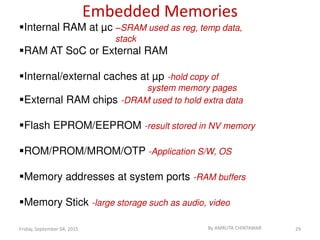
Embedded Memories
Friday, September 04, 2015 By AMRUTA CHINTAWAR 29
Internal RAM at µc –SRAM used as reg, temp data,
stack
RAM AT SoC or External RAM
Internal/external caches at µp -hold copy of
system memory pages
External RAM chips -DRAM used to hold extra data
Flash EPROM/EEPROM -result stored in NV memory
ROM/PROM/MROM/OTP -Application S/W, OS
Memory addresses at system ports -RAM buffers
Memory Stick -large storage such as audio, video
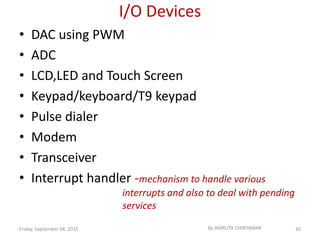
I/O Devices
Friday, September 04, 2015 By AMRUTA CHINTAWAR 30
• DAC using PWM
• ADC
• LCD,LED and Touch Screen
• Keypad/keyboard/T9 keypad
• Pulse dialer
• Modem
• Transceiver
• Interrupt handler -mechanism to handle various
interrupts and also to deal with pending
services
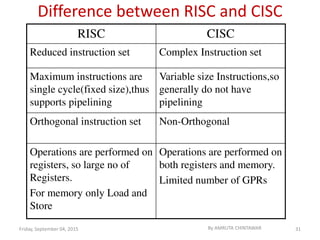
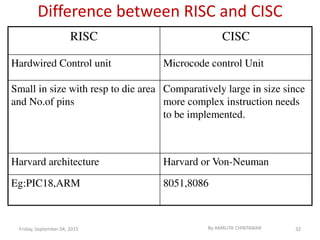
Difference between RISC and CISC
Friday, September 04, 2015 By AMRUTA CHINTAWAR 31
RISC CISC
Reduced instruction set Complex Instruction set
Maximum instructions are
single cycle(fixed size),thus
supports pipelining
Variable size Instructions,so
generally do not have
pipelining
Orthogonal instruction set Non-Orthogonal
Operations are performed on
registers, so large no of
Registers.
For memory only Load and
Store
Operations are performed on
both registers and memory.
Limited number of GPRs
Difference between RISC and CISC
Friday, September 04, 2015 By AMRUTA CHINTAWAR 32
RISC CISC
Hardwired Control unit Microcode control Unit
Small in size with resp to die area
and No.of pins
Comparatively large in size since
more complex instruction needs
to be implemented.
Harvard architecture Harvard or Von-Neuman
Eg:PIC18,ARM 8051,8086
SoC
Friday, September 04, 2015 By AMRUTA CHINTAWAR 33
• System designed on a single chip
• Processor with all analog, digital and S/W
build on a single VLSI chip
SoC
Friday, September 04, 2015 By AMRUTA CHINTAWAR 34
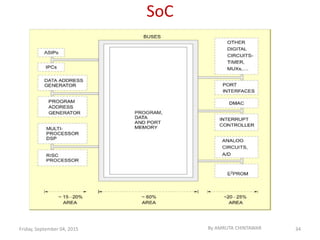
SoC
Friday, September 04, 2015 By AMRUTA CHINTAWAR 35
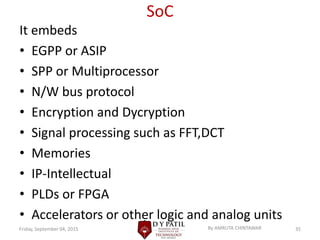
It embeds
• EGPP or ASIP
• SPP or Multiprocessor
• N/W bus protocol
• Encryption and Dycryption
• Signal processing such as FFT,DCT
• Memories
• IP-Intellectual
• PLDs or FPGA
• Accelerators or other logic and analog units
IP-Intellectual Property
Friday, September 04, 2015 By AMRUTA CHINTAWAR 36
• A standard source solution for synthesizing a
higher level component by configuring an
FPGA core/VLSI core
• Components-gate level sophistication in
circuits above that of counter, register,
multiplier, FLU and ALU
H/W and S/W Co-Design
Friday, September 04, 2015 By AMRUTA CHINTAWAR 37
H/W and S/W Co-Design
Friday, September 04, 2015 By AMRUTA CHINTAWAR 38
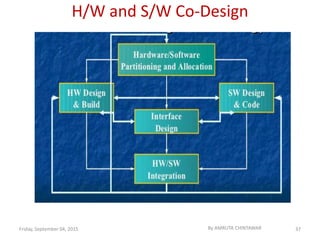
• Joint optimization of H/W and S/W to
optimize design metrics
• S/W and H/W partitioning at early stage
• Both proceed in parallel with interactions and
feedback
• System specification required
• H/W synthesis
• S/W synthesis
• Simulation
• Implementation
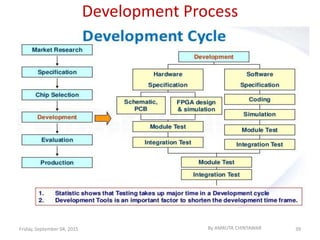
Development Process
Friday, September 04, 2015 By AMRUTA CHINTAWAR 39
Levels of Abstraction from Top to Bottom
• Requirements
• Specifications
• Architecture
• Components
• System Integration
Friday, September 04, 2015 By AMRUTA CHINTAWAR 40
Requirement
Complete clarity of:
• Required Purpose
• Inputs
• Outputs
• Functioning
• Design metrics
• Validation requirements for finally developed
system specifications
• Consistency in the requirements
Friday, September 04, 2015 By AMRUTA CHINTAWAR 41
Specifications
• Clear specification of customer expectations
from the product
• Needs specification for
– H/W, eg: Peripherals, Divices,Processors and
memory specifications
– Data types and processing specifications
• Expected system behavior specifications
• Constraints of design
• Expected lifecycle specifications of the
product
Friday, September 04, 2015 By AMRUTA CHINTAWAR 42
Specifications
• Process specifications analyzed by making list
of I/Ps on event list, O/Ps on events, process
activated on each event
Friday, September 04, 2015 By AMRUTA CHINTAWAR 43
S/W Architectural Layers
• How the different elements- data structures,
data bases, algorithms, control functions,
state transition functions, process, data and
program flow are to be organized
• Data base and Data structure design-
appropriate for given problem
Eg: tree like structure
Friday, September 04, 2015 By AMRUTA CHINTAWAR 44
H/W Components
• Processors, ASIP, Single Processors
• All Types of Memory as per requirement
• Internal and External peripherals and
devices
• Ports and Buses in the system
• Power sources and battery
Friday, September 04, 2015 By AMRUTA CHINTAWAR 45
Design Examples
• ACVM
• Smart Card
• Digital Camera
• Mobile phones
• Mobile Computer
• Set of Robots
Friday, September 04, 2015 By AMRUTA CHINTAWAR 46
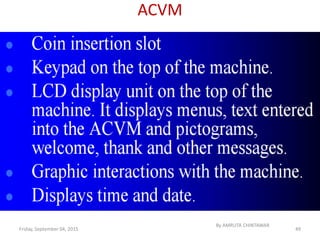
ACVM
Friday, September 04, 2015 By AMRUTA CHINTAWAR 47
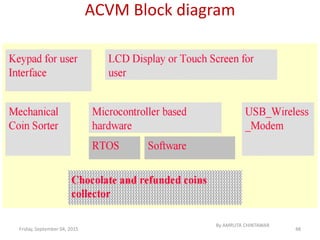
ACVM Block diagram
Friday, September 04, 2015
By AMRUTA CHINTAWAR
48
ACVM
Friday, September 04, 2015
By AMRUTA CHINTAWAR
49
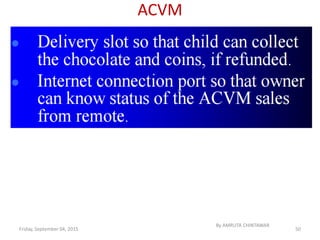
ACVM
Friday, September 04, 2015
By AMRUTA CHINTAWAR
50
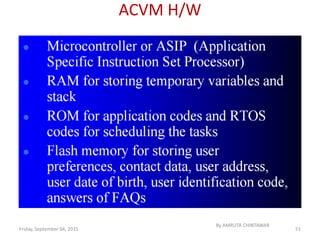
ACVM H/W
Friday, September 04, 2015
By AMRUTA CHINTAWAR
51
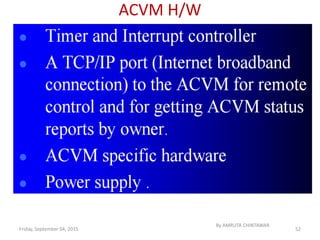
ACVM H/W
Friday, September 04, 2015
By AMRUTA CHINTAWAR
52
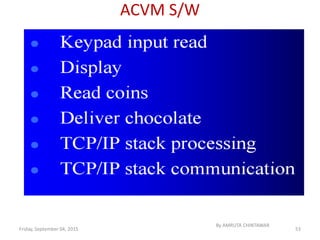
ACVM S/W
Friday, September 04, 2015
By AMRUTA CHINTAWAR
53
SMART CARD
Friday, September 04, 2015 By AMRUTA CHINTAWAR 54
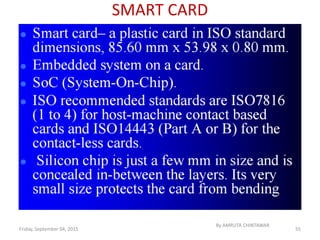
SMART CARD
Friday, September 04, 2015
By AMRUTA CHINTAWAR
55
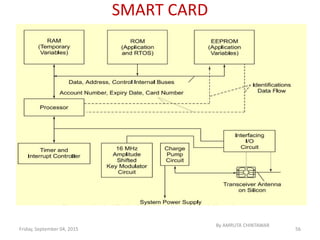
SMART CARD
Friday, September 04, 2015
By AMRUTA CHINTAWAR
56
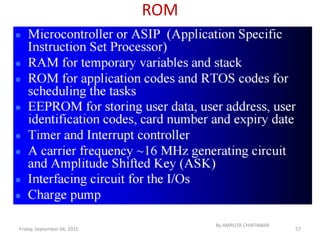
ROM
Friday, September 04, 2015
By AMRUTA CHINTAWAR
57
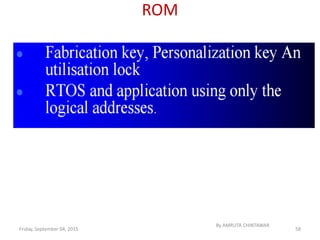
ROM
Friday, September 04, 2015
By AMRUTA CHINTAWAR
58
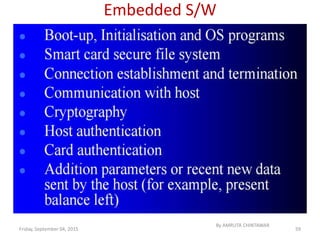
Embedded S/W
Friday, September 04, 2015
By AMRUTA CHINTAWAR
59
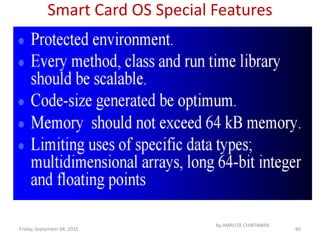
Smart Card OS Special Features
Friday, September 04, 2015
By AMRUTA CHINTAWAR
60
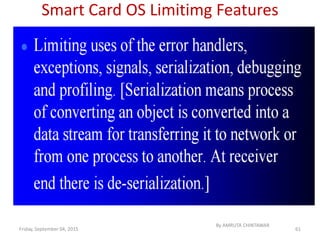
Smart Card OS Limitimg Features
Friday, September 04, 2015
By AMRUTA CHINTAWAR
61
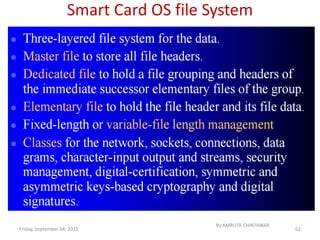
Smart Card OS file System
Friday, September 04, 2015
By AMRUTA CHINTAWAR
62
DIGITAL CAMERA
Friday, September 04, 2015 By AMRUTA CHINTAWAR 63
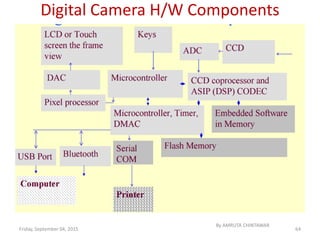
Digital Camera H/W Components
Friday, September 04, 2015
By AMRUTA CHINTAWAR
64
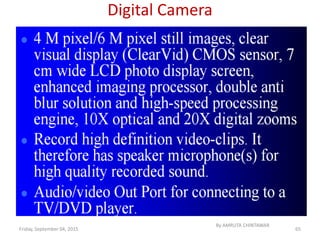
Digital Camera
Friday, September 04, 2015
By AMRUTA CHINTAWAR
65
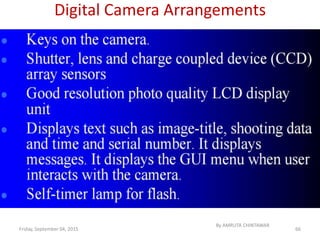
Digital Camera Arrangements
Friday, September 04, 2015
By AMRUTA CHINTAWAR
66
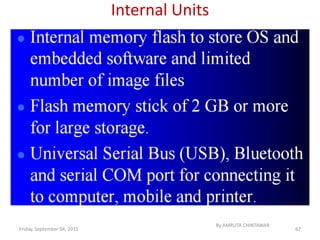
Internal Units
Friday, September 04, 2015
By AMRUTA CHINTAWAR
67
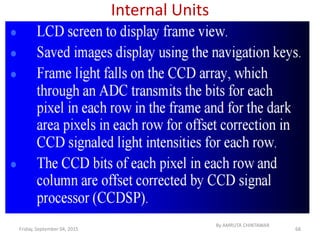
Internal Units
Friday, September 04, 2015
By AMRUTA CHINTAWAR
68
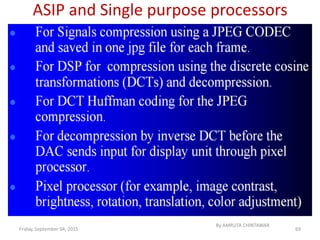
ASIP and Single purpose processors
Friday, September 04, 2015
By AMRUTA CHINTAWAR
69
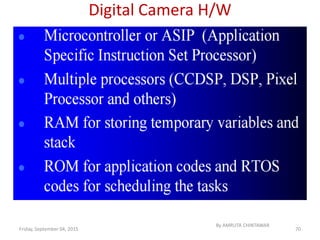
Digital Camera H/W
Friday, September 04, 2015
By AMRUTA CHINTAWAR
70
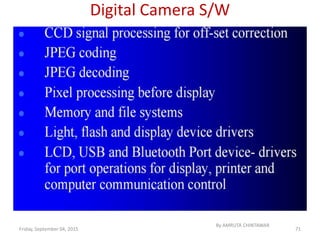
Digital Camera S/W
Friday, September 04, 2015
By AMRUTA CHINTAWAR
71

Introduction to Embedded Architecture

  • 1.
    Embedded Systems Chapter 1:EmbeddedArchitecture BY AMRUTA CHINTAWAR Friday, September 04, 2015 By AMRUTA CHINTAWAR 1
  • 2.
    Embedded Architecture Friday, September04, 2015 By AMRUTA CHINTAWAR 2 • Embedded computers • Characteristics • Applications • Challenges • Embedded memories • ES design process • Requirement specifications • Architecture • H/W and S/W components • System Integration • Design examples
  • 3.
    Definition • Embedded computingsystem: any device that includes a programmable computer but is not itself a general- purpose computer. • System has a S/W embedded into Computer H/W, which makes the system dedicated for an application or specific part of an application or product or part of a larger system. Friday, September 04, 2015 By AMRUTA CHINTAWAR 3
  • 4.
    Definition • Embedded systems(ES) = information processing systems embedded into a larger product • Main reason for buying is not information processing Friday, September 04, 2015 By AMRUTA CHINTAWAR 4
  • 5.
    Comparison Friday, September 04,2015 By AMRUTA CHINTAWAR 5
  • 6.
    Various Embedded MobileSystems Desktop PC Data Processing Consumer Communication Automotive & etc. DTV Media Center Game Console DSC DVC Car Navigation DVD Telematics MP3 Player Credit Card Cellular Phone Notebook PC Internet Smart Phone PDA Bluetooth Audio Friday, September 04, 2015 6By AMRUTA CHINTAWAR
  • 7.
    Examples • Biomedical Instrumentation:ECG Recorder, Blood cell recorder, patient monitor system • Communication system: pagers, cellular phones, cable TV terminals, fax and transreceiver, video games and so on. • Peripheral controllers of a computer –keyboard controller, DRAM controller, Printer Controller, LAN controller, Disk drive Controller Friday, September 04, 2015 By AMRUTA CHINTAWAR 7
  • 8.
    Examples Friday, September 04,2015 By AMRUTA CHINTAWAR 8 • Industrial Instrumentation- Process controller, DC motor controller, robotic system, CNC machines controller, close loop engine controller, industrial moisture recorder cum controller • Scientific –digital storage system, CRT display controller, spectrum analyzer.
  • 9.
    Example Friday, September 04,2015 By AMRUTA CHINTAWAR 9
  • 10.
    Example: Digital Thermostat Friday,September 04, 2015 By AMRUTA CHINTAWAR 10
  • 11.
    Example: Mobile phone Friday,September 04, 2015 By AMRUTA CHINTAWAR 11
  • 12.
    Characteristics • Dedicated andsophisticated functionality • Low manufacturing cost, low power • Complex Algorithm • GUI, other user interface • Reliability • Real Time operations -latencies -Deadlines • Multirate Operations -Audio -Vedio Friday, September 04, 2015 By AMRUTA CHINTAWAR 12
  • 13.
    Design Metrics/Goals • Reliability •Power Consumption • Cost :NRE cost & Manufacturing cost • Weight/size • Time: time to prototype & time to market • Flexibility • Performance • Debuggability • Safty & maintaince • Maximum usage of resources Friday, September 04, 2015 By AMRUTA CHINTAWAR 13
  • 14.
    Challenges • How muchhardware do we need? – How big is the CPU? Memory? • How do we meet our deadlines? – Faster hardware or cleverer software? • How do we minimize power? – Turn off unnecessary logic? Reduce memory accesses? • Does it really work? – Is the specification correct? – Does the implementation meet the spec? – Reliability in safety-critical systems Friday, September 04, 2015 By AMRUTA CHINTAWAR 14
  • 15.
    Challenges • How dowe work on the system? – Complex testing • How do we test for real-time characteristics? • How do we test on real data? – Limited observability and controllability – Restricted development environments • What is our development platform? Friday, September 04, 2015 By AMRUTA CHINTAWAR 15
  • 16.
    Level Abstraction Friday, September04, 2015 By AMRUTA CHINTAWAR 16 requirements specification architecture component design system integration
  • 17.
    Architecture Friday, September 04,2015 By AMRUTA CHINTAWAR 17
  • 18.
    Components of Embeddedsystem Friday, September 04, 2015 By AMRUTA CHINTAWAR 18  H/W - Processor - Power source and clock - Reset circuit - Memory Unit - Interrupt Handler - Linking Embedded System H/W - I/O communication Unit  S/W - ROM image/Applications/w - Programming Languages - Device Drivers - Program Models
  • 19.
    Components of Embeddedsystem Friday, September 04, 2015 By AMRUTA CHINTAWAR 19  RTOS/EOS  S/W Tools - Development tools - Simulator - Project Manager - IDE
  • 20.
    Types of Cores Friday,September 04, 2015 By AMRUTA CHINTAWAR 20 Requirments -Able to solve complex Algorithm - Meet Deadlines - No.of Bits to be operated - Bus Width - Clock Frequency - Performance(MIPS/MFLOPS)
  • 21.
    Types of Cores Friday,September 04, 2015 By AMRUTA CHINTAWAR 21  GPP: General Purpose Processor -Microprocessors -Embedded Processors  ASIP: Application Specific Instruction Processor -Micro controller -Embedded Micro controller -DSP and media Processor -Network Processor  SPP: Single Purpose Processor -Coprocessors eg:Math-coprocessor -Accelerators eg:java acce -Controllers eg:DMA
  • 22.
    Types of Cores Friday,September 04, 2015 By AMRUTA CHINTAWAR 22  ASIC/VLSI chip: Application specific Integrated circuit -GPP/ASIP integrated with analog circuits on VLSI chip using EDA tools.  ASSP:Application Specific System Processor -set top box -Mpeg -HD tv eg:vedio Processors  Multicore Processors/Multiprocessor using GPP eg:Embedded firewall cum Router
  • 23.
    Power Sources,Clock andReset Circuit Friday, September 04, 2015 By AMRUTA CHINTAWAR 23  Power supply -Own supply -Supply from System -Charge Pumps  Clock -External Clock supply -Oscillator -RTC  Reset -Power On -External/Internal Reset -WDT -BOR
  • 24.
    Memory Unit,Interrupt Handlers Friday,September 04, 2015 By AMRUTA CHINTAWAR 24 Memory  ROM/EPROM/FLASH (internal/External)  RAM  Caches Interrupt Handler  External port interrupt  I/O,Timer, RTC, interrupts  S/W Interrupt/Exceptions Linking ES H/W  Multiplexers  Decodes
  • 25.
    I/O communication Unit Friday,September 04, 2015 By AMRUTA CHINTAWAR 25  I/O,O/P devices -Sensors, -actuators -converters -keypads -displays  Buses -Parallel Buses -serial buses
  • 26.
    S/W-ROM Image, Programming Language Friday,September 04, 2015 By AMRUTA CHINTAWAR 26  ROM Image -Final Machine s/w -Can be compressed code or data -Distinct ROM image in distinct ES  Programming Languages -Machine -Assembly -High Level
  • 27.
    S/W-Device Driver, Managers Friday,September 04, 2015 By AMRUTA CHINTAWAR 27 It connects external H/w with Processor  Controlling  Receiving  Sending Part of OS  Manages device  Initializing  Testing  Detecting  Allocating port addresses
  • 28.
    RTOS/OS Friday, September 04,2015 By AMRUTA CHINTAWAR 28 It performs functions  Multitasking  Scheduling  Management  Resource protection  Interprocess Communication eg: Ucos-II, Vxworks, windows CE, RT linux,QNX
  • 29.
    Embedded Memories Friday, September04, 2015 By AMRUTA CHINTAWAR 29 Internal RAM at µc –SRAM used as reg, temp data, stack RAM AT SoC or External RAM Internal/external caches at µp -hold copy of system memory pages External RAM chips -DRAM used to hold extra data Flash EPROM/EEPROM -result stored in NV memory ROM/PROM/MROM/OTP -Application S/W, OS Memory addresses at system ports -RAM buffers Memory Stick -large storage such as audio, video
  • 30.
    I/O Devices Friday, September04, 2015 By AMRUTA CHINTAWAR 30 • DAC using PWM • ADC • LCD,LED and Touch Screen • Keypad/keyboard/T9 keypad • Pulse dialer • Modem • Transceiver • Interrupt handler -mechanism to handle various interrupts and also to deal with pending services
  • 31.
    Difference between RISCand CISC Friday, September 04, 2015 By AMRUTA CHINTAWAR 31 RISC CISC Reduced instruction set Complex Instruction set Maximum instructions are single cycle(fixed size),thus supports pipelining Variable size Instructions,so generally do not have pipelining Orthogonal instruction set Non-Orthogonal Operations are performed on registers, so large no of Registers. For memory only Load and Store Operations are performed on both registers and memory. Limited number of GPRs
  • 32.
    Difference between RISCand CISC Friday, September 04, 2015 By AMRUTA CHINTAWAR 32 RISC CISC Hardwired Control unit Microcode control Unit Small in size with resp to die area and No.of pins Comparatively large in size since more complex instruction needs to be implemented. Harvard architecture Harvard or Von-Neuman Eg:PIC18,ARM 8051,8086
  • 33.
    SoC Friday, September 04,2015 By AMRUTA CHINTAWAR 33 • System designed on a single chip • Processor with all analog, digital and S/W build on a single VLSI chip
  • 34.
    SoC Friday, September 04,2015 By AMRUTA CHINTAWAR 34
  • 35.
    SoC Friday, September 04,2015 By AMRUTA CHINTAWAR 35 It embeds • EGPP or ASIP • SPP or Multiprocessor • N/W bus protocol • Encryption and Dycryption • Signal processing such as FFT,DCT • Memories • IP-Intellectual • PLDs or FPGA • Accelerators or other logic and analog units
  • 36.
    IP-Intellectual Property Friday, September04, 2015 By AMRUTA CHINTAWAR 36 • A standard source solution for synthesizing a higher level component by configuring an FPGA core/VLSI core • Components-gate level sophistication in circuits above that of counter, register, multiplier, FLU and ALU
  • 37.
    H/W and S/WCo-Design Friday, September 04, 2015 By AMRUTA CHINTAWAR 37
  • 38.
    H/W and S/WCo-Design Friday, September 04, 2015 By AMRUTA CHINTAWAR 38 • Joint optimization of H/W and S/W to optimize design metrics • S/W and H/W partitioning at early stage • Both proceed in parallel with interactions and feedback • System specification required • H/W synthesis • S/W synthesis • Simulation • Implementation
  • 39.
    Development Process Friday, September04, 2015 By AMRUTA CHINTAWAR 39
  • 40.
    Levels of Abstractionfrom Top to Bottom • Requirements • Specifications • Architecture • Components • System Integration Friday, September 04, 2015 By AMRUTA CHINTAWAR 40
  • 41.
    Requirement Complete clarity of: •Required Purpose • Inputs • Outputs • Functioning • Design metrics • Validation requirements for finally developed system specifications • Consistency in the requirements Friday, September 04, 2015 By AMRUTA CHINTAWAR 41
  • 42.
    Specifications • Clear specificationof customer expectations from the product • Needs specification for – H/W, eg: Peripherals, Divices,Processors and memory specifications – Data types and processing specifications • Expected system behavior specifications • Constraints of design • Expected lifecycle specifications of the product Friday, September 04, 2015 By AMRUTA CHINTAWAR 42
  • 43.
    Specifications • Process specificationsanalyzed by making list of I/Ps on event list, O/Ps on events, process activated on each event Friday, September 04, 2015 By AMRUTA CHINTAWAR 43
  • 44.
    S/W Architectural Layers •How the different elements- data structures, data bases, algorithms, control functions, state transition functions, process, data and program flow are to be organized • Data base and Data structure design- appropriate for given problem Eg: tree like structure Friday, September 04, 2015 By AMRUTA CHINTAWAR 44
  • 45.
    H/W Components • Processors,ASIP, Single Processors • All Types of Memory as per requirement • Internal and External peripherals and devices • Ports and Buses in the system • Power sources and battery Friday, September 04, 2015 By AMRUTA CHINTAWAR 45
  • 46.
    Design Examples • ACVM •Smart Card • Digital Camera • Mobile phones • Mobile Computer • Set of Robots Friday, September 04, 2015 By AMRUTA CHINTAWAR 46
  • 47.
    ACVM Friday, September 04,2015 By AMRUTA CHINTAWAR 47
  • 48.
    ACVM Block diagram Friday,September 04, 2015 By AMRUTA CHINTAWAR 48
  • 49.
    ACVM Friday, September 04,2015 By AMRUTA CHINTAWAR 49
  • 50.
    ACVM Friday, September 04,2015 By AMRUTA CHINTAWAR 50
  • 51.
    ACVM H/W Friday, September04, 2015 By AMRUTA CHINTAWAR 51
  • 52.
    ACVM H/W Friday, September04, 2015 By AMRUTA CHINTAWAR 52
  • 53.
    ACVM S/W Friday, September04, 2015 By AMRUTA CHINTAWAR 53
  • 54.
    SMART CARD Friday, September04, 2015 By AMRUTA CHINTAWAR 54
  • 55.
    SMART CARD Friday, September04, 2015 By AMRUTA CHINTAWAR 55
  • 56.
    SMART CARD Friday, September04, 2015 By AMRUTA CHINTAWAR 56
  • 57.
    ROM Friday, September 04,2015 By AMRUTA CHINTAWAR 57
  • 58.
    ROM Friday, September 04,2015 By AMRUTA CHINTAWAR 58
  • 59.
    Embedded S/W Friday, September04, 2015 By AMRUTA CHINTAWAR 59
  • 60.
    Smart Card OSSpecial Features Friday, September 04, 2015 By AMRUTA CHINTAWAR 60
  • 61.
    Smart Card OSLimitimg Features Friday, September 04, 2015 By AMRUTA CHINTAWAR 61
  • 62.
    Smart Card OSfile System Friday, September 04, 2015 By AMRUTA CHINTAWAR 62
  • 63.
    DIGITAL CAMERA Friday, September04, 2015 By AMRUTA CHINTAWAR 63
  • 64.
    Digital Camera H/WComponents Friday, September 04, 2015 By AMRUTA CHINTAWAR 64
  • 65.
    Digital Camera Friday, September04, 2015 By AMRUTA CHINTAWAR 65
  • 66.
    Digital Camera Arrangements Friday,September 04, 2015 By AMRUTA CHINTAWAR 66
  • 67.
    Internal Units Friday, September04, 2015 By AMRUTA CHINTAWAR 67
  • 68.
    Internal Units Friday, September04, 2015 By AMRUTA CHINTAWAR 68
  • 69.
    ASIP and Singlepurpose processors Friday, September 04, 2015 By AMRUTA CHINTAWAR 69
  • 70.
    Digital Camera H/W Friday,September 04, 2015 By AMRUTA CHINTAWAR 70
  • 71.
    Digital Camera S/W Friday,September 04, 2015 By AMRUTA CHINTAWAR 71