Fundamentals of Phonology
phonology
• What is phonology
• Phone, phoneme, allophone, and distinctive
  features
• Minimal pairs, phonemic contrast, and
  complementary distribution
• Phonological rules
• Suprasegmental phonology: stress, tone and
  intonation
From phonetics to phonology

• Speech is one of human activities used for
  conveying meaning
• Speech is a continuous process, so the vocal
  organs do not move from one sound segment to
  the next in a series of separate steps. Rather,
  sounds continually show the influence of their
  neighbors.
• map, lamb
Coarticulation
• When such simultaneous or overlapping
  articulations are involved, we call the
  process coarticulation.
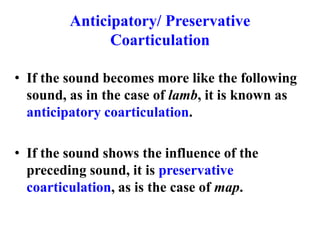
Anticipatory/ Preservative
               Coarticulation

• If the sound becomes more like the following
  sound, as in the case of lamb, it is known as
  anticipatory coarticulation.

• If the sound shows the influence of the
  preceding sound, it is preservative
  coarticulation, as is the case of map.
Anticipatory/ perseverative
             coarticulation
• The fact that the vowel [a] in lamb has some
  quality of the following nasal is a
  phenomenon we call nasalization.
• To indicate that a vowel has been nasalized,
  we add a diacritic to the top of the symbol
  [a], as [a ].
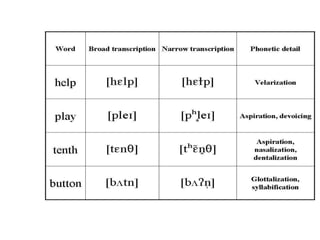
Broad /Narrow Transcription
• When we use a simple set of symbols in our
  transcription, it is called a broad transcription.
• The use of more specific symbols to show
  more phonetic detail is referred to as a
  narrow transcription.
• Both are phonetic transcriptions so we put
  both forms in square brackets [ ].
Phonetics – Phone
• phone: the smallest perceptible discreet
  segment of sound in a stream of speech
• i) phonetic unit
• ii) not distinctive of meaning
• iii) physical as heard or produced
• iv) marked with [ ]
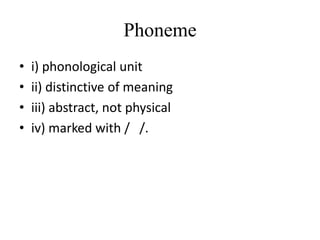
Phoneme
•   i) phonological unit
•   ii) distinctive of meaning
•   iii) abstract, not physical
•   iv) marked with / /.
Allophone
• allophone: phonic variants/realizations of a
  phoneme
• A phoneme is realized as
  allophone1+allophone2+….
• e.g. /p/=[ ph ] + [ p. ] + [ p¬ ] (unreleased)
Allophone

• /p/ → *p h] ∥#___Vs
• /p/ → *p .] ∥___#

• /p/ → *p ] ∥other
          ¬
Phonetic Environment
• Phonetic environment: the sound(s) preceding
  and that/those following it
 e.g The phonetic environment of [i] in [pit] is
  [p_t] and that of [p] is [#_it] (# represents
  silence or word boundary).
Question: What is the phonetic environment of
  [t] in [pit]?
Minimal Pairs
• Purpose for the notion of minimal pair: find out the
  distinctive sounds
• Contrastive distribution: [bit] vs. [but]
  [pit] vs. [bit]
• Three requirements for identifying minimal pairs:
  1) different in meaning;
  2) only one phoneme different;
  3) the different phonemes occur in the same phonetic
  environment.
• e.g. pat vs. fat
• Minimal set: pat, mat, bat, fat, cat, hat, etc
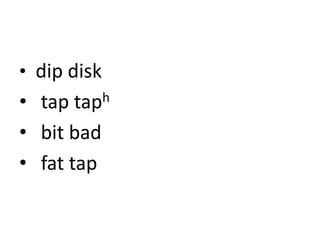
• dip disk
• tap taph
• bit bad
• fat tap
{tip : dip}
     ↓      ↓
    [t] [d]
     ↓      ↓
-VOICE +VOICE
Complementary Distribution
• When two phones are mutually exclusive, i.e., they
  appear in different environments
   – [spæt]       [phæt]      *[sphæt]     *[pæt]
   – [spul]       [phul]      *[sphul]     *[pul]
• [ph] and [p] are in complementary distribution
  (which means they are allophones of the same
  phoneme).
• When sounds are in complementary distribution, you
  can predict where you get each sound.
Free Variation
• When two sounds appear in the same environment,
  but don’t make a difference in meaning:
      [lip] leap           [lip|] leap
      [sowp] soap          [sowp|] soap
Perceived as the same sound: another kind of
  allophony. This is called free variation.
Question
• What is the distribution of clear [l] dark *ł+
  respectively?
•
• live/leave
• slave/split
• film/felt
• people/cattle
• Dark *ł+: After vowels and after syllabic
  consonants
• Clear [l]: Elsewhere
How can I tell if two sounds are
    phonemes or allophones? Method 1
• Check for minimal pairs. If there is a pair then the
  sounds are separate phonemes
• Check for complementary distribution. Are the
  sounds found in the same phonetic environment? If
  not, they are allophones of the same phoneme.
How can I tell if two sounds are
    phonemes or allophones? Method 1
• If two sounds are in complementary distribution
  then (a) figure out which one is predictable and
  which one is the “elsewhere” variant. The elsewhere
  variant is the symbol that we use for the phoneme
                  /X/                  Phoneme (in your mind)

         [X]            [Y]            Allophones (what you say)
      elsewhere          predictable


                  same symbol
How can I tell if two sounds are
    phonemes or allophones? Method 1
• and (b) write a rule that spells out where the
  predictable variant is found.
      • /X/  [Y] / environment ____ environment


• A fairly rare situation: If the two sounds are in the
  same phonetic environment (and there were no
  minimal pairs!) Then they are possibly in free
  variation.
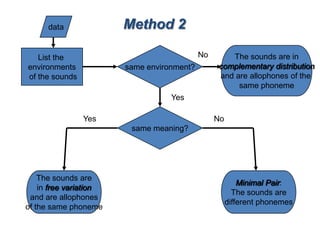
data              Method 2

   List the                                 No      The sounds are in
environments            same environment?        complementary distribution
of the sounds                                    and are allophones of the
                                                      same phoneme
                                   Yes

                Yes                              No
                         same meaning?


    The sounds are
                                                          Minimal Pair:
    in free variation
                                                        The sounds are
 and are allophones
                                                      different phonemes
of the same phoneme
Sample problem: English long vowels
Question: are long and short vowels in English allophones of single
phonemes, or are they separate phonemes?
(a vowel followed by the symbol [:] is a long vowel)


[phæ:d] ‘pad’                     [phæt] ‘pat’
[hu:d] ‘who’d’                    [hut] ‘hoot’
[mi:d] ‘mead’                     [mit] ‘meet’         Are there any minimal pairs?
                                                       NO! (There are no examples that differ
[row:m]‘roam’                     [rowp] ‘rope’        in ONLY one sound!)
[ti:D]    teethe                  [tiT] ‘teeth’        Do long and short vowels
                                  [flu] ‘flew’         occur in the same
                                          V            phonological environment?
     V:
                                                       NO!
                Is there any              _ t
     _d         overlap between                        Therefore, these are in
                the columns?              _p
     _m                                                complementary distribution
                                          _T           and each long/short vowel
     _D
                                                       pair represent allophones of
                                          _#
                                                       same phoneme.
Phonological Processes
• Assimilation
A process by which one sound takes on some or
  all the characteristics of a neighboring sound
Assimilation
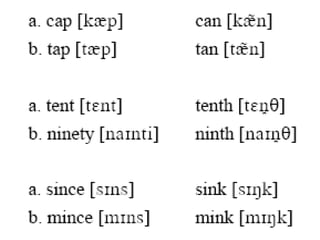
• Nasalization,
• dentalization,
• velarization
Phonological rule
• Nasalization rule:
  [-nasal]  [+nasal] / ____ [+nasal]
• Dentalization rule:
  [-dental]  [dental] / ____ [dental]
• Velarization rule:
  [-velar]  [+velar] / ____ [+velar]
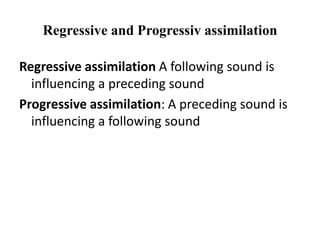
Regressive and Progressiv assimilation

Regressive assimilation A following sound is
  influencing a preceding sound
Progressive assimilation: A preceding sound is
  influencing a following sound
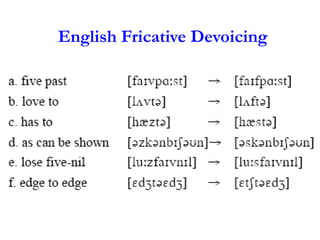
English Fricative Devoicing
Phonological rule
• /v/  [f] /z/  [s] etc.
• voiced fricative  voiceless / ____ voiceless

•
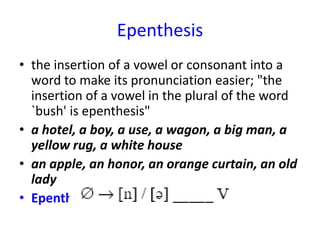
Epenthesis
• the insertion of a vowel or consonant into a
  word to make its pronunciation easier; "the
  insertion of a vowel in the plural of the word
  `bush' is epenthesis"
• a hotel, a boy, a use, a wagon, a big man, a
  yellow rug, a white house
• an apple, an honor, an orange curtain, an old
  lady
• Epenthesis (Insertion) Rule:
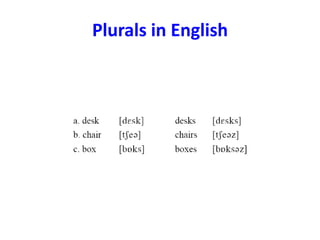
Plurals in English
Phonological rule
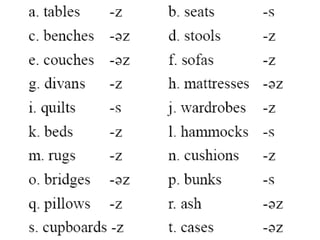
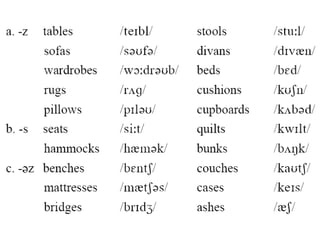
• a. The [s] appears after voiceless sounds.
• b. The [z] appears after voiced sounds.
• c. The [ ] appears after sibilants.

• /z/  [s] / [–voice, C] _____ (Devoicing)
•   [] / [+sibilant] _____ [z] (Epenthesis)
Distinctive features
• Speech sounds are divided into classes
  according to a number of properties, these
  properties serve to distinguish one phoneme
  from another, thus are called distinctive
  features, which are binary in nature.
• i.e. for /p/, its distinctive features are [-voice],
  [+bilabial], [-nasal]. However, [aspirated] is
  not a distinctive feature for /p/.
Syllables
• Suprasegmental feature, features that involve
  more than single sound segment, such as
  syllables, stress, tone, and intonation.
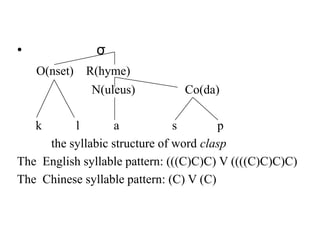
• A syllable can be divided into two parts, the
  rhyme and the onset. Within the rhyme there
  are nucleus (the vowel) and the coda (the
  ending consonant).
• A syllable that has no coda is an open syllable,
  while a syllable with coda is closed syllable.
•              σ
    O(nset)   R(hyme)
              N(uleus)          Co(da)

    k     l        a           s        p
     the syllabic structure of word clasp
The English syllable pattern: (((C)C)C) V ((((C)C)C)C)
The Chinese syllable pattern: (C) V (C)
Sonority scale
• The degree of sonority of different classes of
  sound affects their possible positions in the
  syllable.
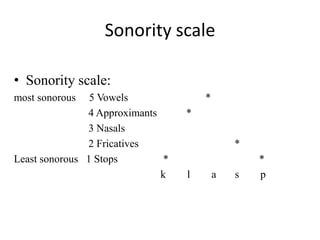
Sonority scale

• Sonority scale:
most sonorous   5 Vowels              *
               4 Approximants     *
               3 Nasals
               2 Fricatives                   *
Least sonorous 1 Stops        *                   *
                              k   l       a   s   p
Stress
• The degree of force used in producing a
  syllable.
• Word stress/sentence stress
• Primary stress/secondary stress
•
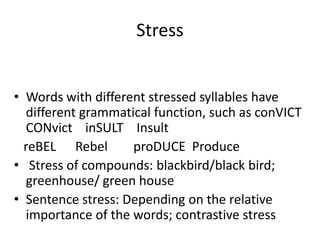
Stress


• Words with different stressed syllables have
   different grammatical function, such as conVICT
   CONvict inSULT Insult
  reBEL Rebel        proDUCE Produce
• Stress of compounds: blackbird/black bird;
   greenhouse/ green house
• Sentence stress: Depending on the relative
   importance of the words; contrastive stress
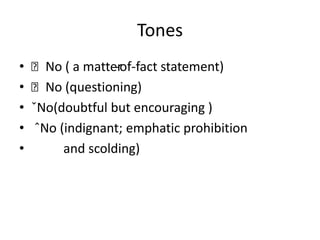
Tones
•   ˋNo ( a matter -of-fact statement)
•   ˋNo (questioning)
•   ˇNo(doubtful but encouraging )
•    ˆNo (indignant; emphatic prohibition
•         and scolding)

Intro to phonology lectr 2

  • 1.
  • 2.
    phonology • What isphonology • Phone, phoneme, allophone, and distinctive features • Minimal pairs, phonemic contrast, and complementary distribution • Phonological rules • Suprasegmental phonology: stress, tone and intonation
  • 3.
    From phonetics tophonology • Speech is one of human activities used for conveying meaning • Speech is a continuous process, so the vocal organs do not move from one sound segment to the next in a series of separate steps. Rather, sounds continually show the influence of their neighbors. • map, lamb
  • 4.
    Coarticulation • When suchsimultaneous or overlapping articulations are involved, we call the process coarticulation.
  • 5.
    Anticipatory/ Preservative Coarticulation • If the sound becomes more like the following sound, as in the case of lamb, it is known as anticipatory coarticulation. • If the sound shows the influence of the preceding sound, it is preservative coarticulation, as is the case of map.
  • 6.
    Anticipatory/ perseverative coarticulation • The fact that the vowel [a] in lamb has some quality of the following nasal is a phenomenon we call nasalization. • To indicate that a vowel has been nasalized, we add a diacritic to the top of the symbol [a], as [a ].
  • 7.
    Broad /Narrow Transcription •When we use a simple set of symbols in our transcription, it is called a broad transcription. • The use of more specific symbols to show more phonetic detail is referred to as a narrow transcription. • Both are phonetic transcriptions so we put both forms in square brackets [ ].
  • 9.
    Phonetics – Phone •phone: the smallest perceptible discreet segment of sound in a stream of speech • i) phonetic unit • ii) not distinctive of meaning • iii) physical as heard or produced • iv) marked with [ ]
  • 10.
    Phoneme • i) phonological unit • ii) distinctive of meaning • iii) abstract, not physical • iv) marked with / /.
  • 11.
    Allophone • allophone: phonicvariants/realizations of a phoneme • A phoneme is realized as allophone1+allophone2+…. • e.g. /p/=[ ph ] + [ p. ] + [ p¬ ] (unreleased)
  • 12.
    Allophone • /p/ →*p h] ∥#___Vs • /p/ → *p .] ∥___# • /p/ → *p ] ∥other ¬
  • 13.
    Phonetic Environment • Phoneticenvironment: the sound(s) preceding and that/those following it e.g The phonetic environment of [i] in [pit] is [p_t] and that of [p] is [#_it] (# represents silence or word boundary). Question: What is the phonetic environment of [t] in [pit]?
  • 14.
    Minimal Pairs • Purposefor the notion of minimal pair: find out the distinctive sounds • Contrastive distribution: [bit] vs. [but] [pit] vs. [bit] • Three requirements for identifying minimal pairs: 1) different in meaning; 2) only one phoneme different; 3) the different phonemes occur in the same phonetic environment. • e.g. pat vs. fat • Minimal set: pat, mat, bat, fat, cat, hat, etc
  • 15.
    • dip disk •tap taph • bit bad • fat tap
  • 16.
    {tip : dip} ↓ ↓ [t] [d] ↓ ↓ -VOICE +VOICE
  • 17.
    Complementary Distribution • Whentwo phones are mutually exclusive, i.e., they appear in different environments – [spæt] [phæt] *[sphæt] *[pæt] – [spul] [phul] *[sphul] *[pul] • [ph] and [p] are in complementary distribution (which means they are allophones of the same phoneme). • When sounds are in complementary distribution, you can predict where you get each sound.
  • 18.
    Free Variation • Whentwo sounds appear in the same environment, but don’t make a difference in meaning: [lip] leap [lip|] leap [sowp] soap [sowp|] soap Perceived as the same sound: another kind of allophony. This is called free variation.
  • 19.
    Question • What isthe distribution of clear [l] dark *ł+ respectively? • • live/leave • slave/split • film/felt • people/cattle
  • 20.
    • Dark *ł+:After vowels and after syllabic consonants • Clear [l]: Elsewhere
  • 21.
    How can Itell if two sounds are phonemes or allophones? Method 1 • Check for minimal pairs. If there is a pair then the sounds are separate phonemes • Check for complementary distribution. Are the sounds found in the same phonetic environment? If not, they are allophones of the same phoneme.
  • 22.
    How can Itell if two sounds are phonemes or allophones? Method 1 • If two sounds are in complementary distribution then (a) figure out which one is predictable and which one is the “elsewhere” variant. The elsewhere variant is the symbol that we use for the phoneme /X/ Phoneme (in your mind) [X] [Y] Allophones (what you say) elsewhere predictable same symbol
  • 23.
    How can Itell if two sounds are phonemes or allophones? Method 1 • and (b) write a rule that spells out where the predictable variant is found. • /X/  [Y] / environment ____ environment • A fairly rare situation: If the two sounds are in the same phonetic environment (and there were no minimal pairs!) Then they are possibly in free variation.
  • 24.
    data Method 2 List the No The sounds are in environments same environment? complementary distribution of the sounds and are allophones of the same phoneme Yes Yes No same meaning? The sounds are Minimal Pair: in free variation The sounds are and are allophones different phonemes of the same phoneme
  • 25.
    Sample problem: Englishlong vowels Question: are long and short vowels in English allophones of single phonemes, or are they separate phonemes? (a vowel followed by the symbol [:] is a long vowel) [phæ:d] ‘pad’ [phæt] ‘pat’ [hu:d] ‘who’d’ [hut] ‘hoot’ [mi:d] ‘mead’ [mit] ‘meet’ Are there any minimal pairs? NO! (There are no examples that differ [row:m]‘roam’ [rowp] ‘rope’ in ONLY one sound!) [ti:D] teethe [tiT] ‘teeth’ Do long and short vowels [flu] ‘flew’ occur in the same V phonological environment? V: NO! Is there any _ t _d overlap between Therefore, these are in the columns? _p _m complementary distribution _T and each long/short vowel _D pair represent allophones of _# same phoneme.
  • 26.
    Phonological Processes • Assimilation Aprocess by which one sound takes on some or all the characteristics of a neighboring sound
  • 28.
  • 29.
    Phonological rule • Nasalizationrule: [-nasal]  [+nasal] / ____ [+nasal] • Dentalization rule: [-dental]  [dental] / ____ [dental] • Velarization rule: [-velar]  [+velar] / ____ [+velar]
  • 30.
    Regressive and Progressivassimilation Regressive assimilation A following sound is influencing a preceding sound Progressive assimilation: A preceding sound is influencing a following sound
  • 31.
  • 32.
    Phonological rule • /v/ [f] /z/  [s] etc. • voiced fricative  voiceless / ____ voiceless •
  • 33.
    Epenthesis • the insertionof a vowel or consonant into a word to make its pronunciation easier; "the insertion of a vowel in the plural of the word `bush' is epenthesis" • a hotel, a boy, a use, a wagon, a big man, a yellow rug, a white house • an apple, an honor, an orange curtain, an old lady • Epenthesis (Insertion) Rule:
  • 34.
  • 37.
    Phonological rule • a.The [s] appears after voiceless sounds. • b. The [z] appears after voiced sounds. • c. The [ ] appears after sibilants. • /z/  [s] / [–voice, C] _____ (Devoicing) •   [] / [+sibilant] _____ [z] (Epenthesis)
  • 38.
    Distinctive features • Speechsounds are divided into classes according to a number of properties, these properties serve to distinguish one phoneme from another, thus are called distinctive features, which are binary in nature. • i.e. for /p/, its distinctive features are [-voice], [+bilabial], [-nasal]. However, [aspirated] is not a distinctive feature for /p/.
  • 39.
    Syllables • Suprasegmental feature,features that involve more than single sound segment, such as syllables, stress, tone, and intonation. • A syllable can be divided into two parts, the rhyme and the onset. Within the rhyme there are nucleus (the vowel) and the coda (the ending consonant). • A syllable that has no coda is an open syllable, while a syllable with coda is closed syllable.
  • 40.
    σ O(nset) R(hyme) N(uleus) Co(da) k l a s p the syllabic structure of word clasp The English syllable pattern: (((C)C)C) V ((((C)C)C)C) The Chinese syllable pattern: (C) V (C)
  • 41.
    Sonority scale • Thedegree of sonority of different classes of sound affects their possible positions in the syllable.
  • 42.
    Sonority scale • Sonorityscale: most sonorous 5 Vowels * 4 Approximants * 3 Nasals 2 Fricatives * Least sonorous 1 Stops * * k l a s p
  • 43.
    Stress • The degreeof force used in producing a syllable. • Word stress/sentence stress • Primary stress/secondary stress •
  • 44.
    Stress • Words withdifferent stressed syllables have different grammatical function, such as conVICT CONvict inSULT Insult reBEL Rebel proDUCE Produce • Stress of compounds: blackbird/black bird; greenhouse/ green house • Sentence stress: Depending on the relative importance of the words; contrastive stress
  • 45.
    Tones • ˋNo ( a matter -of-fact statement) • ˋNo (questioning) • ˇNo(doubtful but encouraging ) • ˆNo (indignant; emphatic prohibition • and scolding)