Presentation  on  Weak Syllables  and Strong Syllables
Syllable A syllable is a  rhythmic  unit of speech. Syllables exist to make the speech stream easier for the human mind to process. A syllable comprises one or more segments; segments are the  building blocks  for syllables.
Syllable A syllable  is a unit of organization for a sequence of  speech  sounds. For example, the word  water  is composed of two syllables:  wa  and  ter . A syllable is typically made up of a  syllable nucleus  (most often a  vowel ) with optional initial and final margins
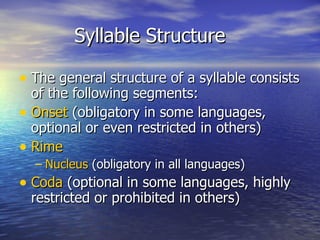
Syllable Structure The general structure of a syllable consists of the following segments: Onset  (obligatory in some languages, optional or even restricted in others)  Rime   Nucleus  (obligatory in all languages)  Coda  (optional in some languages, highly restricted or prohibited in others)
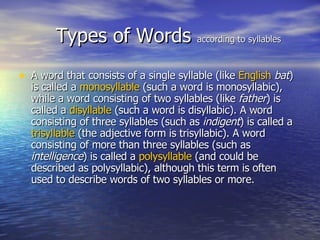
Types of Words  according to syllables A word that consists of a single syllable (like  English   bat ) is called a  monosyllable  (such a word is monosyllabic), while a word consisting of two syllables (like  father ) is called a  disyllable  (such a word is disyllabic). A word consisting of three syllables (such as  indigent ) is called a  trisyllable  (the adjective form is trisyllabic). A word consisting of more than three syllables (such as  intelligence ) is called a  polysyllable  (and could be described as polysyllabic), although this term is often used to describe words of two syllables or more.
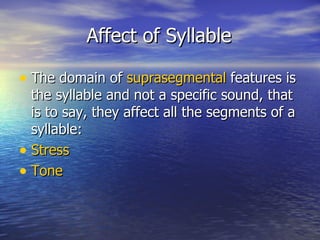
Affect of Syllable The domain of  suprasegmental  features is the syllable and not a specific sound, that is to say, they affect all the segments of a syllable: Stress   Tone
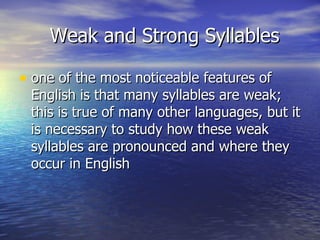
Weak and Strong Syllables one of the most noticeable features of English is that many syllables are weak; this is true of many other languages, but it is necessary to study how these weak syllables are pronounced and where they occur in English
Description  of weak and strong syllables We could describe them  partly in terms of stress (by saying, for example, that strong syllables are stressed and weak syllables unstressed.
Weak Syllables Will have….. four types of center: i) the vowel  (" shwa")  ii) a close front unrounded vowel in the general area of i: and I iii) a close back rounded vowel in the general area of u: and  ʊ   iv) a syllabic consonant
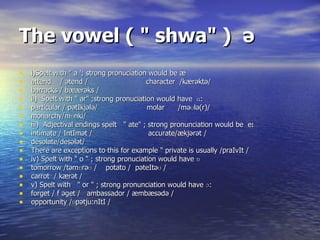
The vowel ( " shwa" )  ə i)Spelt with " a '; strong pronuciation would be  æ   attend  /  ətend  /  character  /k æ r əktə / barracks / b æærəks  /  ii)  Spelt with " ar" ;strong pronuciation would have  ɑ:  particular / p ə tIkj ə l ə /  molar  /m əʊlə(r )/ monarchy/m ɒ nki/ iii)  Adjectival endings spelt  " ate" ; strong pronunciation would be  e I  intimate / IntIm ət  /  accurate/ æ kj ərət  / desolate/des ələt /  There are exceptions to this for example " private is usually /praIvIt / iv) Spelt with " o " ; strong pronuciation would have  ɒ   tomorrow /t əmɒrəʊ  /  potato /  p əteItəʊ  / carrot  / k æ r ət  / v) Spelt with  " or " ; strong pronunciation would have ɔ:  forget / f  əget  /  ambassador /  æ mb æ s ə d ə  / opportunity / ɒ p ətju:nItI /
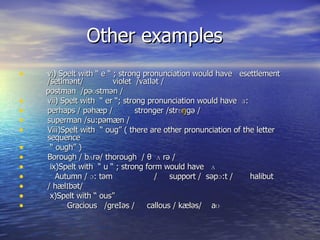
Other examples vi) Spelt with “ e “ ; strong pronunciation would have  esettlement /setlm ənt /  violet  /va I l ət  / postman  /p əʊstmən  / vii) Spelt with  “ er “; strong pronunciation would have  ɜ:  perhaps / p əhæp  /  stronger /str ɒ ŋ g ə  / superman /su:p ə m æn  / Viii)Spelt with  “ oug” ( there are other pronunciation of the letter sequence  “  ough” )  Borough / bʌr ə / thorough  / θ  ʌ r ə  / ix)Spelt with  “ u “ ; strong form would have  ʌ  Autumn / ɔ: t əm   /  support /  s əp ɔ: t  /  halibut / h æ l I b ət /  x)Spelt with “ ous”  Gracious  /greI əs  /  callous / k æ l əs /  aʊ
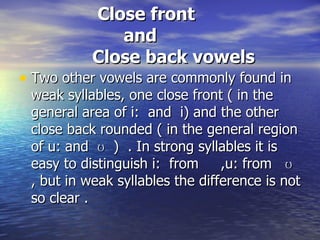
Close front    and    Close back vowels   Two other vowels are commonly found in weak syllables, one close front ( in the general area of i:  and  i) and the other close back rounded ( in the general region of u: and  ʊ  )  . In strong syllables it is easy to distinguish i:  from  ,u: from  ʊ , but in weak syllables the difference is not so clear .
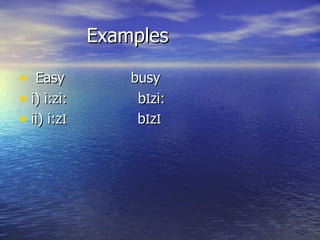
Examples Easy  busy i) i:zi:  b I zi: ii) i:z I   b I z I
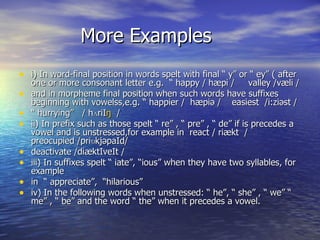
More Examples i) In word-final position in words spelt with final “ y” or “ ey” ( after one or more consonant letter e.g.  “ happy / hæpi /  valley /væli / and in morpheme final position when such words have suffixes beginning with vowelss,e.g. “ happier /  hæpiə /  easiest  /i:ziəst / “  hurrying”  / h ʌ riI ŋ   / ii) In prefix such as those spelt “ re” , “ pre” , “ de” if is precedes a vowel and is unstressed,for example in  react / riækt  /  preocupied /priɒkjəpaId/  deactivate /diæktIveIt / iii) In suffixes spelt “ iate”, “ious” when they have two syllables, for example  in  “ appreciate”,  “hilarious”  iv) In the following words when unstressed: “ he”, “ she” , “ we” “ me” , “ be” and the word “ the” when it precedes a vowel.
Examples In most other cases of weak syllables containing a close front unrounded vowel we can assign the vowel to the phoneme, as in the first syllable of “ resist”/rIzIst/ “  Inane / IneIn /  “ enough”  /In  ʌ  f /  and the middle syllable of “ incident” and the final syllable of  “ swimming” / swImI ŋ  /  liquid  / lIkwId  /  Optic / ɒptIk /.It can be seen that this vowel is most often represented in spelling by the letters “ i’’ and “ e”  Weak syllbles with close back rounded vowel are not so common.Their most frequent occurrence is in the words “ you”  , “ into”, “ to”, “ do”,when they are unstressed and are not immediately preceding a consonant, and “ through” and “ who” in all positions whey they are unstressed.We also find weak syllable where the vowel tends to sound more like the ʊ vowel of the book;usually this is found with a preceding  j  glide, as in evacuation / IvækjueI ʃn  /.An example of such a vowel without a preceding  j  is  Influenza / Inflluenza /
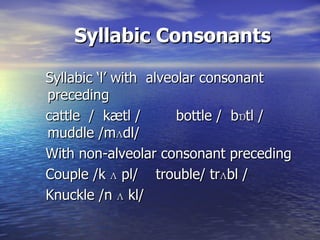
Syllabic Consonants Syllabic ‘l’ with  alveolar consonant preceding cattle  /  kætl /  bottle /  bɒtl /  muddle /m ʌ dl/ With non-alveolar consonant preceding Couple /k  ʌ  pl/  trouble/ tr ʌ bl / Knuckle /n  ʌ  kl/
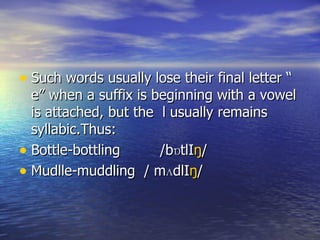
Such words usually lose their final letter “ e” when a suffix is beginning with a vowel is attached, but the  l usually remains syllabic.Thus: Bottle-bottling  /bɒtlI ŋ / Mudlle-muddling  / m ʌ dlI ŋ /
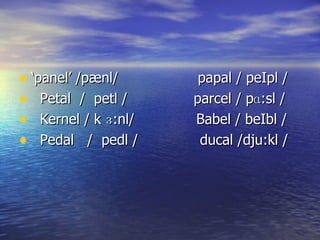
‘ panel’ /p æ nl/  papal / peIpl / Petal  /  petl /  parcel / p ɑ: sl / Kernel / k  ɜ: nl/  Babel / beIbl / Pedal  /  pedl /  ducal /dju:kl /

Weak ,Strong Syllables2

  • 1.
    Presentation on Weak Syllables and Strong Syllables
  • 2.
    Syllable A syllableis a rhythmic unit of speech. Syllables exist to make the speech stream easier for the human mind to process. A syllable comprises one or more segments; segments are the building blocks for syllables.
  • 3.
    Syllable A syllable is a unit of organization for a sequence of speech sounds. For example, the word water is composed of two syllables: wa and ter . A syllable is typically made up of a syllable nucleus (most often a vowel ) with optional initial and final margins
  • 4.
    Syllable Structure Thegeneral structure of a syllable consists of the following segments: Onset (obligatory in some languages, optional or even restricted in others) Rime Nucleus (obligatory in all languages) Coda (optional in some languages, highly restricted or prohibited in others)
  • 5.
    Types of Words according to syllables A word that consists of a single syllable (like English bat ) is called a monosyllable (such a word is monosyllabic), while a word consisting of two syllables (like father ) is called a disyllable (such a word is disyllabic). A word consisting of three syllables (such as indigent ) is called a trisyllable (the adjective form is trisyllabic). A word consisting of more than three syllables (such as intelligence ) is called a polysyllable (and could be described as polysyllabic), although this term is often used to describe words of two syllables or more.
  • 6.
    Affect of SyllableThe domain of suprasegmental features is the syllable and not a specific sound, that is to say, they affect all the segments of a syllable: Stress Tone
  • 7.
    Weak and StrongSyllables one of the most noticeable features of English is that many syllables are weak; this is true of many other languages, but it is necessary to study how these weak syllables are pronounced and where they occur in English
  • 8.
    Description ofweak and strong syllables We could describe them partly in terms of stress (by saying, for example, that strong syllables are stressed and weak syllables unstressed.
  • 9.
    Weak Syllables Willhave….. four types of center: i) the vowel (" shwa") ii) a close front unrounded vowel in the general area of i: and I iii) a close back rounded vowel in the general area of u: and ʊ iv) a syllabic consonant
  • 10.
    The vowel (" shwa" ) ə i)Spelt with " a '; strong pronuciation would be æ attend / ətend / character /k æ r əktə / barracks / b æærəks / ii) Spelt with " ar" ;strong pronuciation would have ɑ: particular / p ə tIkj ə l ə / molar /m əʊlə(r )/ monarchy/m ɒ nki/ iii) Adjectival endings spelt " ate" ; strong pronunciation would be e I intimate / IntIm ət / accurate/ æ kj ərət / desolate/des ələt / There are exceptions to this for example " private is usually /praIvIt / iv) Spelt with " o " ; strong pronuciation would have ɒ tomorrow /t əmɒrəʊ / potato / p əteItəʊ / carrot / k æ r ət / v) Spelt with " or " ; strong pronunciation would have ɔ: forget / f əget / ambassador / æ mb æ s ə d ə / opportunity / ɒ p ətju:nItI /
  • 11.
    Other examples vi)Spelt with “ e “ ; strong pronunciation would have esettlement /setlm ənt / violet /va I l ət / postman /p əʊstmən / vii) Spelt with “ er “; strong pronunciation would have ɜ: perhaps / p əhæp / stronger /str ɒ ŋ g ə / superman /su:p ə m æn / Viii)Spelt with “ oug” ( there are other pronunciation of the letter sequence “ ough” ) Borough / bʌr ə / thorough / θ ʌ r ə / ix)Spelt with “ u “ ; strong form would have ʌ Autumn / ɔ: t əm / support / s əp ɔ: t / halibut / h æ l I b ət / x)Spelt with “ ous” Gracious /greI əs / callous / k æ l əs / aʊ
  • 12.
    Close front and Close back vowels Two other vowels are commonly found in weak syllables, one close front ( in the general area of i: and i) and the other close back rounded ( in the general region of u: and ʊ ) . In strong syllables it is easy to distinguish i: from ,u: from ʊ , but in weak syllables the difference is not so clear .
  • 13.
    Examples Easy busy i) i:zi: b I zi: ii) i:z I b I z I
  • 14.
    More Examples i)In word-final position in words spelt with final “ y” or “ ey” ( after one or more consonant letter e.g. “ happy / hæpi / valley /væli / and in morpheme final position when such words have suffixes beginning with vowelss,e.g. “ happier / hæpiə / easiest /i:ziəst / “ hurrying” / h ʌ riI ŋ / ii) In prefix such as those spelt “ re” , “ pre” , “ de” if is precedes a vowel and is unstressed,for example in react / riækt / preocupied /priɒkjəpaId/ deactivate /diæktIveIt / iii) In suffixes spelt “ iate”, “ious” when they have two syllables, for example in “ appreciate”, “hilarious” iv) In the following words when unstressed: “ he”, “ she” , “ we” “ me” , “ be” and the word “ the” when it precedes a vowel.
  • 15.
    Examples In mostother cases of weak syllables containing a close front unrounded vowel we can assign the vowel to the phoneme, as in the first syllable of “ resist”/rIzIst/ “ Inane / IneIn / “ enough” /In ʌ f / and the middle syllable of “ incident” and the final syllable of “ swimming” / swImI ŋ / liquid / lIkwId / Optic / ɒptIk /.It can be seen that this vowel is most often represented in spelling by the letters “ i’’ and “ e” Weak syllbles with close back rounded vowel are not so common.Their most frequent occurrence is in the words “ you” , “ into”, “ to”, “ do”,when they are unstressed and are not immediately preceding a consonant, and “ through” and “ who” in all positions whey they are unstressed.We also find weak syllable where the vowel tends to sound more like the ʊ vowel of the book;usually this is found with a preceding j glide, as in evacuation / IvækjueI ʃn /.An example of such a vowel without a preceding j is Influenza / Inflluenza /
  • 16.
    Syllabic Consonants Syllabic‘l’ with alveolar consonant preceding cattle / kætl / bottle / bɒtl / muddle /m ʌ dl/ With non-alveolar consonant preceding Couple /k ʌ pl/ trouble/ tr ʌ bl / Knuckle /n ʌ kl/
  • 17.
    Such words usuallylose their final letter “ e” when a suffix is beginning with a vowel is attached, but the l usually remains syllabic.Thus: Bottle-bottling /bɒtlI ŋ / Mudlle-muddling / m ʌ dlI ŋ /
  • 18.
    ‘ panel’ /pæ nl/ papal / peIpl / Petal / petl / parcel / p ɑ: sl / Kernel / k ɜ: nl/ Babel / beIbl / Pedal / pedl / ducal /dju:kl /