PHONETICS
The general study of the
characteristics of speech sounds is called
phonetics. Our main interest will be in
articulatory phonetics, which is the study
of how speech sounds are made, or
articulated.
VOICED AND VOICELESS SOUNDS
In articulatory phonetics, we
investigate how speech sounds are
produced using the fairly complex oral
equipment we have. We start with the
air pushed out by the lungs up trough
the trachea (or windpipe) to the larynx.
Inside the larynx are you vocal folds (or
vocal cords), which take two basic
positions.
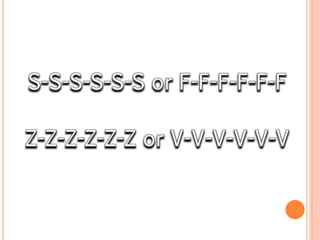
HOW DO WE KNOW IF A SOUND IS
VOICELESS OR VOICED?
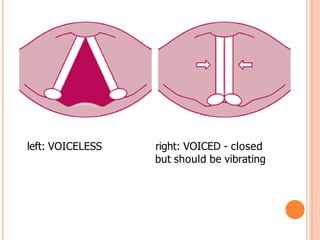
 VOICELESS (VL) = NO
VIBRATION OF VOCAL CORDS
 VOICED (VD) = VIBRATION
OF VOCAL CORDS.
left: VOICELESS right: VOICED - closed
but should be vibrating
PLACE OF ARTICULATION
 Once the air has passed trough the larynx, it
comes up and out trough the mouth and/or the
nose. Most consonant sounds are produced by
using the tongue and other parts of the mouth to
constrict, in some way, the shape of the oral city
trough which the air is passing.
 The terms used to describe many sounds are
those which denote the place of articulation of the
sound: that is, the location inside the mouth at
which the constriction takes place.
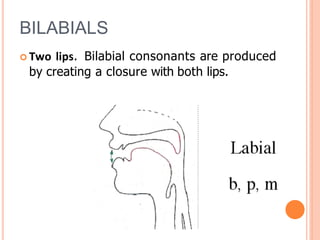
BILABIALS
 Two lips. Bilabial consonants are produced
by creating a closure with both lips.
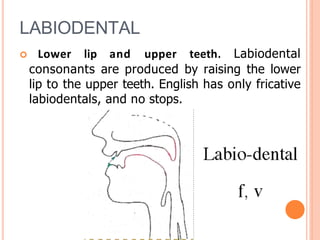
LABIODENTAL
 Lower lip and upper teeth. Labiodental
consonants are produced by raising the lower
lip to the upper teeth. English has only fricative
labiodentals, and no stops.
INTERDENTAL
 Tongue between the teeth, or just behind the upper
teeth (also called "dental"). In English, the
interdental consonants are also all fricatives. In the
ASCII phonetic alphabet, these sounds are the voiced
[th] and the voiceless [TH].
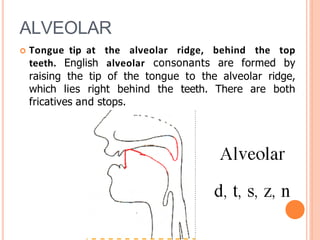
ALVEOLAR
 Tongue tip at the alveolar ridge, behind the top
teeth. English alveolar consonants are formed by
raising the tip of the tongue to the alveolar ridge,
which lies right behind the teeth. There are both
fricatives and stops.
PALATAL
 The front or body of the tongue raised to the palatal
region or the domed area at the roof of your mouth.
In our ASCII phonetic alphabet, these are the
voiceless [S] and the voiced [Z]
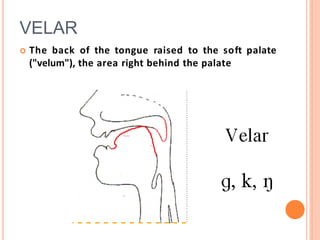
VELAR
 The back of the tongue raised to the soft palate
("velum"), the area right behind the palate
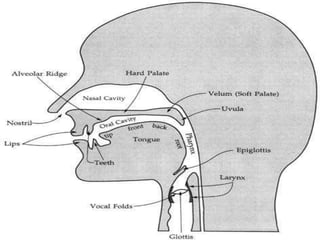
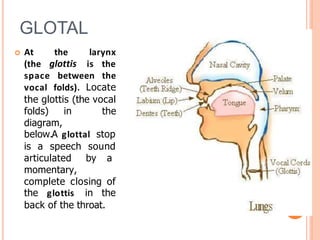
GLOTAL
 At the larynx
(the glottis is the
space between the
vocal folds). Locate
the glottis (the vocal
folds) in the
diagram,
below.A glottal stop
is a speech sound
articulated by a
momentary,
complete closing of
the glottis in the
back of the throat.
IN CONCLUSION
The airflow can be modified at
various points within vocal organs to
produce distinct speech sounds. The
point where a sound is produced is
referred to as its place of articulation.
HIGH
MID
LOW
FRONT CENTRAL BACK
MANNER OF ARTICULATION

In articulatory phonetics, the manner of
articulation is the configuration and interaction
of the articulators (speech organs such as the
tongue, lips, and palate) when making a speech
sound. Also is the type of closure made by the
articulators and the degree of the obstruction of
the airstream by those articulators
 Stops: an oral occlusive, where there is occlusion (blocking)
of the oral vocal tract, and no nasal air flow, so the air flow
stops completely. Examples include: [p], [b], [t], [d], [k], [g].
 Fricatives: sometimes called spirant, where there is
continuous frication (turbulent and noisy airflow) at the
place of
Examples include: [f], [v], [θ], [ð], [s],
articulation.
[z], [ ʃ ], [ʒ].
 Affricates: which begins like a stop, but this releases into a
fricative rather than having a separate release of its own.
Examples include: [ ʧ ], [ʤ].
 Nasals: a nasal occlusive, where there is occlusion of the oral
tract, but air passes through the nose. The shape and
position of the tongue determine the resonant cavity that
gives different nasals their characteristic sounds.
Examples include: [m], [n], [ŋ].
 Liquids: Lateral approximants, usually shortened to lateral, are a
type of approximant pronounced with the side of the tongue.
English / l/ is a lateral. Together with the rhotics, which have
similar behavior in many languages, these form a class of
consonant called liquids. For example, the initial sounds in led
and red are described as liquids.
 Glides: One use of the word semivowel, sometimes called a glide,
is a type of approximant, pronounced like a vowel but with the
tongue closer to the roof of the mouth, so that there is slight
turbulence. In English, /w/ is the semivowel equivalent of the
vowel /u/, and /j/ (spelled "y") is the semivowel equivalent of
the vowel /i/ in this usage.
 In some approaches, the liquids [l], [r] and glides [w], [j] are
combined in one category called “approximants
 Glottal stop: is a type of consonantal sound
used in many spoken languages, produced by
obstructing airflow in the vocal tract or, more
precisely, the glottis. The symbol in the
International Phonetic Alphabet that represents
this sound is [?].
 Flap: In phonetics, a flap or tap is a type of
consonantal sound, which is produced with a
single contraction of the muscles so that one
articulator (such as the tongue) is thrown
against another.

sodapdf-converted (1).pptx

  • 2.
    PHONETICS The general studyof the characteristics of speech sounds is called phonetics. Our main interest will be in articulatory phonetics, which is the study of how speech sounds are made, or articulated.
  • 3.
    VOICED AND VOICELESSSOUNDS In articulatory phonetics, we investigate how speech sounds are produced using the fairly complex oral equipment we have. We start with the air pushed out by the lungs up trough the trachea (or windpipe) to the larynx. Inside the larynx are you vocal folds (or vocal cords), which take two basic positions.
  • 4.
    HOW DO WEKNOW IF A SOUND IS VOICELESS OR VOICED?  VOICELESS (VL) = NO VIBRATION OF VOCAL CORDS  VOICED (VD) = VIBRATION OF VOCAL CORDS.
  • 6.
    left: VOICELESS right:VOICED - closed but should be vibrating
  • 7.
    PLACE OF ARTICULATION Once the air has passed trough the larynx, it comes up and out trough the mouth and/or the nose. Most consonant sounds are produced by using the tongue and other parts of the mouth to constrict, in some way, the shape of the oral city trough which the air is passing.  The terms used to describe many sounds are those which denote the place of articulation of the sound: that is, the location inside the mouth at which the constriction takes place.
  • 9.
    BILABIALS  Two lips.Bilabial consonants are produced by creating a closure with both lips.
  • 10.
    LABIODENTAL  Lower lipand upper teeth. Labiodental consonants are produced by raising the lower lip to the upper teeth. English has only fricative labiodentals, and no stops.
  • 11.
    INTERDENTAL  Tongue betweenthe teeth, or just behind the upper teeth (also called "dental"). In English, the interdental consonants are also all fricatives. In the ASCII phonetic alphabet, these sounds are the voiced [th] and the voiceless [TH].
  • 12.
    ALVEOLAR  Tongue tipat the alveolar ridge, behind the top teeth. English alveolar consonants are formed by raising the tip of the tongue to the alveolar ridge, which lies right behind the teeth. There are both fricatives and stops.
  • 13.
    PALATAL  The frontor body of the tongue raised to the palatal region or the domed area at the roof of your mouth. In our ASCII phonetic alphabet, these are the voiceless [S] and the voiced [Z]
  • 14.
    VELAR  The backof the tongue raised to the soft palate ("velum"), the area right behind the palate
  • 15.
    GLOTAL  At thelarynx (the glottis is the space between the vocal folds). Locate the glottis (the vocal folds) in the diagram, below.A glottal stop is a speech sound articulated by a momentary, complete closing of the glottis in the back of the throat.
  • 16.
    IN CONCLUSION The airflowcan be modified at various points within vocal organs to produce distinct speech sounds. The point where a sound is produced is referred to as its place of articulation.
  • 18.
  • 20.
    MANNER OF ARTICULATION  Inarticulatory phonetics, the manner of articulation is the configuration and interaction of the articulators (speech organs such as the tongue, lips, and palate) when making a speech sound. Also is the type of closure made by the articulators and the degree of the obstruction of the airstream by those articulators
  • 21.
     Stops: anoral occlusive, where there is occlusion (blocking) of the oral vocal tract, and no nasal air flow, so the air flow stops completely. Examples include: [p], [b], [t], [d], [k], [g].  Fricatives: sometimes called spirant, where there is continuous frication (turbulent and noisy airflow) at the place of Examples include: [f], [v], [θ], [ð], [s], articulation. [z], [ ʃ ], [ʒ].  Affricates: which begins like a stop, but this releases into a fricative rather than having a separate release of its own. Examples include: [ ʧ ], [ʤ].  Nasals: a nasal occlusive, where there is occlusion of the oral tract, but air passes through the nose. The shape and position of the tongue determine the resonant cavity that gives different nasals their characteristic sounds. Examples include: [m], [n], [ŋ].
  • 22.
     Liquids: Lateralapproximants, usually shortened to lateral, are a type of approximant pronounced with the side of the tongue. English / l/ is a lateral. Together with the rhotics, which have similar behavior in many languages, these form a class of consonant called liquids. For example, the initial sounds in led and red are described as liquids.  Glides: One use of the word semivowel, sometimes called a glide, is a type of approximant, pronounced like a vowel but with the tongue closer to the roof of the mouth, so that there is slight turbulence. In English, /w/ is the semivowel equivalent of the vowel /u/, and /j/ (spelled "y") is the semivowel equivalent of the vowel /i/ in this usage.  In some approaches, the liquids [l], [r] and glides [w], [j] are combined in one category called “approximants
  • 23.
     Glottal stop:is a type of consonantal sound used in many spoken languages, produced by obstructing airflow in the vocal tract or, more precisely, the glottis. The symbol in the International Phonetic Alphabet that represents this sound is [?].  Flap: In phonetics, a flap or tap is a type of consonantal sound, which is produced with a single contraction of the muscles so that one articulator (such as the tongue) is thrown against another.