Affricate Sounds A further enquiries
Preliminary Perspective An Affricate is sound is, under a preliminary perspective, are a non-stop combination of sounds begun by a plosive  (total stop of air causing an explotion)  sound and immediatelt followed by a  fricative (friction)  sound.
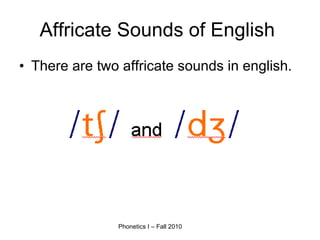
Affricate Sounds of English  There are two affricate sounds in english.
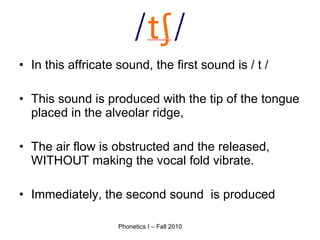
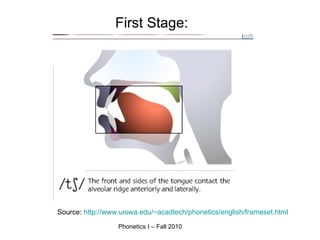
In this affricate sound, the first sound is / t /  This sound is produced with the tip of the tongue placed in the alveolar ridge,  The air flow is obstructed and the released, WITHOUT making the vocal fold vibrate. Immediately, the second sound  is produced
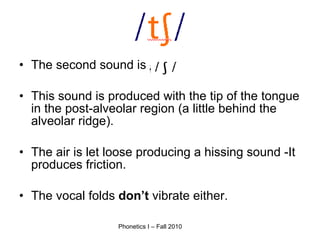
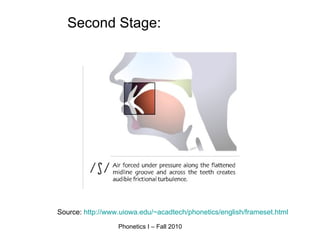
The second sound is This sound is produced with the tip of the tongue in the post-alveolar region (a little behind the alveolar ridge). The air is let loose producing a hissing sound -It produces friction. The vocal folds  don’t  vibrate either.
First Stage: Source:  http://www.uiowa.edu/~acadtech/phonetics/english/frameset.html
Second Stage: Source:  http://www.uiowa.edu/~acadtech/phonetics/english/frameset.html
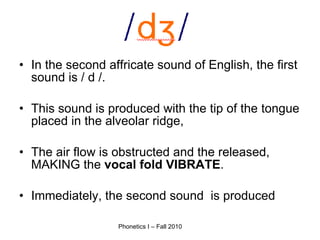
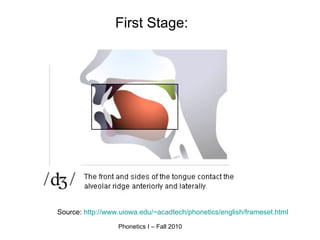
In the second affricate sound of English, the first sound is / d /. This sound is produced with the tip of the tongue placed in the alveolar ridge,  The air flow is obstructed and the released, MAKING the  vocal fold VIBRATE . Immediately, the second sound  is produced
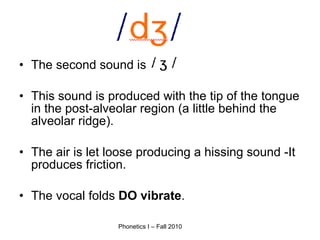
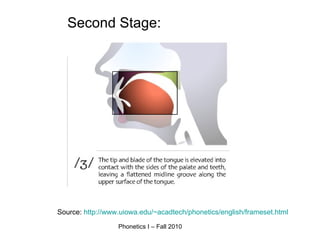
The second sound is This sound is produced with the tip of the tongue in the post-alveolar region (a little behind the alveolar ridge). The air is let loose producing a hissing sound -It produces friction. The vocal folds  DO vibrate .
First Stage: Source:  http://www.uiowa.edu/~acadtech/phonetics/english/frameset.html
Second Stage: Source:  http://www.uiowa.edu/~acadtech/phonetics/english/frameset.html
Further Discussion Peter Roach in his book  English phonetics and phonology: a practical course (Cambridge, 3rd edition,  2009) points out that not all the combination of plosive+fricative sounds are considered  Affricate Sounds . It is said that these type of combinations need to be  HOMORGANIC , that means, they must be produced  with the same articulators . In this way the combination / ks / of the word ta x i is not considered an affricate because the sounds are not prouced with the same articulators
See: http://books.google.cl/books?id=u29ff2oIPk8C&pg=PA48&lpg=PA48&dq=what%27s+an+affricate+sound%3F+roach&source=bl&ots=56mem1aAZX&sig=gNL3zJzj-pswnZko_TqIB-3lZmQ&hl=es&ei=cQPiS_3oKYOY8ASmysTvAg&sa=X&oi=book_result&ct=result&resnum=1&ved=0CAYQ6AEwAA#v=onepage&q&f=false Pages 48-49 Here is a part of the book, copy and paste on the browser

Affricate sounds 2010

  • 1.
    Affricate Sounds Afurther enquiries
  • 2.
    Preliminary Perspective AnAffricate is sound is, under a preliminary perspective, are a non-stop combination of sounds begun by a plosive (total stop of air causing an explotion) sound and immediatelt followed by a fricative (friction) sound.
  • 3.
    Affricate Sounds ofEnglish There are two affricate sounds in english.
  • 4.
    In this affricatesound, the first sound is / t / This sound is produced with the tip of the tongue placed in the alveolar ridge, The air flow is obstructed and the released, WITHOUT making the vocal fold vibrate. Immediately, the second sound is produced
  • 5.
    The second soundis This sound is produced with the tip of the tongue in the post-alveolar region (a little behind the alveolar ridge). The air is let loose producing a hissing sound -It produces friction. The vocal folds don’t vibrate either.
  • 6.
    First Stage: Source: http://www.uiowa.edu/~acadtech/phonetics/english/frameset.html
  • 7.
    Second Stage: Source: http://www.uiowa.edu/~acadtech/phonetics/english/frameset.html
  • 8.
    In the secondaffricate sound of English, the first sound is / d /. This sound is produced with the tip of the tongue placed in the alveolar ridge, The air flow is obstructed and the released, MAKING the vocal fold VIBRATE . Immediately, the second sound is produced
  • 9.
    The second soundis This sound is produced with the tip of the tongue in the post-alveolar region (a little behind the alveolar ridge). The air is let loose producing a hissing sound -It produces friction. The vocal folds DO vibrate .
  • 10.
    First Stage: Source: http://www.uiowa.edu/~acadtech/phonetics/english/frameset.html
  • 11.
    Second Stage: Source: http://www.uiowa.edu/~acadtech/phonetics/english/frameset.html
  • 12.
    Further Discussion PeterRoach in his book English phonetics and phonology: a practical course (Cambridge, 3rd edition, 2009) points out that not all the combination of plosive+fricative sounds are considered Affricate Sounds . It is said that these type of combinations need to be HOMORGANIC , that means, they must be produced with the same articulators . In this way the combination / ks / of the word ta x i is not considered an affricate because the sounds are not prouced with the same articulators
  • 13.