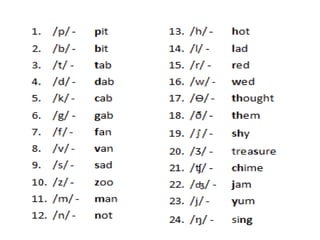
CONSONANTS
LECTURE 2 
• How are consonants described & 
classified in terms of: 
–Place of articulation 
–Manner of articulation 
–Voicing 
–Force of articulation
ENGLISH CONSONANTS – CRITERIA IN DESCRIBING 
• Do the vocal cords vibrate or not? – 
Voiced/Voiceless 
• Is the soft palate raised or lowered? – 
Oral/Nasal 
• At what point or points & between what speech 
organs does the closure or narrowing take 
place? – Place of articulation 
• What is the type of closure or narrowing at the 
point of articulation? – Manner of articulation
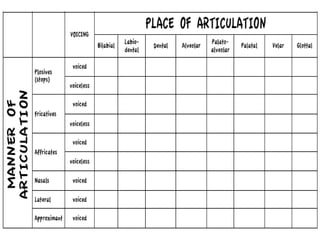
Place of articulation the point of contact where an 
obstruction occurs in the vocal tract 
Bilabial 
consonants 
Labio-dental 
consonants 
Dental consonants 
Alveolar consonants 
Palatal 
consonants 
Post/palato 
alveolar 
consonants 
Velar 
consonants 
Glottal 
consonants
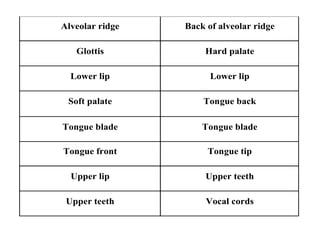
Alveolar ridge Back of alveolar ridge 
Glottis Hard palate 
Lower lip Lower lip 
Soft palate Tongue back 
Tongue blade Tongue blade 
Tongue front Tongue tip 
Upper lip Upper teeth 
Upper teeth Vocal cords
Place of articulation the point of contact where an 
obstruction occurs in the vocal tract 
Bilabial 
consonants 
Labio-dental 
consonants 
Dental consonants 
Alveolar consonants 
Tongue back 
Soft palate 
Palatal 
consonants 
Post/palato 
alveolar 
consonants 
Velar 
consonants 
Glottal 
consonants 
Upper lip 
Lower lip 
Lower lip 
Upper teeth 
Tongue tip 
Upper teeth 
Tongue blade 
Alveolar ridge 
Glottis 
Tongue front 
Hard palate 
Tongue blade Vocal cords 
Back of alveolar ridge
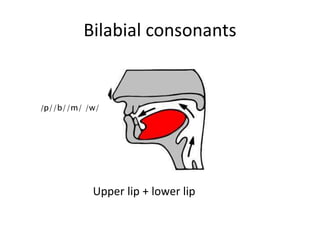
Bilabial consonants 
/p//b//m/ /w/ 
Upper lip + lower lip
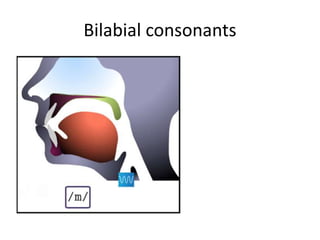
Bilabial consonants
Bilabial consonants
Labio-dental consonants 
/f/ /v/ 
Lower lip (active) + upper teeth (passive)
Labio-dental consonants
Dental consonants 
/θ//δ/ 
Upper teeth (passive) + tongue tip (active)
Dental consonants
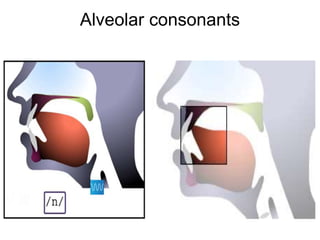
Alveolar consonants 
/t//d//n//z//s//l/ 
Alveolar ridge (passive) + tongue blade (tip +blade) (active)
Alveolar consonants
Alveolar consonants
Alveolar consonants
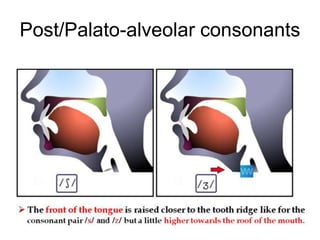
Post/Palato-alveolar consonants 
Tongue blade or tip & blade + back of 
alveolar ridge +raising of tongue front 
towards hard palate 
/ʃ//ʒ//ʧ//ʤ//r/
Post/Palato-alveolar consonants
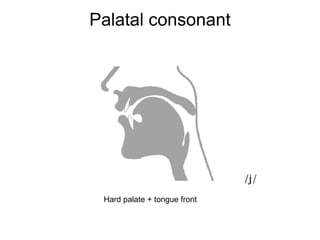
Palatal consonant 
Hard palate + tongue front 
/j/
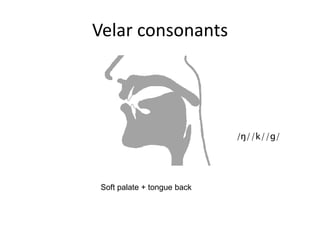
Velar consonants 
Soft palate + tongue back 
/ŋ//k//g/
Velar consonants
Glottal consonant 
the glottis, vocal cords
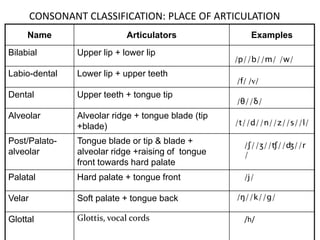
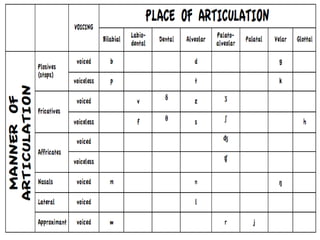
CONSONANT CLASSIFICATION: PLACE OF ARTICULATION 
Name Articulators Examples 
Bilabial Upper lip + lower lip 
Labio-dental Lower lip + upper teeth 
Dental Upper teeth + tongue tip 
Alveolar Alveolar ridge + tongue blade (tip 
+blade) 
Post/Palato-alveolar 
Tongue blade or tip & blade + 
alveolar ridge +raising of tongue 
front towards hard palate 
Palatal Hard palate + tongue front 
Velar Soft palate + tongue back 
Glottal Glottis, vocal cords 
/p//b//m/ /w/ 
/f/ /v/ 
/θ//δ/ 
/t//d//n//z//s//l/ 
/ʃ//ʒ//ʧ//ʤ//r 
/ 
/j/ 
/ŋ//k//g/ 
/h/
MANNER OF ARTICULATION 
TYPE OF CLOSURE MADE BY THE 
ARTICULATORS 
Nasal consonants 
Plosives/stops 
Fricatives 
Affricates 
Approximants 
Lateral 
consonant
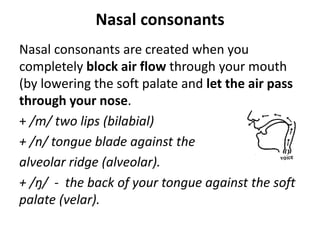
Nasal consonants 
Nasal consonants are created when you 
completely block air flow through your mouth 
(by lowering the soft palate and let the air pass 
through your nose. 
+ /m/ two lips (bilabial) 
+ /n/ tongue blade against the 
alveolar ridge (alveolar). 
+ /ŋ/ - the back of your tongue against the soft 
palate (velar).
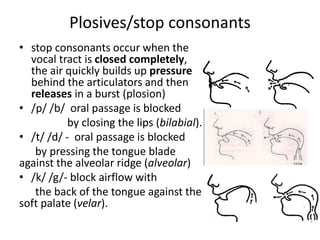
Plosives/stop consonants 
• stop consonants occur when the 
vocal tract is closed completely, 
the air quickly builds up pressure 
behind the articulators and then 
releases in a burst (plosion) 
• /p/ /b/ oral passage is blocked 
by closing the lips (bilabial). 
• /t/ /d/ - oral passage is blocked 
by pressing the tongue blade 
against the alveolar ridge (alveolar) 
• /k/ /g/- block airflow with 
the back of the tongue against the 
soft palate (velar).
4 phases of production of stops 
• Closure phase: the articulators move to form 
the stricture (obstruction) 
• Hold phase: the compressed air is stopped 
from escaping 
• release phase: the articulators are moved to 
allow air to escape 
• Post-release phase
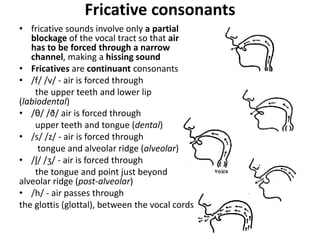
Fricative consonants 
• fricative sounds involve only a partial 
blockage of the vocal tract so that air 
has to be forced through a narrow 
channel, making a hissing sound 
• Fricatives are continuant consonants 
• /f/ /v/ - air is forced through 
the upper teeth and lower lip 
(labiodental) 
• /θ/ /ð/ air is forced through 
upper teeth and tongue (dental) 
• /s/ /z/ - air is forced through 
tongue and alveolar ridge (alveolar) 
• /ʃ/ /ʒ/ - air is forced through 
the tongue and point just beyond 
alveolar ridge (post-alveolar) 
• /h/ - air passes through 
the glottis (glottal), between the vocal cords
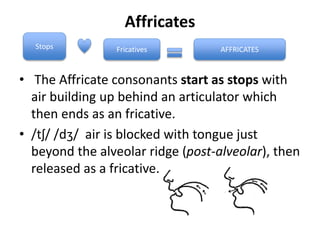
Affricates 
Stops Fricatives AFFRICATES 
• The Affricate consonants start as stops with 
air building up behind an articulator which 
then ends as an fricative. 
• /tʃ/ /dʒ/ air is blocked with tongue just 
beyond the alveolar ridge (post-alveolar), then 
released as a fricative.
Approximant 
• Approximants are created when two 
articulators come close together but 
not quite close enough to create air 
turbulence. 
• /w/ - back of tongue raises to velum 
(but not too close!) and lips are 
rounded (bilabial) (labio-velar) 
• /j/ - tongue front raises to hard palate 
(but not too close!) (palatal). 
• /r/ - tongue blade raises to hard palate 
(post-alveolar)
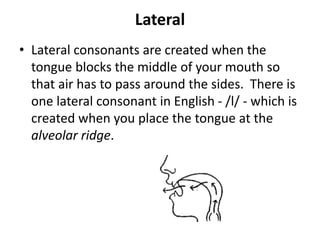
Lateral 
• Lateral consonants are created when the 
tongue blocks the middle of your mouth so 
that air has to pass around the sides. There is 
one lateral consonant in English - /l/ - which is 
created when you place the tongue at the 
alveolar ridge.
Manner of articulation 
Types Features Symbols 
Plosives (stop 
consonants) 
Complete 
closure, air 
pressure -> 
explosion 
Bilabial plosives: Alveolar 
plosives: 
Velar plosives: 
Fricatives 
(continuant 
consonants) 
Air escapes thru’ 
a small 
passage=> 
hissing sound 
(friction) 
/p/ /b/ 
Labio-dental 
fricatives: 
Dental 
fricatives 
/t/ /d/ 
Alveolar 
fricatives 
/k/ /g/ 
Palato-alveolar 
fricatives 
Glottal 
fricative 
Nasals Air escapes thru’ 
the nose 
/f/ /v/ /θ/ /δ/ /s/ /z/ /ʃ/ 
/ʒ/ 
Bilabial nasal Alveolar nasal Velar nasal 
/h/ 
/m/ /n/ /ŋ/
Manner of articulation 
Types Features Symbols 
Affricates 
(Palato-alveolar 
affricates) 
Closure between tip, blade, 
rims of tongue & upper alveolar 
ridge & side teeth. 
Front of tongue raised towards 
hard palate in readiness for 
fricative release 
Friction is shorter than in 
fricatives. 
(Alveolar) 
Lateral 
Tip of tongue makes contact 
with upper teeth ridge. 
Air escapes on both sides of 
tongue on upper side teeth 
Approximant 
s 
Articulators approach each 
other but do not get sufficiently 
close to each other to produce a 
“complete” consonant such as 
plosive, nasal or fricative 
Post- 
Alveolar 
approximant 
Palatal 
approximant 
bilabial 
approximant 
/ʤ/ 
/ʧ/ 
/l/ 
/r/ /j/ /w/
ACCORDING TO VOICING 
1. Voiced consonants: are produced when 
the vocal cords are vibrating. 
e.g. 
2. Voiceless consonants: are produced when 
the vocal cords are not vibrating. 
e.g.
DESCRIBING ENGLISH CONSONANTS 
• The description includes the following information: 
a. Voicing 
b. Place of articulation 
c. Manner of articulation 
e.g. /s/: 
/n/: 
/f/: 
/t/: 
//: 
/j/: 
/g/:
INDENTIFYING ENGLISH CONSONANTS 
• A description in given and you have to identify which sound is 
being described. 
Voiced velar nasal: 
Voiceless palato-alveolar fricative: 
Voiced bilabial stop: 
Voiced labio-dental fricative: 
Voiced alveolar lateral: 
Voiceless palato-alveolar affricate: 
Voiced dental fricative:
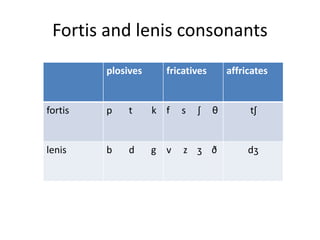
Fortis and lenis consonants 
plosives fricatives affricates 
fortis p t k f s ʃ θ tʃ 
lenis b d g v z ʒ ð dʒ
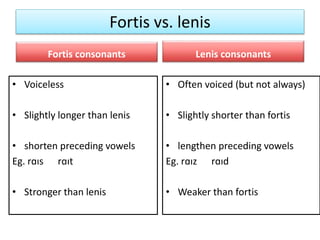
Fortis vs. lenis 
Fortis consonants 
• Voiceless 
• Slightly longer than lenis 
• shorten preceding vowels 
Eg. rɑɪs rɑɪt 
• Stronger than lenis 
Lenis consonants 
• Often voiced (but not always) 
• Slightly shorter than fortis 
• lengthen preceding vowels 
Eg. rɑɪz rɑɪd 
• Weaker than fortis
Fortis vs lenis plosives 
• Fortis plosives are strongly aspirated in initial (stressed) 
positions 
Eg. [pʰen] [tʰʌn] [kʰæn] [pəˈtʰeɪtəʊ] 
• Fortis plosives are weakly aspirated in unstressed and final 
position. 
Eg. [pʰɒt] [təˈmɒrəʊ] 
• /l, r, w, j/ are devoiced when following fortis plosives 
Eg. [ple̥ɪ] [kr̥ɑɪ] [tw̥ɪn] 
• Lenis plosives are voiced only when they are between voiced 
sounds 
Eg. [b̥ʊk] [d̥ɒg̊] [ˈhɑːdə]
Fortis vs. lenis fricatives 
• Friction noise of fortis fricatives is louder 
• Lenis fricatives are voiced between voiced 
sounds 
Eg. [lɑɪv̥] [briːð̥] [z̥uː] [ˈmeʒə]
Fortis vs. lenis affricates 
• Lenis affricates are voiced between voiced 
sounds. 
Eg. [lɑːdʒ̊] [lɑːdʒə] [dʒ̊ɒb̥]

Consonants

  • 1.
  • 3.
    LECTURE 2 •How are consonants described & classified in terms of: –Place of articulation –Manner of articulation –Voicing –Force of articulation
  • 4.
    ENGLISH CONSONANTS –CRITERIA IN DESCRIBING • Do the vocal cords vibrate or not? – Voiced/Voiceless • Is the soft palate raised or lowered? – Oral/Nasal • At what point or points & between what speech organs does the closure or narrowing take place? – Place of articulation • What is the type of closure or narrowing at the point of articulation? – Manner of articulation
  • 5.
    Place of articulationthe point of contact where an obstruction occurs in the vocal tract Bilabial consonants Labio-dental consonants Dental consonants Alveolar consonants Palatal consonants Post/palato alveolar consonants Velar consonants Glottal consonants
  • 6.
    Alveolar ridge Backof alveolar ridge Glottis Hard palate Lower lip Lower lip Soft palate Tongue back Tongue blade Tongue blade Tongue front Tongue tip Upper lip Upper teeth Upper teeth Vocal cords
  • 7.
    Place of articulationthe point of contact where an obstruction occurs in the vocal tract Bilabial consonants Labio-dental consonants Dental consonants Alveolar consonants Tongue back Soft palate Palatal consonants Post/palato alveolar consonants Velar consonants Glottal consonants Upper lip Lower lip Lower lip Upper teeth Tongue tip Upper teeth Tongue blade Alveolar ridge Glottis Tongue front Hard palate Tongue blade Vocal cords Back of alveolar ridge
  • 8.
    Bilabial consonants /p//b//m//w/ Upper lip + lower lip
  • 9.
  • 10.
  • 11.
    Labio-dental consonants /f//v/ Lower lip (active) + upper teeth (passive)
  • 12.
  • 13.
    Dental consonants /θ//δ/ Upper teeth (passive) + tongue tip (active)
  • 14.
  • 15.
    Alveolar consonants /t//d//n//z//s//l/ Alveolar ridge (passive) + tongue blade (tip +blade) (active)
  • 16.
  • 17.
  • 18.
  • 19.
    Post/Palato-alveolar consonants Tongueblade or tip & blade + back of alveolar ridge +raising of tongue front towards hard palate /ʃ//ʒ//ʧ//ʤ//r/
  • 20.
  • 21.
  • 22.
  • 23.
    Palatal consonant Hardpalate + tongue front /j/
  • 24.
    Velar consonants Softpalate + tongue back /ŋ//k//g/
  • 25.
  • 26.
    Glottal consonant theglottis, vocal cords
  • 27.
    CONSONANT CLASSIFICATION: PLACEOF ARTICULATION Name Articulators Examples Bilabial Upper lip + lower lip Labio-dental Lower lip + upper teeth Dental Upper teeth + tongue tip Alveolar Alveolar ridge + tongue blade (tip +blade) Post/Palato-alveolar Tongue blade or tip & blade + alveolar ridge +raising of tongue front towards hard palate Palatal Hard palate + tongue front Velar Soft palate + tongue back Glottal Glottis, vocal cords /p//b//m/ /w/ /f/ /v/ /θ//δ/ /t//d//n//z//s//l/ /ʃ//ʒ//ʧ//ʤ//r / /j/ /ŋ//k//g/ /h/
  • 28.
    MANNER OF ARTICULATION TYPE OF CLOSURE MADE BY THE ARTICULATORS Nasal consonants Plosives/stops Fricatives Affricates Approximants Lateral consonant
  • 29.
    Nasal consonants Nasalconsonants are created when you completely block air flow through your mouth (by lowering the soft palate and let the air pass through your nose. + /m/ two lips (bilabial) + /n/ tongue blade against the alveolar ridge (alveolar). + /ŋ/ - the back of your tongue against the soft palate (velar).
  • 30.
    Plosives/stop consonants •stop consonants occur when the vocal tract is closed completely, the air quickly builds up pressure behind the articulators and then releases in a burst (plosion) • /p/ /b/ oral passage is blocked by closing the lips (bilabial). • /t/ /d/ - oral passage is blocked by pressing the tongue blade against the alveolar ridge (alveolar) • /k/ /g/- block airflow with the back of the tongue against the soft palate (velar).
  • 31.
    4 phases ofproduction of stops • Closure phase: the articulators move to form the stricture (obstruction) • Hold phase: the compressed air is stopped from escaping • release phase: the articulators are moved to allow air to escape • Post-release phase
  • 32.
    Fricative consonants •fricative sounds involve only a partial blockage of the vocal tract so that air has to be forced through a narrow channel, making a hissing sound • Fricatives are continuant consonants • /f/ /v/ - air is forced through the upper teeth and lower lip (labiodental) • /θ/ /ð/ air is forced through upper teeth and tongue (dental) • /s/ /z/ - air is forced through tongue and alveolar ridge (alveolar) • /ʃ/ /ʒ/ - air is forced through the tongue and point just beyond alveolar ridge (post-alveolar) • /h/ - air passes through the glottis (glottal), between the vocal cords
  • 33.
    Affricates Stops FricativesAFFRICATES • The Affricate consonants start as stops with air building up behind an articulator which then ends as an fricative. • /tʃ/ /dʒ/ air is blocked with tongue just beyond the alveolar ridge (post-alveolar), then released as a fricative.
  • 34.
    Approximant • Approximantsare created when two articulators come close together but not quite close enough to create air turbulence. • /w/ - back of tongue raises to velum (but not too close!) and lips are rounded (bilabial) (labio-velar) • /j/ - tongue front raises to hard palate (but not too close!) (palatal). • /r/ - tongue blade raises to hard palate (post-alveolar)
  • 35.
    Lateral • Lateralconsonants are created when the tongue blocks the middle of your mouth so that air has to pass around the sides. There is one lateral consonant in English - /l/ - which is created when you place the tongue at the alveolar ridge.
  • 36.
    Manner of articulation Types Features Symbols Plosives (stop consonants) Complete closure, air pressure -> explosion Bilabial plosives: Alveolar plosives: Velar plosives: Fricatives (continuant consonants) Air escapes thru’ a small passage=> hissing sound (friction) /p/ /b/ Labio-dental fricatives: Dental fricatives /t/ /d/ Alveolar fricatives /k/ /g/ Palato-alveolar fricatives Glottal fricative Nasals Air escapes thru’ the nose /f/ /v/ /θ/ /δ/ /s/ /z/ /ʃ/ /ʒ/ Bilabial nasal Alveolar nasal Velar nasal /h/ /m/ /n/ /ŋ/
  • 37.
    Manner of articulation Types Features Symbols Affricates (Palato-alveolar affricates) Closure between tip, blade, rims of tongue & upper alveolar ridge & side teeth. Front of tongue raised towards hard palate in readiness for fricative release Friction is shorter than in fricatives. (Alveolar) Lateral Tip of tongue makes contact with upper teeth ridge. Air escapes on both sides of tongue on upper side teeth Approximant s Articulators approach each other but do not get sufficiently close to each other to produce a “complete” consonant such as plosive, nasal or fricative Post- Alveolar approximant Palatal approximant bilabial approximant /ʤ/ /ʧ/ /l/ /r/ /j/ /w/
  • 38.
    ACCORDING TO VOICING 1. Voiced consonants: are produced when the vocal cords are vibrating. e.g. 2. Voiceless consonants: are produced when the vocal cords are not vibrating. e.g.
  • 39.
    DESCRIBING ENGLISH CONSONANTS • The description includes the following information: a. Voicing b. Place of articulation c. Manner of articulation e.g. /s/: /n/: /f/: /t/: //: /j/: /g/:
  • 40.
    INDENTIFYING ENGLISH CONSONANTS • A description in given and you have to identify which sound is being described. Voiced velar nasal: Voiceless palato-alveolar fricative: Voiced bilabial stop: Voiced labio-dental fricative: Voiced alveolar lateral: Voiceless palato-alveolar affricate: Voiced dental fricative:
  • 43.
    Fortis and lenisconsonants plosives fricatives affricates fortis p t k f s ʃ θ tʃ lenis b d g v z ʒ ð dʒ
  • 44.
    Fortis vs. lenis Fortis consonants • Voiceless • Slightly longer than lenis • shorten preceding vowels Eg. rɑɪs rɑɪt • Stronger than lenis Lenis consonants • Often voiced (but not always) • Slightly shorter than fortis • lengthen preceding vowels Eg. rɑɪz rɑɪd • Weaker than fortis
  • 45.
    Fortis vs lenisplosives • Fortis plosives are strongly aspirated in initial (stressed) positions Eg. [pʰen] [tʰʌn] [kʰæn] [pəˈtʰeɪtəʊ] • Fortis plosives are weakly aspirated in unstressed and final position. Eg. [pʰɒt] [təˈmɒrəʊ] • /l, r, w, j/ are devoiced when following fortis plosives Eg. [ple̥ɪ] [kr̥ɑɪ] [tw̥ɪn] • Lenis plosives are voiced only when they are between voiced sounds Eg. [b̥ʊk] [d̥ɒg̊] [ˈhɑːdə]
  • 46.
    Fortis vs. lenisfricatives • Friction noise of fortis fricatives is louder • Lenis fricatives are voiced between voiced sounds Eg. [lɑɪv̥] [briːð̥] [z̥uː] [ˈmeʒə]
  • 47.
    Fortis vs. lenisaffricates • Lenis affricates are voiced between voiced sounds. Eg. [lɑːdʒ̊] [lɑːdʒə] [dʒ̊ɒb̥]