




Phonetics
course
Moza AE
mɔːzə eɪ ɪː
æ
The content
• What is linguistic?
• What is phonetics?
• Why do we need it?
• What are the phonetics branches?
• IPA
• Consonant
• Vowels
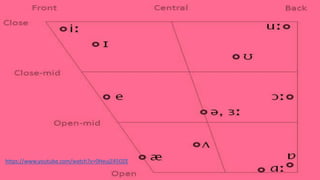
ɒ
ɑ:
ʌ
ɔ:
ɜ:ɫ
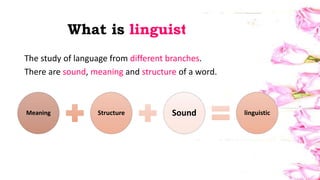
What is linguistic?
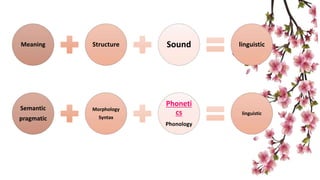
Meaning Structure Sound linguistic
The study of language from different branches.
There are sound, meaning and structure of a word.
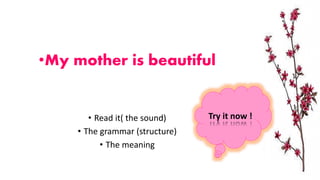
•My mother is beautiful
• Read it( the sound)
• The grammar (structure)
• The meaning
Try it now !
Meaning Structure Sound linguistic
Semantic
pragmatic
Morphology
Syntax
Phoneti
cs
Phonology
linguistic
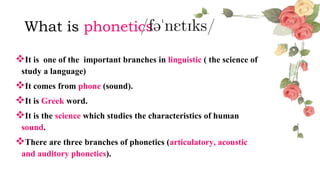
What is phonetics
It is one of the important branches in linguistic ( the science of
study a language)
It comes from phone (sound).
It is Greek word.
It is the science which studies the characteristics of human
sound.
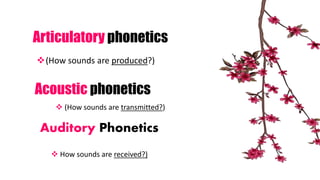
There are three branches of phonetics (articulatory, acoustic
and auditory phonetics).
Articulatory phonetics
(How sounds are produced?)
Acoustic phonetics
 (How sounds are transmitted?)
Auditory Phonetics
 How sounds are received?)
Why do we need Phonetics?
 WeneedtostudyPhoneticssothatwecanimproveourpronunciationby
learningtoproduceeachsoundofStandardEnglishcorrectly.
 Weneedtostudyphoneticssothatwecaninterpretthesymbolsusedindictionaries
whichrepresentthepronunciationofradioannouncersandeducatedEnglish-
speakingpeople.
 WestudyPhoneticstofeelcomfortableinusing Englishlanguage
•We are dealing with
sounds
•The International Phonetic Alphabet
IPA
The International Phonetic Alphabet (IPA) is a system where
each symbol is associated with a particular English sound. By
using IPA you can know exactly how to pronounce a certain
word in English. This helps in improving English pronunciation
and feeling more confident speaking in English.
How to describe consonant sounds
The place of articulation
The manner of articulation
Voicing
In English we have consonant and vowels
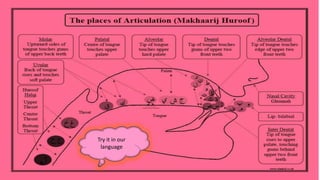
Let’s try it in Arabic
Try it in our
language
English Sounds
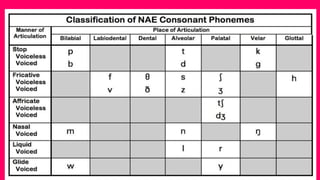
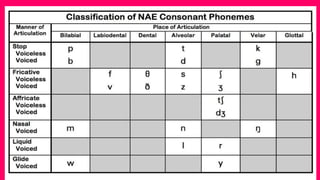
Most English consonants can be classified using three
articulatory parameters:
Voicing: vibration or lack of vibration of the vocal
folds.
Place of Articulation: the point at which the air
stream is most restricted.
Manner of Articulation: what happens to the moving
column of air.
CLASSIFICATION OF CONSONANTS
Voicing
Voicing
• Voicing introduces vibration into the resonating
column of air. When the vocal folds are tensed, they
vibrate as the air stream passes them.
• When your vocal cords are vibrating( voiced)
• When your vocal cords are NOT vibrating
(voiceless)
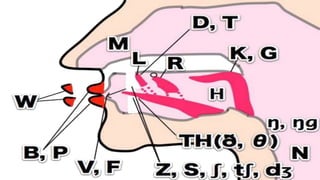
Place of Articulation:
the point at which the air stream is most restricted.
Bilabi
al
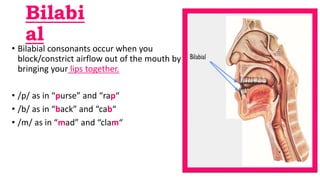
• Bilabial consonants occur when you
block/constrict airflow out of the mouth by
bringing your lips together.
• /p/ as in “purse” and “rap“
• /b/ as in “back” and “cab“
• /m/ as in “mad” and “clam“
Labio-Dental
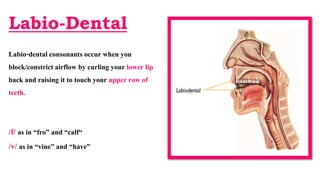
Labio-dental consonants occur when you
block/constrict airflow by curling your lower lip
back and raising it to touch your upper row of
teeth.
/f/ as in “fro” and “calf“
/v/ as in “vine” and “have”
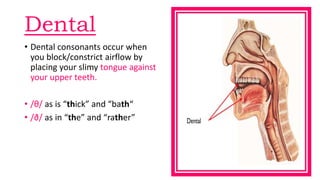
Dental
• Dental consonants occur when
you block/constrict airflow by
placing your slimy tongue against
your upper teeth.
• /θ/ as is “thick” and “bath“
• /ð/ as in “the” and “rather”
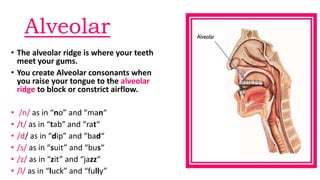
Alveolar
• The alveolar ridge is where your teeth
meet your gums.
• You create Alveolar consonants when
you raise your tongue to the alveolar
ridge to block or constrict airflow.
• /n/ as in “no” and “man“
• /t/ as in “tab” and “rat“
• /d/ as in “dip” and “bad“
• /s/ as in “suit” and “bus“
• /z/ as in “zit” and “jazz“
• /l/ as in “luck” and “fully”
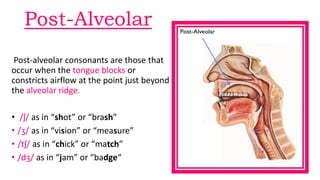
Post-Alveolar
Post-alveolar consonants are those that
occur when the tongue blocks or
constricts airflow at the point just beyond
the alveolar ridge.
• /ʃ/ as in “shot” or “brash”
• /ʒ/ as in “vision” or “measure”
• /tʃ/ as in “chick” or “match”
• /dʒ/ as in “jam” or “badge“
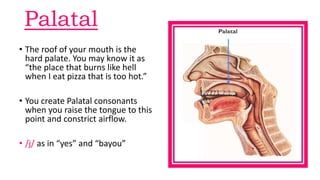
Palatal
• The roof of your mouth is the
hard palate. You may know it as
“the place that burns like hell
when I eat pizza that is too hot.”
• You create Palatal consonants
when you raise the tongue to this
point and constrict airflow.
• /j/ as in “yes” and “bayou”
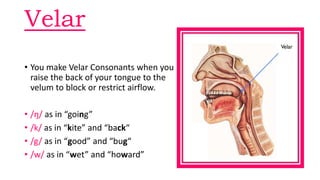
Velar
• You make Velar Consonants when you
raise the back of your tongue to the
velum to block or restrict airflow.
• /ŋ/ as in “going”
• /k/ as in “kite” and “back“
• /g/ as in “good” and “bug“
• /w/ as in “wet” and “howard”
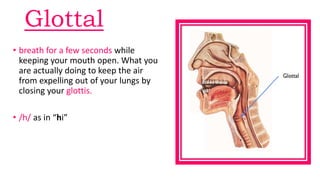
Glottal
• breath for a few seconds while
keeping your mouth open. What you
are actually doing to keep the air
from expelling out of your lungs by
closing your glottis.
• /h/ as in “hi”
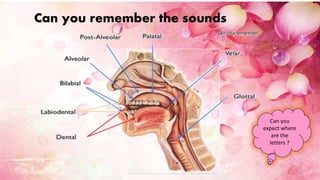
Can you remember the sounds
Can you
expect where
are the
letters ?
Manner of Articulation:
what happens to the moving column of air.
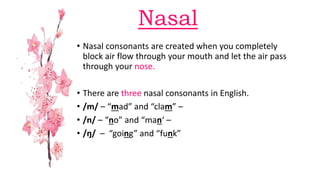
Nasal
• Nasal consonants are created when you completely
block air flow through your mouth and let the air pass
through your nose.
• There are three nasal consonants in English.
• /m/ – “mad” and “clam” –
• /n/ – “no” and “man‘ –
• /ŋ/ – “going” and “funk”
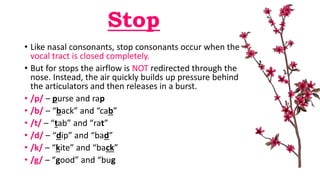
Stop
• Like nasal consonants, stop consonants occur when the
vocal tract is closed completely.
• But for stops the airflow is NOT redirected through the
nose. Instead, the air quickly builds up pressure behind
the articulators and then releases in a burst.
• /p/ – purse and rap
• /b/ – “back” and “cab”
• /t/ – “tab” and “rat”
• /d/ – “dip” and “bad”
• /k/ – “kite” and “back”
• /g/ – “good” and “bug
Fricative
• fricative sounds involve only a partial blockage of the
vocal tract so that air has to be forced through a
narrow channel.
• /f/ – “fro” and “calf“-
• /v/ – “vine” and “have”
• –/θ/ – “thick” and “bath”
• /ð/ – “the” and “rather” –)
• /s/ – “suit” and “bus” –
• /z/ – “zit” and “jazz”
• /ʃ/ – “shot” and “brash” –
• /ʒ/ – “vision” and “)
• /h/ – “happy” and “hope
Affricate
• When stop consonants mix with fricative consonants, the result is
an affricate consonant.
• The English affricate sounds are:
• /tʃ/ – “chick” and “match” –
• /dʒ/ – “jam” and “badge” –
Vowels
 Vowel is a speech sound produced by humans when the breath flows out
through the mouth without being blocked by the teeth, tongue, or lips.
 We need to study vowels because it is the most important sound in a syllable .
There are no word without vowels.
 There are five English vowels, (A, E, I, O, U.).
 There are five vowels letter in English, but what are the vowels sounds .
Are they the same????!!!
Think about it, then read it.
•Bitter
•Better
•Butter
Think about your
example
Wehave5English
lettersthatgiveus20
Englishsounds
https://www.youtube.com/watch?v=0HeujZ45OZE
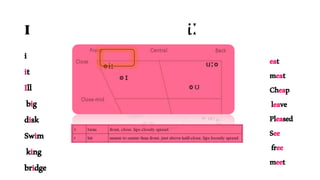
ɪ iː
i
it
Ill
big
disk
Swim
king
bridge
eat
meat
Cheap
leave
Pleased
See
free
meet
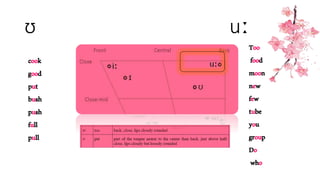
ʊ uː
cook
good
put
bush
push
full
pull
Too
food
moon
new
few
tube
you
group
Do
who
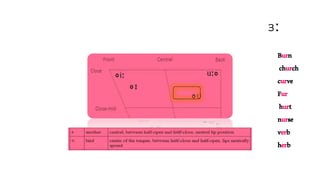
ɜː
Burn
church
curve
Fur
hurt
nurse
verb
herb
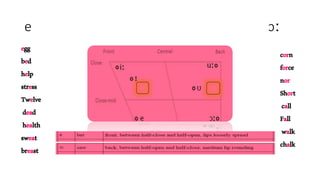
e ɔː
corn
force
nor
Short
call
Fall
walk
chalk
egg
bed
help
stress
Twelve
dead
health
sweat
breast

linguistics (Phonetics and its characteristics )

  • 1.
  • 2.
    æ The content • Whatis linguistic? • What is phonetics? • Why do we need it? • What are the phonetics branches? • IPA • Consonant • Vowels ɒ ɑ: ʌ ɔ: ɜ:ɫ
  • 3.
    What is linguistic? MeaningStructure Sound linguistic The study of language from different branches. There are sound, meaning and structure of a word.
  • 4.
    •My mother isbeautiful • Read it( the sound) • The grammar (structure) • The meaning Try it now !
  • 5.
    Meaning Structure Soundlinguistic Semantic pragmatic Morphology Syntax Phoneti cs Phonology linguistic
  • 6.
    What is phonetics Itis one of the important branches in linguistic ( the science of study a language) It comes from phone (sound). It is Greek word. It is the science which studies the characteristics of human sound. There are three branches of phonetics (articulatory, acoustic and auditory phonetics).
  • 7.
    Articulatory phonetics (How soundsare produced?) Acoustic phonetics  (How sounds are transmitted?) Auditory Phonetics  How sounds are received?)
  • 8.
    Why do weneed Phonetics?  WeneedtostudyPhoneticssothatwecanimproveourpronunciationby learningtoproduceeachsoundofStandardEnglishcorrectly.  Weneedtostudyphoneticssothatwecaninterpretthesymbolsusedindictionaries whichrepresentthepronunciationofradioannouncersandeducatedEnglish- speakingpeople.  WestudyPhoneticstofeelcomfortableinusing Englishlanguage
  • 9.
    •We are dealingwith sounds
  • 10.
    •The International PhoneticAlphabet IPA The International Phonetic Alphabet (IPA) is a system where each symbol is associated with a particular English sound. By using IPA you can know exactly how to pronounce a certain word in English. This helps in improving English pronunciation and feeling more confident speaking in English.
  • 11.
    How to describeconsonant sounds The place of articulation The manner of articulation Voicing In English we have consonant and vowels
  • 12.
    Let’s try itin Arabic
  • 13.
    Try it inour language
  • 14.
  • 16.
    Most English consonantscan be classified using three articulatory parameters: Voicing: vibration or lack of vibration of the vocal folds. Place of Articulation: the point at which the air stream is most restricted. Manner of Articulation: what happens to the moving column of air. CLASSIFICATION OF CONSONANTS
  • 17.
  • 18.
    Voicing • Voicing introducesvibration into the resonating column of air. When the vocal folds are tensed, they vibrate as the air stream passes them. • When your vocal cords are vibrating( voiced) • When your vocal cords are NOT vibrating (voiceless)
  • 19.
    Place of Articulation: thepoint at which the air stream is most restricted.
  • 20.
    Bilabi al • Bilabial consonantsoccur when you block/constrict airflow out of the mouth by bringing your lips together. • /p/ as in “purse” and “rap“ • /b/ as in “back” and “cab“ • /m/ as in “mad” and “clam“
  • 21.
    Labio-Dental Labio-dental consonants occurwhen you block/constrict airflow by curling your lower lip back and raising it to touch your upper row of teeth. /f/ as in “fro” and “calf“ /v/ as in “vine” and “have”
  • 22.
    Dental • Dental consonantsoccur when you block/constrict airflow by placing your slimy tongue against your upper teeth. • /θ/ as is “thick” and “bath“ • /ð/ as in “the” and “rather”
  • 23.
    Alveolar • The alveolarridge is where your teeth meet your gums. • You create Alveolar consonants when you raise your tongue to the alveolar ridge to block or constrict airflow. • /n/ as in “no” and “man“ • /t/ as in “tab” and “rat“ • /d/ as in “dip” and “bad“ • /s/ as in “suit” and “bus“ • /z/ as in “zit” and “jazz“ • /l/ as in “luck” and “fully”
  • 24.
    Post-Alveolar Post-alveolar consonants arethose that occur when the tongue blocks or constricts airflow at the point just beyond the alveolar ridge. • /ʃ/ as in “shot” or “brash” • /ʒ/ as in “vision” or “measure” • /tʃ/ as in “chick” or “match” • /dʒ/ as in “jam” or “badge“
  • 25.
    Palatal • The roofof your mouth is the hard palate. You may know it as “the place that burns like hell when I eat pizza that is too hot.” • You create Palatal consonants when you raise the tongue to this point and constrict airflow. • /j/ as in “yes” and “bayou”
  • 26.
    Velar • You makeVelar Consonants when you raise the back of your tongue to the velum to block or restrict airflow. • /ŋ/ as in “going” • /k/ as in “kite” and “back“ • /g/ as in “good” and “bug“ • /w/ as in “wet” and “howard”
  • 27.
    Glottal • breath fora few seconds while keeping your mouth open. What you are actually doing to keep the air from expelling out of your lungs by closing your glottis. • /h/ as in “hi”
  • 29.
    Can you rememberthe sounds Can you expect where are the letters ?
  • 31.
    Manner of Articulation: whathappens to the moving column of air.
  • 32.
    Nasal • Nasal consonantsare created when you completely block air flow through your mouth and let the air pass through your nose. • There are three nasal consonants in English. • /m/ – “mad” and “clam” – • /n/ – “no” and “man‘ – • /ŋ/ – “going” and “funk”
  • 33.
    Stop • Like nasalconsonants, stop consonants occur when the vocal tract is closed completely. • But for stops the airflow is NOT redirected through the nose. Instead, the air quickly builds up pressure behind the articulators and then releases in a burst. • /p/ – purse and rap • /b/ – “back” and “cab” • /t/ – “tab” and “rat” • /d/ – “dip” and “bad” • /k/ – “kite” and “back” • /g/ – “good” and “bug
  • 34.
    Fricative • fricative soundsinvolve only a partial blockage of the vocal tract so that air has to be forced through a narrow channel. • /f/ – “fro” and “calf“- • /v/ – “vine” and “have” • –/θ/ – “thick” and “bath” • /ð/ – “the” and “rather” –) • /s/ – “suit” and “bus” – • /z/ – “zit” and “jazz” • /ʃ/ – “shot” and “brash” – • /ʒ/ – “vision” and “) • /h/ – “happy” and “hope
  • 35.
    Affricate • When stopconsonants mix with fricative consonants, the result is an affricate consonant. • The English affricate sounds are: • /tʃ/ – “chick” and “match” – • /dʒ/ – “jam” and “badge” –
  • 36.
    Vowels  Vowel isa speech sound produced by humans when the breath flows out through the mouth without being blocked by the teeth, tongue, or lips.  We need to study vowels because it is the most important sound in a syllable . There are no word without vowels.  There are five English vowels, (A, E, I, O, U.).  There are five vowels letter in English, but what are the vowels sounds . Are they the same????!!!
  • 37.
    Think about it,then read it. •Bitter •Better •Butter Think about your example
  • 38.
  • 39.
  • 40.
  • 41.
  • 42.
  • 43.