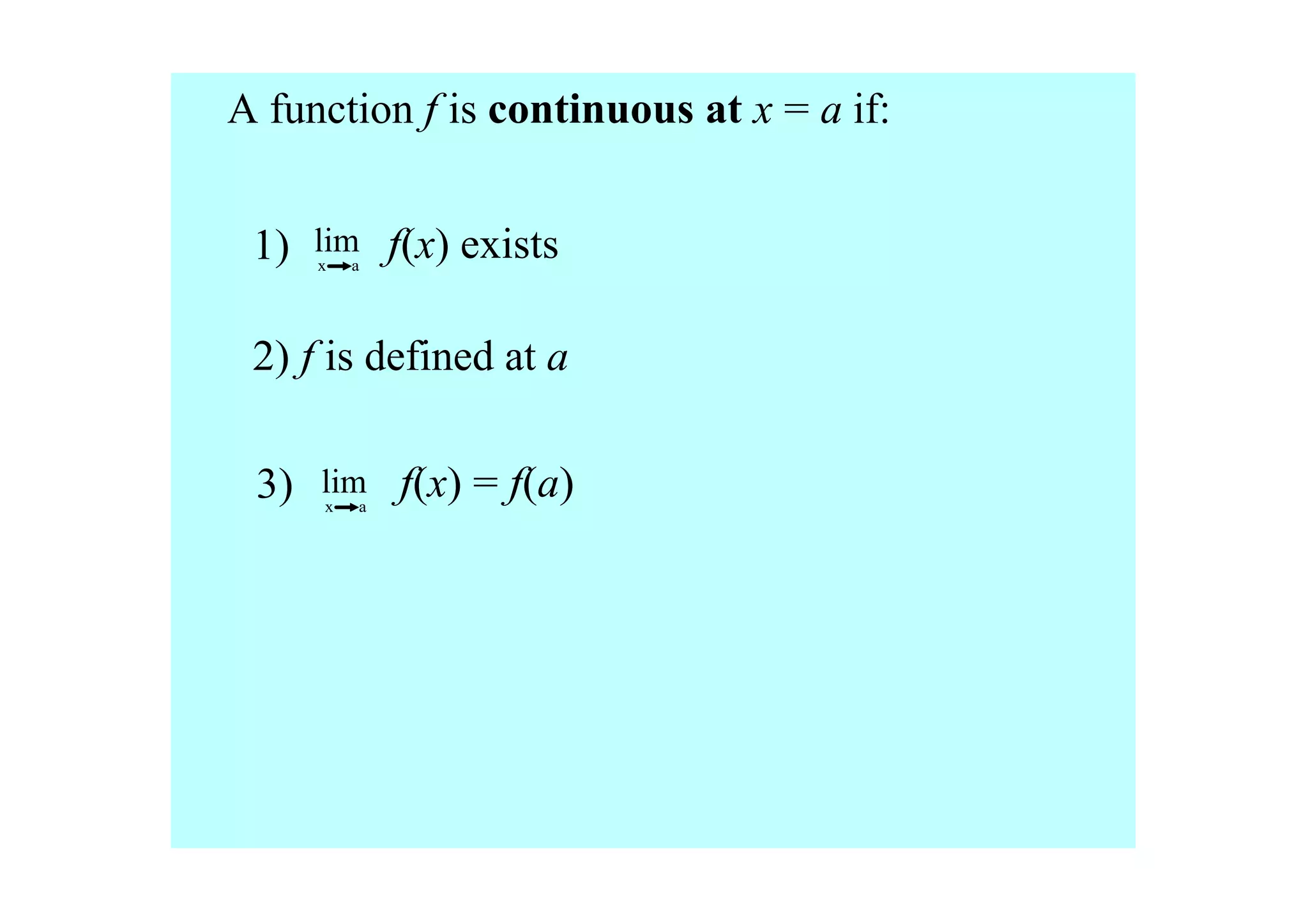
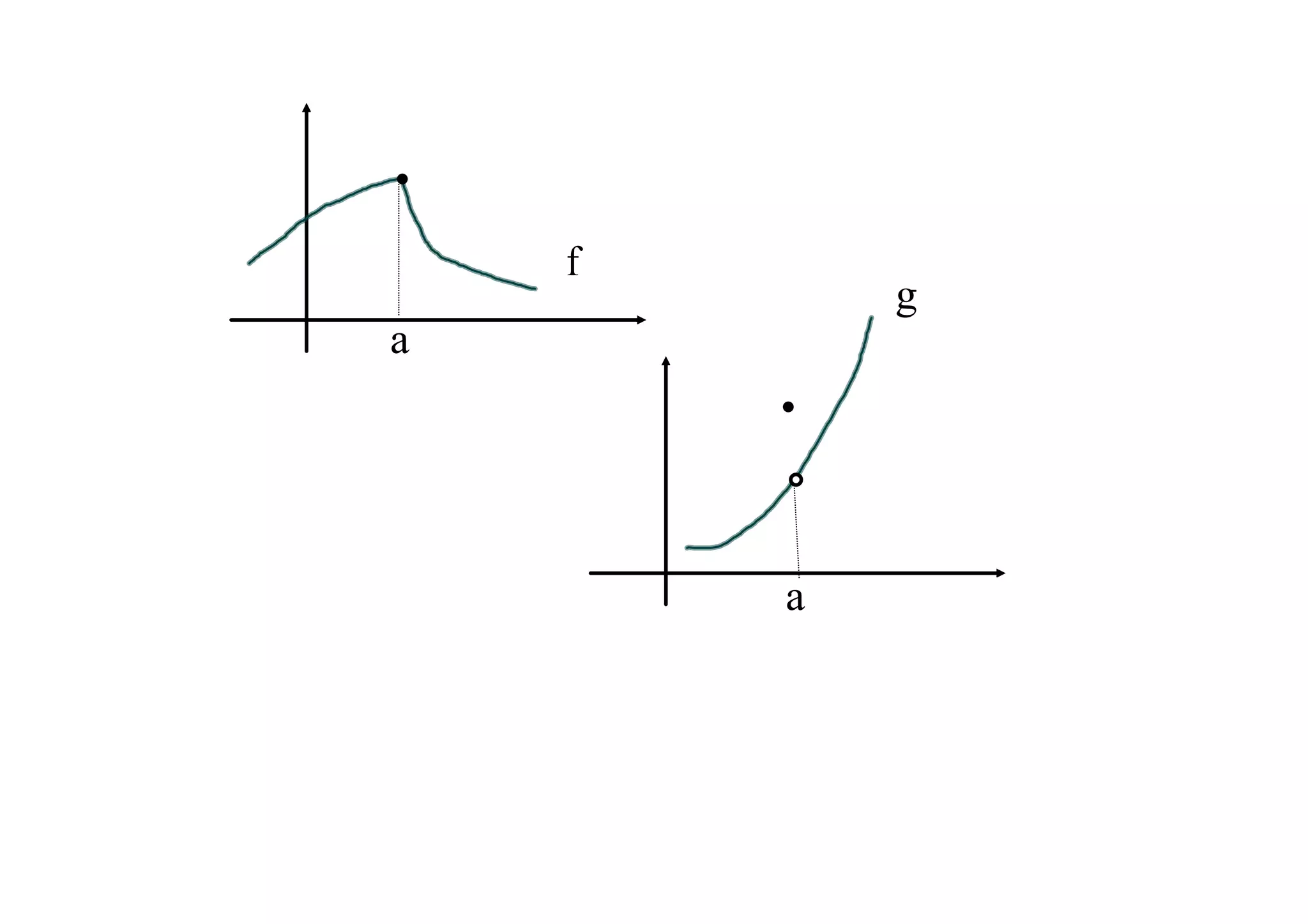
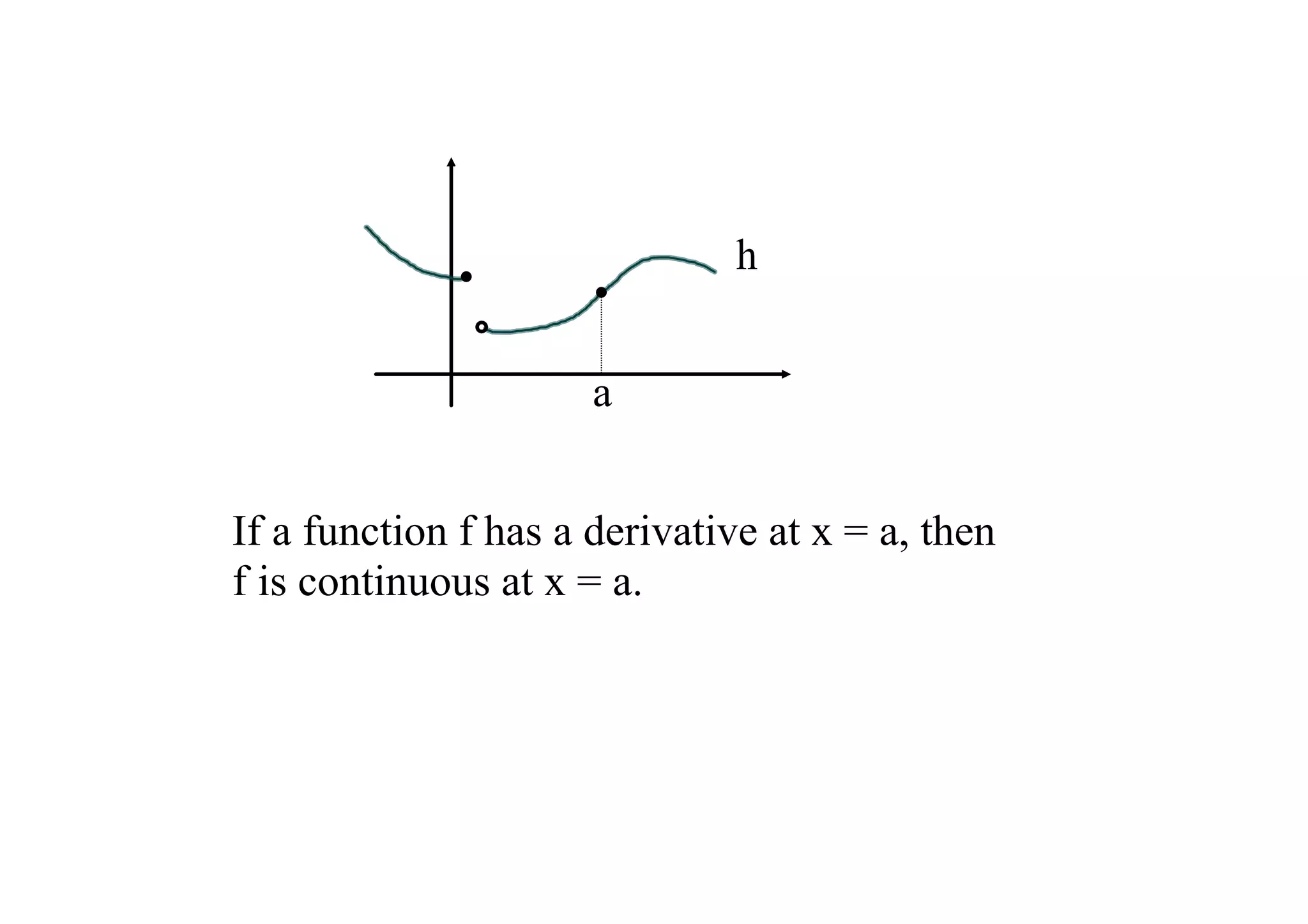
This document discusses continuity of functions, including definitions of continuity at a point and on an interval. It introduces the intermediate value theorem and extreme value theorem for continuous functions on closed intervals. It also states that differentiability at a point implies continuity at that point.

![Continuity on an interval
A function f is continuous on the closed interval
[a, b] if it is continuous at every number in the
open interval (a, b) and
lim
x a+
f(x) = f (a) and lim f(x) = f(b)
x b
right continuous
left continuous](https://image.slidesharecdn.com/derivativeslessonoct19-091019123044-phpapp02/75/Derivatives-Lesson-Oct-19-9-2048.jpg)
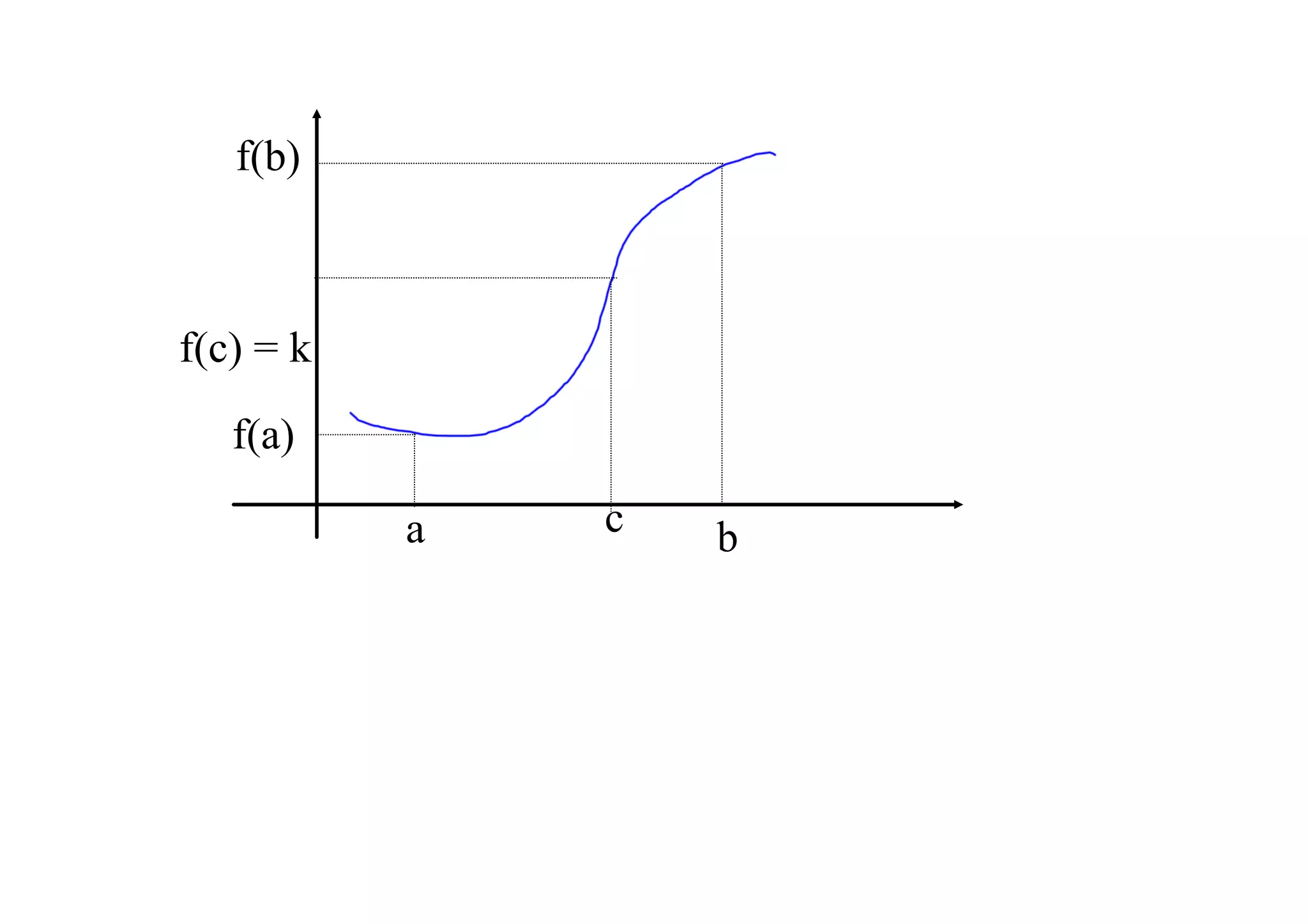
![The Intermediate Value Theorem: If the
function f is continuous on the closed interval
[a, b], with f(a) f(b), and k is a number
=
between f(a) and f(b), then there exists at least
one number c in (a, b) for which f(c) = k.](https://image.slidesharecdn.com/derivativeslessonoct19-091019123044-phpapp02/75/Derivatives-Lesson-Oct-19-10-2048.jpg)
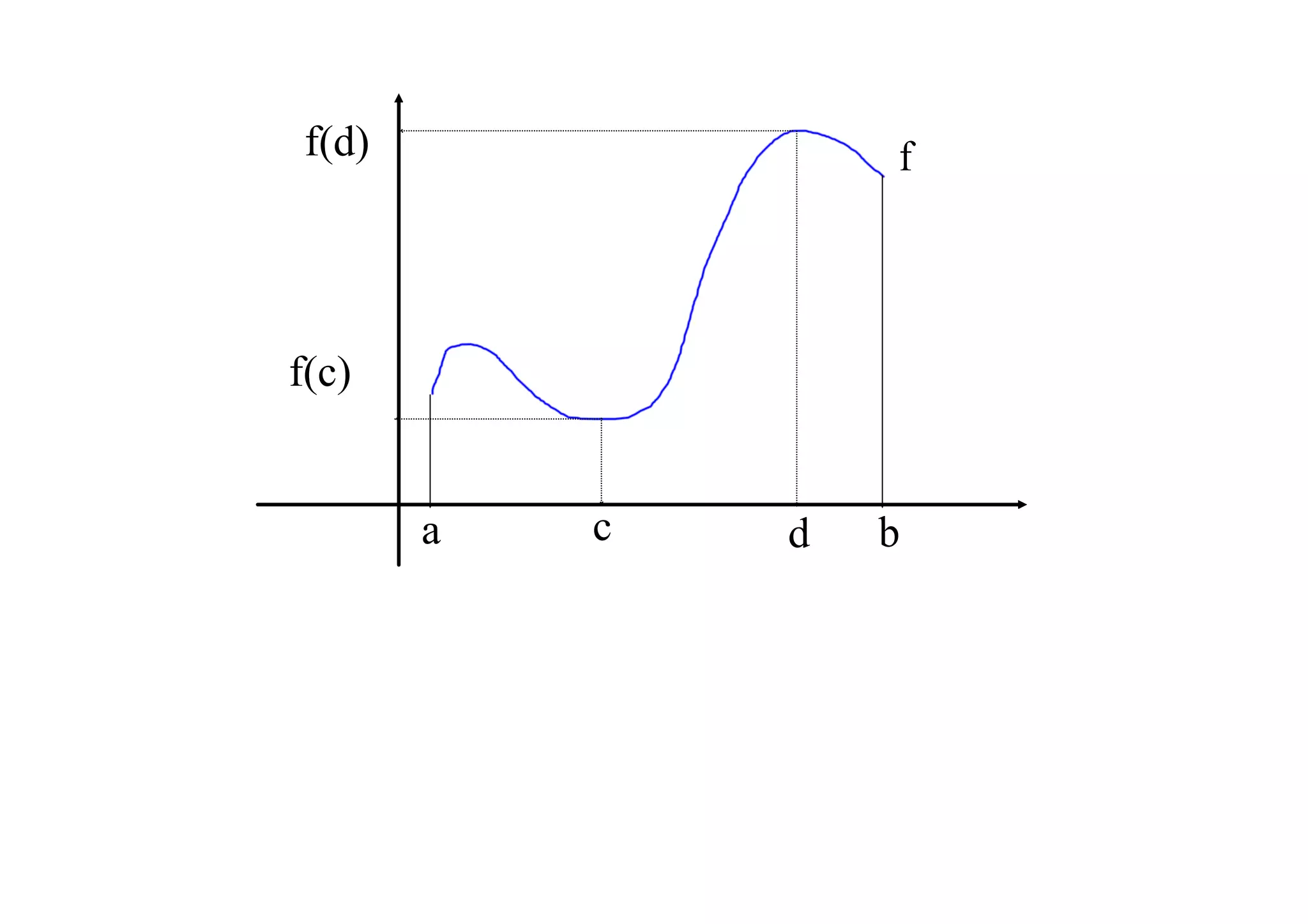
![The Extreme Value Theorem: If the
function f is continuous on the interval [a, b],
then there exist numbers c and d in [a, b] such
that for all x in [a, b],
f(c) < f(x) and f(d) > f(x)](https://image.slidesharecdn.com/derivativeslessonoct19-091019123044-phpapp02/75/Derivatives-Lesson-Oct-19-12-2048.jpg)


![Limits and continuity[1]](https://cdn.slidesharecdn.com/ss_thumbnails/limitsandcontinuity1-110816105053-phpapp01-thumbnail.jpg?width=640&height=640&fit=bounds)


