Download as PDF, PPTX
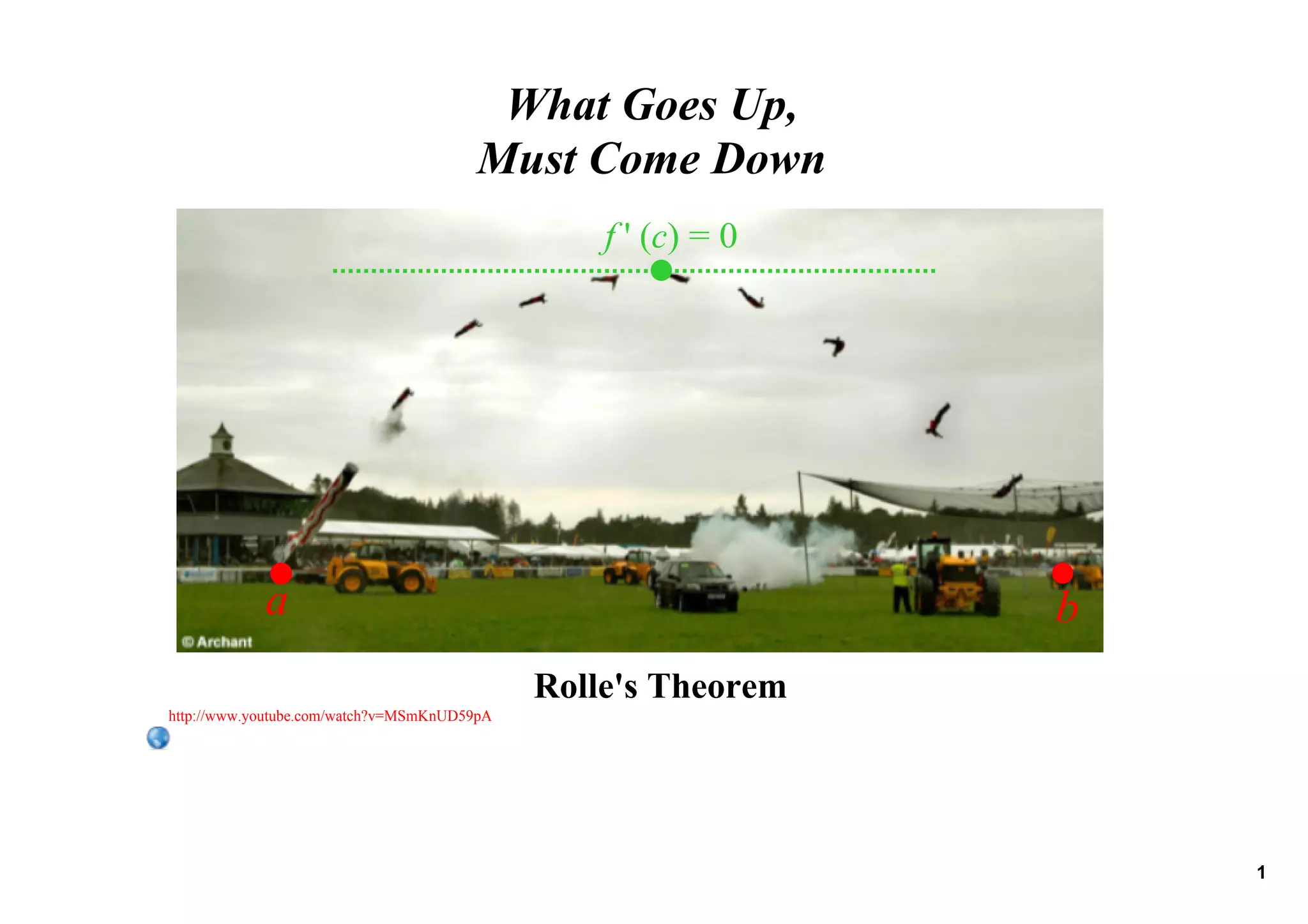
![f(x) is a continuous function on the closed interval [a, b].
f(a) = f(b)
f(x) is a differentiable function on the open interval (a, b).
there exists at least one xvalue, c such that f'(c) = 0
2](https://image.slidesharecdn.com/classnotes-sec5-5-rollestheorem-100419141555-phpapp02/75/Rolle-s-Theorem-2-2048.jpg)
![Since:
1) f(x) is a polynomial function so it is continuous
on the closed interval [1, 2]
2) f(1) = f(2) = 0
3) f(x) is differentiable for all xvalues on the
open interval (1, 2)
Therefore by Rolle's Theorem there exists at least one
xvalue c such that f'(c) = 0. (This occurs at the vertex, x = 1.5.)
3](https://image.slidesharecdn.com/classnotes-sec5-5-rollestheorem-100419141555-phpapp02/75/Rolle-s-Theorem-3-2048.jpg)
Rolle's Theorem states that if a function f(x) is continuous on a closed interval [a,b] and differentiable on the open interval (a,b), where f(a) = f(b), then there exists at least one number c in the open interval (a,b) where the derivative f'(c) is equal to 0. The document provides an example of applying Rolle's Theorem to the polynomial function f(x) = x^2 - 2.5x + 1.5 on the interval [1,2], showing that the derivative is 0 at x = 1.5.


