WELCOME TO
MY
PRESENTATION
NAME: Md. MIzANuR RAhAMAN
dEPARTMENT: CSE
STudENT Id: 171028005
COuRSE NAME: dIffERENTIAL
CALCuLuS
COuRSE COdE: MATh-101
The Mean Value Theorem
In this section, we will learn about:
The significance of the mean value theorem.
MEAN VALUE THEOREM
A special case of this theorem was first described by Parameshvara
(1370–1460), from the Kerala school of astronomy and mathematics in
India, in his commentaries on Govindasvāmi and Bhāskara II .
A restricted form of the theorem was proved by Rolle’s in 1691; the
result was what is now known as Rolle's theorem, and was proved only
for polynomials, without the techniques of calculus.
The mean value theorem in its modern form was stated and proved
by Cauchy in 1823.
MEAN VALUE THEOREM
Let f be a function that fulfills two hypotheses:
1. f is continuous on the closed interval [a, b].
2. f is differentiable on the open interval (a, b).
Then, there is a number c in (a, b) such that
( ) ( )
'( )
f b f a
f c
b a
−
=
−
MEAN VALUE THEOREM
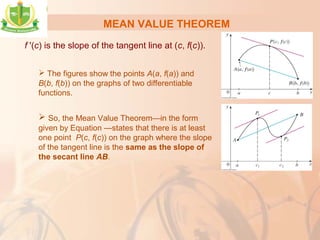
f '(c) is the slope of the tangent line at (c, f(c)).
 The figures show the points A(a, f(a)) and
B(b, f(b)) on the graphs of two differentiable
functions.
 So, the Mean Value Theorem—in the form
given by Equation —states that there is at least
one point P(c, f(c)) on the graph where the slope
of the tangent line is the same as the slope of
the secant line AB.
MEAN VALUE THEOREM
To illustrate the Mean Value Theorem with a specific function, let’s consider
f(x) = x3
– x, a = 0, b = 2.
Example
 Since f is a polynomial, it is continuous and differentiable for all x. So, it is
certainly continuous on [0, 2] and differentiable on (0, 2).
Therefore, by the Mean Value Theorem, there is a number c in (0,2) such
that:
4
3
2 / 3±
2 / 3 1.15≈
MEAN VALUE THEOREM
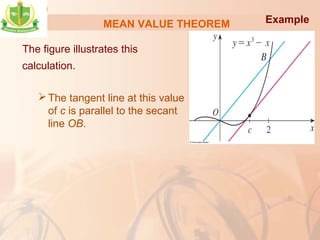
The figure illustrates this
calculation.
The tangent line at this value
of c is parallel to the secant
line OB.
Example
END OF
MY
PRESENTATION
ANY QUESTION

Mean value theorem

  • 1.
  • 2.
    NAME: Md. MIzANuRRAhAMAN dEPARTMENT: CSE STudENT Id: 171028005 COuRSE NAME: dIffERENTIAL CALCuLuS COuRSE COdE: MATh-101
  • 3.
    The Mean ValueTheorem In this section, we will learn about: The significance of the mean value theorem.
  • 4.
    MEAN VALUE THEOREM Aspecial case of this theorem was first described by Parameshvara (1370–1460), from the Kerala school of astronomy and mathematics in India, in his commentaries on Govindasvāmi and Bhāskara II . A restricted form of the theorem was proved by Rolle’s in 1691; the result was what is now known as Rolle's theorem, and was proved only for polynomials, without the techniques of calculus. The mean value theorem in its modern form was stated and proved by Cauchy in 1823.
  • 5.
    MEAN VALUE THEOREM Letf be a function that fulfills two hypotheses: 1. f is continuous on the closed interval [a, b]. 2. f is differentiable on the open interval (a, b). Then, there is a number c in (a, b) such that ( ) ( ) '( ) f b f a f c b a − = −
  • 6.
    MEAN VALUE THEOREM f'(c) is the slope of the tangent line at (c, f(c)).  The figures show the points A(a, f(a)) and B(b, f(b)) on the graphs of two differentiable functions.  So, the Mean Value Theorem—in the form given by Equation —states that there is at least one point P(c, f(c)) on the graph where the slope of the tangent line is the same as the slope of the secant line AB.
  • 7.
    MEAN VALUE THEOREM Toillustrate the Mean Value Theorem with a specific function, let’s consider f(x) = x3 – x, a = 0, b = 2. Example  Since f is a polynomial, it is continuous and differentiable for all x. So, it is certainly continuous on [0, 2] and differentiable on (0, 2). Therefore, by the Mean Value Theorem, there is a number c in (0,2) such that: 4 3 2 / 3± 2 / 3 1.15≈
  • 8.
    MEAN VALUE THEOREM Thefigure illustrates this calculation. The tangent line at this value of c is parallel to the secant line OB. Example
  • 9.
  • 11.