DENTINOGENESIS
DR Monika Negi
MDS
ORAL PATHOLOGY MICROBIOLOGY AND FORENSIC ODONTOLOGY
DENTINOGENESIS
PROCESS OF FORMATION OF DENTIN BY
ODONTOBLASTS
Dental papilla cells small, undifferentiated,exhibit
central nucleus
Separated from inner enamel epithelium by
acellular zone
Cells of IEE reverse polarity & express
signaling molecules & growth factors
Ectomesenchymal cell adjoining acellular
zone enlarge to proliferate into
proodontoblasts
In proodontoblasts cytoplasm + amount of
protein synthesising organelles increase
to diff. them into odontoblasts
In odontoblast nuclei positioned away
from IEE
 FORMATION OF MANTLE DENTIN
- After diff. odontoblasts synthesise first
dentin collagen of organic matrix
- This collagen deposited in ground
substance of dental papilla
- Appearance of distinct, large diameter
collagen k/a VON KORFF’S fibres is
first sign of dentin formation
• VON KORFF’S fibres mainly consist of
TYPE III collagen
VASCULAR SUPPLY
• Provided by the Capillaries found in the
subodontoblastic
layer of the pulp.
• Migrate between odontoblasts, and later -
Regress
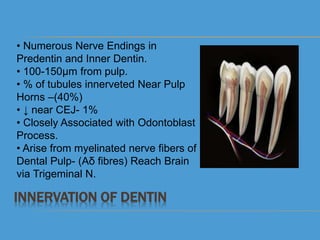
INNERVATION OF DENTIN
• Numerous Nerve Endings in
Predentin and Inner Dentin.
• 100-150μm from pulp.
• % of tubules innerveted Near Pulp
Horns –(40%)
• ↓ near CEJ- 1%
• Closely Associated with Odontoblast
Process.
• Arise from myelinated nerve fibers of
Dental Pulp- (Aδ fibres) Reach Brain
via Trigeminal N.
PAIN TRANSMISSION THROUGH
DENTIN
• DIRECT NEURAL
STMULATION
• TRANSDUCTION THEORY
• HYDRODYNAMIC THEORY
DIRECT NEURAL STIMULATION
• It was proposed by Scott
Stella in 1963
• Nerve endings in Tubules
are Directly Activated by
External Stimuli
• This view rests on the
assumption that Nerve
fibres Extend to DEJ.
• Not accepted
TRANSDUCTION THEORY
• Odontoblastic Processes are
primary structures excited by
stimulus.
• Transmit impulse to Nerve
Endings
• Supported by evidence that
odontoblasts → Neural Crest
Origin
• Discarded -No synaptic
Contacts
or vesicles - b/n odontoblasts
and
axons.
HYDRODYNAMIC THEORY
• Most popular Theory
• Gysi (1900), Brannstrom
• Various stimuli such as Heat,
Cold, Air, Mechanical
Pressure →Movement
of Fluid Within Tubule
↓
• Activating the Free Nerve
Endings Associated with
Odontoblast and its Process
• Act as Mechanoreceptors-
Sensation is felt as pain.
Dentinogenesis

Dentinogenesis

  • 1.
    DENTINOGENESIS DR Monika Negi MDS ORALPATHOLOGY MICROBIOLOGY AND FORENSIC ODONTOLOGY
  • 2.
    DENTINOGENESIS PROCESS OF FORMATIONOF DENTIN BY ODONTOBLASTS Dental papilla cells small, undifferentiated,exhibit central nucleus Separated from inner enamel epithelium by acellular zone Cells of IEE reverse polarity & express signaling molecules & growth factors
  • 3.
    Ectomesenchymal cell adjoiningacellular zone enlarge to proliferate into proodontoblasts In proodontoblasts cytoplasm + amount of protein synthesising organelles increase to diff. them into odontoblasts In odontoblast nuclei positioned away from IEE
  • 4.
     FORMATION OFMANTLE DENTIN - After diff. odontoblasts synthesise first dentin collagen of organic matrix - This collagen deposited in ground substance of dental papilla - Appearance of distinct, large diameter collagen k/a VON KORFF’S fibres is first sign of dentin formation • VON KORFF’S fibres mainly consist of TYPE III collagen
  • 16.
    VASCULAR SUPPLY • Providedby the Capillaries found in the subodontoblastic layer of the pulp. • Migrate between odontoblasts, and later - Regress
  • 17.
    INNERVATION OF DENTIN •Numerous Nerve Endings in Predentin and Inner Dentin. • 100-150μm from pulp. • % of tubules innerveted Near Pulp Horns –(40%) • ↓ near CEJ- 1% • Closely Associated with Odontoblast Process. • Arise from myelinated nerve fibers of Dental Pulp- (Aδ fibres) Reach Brain via Trigeminal N.
  • 18.
    PAIN TRANSMISSION THROUGH DENTIN •DIRECT NEURAL STMULATION • TRANSDUCTION THEORY • HYDRODYNAMIC THEORY
  • 19.
    DIRECT NEURAL STIMULATION •It was proposed by Scott Stella in 1963 • Nerve endings in Tubules are Directly Activated by External Stimuli • This view rests on the assumption that Nerve fibres Extend to DEJ. • Not accepted
  • 20.
    TRANSDUCTION THEORY • OdontoblasticProcesses are primary structures excited by stimulus. • Transmit impulse to Nerve Endings • Supported by evidence that odontoblasts → Neural Crest Origin • Discarded -No synaptic Contacts or vesicles - b/n odontoblasts and axons.
  • 21.
    HYDRODYNAMIC THEORY • Mostpopular Theory • Gysi (1900), Brannstrom • Various stimuli such as Heat, Cold, Air, Mechanical Pressure →Movement of Fluid Within Tubule ↓ • Activating the Free Nerve Endings Associated with Odontoblast and its Process • Act as Mechanoreceptors- Sensation is felt as pain.