AMELOGENESIS
INTRODUCTION
 The development of tooth is divided into – bud, cap, early
bell and advanced bell stage.
 Enamel organ consists of 4 layers – outer enamel epithelium,
inner enamel epithelium, stratum intermedium, stellate
reticulum.
 The cells of the inner enamel epithelium become more
columnar and convert into ameloblasts, which produce
enamel.
 Enamel formation begins in the advanced bell stage.
Amelogenesis
 It is the process of enamel formation.
 Cells responsible for amelogenesis are
called ameloblasts.
Stages of Amelogenesis
 Amelogenesis, or enamel formation, is two-step
process.
Amelogenesis
Organic Matrix
Formation
Mineralization
 Secretion of enamel
proteins
 Produces a partial
mineralized (30%) enamel
 Deposition of
Hydroxyapatite crystals
 Organic matrix and water
are lost and mineral is
added to attain greater
than 96% mineral content
Ameloblasts
 Secrete matrix proteins.
 Create and maintain extracellular environment
favorable to mineral deposition.
 Exhibit unique life cycle characterized by
progressive phenotype changes that reflects its
primary activity at various times of enamel
formation.
 Each ameloblast is approximately 4 micrometers in
diameter, 40 micrometers in length and has a
hexagonal cross section.
 The secretory end of the ameloblast ends in a six-
sided pyramid-like projection known as the Tomes'
process.
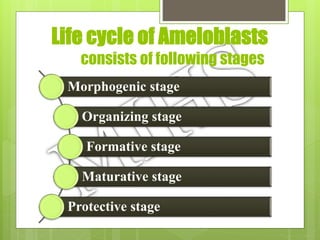
Life cycle of Ameloblasts
consists of following stages
Morphogenic stage
Organizing stage
Formative stage
Maturative stage
Protective stage
 Amelogenesis occurs during formative and
maturative stage
Phases of the Amelogenesis
 Amelogenesis has been described in as many as
six phases but generally is subdivided into three
main functional stages:
Phases of the Amelogenesis
Amelogenesis
Presecretory
Phase
Differentiation
Phase
Morphogenetic
Phase
Secretory Phase
Maturative
Phase
Maturation
Proper
Transitional
Phase
Presecretory Stage
 Differentiating ameloblasts acquire their
phenotype.
 Change polarity.
 Develop an extensive protein synthetic apparatus.
 Prepare to secrete the organic matrix of enamel.
Morphogenetic Phase
of the Presecretory Stage
 Shape of crown is determined in Bell stage of
tooth development.
 Cells of inner epithelium are separated from dental
papilla by a basement membrane.
Morphogenetic Phase
of the Presecretory Stage
 The cells are cuboidal or low
columnar.
 Large, centrally located nuclei.
 Poorly developed Golgi elements in
the proximal portion of the cells
(facing the stratum intermedium)
where junctional Complex exists.
 Scattered mitochondria and other
cytoplasmic components.
Differentiation Phase
of the Presecretory Stage
 All cells of inner enamel epithelium differentiate
into ameloblasts.
 The basal lamina is fragmented by cytoplasmic
projections and disintegrates during mantle
predentin formation.
Differentiation Phase
of the Presecretory Stage
 Cells elongate.
 Nuclei shift proximally.
 Golgi apparatus increases and
migrates distally.
 Rough endoplasmic reticulum
increases.
 Second junctional complex is
devoloped at distal extremity
dividing the ameloblast into
body and a distal extention
called Tomes’ process, against
enamel forms.
Differentiation Phase
of the Presecretory Stage
Differentiation Phase
of the Presecretory Stage
 Fine actin containing
filaments radiate from
junction complexes
forming proximal and
distal terminal webs.
Secretory Stage
 Cells acquire intense synthetic and
secretory activity
 Enamel proteins are translated by
rough endoplasmic reticulum →
modified by Golgi apparatus →
Packed into secretory granules
 These granules migrate to distal
extremity of the cell, into Tomes
Process
Secretory Stage
 When enamel formation begins, Tome’s process
comprises of only a proximal portion
 Contents of secretory granules is released against
newly formed dentin along the surface of Tome’s
Process
 Initial layer of enamel does not contain rods
Secretory Stage
Pre Dentin
Pre Enamel (rodless)
Secretory Stage
Secretory Stage
 Ameloblasts migrate away from the dentin surface
and devolop distal portion of Tome’s process as an
outgrowth of proximal portion.
 Secretion of enamel protiens
becomes unstable and is confined to
two sites.
Secretory Stage
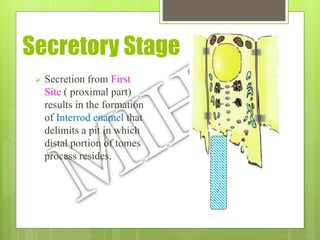
 Secretion from First
Site ( proximal part)
results in the formation
of Interrod enamel that
delimits a pit in which
distal portion of tomes
process resides.
Secretory Stage
Secretory Stage
Secretory Stage
 Secretion from Second Site
( distal part) provides
matrix that results in the
formation of Rod Enamel
which fills the pit.
Rod enamel
Interrod enamel
Secretory Stage
Secretory Stage
 Tome’s processes decreases in
size as rod grows in diameter.
 Narrow space is formed along
the circumference between rods
and interrods which is filled my
organic material, forming rod
sheath.
 Rod and Interod enamel differ
only in the orientation of their
crystallites.
Maturation Stage
 It is divided into
 Translational Phase
 Maturation Proper
Transitional Phase
of the Presecretory Stage
 Ameloblasts undergo significant morphological
changes.
 Height of cell reduces.
 Cell volume and organelle decreases.
 Ameloblasts undergo programmed cell death
(Apoptosis)
 25% of cells die during transitional phase.
Transitional Phase
of the Presecretory Stage
Maturation Proper
of the Presecretory Stage
 Removal of water and organic material from enamel
and introduction of Inorganic material.
 The dramatic activity of ameloblasts is modulation,
the cyclic creation, loss, and recreation of a highly
invaginated ruffled-ended apical surface.
 Modulation occurs rapidly as often as once every 8
hours.
Maturation Proper
of the Presecretory Stage
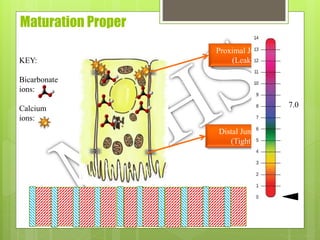
Ruffle-ended ameloblasts:
 Proximal Junctions Leaky
 Distal Junctions Tight
 Cell spends 80% of its lifetime
in this form
Maturation Proper
of the Presecretory Stage
Ruffle-ended ameloblasts:
 Acidification associated with outgoing mineral
accretion during maturation causes ruffled end
ameloblasts to produce bicarbonate ions, this process
alkalizes the enamel fluid to prevent the
demineralization of the growing crystals and
maintain pH conditions optimized for functioning of
the matrix degrading enzymes.
Maturation Proper
of the Presecretory Stage
 Ruffled ended ameloblasts show considerable
endocytotic activity and contain:
 Lysosomes
 Calcium Binding Proteins
 Calcium ATPases
That promote the pumping of Calcium
ions into the maturing enamel.
 Calcium ions pass through the ruffled ended
ameloblasts (because their distal ends are tight).
Maturation Proper
Proximal Junction
(Leaky)
Distal Junction
(Tight)
KEY:
Bicarbonate
ions:
Calcium
ions:
7.0
Maturation Proper
of the Presecretory Stage
Smooth-ended ameloblasts:
 Proximal Junctions Tight
 Distal Junctions Leaky
 Cell spends 20% of its lifetime
in this form
Maturation Proper
of the Presecretory Stage
Smooth-ended ameloblasts:
 Bulk-Degrading enzymes act extracellularly to digest
various matrix proteins into fragments small enough to
leave the enamel.
 Polypeptide fragments leave the enamel through distal
(leaky) junctions of smooth ended ameloblasts and
diffuse laterally among the ameloblasts to be taken up
along their basolateral surfaces.
Maturation Proper
Proximal Junction
(Tight)
Distal Junction
(Leaky)
KEY:
Degrading
Enzyme:
Enamel
Protein:
Polypeptide
Fragment: 5.5
Ameloblast Secretory Products
1)- Amelogenin:
 90% of the enamel proteins are a heterogeneous group
of low-molecular-weight proteins known as
amelogenins.
 Amelogenins are hydrophobic proteins rich in proline,
histidine, and glutamine.
 Molecular weights range between 5-45 kDa.
 They accumulate during the secretory stage.
 Undergo minor short-term and major long-term
extracellular processing by proteolytic enzymes into
lower molecular weight fragments.
 Loss of Function causes deposition of thin hypoplastic
enamel layer which lacks rods & interrods.
Ameloblast Secretory Products
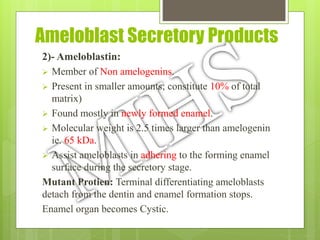
2)- Ameloblastin:
 Member of Non amelogenins.
 Present in smaller amounts; constitute 10% of total
matrix)
 Found mostly in newly formed enamel.
 Molecular weight is 2.5 times larger than amelogenin
ie. 65 kDa.
 Assist ameloblasts in adhering to the forming enamel
surface during the secretory stage.
Mutant Protien: Terminal differentiating ameloblasts
detach from the dentin and enamel formation stops.
Enamel organ becomes Cystic.
Ameloblast Secretory Products
3)- Enamelin:
 It is also a member of non amelogenins.
 Constitute 2% of total enamel proteins.
 It has largest molecular weight 186 kDa.
 Large fragments of enamelin (89 kDa) are present only
at growing enamel surface.
 Small fragments of enamelin ( 32 & 25 kDa) bind
strongly to mineral and inhibit crystal growth.
 Loss of Function and Mutant Protein : No defined
Enamel Layer.
Ameloblast Secretory Products
4)- Tuftlin:
 Acidic Phosphorylated Glycoprotein.
 Molecular weight is 45 kDa.
 Confined to Amelodentinal Junction
MINERAL PATHWAY &
MINERALIZATION
 Calcium moves from blood vessels through the enamel
organ to reach enamel.
 The stratum intermedium may also participate in the
translocation of calcium since calcium ATPase activity
has been localized at the cell membrane of the stratum
intermedium.
 No matrix vesicles are associated with the
mineralization of enamel.
Regulation of pH during Enamel
Formation
 pH values of forming enamel are maintained near
neutral during secretion
 But they show considerable variation during
maturation shifting from
Highly Acidic → Nearly Neutral→ Alkaline
 Carbonic anhydrases mainly CA2 and CA6, generates
local bicarbonate – chloride exchangers, bicarbonate co
transporters, Na+/H+ exchangers
 Transport phosphate and nutrients from blood vessels
to enamel organ.
Amelogenesis

Amelogenesis

  • 1.
  • 2.
    INTRODUCTION  The developmentof tooth is divided into – bud, cap, early bell and advanced bell stage.  Enamel organ consists of 4 layers – outer enamel epithelium, inner enamel epithelium, stratum intermedium, stellate reticulum.  The cells of the inner enamel epithelium become more columnar and convert into ameloblasts, which produce enamel.  Enamel formation begins in the advanced bell stage.
  • 3.
    Amelogenesis  It isthe process of enamel formation.  Cells responsible for amelogenesis are called ameloblasts.
  • 4.
    Stages of Amelogenesis Amelogenesis, or enamel formation, is two-step process.
  • 5.
    Amelogenesis Organic Matrix Formation Mineralization  Secretionof enamel proteins  Produces a partial mineralized (30%) enamel  Deposition of Hydroxyapatite crystals  Organic matrix and water are lost and mineral is added to attain greater than 96% mineral content
  • 6.
    Ameloblasts  Secrete matrixproteins.  Create and maintain extracellular environment favorable to mineral deposition.  Exhibit unique life cycle characterized by progressive phenotype changes that reflects its primary activity at various times of enamel formation.  Each ameloblast is approximately 4 micrometers in diameter, 40 micrometers in length and has a hexagonal cross section.  The secretory end of the ameloblast ends in a six- sided pyramid-like projection known as the Tomes' process.
  • 7.
    Life cycle ofAmeloblasts consists of following stages Morphogenic stage Organizing stage Formative stage Maturative stage Protective stage
  • 8.
     Amelogenesis occursduring formative and maturative stage
  • 9.
    Phases of theAmelogenesis  Amelogenesis has been described in as many as six phases but generally is subdivided into three main functional stages:
  • 10.
    Phases of theAmelogenesis Amelogenesis Presecretory Phase Differentiation Phase Morphogenetic Phase Secretory Phase Maturative Phase Maturation Proper Transitional Phase
  • 11.
    Presecretory Stage  Differentiatingameloblasts acquire their phenotype.  Change polarity.  Develop an extensive protein synthetic apparatus.  Prepare to secrete the organic matrix of enamel.
  • 12.
    Morphogenetic Phase of thePresecretory Stage  Shape of crown is determined in Bell stage of tooth development.  Cells of inner epithelium are separated from dental papilla by a basement membrane.
  • 13.
    Morphogenetic Phase of thePresecretory Stage  The cells are cuboidal or low columnar.  Large, centrally located nuclei.  Poorly developed Golgi elements in the proximal portion of the cells (facing the stratum intermedium) where junctional Complex exists.  Scattered mitochondria and other cytoplasmic components.
  • 14.
    Differentiation Phase of thePresecretory Stage  All cells of inner enamel epithelium differentiate into ameloblasts.  The basal lamina is fragmented by cytoplasmic projections and disintegrates during mantle predentin formation.
  • 15.
    Differentiation Phase of thePresecretory Stage  Cells elongate.  Nuclei shift proximally.  Golgi apparatus increases and migrates distally.  Rough endoplasmic reticulum increases.  Second junctional complex is devoloped at distal extremity dividing the ameloblast into body and a distal extention called Tomes’ process, against enamel forms.
  • 16.
    Differentiation Phase of thePresecretory Stage
  • 17.
    Differentiation Phase of thePresecretory Stage  Fine actin containing filaments radiate from junction complexes forming proximal and distal terminal webs.
  • 18.
    Secretory Stage  Cellsacquire intense synthetic and secretory activity  Enamel proteins are translated by rough endoplasmic reticulum → modified by Golgi apparatus → Packed into secretory granules  These granules migrate to distal extremity of the cell, into Tomes Process
  • 19.
    Secretory Stage  Whenenamel formation begins, Tome’s process comprises of only a proximal portion  Contents of secretory granules is released against newly formed dentin along the surface of Tome’s Process  Initial layer of enamel does not contain rods
  • 20.
  • 21.
  • 22.
    Secretory Stage  Ameloblastsmigrate away from the dentin surface and devolop distal portion of Tome’s process as an outgrowth of proximal portion.  Secretion of enamel protiens becomes unstable and is confined to two sites.
  • 23.
    Secretory Stage  Secretionfrom First Site ( proximal part) results in the formation of Interrod enamel that delimits a pit in which distal portion of tomes process resides.
  • 24.
  • 25.
  • 26.
    Secretory Stage  Secretionfrom Second Site ( distal part) provides matrix that results in the formation of Rod Enamel which fills the pit. Rod enamel Interrod enamel
  • 27.
  • 28.
    Secretory Stage  Tome’sprocesses decreases in size as rod grows in diameter.  Narrow space is formed along the circumference between rods and interrods which is filled my organic material, forming rod sheath.  Rod and Interod enamel differ only in the orientation of their crystallites.
  • 29.
    Maturation Stage  Itis divided into  Translational Phase  Maturation Proper
  • 30.
    Transitional Phase of thePresecretory Stage  Ameloblasts undergo significant morphological changes.  Height of cell reduces.  Cell volume and organelle decreases.  Ameloblasts undergo programmed cell death (Apoptosis)  25% of cells die during transitional phase.
  • 31.
    Transitional Phase of thePresecretory Stage
  • 32.
    Maturation Proper of thePresecretory Stage  Removal of water and organic material from enamel and introduction of Inorganic material.  The dramatic activity of ameloblasts is modulation, the cyclic creation, loss, and recreation of a highly invaginated ruffled-ended apical surface.  Modulation occurs rapidly as often as once every 8 hours.
  • 33.
    Maturation Proper of thePresecretory Stage Ruffle-ended ameloblasts:  Proximal Junctions Leaky  Distal Junctions Tight  Cell spends 80% of its lifetime in this form
  • 34.
    Maturation Proper of thePresecretory Stage Ruffle-ended ameloblasts:  Acidification associated with outgoing mineral accretion during maturation causes ruffled end ameloblasts to produce bicarbonate ions, this process alkalizes the enamel fluid to prevent the demineralization of the growing crystals and maintain pH conditions optimized for functioning of the matrix degrading enzymes.
  • 35.
    Maturation Proper of thePresecretory Stage  Ruffled ended ameloblasts show considerable endocytotic activity and contain:  Lysosomes  Calcium Binding Proteins  Calcium ATPases That promote the pumping of Calcium ions into the maturing enamel.  Calcium ions pass through the ruffled ended ameloblasts (because their distal ends are tight).
  • 36.
    Maturation Proper Proximal Junction (Leaky) DistalJunction (Tight) KEY: Bicarbonate ions: Calcium ions: 7.0
  • 37.
    Maturation Proper of thePresecretory Stage Smooth-ended ameloblasts:  Proximal Junctions Tight  Distal Junctions Leaky  Cell spends 20% of its lifetime in this form
  • 38.
    Maturation Proper of thePresecretory Stage Smooth-ended ameloblasts:  Bulk-Degrading enzymes act extracellularly to digest various matrix proteins into fragments small enough to leave the enamel.  Polypeptide fragments leave the enamel through distal (leaky) junctions of smooth ended ameloblasts and diffuse laterally among the ameloblasts to be taken up along their basolateral surfaces.
  • 39.
    Maturation Proper Proximal Junction (Tight) DistalJunction (Leaky) KEY: Degrading Enzyme: Enamel Protein: Polypeptide Fragment: 5.5
  • 40.
    Ameloblast Secretory Products 1)-Amelogenin:  90% of the enamel proteins are a heterogeneous group of low-molecular-weight proteins known as amelogenins.  Amelogenins are hydrophobic proteins rich in proline, histidine, and glutamine.  Molecular weights range between 5-45 kDa.  They accumulate during the secretory stage.  Undergo minor short-term and major long-term extracellular processing by proteolytic enzymes into lower molecular weight fragments.  Loss of Function causes deposition of thin hypoplastic enamel layer which lacks rods & interrods.
  • 41.
    Ameloblast Secretory Products 2)-Ameloblastin:  Member of Non amelogenins.  Present in smaller amounts; constitute 10% of total matrix)  Found mostly in newly formed enamel.  Molecular weight is 2.5 times larger than amelogenin ie. 65 kDa.  Assist ameloblasts in adhering to the forming enamel surface during the secretory stage. Mutant Protien: Terminal differentiating ameloblasts detach from the dentin and enamel formation stops. Enamel organ becomes Cystic.
  • 42.
    Ameloblast Secretory Products 3)-Enamelin:  It is also a member of non amelogenins.  Constitute 2% of total enamel proteins.  It has largest molecular weight 186 kDa.  Large fragments of enamelin (89 kDa) are present only at growing enamel surface.  Small fragments of enamelin ( 32 & 25 kDa) bind strongly to mineral and inhibit crystal growth.  Loss of Function and Mutant Protein : No defined Enamel Layer.
  • 43.
    Ameloblast Secretory Products 4)-Tuftlin:  Acidic Phosphorylated Glycoprotein.  Molecular weight is 45 kDa.  Confined to Amelodentinal Junction
  • 44.
    MINERAL PATHWAY & MINERALIZATION Calcium moves from blood vessels through the enamel organ to reach enamel.  The stratum intermedium may also participate in the translocation of calcium since calcium ATPase activity has been localized at the cell membrane of the stratum intermedium.  No matrix vesicles are associated with the mineralization of enamel.
  • 45.
    Regulation of pHduring Enamel Formation  pH values of forming enamel are maintained near neutral during secretion  But they show considerable variation during maturation shifting from Highly Acidic → Nearly Neutral→ Alkaline  Carbonic anhydrases mainly CA2 and CA6, generates local bicarbonate – chloride exchangers, bicarbonate co transporters, Na+/H+ exchangers  Transport phosphate and nutrients from blood vessels to enamel organ.