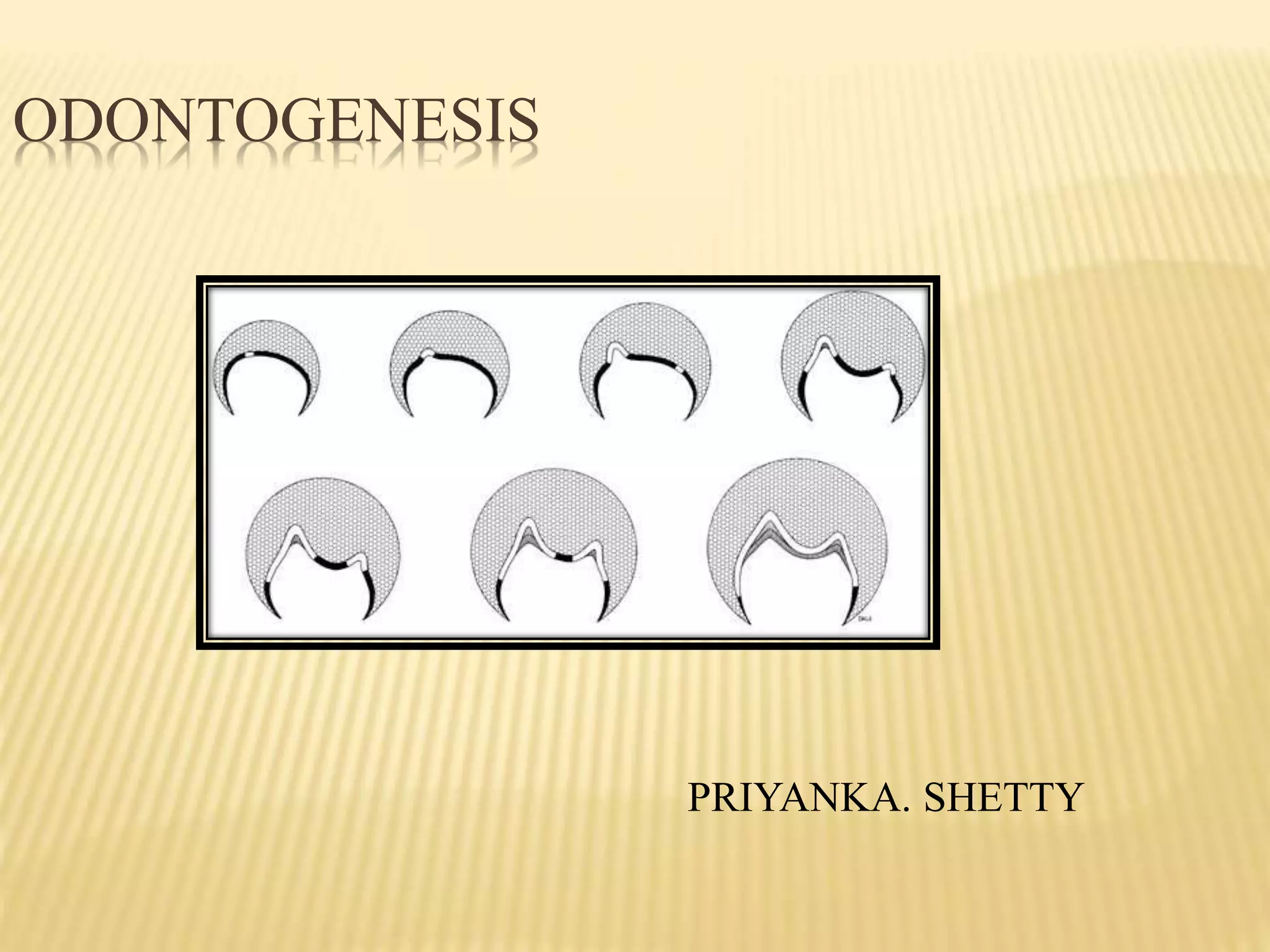
ODONTOGENESIS
PRIYANKA. SHETTY
CONTENTS
INTRODUCTION
NEURAL CREST
PRIMARY EPITHELIAL BAND
DENTAL LAMINA
VESTIBULAR LAMINA
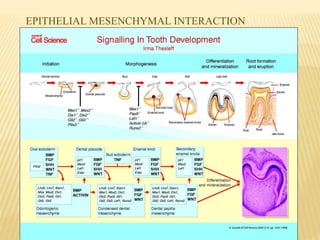
EPITHELIAL-MESENCHYMAL INTERACTIONS
GENES EXPRESSED DURING TOOTH DEVELOPMENT
STAGES IN DEV OF TOOTH
ROOT FORMATION
FORMATION OF SUPPORTING TISSUES
CLINICAL IMPLICATIONS
CONCLUSION
RECENT ADVANCES
In human,20 primary and 32 permanent teeth develop from the interaction of
oral epithelial cells and underlying mesenchymal cells.
Each developing tooth grows as an anatomically distinct unit, but the basic
developmental process is similar for all teeth.
INTRODUCTION:
NEURAL CREST
 Group of cells-separated from neuroectoderm-capacity to migrate&
differentiate extensively within embryo.
 Structures-spinal sensory ganglia, sympathetic neurons, Schwann cells,
pigment cells& meninges.
 Avian embryo-crest of neural folds-name
 Mammalian embryo-lateral aspect of neural plate.
 H&N-imp role.
 Differentiate-most of the CT.
 CT elsewhere-mesoderm: ‘mesenchyme’.
 Head- ‘ectomesenchyme’-origin from neuroectoderm.
 Proper migration-essential- dvp of face& teeth.
 All the tissues of teeth & supporting app (exc enamel)- dvp
directly from NC.
 Depletion prevents proper dvp.
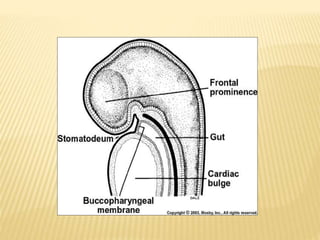
 The primitive oral cavity or stomadeum is lined by stratified squamous epithelium
called the ORAL ECTODERM.
 The oral ectoderm contacts the endoderm of the foregut to form the
buccopharyngeal membrane.
 At about 27 th day of gestation this membrane ruptures and the primitive oral
cavity establishes a connection with the foregut.
 Most of the connective tissue cells underlying the oral ectoderm are neural crest or
ectomesenchymal in orgin.
 These cells are thought to instruct or induce the overlying ectoderm to start tooth
development,which begins in anterior portion of what will be future maxilla and
mandible and proceeds posteriorly.
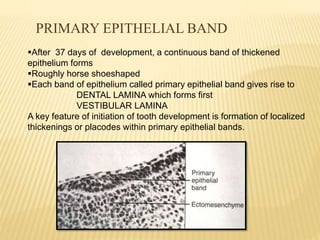
PRIMARY EPITHELIAL BAND
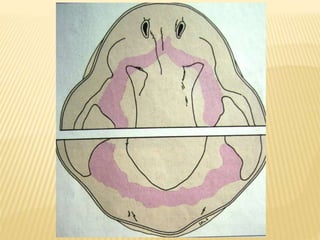
After 37 days of development, a continuous band of thickened
epithelium forms
Roughly horse shoeshaped
Each band of epithelium called primary epithelial band gives rise to
DENTAL LAMINA which forms first
VESTIBULAR LAMINA
A key feature of initiation of tooth development is formation of localized
thickenings or placodes within primary epithelial bands.
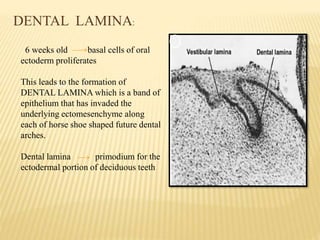
DENTAL LAMINA:
o o
6 weeks old basal cells of oral
ectoderm proliferates
This leads to the formation of
DENTAL LAMINA which is a band of
epithelium that has invaded the
underlying ectomesenchyme along
each of horse shoe shaped future dental
arches.
Dental lamina primodium for the
ectodermal portion of deciduous teeth
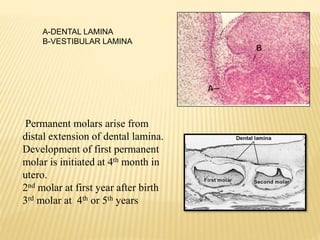
A-DENTAL LAMINA
B-VESTIBULAR LAMINA
Permanent molars arise from
distal extension of dental lamina.
Development of first permanent
molar is initiated at 4th month in
utero.
2nd molar at first year after birth
3rd molar at 4th or 5th years
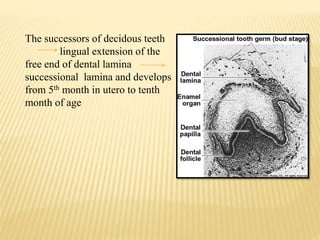
The successors of decidous teeth
lingual extension of the
free end of dental lamina
successional lamina and develops
from 5th month in utero to tenth
month of age
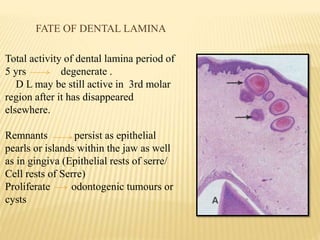
FATE OF DENTAL LAMINA
Total activity of dental lamina period of
5 yrs degenerate .
D L may be still active in 3rd molar
region after it has disappeared
elsewhere.
Remnants persist as epithelial
pearls or islands within the jaw as well
as in gingiva (Epithelial rests of serre/
Cell rests of Serre)
Proliferate odontogenic tumours or
cysts
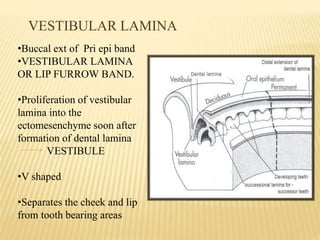
VESTIBULAR LAMINA
•Buccal ext of Pri epi band
•VESTIBULAR LAMINA
OR LIP FURROW BAND.
•Proliferation of vestibular
lamina into the
ectomesenchyme soon after
formation of dental lamina
VESTIBULE
•V shaped
•Separates the cheek and lip
from tooth bearing areas
EPITHELIAL MESENCHYMAL INTERACTION
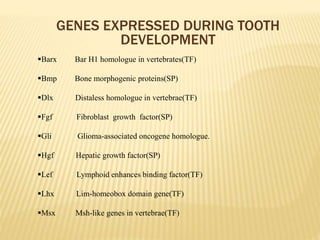
GENES EXPRESSED DURING TOOTH
DEVELOPMENT
Barx Bar H1 homologue in vertebrates(TF)
Bmp Bone morphogenic proteins(SP)
Dlx Distaless homologue in vertebrae(TF)
Fgf Fibroblast growth factor(SP)
Gli Glioma-associated oncogene homologue.
Hgf Hepatic growth factor(SP)
Lef Lymphoid enhances binding factor(TF)
Lhx Lim-homeobox domain gene(TF)
Msx Msh-like genes in vertebrae(TF)
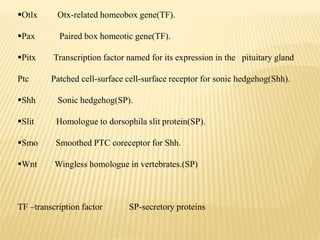
Otlx Otx-related homeobox gene(TF).
Pax Paired box homeotic gene(TF).
Pitx Transcription factor named for its expression in the pituitary gland
Ptc Patched cell-surface cell-surface receptor for sonic hedgehog(Shh).
Shh Sonic hedgehog(SP).
Slit Homologue to dorsophila slit protein(SP).
Smo Smoothed PTC coreceptor for Shh.
Wnt Wingless homologue in vertebrates.(SP)
TF –transcription factor SP-secretory proteins
INITIATION OF TOOTH
DEVELOPMENT
TOOTH PATTERNING
REGIONALISATION OF
DENTAL ECTODERM
Initiation of tooth development:
Odontogenesis is first initiated by factors resident in the 1st
arch epithelium influencing ectomesenchyme but with time
this potential is assumed by ectomesenchyme
1. lhx-6 & lhx-7 and lim-homeobox domain gene (transcription factor):
Earliest mesnchymal markers which initiate tooth development.
Induced by fgf-8 present in epithelium of 1st brachial arch.
2. pax-9
Tooth initiation & Tooth germ location
Induced by fgf-8 & down regulated by BMP2 and BMP4(seen where fgf-8 not
seen).
3. Gli gene
4. Lef-1
 1st expressed in dental epithelial thickenings and during bud formation shifts to
being expressed in condensing mesenchyme.
5.Shh-have a role in stimulating epithelial cell proliferation.
6. Dlx-1 ,Dlx-2
Regionalisation of dental ectoderm:
Shh is expressed where dental ectoderm is formed.
Wnt is expressed throughout in oral cavity except for presumptive
dental ectoderm where shh is expressed
TOOTH TYPE PATTERNING:Determination of specific tooth types at their
correct positions in the jaws.
In heterodonts, 3 families of shapes:
oIncisiform
oCaniniform
oMolariform
HYPOTHESIS
Odontogenic homeobox code model of dental patterning(Field theory)
Clone theory
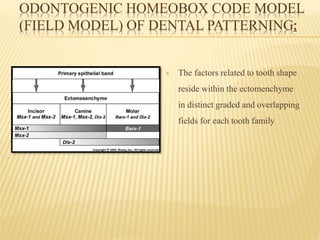
ODONTOGENIC HOMEOBOX CODE MODEL
(FIELD MODEL) OF DENTAL PATTERNING:
 The factors related to tooth shape
reside within the ectomenchyme
in distinct graded and overlapping
fields for each tooth family
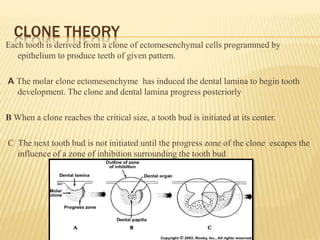
CLONE THEORY
Each tooth is derived from a clone of ectomesenchymal cells programmed by
epithelium to produce teeth of given pattern.
A The molar clone ectomesenchyme has induced the dental lamina to begin tooth
development. The clone and dental lamina progress posteriorly
B When a clone reaches the critical size, a tooth bud is initiated at its center.
C The next tooth bud is not initiated until the progress zone of the clone escapes the
influence of a zone of inhibition surrounding the tooth bud
DEVELOPMENTAL STAGES
 Continuous process.
 Different morphologic ‘stages’-descriptive purposes.
 Different sizes& shapes; similar stages of dvp.
Named after shape of EO:
 Bud
 Cap
 Bell
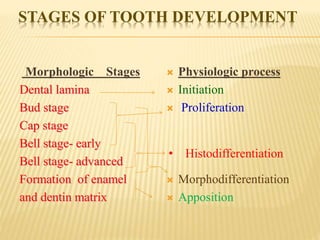
STAGES OF TOOTH DEVELOPMENT
Morphologic Stages
Dental lamina
Bud stage
Cap stage
Bell stage- early
Bell stage- advanced
Formation of enamel
and dentin matrix
 Physiologic process
 Initiation
 Proliferation
 Morphodifferentiation
 Apposition
• Histodifferentiation
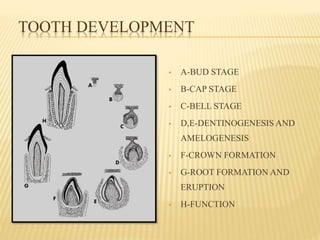
TOOTH DEVELOPMENT
 A-BUD STAGE
 B-CAP STAGE
 C-BELL STAGE
 D,E-DENTINOGENESIS AND
AMELOGENESIS
 F-CROWN FORMATION
 G-ROOT FORMATION AND
ERUPTION
 H-FUNCTION
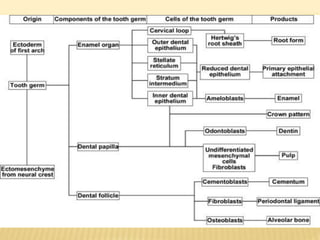
TOOTH GERM
 Includes all the formative tissues for the entire tooth and its supporting structures.
 Three main components:-
 Enamel organ - ectodermal component that gives rise to enamel.
 Dental papilla - ectomesenchymal component that gives rise to dentin and pulp.
 Dental follicle or dental sac - ectomesenchymal component giving rise to cementum,
periodontal ligament, and part of the alveolar socket
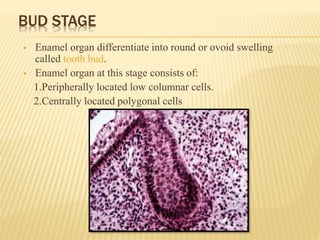
BUD STAGE
 Enamel organ differentiate into round or ovoid swelling
called tooth bud.
 Enamel organ at this stage consists of:
1.Peripherally located low columnar cells.
2.Centrally located polygonal cells
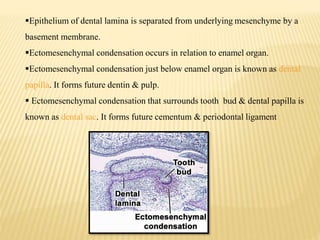
Epithelium of dental lamina is separated from underlying mesenchyme by a
basement membrane.
Ectomesenchymal condensation occurs in relation to enamel organ.
Ectomesenchymal condensation just below enamel organ is known as dental
papilla. It forms future dentin & pulp.
 Ectomesenchymal condensation that surrounds tooth bud & dental papilla is
known as dental sac. It forms future cementum & periodontal ligament
MOLECULAR BASIS:
 Msx gene expression induces ectomesnchymal condensation .
 BMP4
Induces ectomesenchymal condensation .
Induces Msx.
Induces BMP2 & Shh which helps in
transition from Bud to Cap stage.
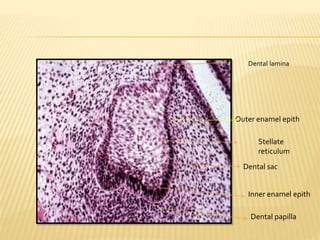
CAP STAGE
 Unequal growths in different parts of the tooth bud leads to cap stage
 Shallow invagination on the deep surface of the bud.
 Resembles a cap sitting on a ball of condensed ectomesenchyme .
Outer enamel epith
Stellate
reticulum
Dental sac
Dental papilla
Inner enamel epith
Dental lamina
OUTER AND INNER ENAMEL EPITHELIUM
 The peripheral cells of the cap stage: outer enamel epithelium.
 The cells in the concavity of cap becomes tall,columnar : inner enamel
epithelium.
 The outer enamel epithelium is separated from the dental sac
 Inner enamel epithelium from dental papilla by a delicate basement membrane
 Hemidesmosomes
STELLATE RETICULUM
 Bw IEE& OEE- polygonal cells- synthesize& secrete GAGs into extracellular
component bw epi.cells.
 GAGs-hydrophilic-osmotic pressure-drag water into EO.
 Increasing amount of fluid-increases-volume of extracellular compartment.
 Central cells-forced apart.
 Retain connection with each other through cytoplasmic extensions&
desmosomal attachments: star shaped.
 Gives central area cushion-like consistency.
 Shock absorber.
 Protects delicate enamel-forming cells.
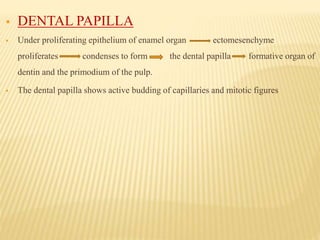
 DENTAL PAPILLA
 Under proliferating epithelium of enamel organ ectomesenchyme
proliferates condenses to form the dental papilla formative organ of
dentin and the primodium of the pulp.
 The dental papilla shows active budding of capillaries and mitotic figures
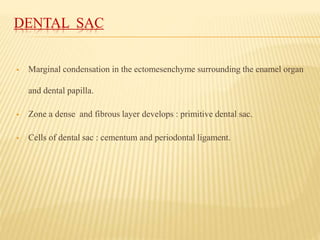
DENTAL SAC
 Marginal condensation in the ectomesenchyme surrounding the enamel organ
and dental papilla.
 Zone a dense and fibrous layer develops : primitive dental sac.
 Cells of dental sac : cementum and periodontal ligament.
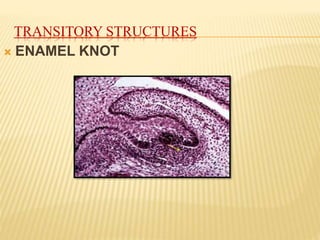
TRANSITORY STRUCTURES
 ENAMEL KNOT
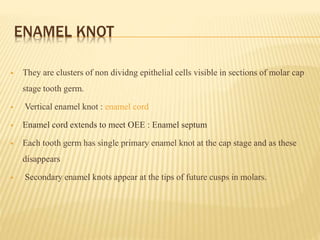
ENAMEL KNOT
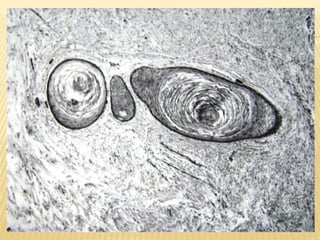
 They are clusters of non dividng epithelial cells visible in sections of molar cap
stage tooth germ.
 Vertical enamel knot : enamel cord
 Enamel cord extends to meet OEE : Enamel septum
 Each tooth germ has single primary enamel knot at the cap stage and as these
disappears
 Secondary enamel knots appear at the tips of future cusps in molars.
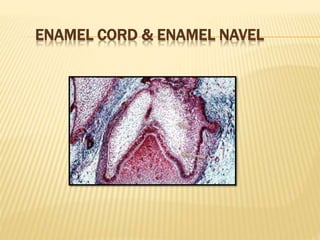
ENAMEL CORD & ENAMEL NAVEL
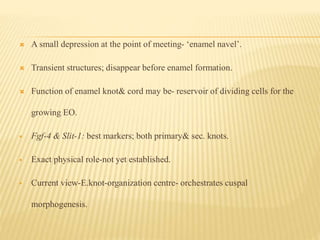
 A small depression at the point of meeting- ‘enamel navel’.
 Transient structures; disappear before enamel formation.
 Function of enamel knot& cord may be- reservoir of dividing cells for the
growing EO.
 Fgf-4 & Slit-1: best markers; both primary& sec. knots.
 Exact physical role-not yet established.
 Current view-E.knot-organization centre- orchestrates cuspal
morphogenesis.
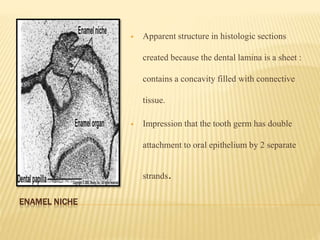
ENAMEL NICHE
 Apparent structure in histologic sections
created because the dental lamina is a sheet :
contains a concavity filled with connective
tissue.
 Impression that the tooth germ has double
attachment to oral epithelium by 2 separate
strands.
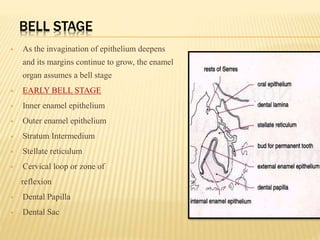
BELL STAGE
 As the invagination of epithelium deepens
and its margins continue to grow, the enamel
organ assumes a bell stage
 EARLY BELL STAGE
 Inner enamel epithelium
 Outer enamel epithelium
 Stratum Intermedium
 Stellate reticulum
 Cervical loop or zone of
reflexion
 Dental Papilla
 Dental Sac
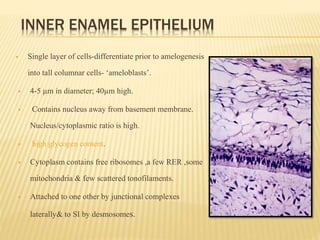
INNER ENAMEL EPITHELIUM
 Single layer of cells-differentiate prior to amelogenesis
into tall columnar cells- ‘ameloblasts’.
 4-5 µm in diameter; 40µm high.
 Contains nucleus away from basement membrane.
Nucleus/cytoplasmic ratio is high.
 high glycogen content.
 Cytoplasm contains free ribosomes ,a few RER ,some
mitochondria & few scattered tonofilaments.
 Attached to one other by junctional complexes
laterally& to SI by desmosomes.
STRATUM INTERMEDIUM
 A few layers of squamous cells b/w IEE& OEE.
 Closely packed-desmosomes& gap jn.
 Desmosomal jn bw SR& IEE.
 Cells-well developed cytoplasmic organelles, acid mucopolysaccharides&
glycogen deposits: high mitotic activity.
 High activity of alk.ph.
 Responsible for enamel formation
STELLATE RETICULUM
 Expands further-increased extracellular fluid.
 Desmosomal jns-bw-SR,SI& OEE.
 Before enamel formation- SR collapses.
 Reduces distance bw ameloblasts& nutrient capillaries near OEE.
 Then, cells-hardly distinguishable from SI.
 This change begins-height of cusp, progresses cervically.
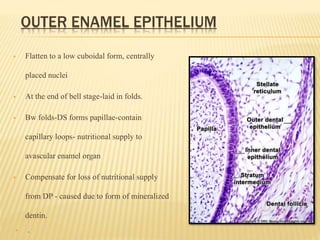
OUTER ENAMEL EPITHELIUM
 Flatten to a low cuboidal form, centrally
placed nuclei
 At the end of bell stage-laid in folds.
 Bw folds-DS forms papillae-contain
capillary loops- nutritional supply to
avascular enamel organ
 Compensate for loss of nutritional supply
from DP - caused due to form of mineralized
dentin.
 .
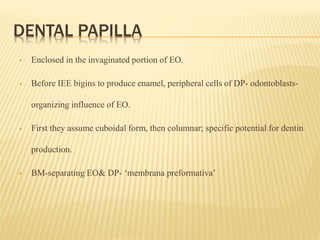
DENTAL PAPILLA
 Enclosed in the invaginated portion of EO.
 Before IEE bigins to produce enamel, peripheral cells of DP- odontoblasts-
organizing influence of EO.
 First they assume cuboidal form, then columnar; specific potential for dentin
production.
 BM-separating EO& DP- ‘membrana preformativa’
Dental Sac:
 Consists of undifferentiated mesenchymal cells & circularly arranged collagen
fibrils around enamel organ & dental papilla.
 Collagen fibrils are more in dental sac than dental papilla.
 Ramifying nerves & vessels are also seen.
 Dvp of root DS differentiate into perio fibres that gets embedded in dvp cementum
n alv bone
Cervical loop or zone of reflexion :
 Its region where the inner and outer enamel epithelia meet at the rim of the enamel
organ
 This is the point where cells continue to divide until tooth attains its full size &
which after crown formation gives rise to epithelial component of root formation.
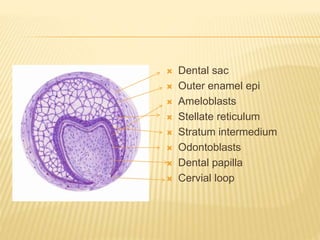
 Dental sac
 Outer enamel epi
 Ameloblasts
 Stellate reticulum
 Stratum intermedium
 Odontoblasts
 Dental papilla
 Cervial loop
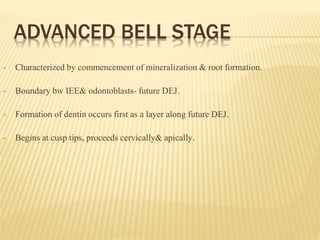
ADVANCED BELL STAGE
 Characterized by commencement of mineralization & root formation.
 Boundary bw IEE& odontoblasts- future DEJ.
 Formation of dentin occurs first as a layer along future DEJ.
 Begins at cusp tips, proceeds cervically& apically.
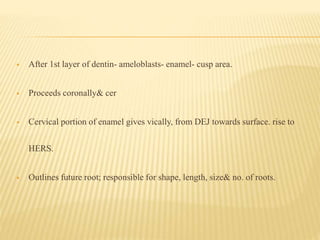
 After 1st layer of dentin- ameloblasts- enamel- cusp area.
 Proceeds coronally& cer
 Cervical portion of enamel gives vically, from DEJ towards surface. rise to
HERS.
 Outlines future root; responsible for shape, length, size& no. of roots.
BREAK OF DL& CROWN PATTERN
DETERMINATION
 2 imp events occur in the bell stage:
1
 . Dental lamina joining tooth germ to OE fragments, eventually- separates
developing tooth from OE.
 Fragmentation-> discrete clusters of epithelial cells- normally degenerate.
 Some may persist- epithelial pearls (formerly- glands of Serres)
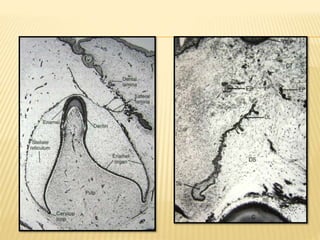
2.
 IEE completes its folding, making it possible to recognize the shape of
future crown pattern.
 Folding occurs not from growth pressures within DP.
 Results from intrinsic growth caused by differential rates of mitotic
divisions within cells of IEE.
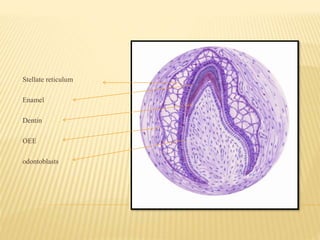
Stellate reticulum
Enamel
Dentin
OEE
odontoblasts
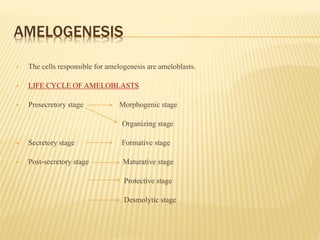
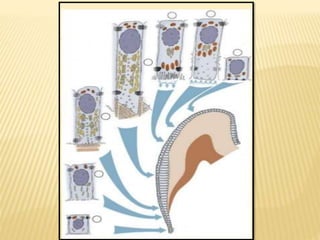
AMELOGENESIS
 The cells responsible for amelogenesis are ameloblasts.
 LIFE CYCLE OF AMELOBLASTS
 Presecretory stage Morphogenic stage
Organizing stage
 Secretory stage Formative stage
 Post-secretory stage Maturative stage
Protective stage
Desmolytic stage
MORPHOGENIC STAGE
 The function of ameloblasts :determination of shape of the tooth.
 The IEE interacts with the underlying connective tissue and through
differential growth helps to establish DEJ and thereby determine shape of the
tooth.
 The ameloblasts at this stage are low columnar, centrally placed nucleus.
 Cytoplasmic organelles are not abundant,the centrioles and golgi apparatus are
at apical part of cytoplasm and mitochondria is evenly distributed through out
the cytoplasm.
ORGANIZING STAGE/DIFFERENTIATION
STAGE
 The ameloblasts exert organizing influence on dental papilla cells and help in
their differentiation to odontoblasts.
 Ameloblasts increase in length about 40 microns and has abundant cytoplasmic
organelles for protein synthesis
 Reverse polarity is seen.
 It’s a preparation to secretion because organelles are moved to secretory end of
cell which is at the basal region.
 The cells also develop intercellular junctions at proximal and distal ends called
proximal and distal terminal bars.
 During the terminal phase : dentin formation begins and basal lamina supporting
the ameloblasts layer disintergrates.
 Ameloblasts attain secretory function only after a layer of dentin is formed.
 This interdependence b/w ameloblasts and odontoblasts is called
RECIPROCAL INDUCTION
FORMATIVE/SECRETORY STAGE
 In this stage ameloblasts performs functin of secretion of enamel matrix and
partial mineralisation.
 Here they synthesise enamel proteins
 In initial stages ameloblasts have flat basal region.
 As the enamel matrix is deposited, the ameloblasts move away from dentin side
but a part of distal end of ameloblasts gets trapped in its own matrix and this
conical trapped portion is called tomes process.
 After Tomes process is formed ,the secretion of enamel takes place from 2
different sites and is responsible for the rod structure of enamel.
MATURATIVE STAGE
 Ameloblasts : helps in the mineralization and maturation of enamel.
 Introduce the inorganic material necessary for maturation and also removes
proteins and water to provide space for minerals.
 Show morphologic alterations.
 Ameloblasts are ruffle ended when they are reabsorbing proteins and water.
 Shows slight reduction in height and decrease in volume and organelles content.
 The basal plasma membrane of ruffle ended ameloblasts shows a brush border with
many foldings while that of smooth ended ameloblasts is smooth.
 The cytoplasm of ameloblasts also has vacoules which contains material resembling
enamel matrix indicating absorptive function of these cells.
 Excess synthetic organelles are removed and the remaining organelles are shifted to
the distal end of the cells.
PROTECTIVE STAGE
 After the enamel formation is completed the basal plasma membrane of ameloblasts
looses the brush border and become smooth.
 They secrete protein : to the surface of newly formed enamel.
 Dev hemidesmosomal attachments to these basal lamina structure which help in
holding these firmly to the tooth surface.
 Columnar ameloblasts shorten to cuboidal and along with the other collasped
layers of enamel organ forms 2-3 layered stratified epithelium which is termed as
REE.
 This reduced enamel epithelium covers the newly formed enamel and protects : till
tooth erupts into the oral cavity .
 Helps establishing the dentino gingival junction.
DESMOLYTIC STAGE
 In this stage the REE secretes collagenase enzyme which destroys the connective
tissue between oral mucosa & erupting tooth. This facilitates eruption process.
 During this stage the REE proliferates and fuses with the oral epithelium to form a
solid plug of epithelial cells.
 The central cells of this degenerate to form a canal through which the tooth erupts.
 Amelogenesis , the process of formation of enamel involves 2 steps : Matrix
deposition & Mineralization.
ENAMEL MATRIX DEPOSITION:
 Enamel formation begins :tips and the incisal edges progresses outwards and
cervical.
 As matrix deposition progresses ameloblasts move outward away from the matrix.
 In the early stages of amelogenesis the enamel matrix consists of 20-30% of proteins
and this protein gradually decreases
 Ameloblasts synthesise and secrete enamel matrix which is composed of enamel
proteins. Amelogenin and non amelogenin.
 Enamel matrix also contains sulphated glyco conjugates.
 After a little thickness of enamel matrix is deposited ameloblasts develop a conical
process at the base which is called Tome’s process.
 Enamel secretion takes place through two sites in Tome’s process
1. Interod growth region
2. Rod growth region
Tome’s process is responsible for the rod structure of enamel
MINERALIZATION OF ENAMEL MATRIX
 In Immediate partial mineralization.
 25-35% of total mineral content is deposited in matrix.
 It begins at DEJ where the tuftelin , ameloblastin/enamel proteins are deposited on
layer of dentin.
 The initial enamel crystallizes to form a ribbon of minerals perpendicular to
DEJ and the process continues till the entire thickness of enamel matrix secreted.
 After nucleation , the ameloblasts deposit matrix rich in amelogenin..
 Maturation
 Massive reabsorption of matrix protein and water takes place by ameloblasts and
there is rapid growth of crystallites.
 Initially amelogenin proteins are absorbed onto specific crystal faces , thus
controlling their growth.
 The amelogenin proteins are removed from mineralizing front by proteolytic
cleavage mediated by proteinase enzyme and is reabsorbed by endocytic action of
ameloblasts to bring about crystal growth.
 The maturation process starts at DEJ and progresses to the surface similarly it
proceeds from cusp/incisal tip to cervical region.
DENTINOGENESIS
Dentin is formed by cells called odontoblasts that differentiates from
ectomesenchymal cells of dental papille following an organizing influence
that emanates from inner enamel epithelium.
 ODONTOBLAST DIFFERENTIATION
 The dental papilla cells : small and undifferentiated , a central nucleus and a
few other organelles.
 Separated from the inner enamel epithelium by an acellular zone that
contains some fine collagen fibrils
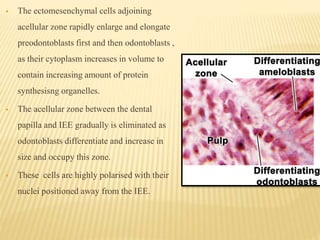
 The ectomesenchymal cells adjoining
acellular zone rapidly enlarge and elongate
preodontoblasts first and then odontoblasts ,
as their cytoplasm increases in volume to
contain increasing amount of protein
synthesisng organelles.
 The acellular zone between the dental
papilla and IEE gradually is eliminated as
odontoblasts differentiate and increase in
size and occupy this zone.
 These cells are highly polarised with their
nuclei positioned away from the IEE.
FORMATION OF MANTLE DENTIN
 Formation of organic matrix. Odontoblasts differentiate in the preexisting
ground substance of dental papilla and 1st dentin collagen synthesised by
them is deposited in this ground substance.
 Von korffs fibres appear. They are type 3 associated collagen fibres.
 As odontoblasts increase in size, they produce smaller type 1 collagen
fibrils that orient themselves parallel to the future DEJ.
 A layer of mantle predentin appears.
 The plasma mem of odontoblasts adjacent to IEE extends stubby process into
extracellular matrix which penetrate and interpose itself b/w cells of IEE to form
enamel spindle.
 As odontoblasts forms these process, it also buds off a number of small mem
bound vesicles known as matrix vesicles
 The odontoblasts then develops a cell process odontoblast process, which is left
behind in the forming dentin matrix ,as the odontoblast moves away towards the
pulp.
 The mineral phase first appears within the matrix vesicles as single crystals
seeded by phospholipids present in the vesicle membrane.
 The crystals grow and rupture spread as a cluster of crystallites that fuse with
adjacent clusters to form a continuous layer of mineralized matrix .
 The deposition of mineral layer lags behind the formation of the organic matrix so
that a layer called predentin is found between the odontoblasts and mineralization
front.
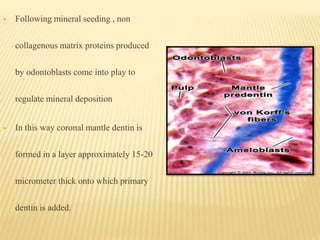
 Following mineral seeding , non
collagenous matrix proteins produced
by odontoblasts come into play to
regulate mineral deposition
 In this way coronal mantle dentin is
formed in a layer approximately 15-20
micrometer thick onto which primary
dentin is added.
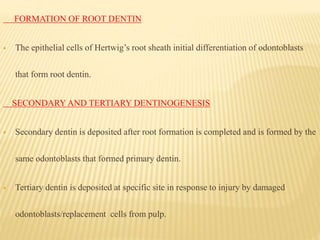
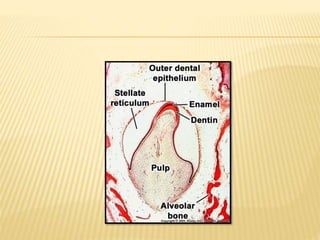
FORMATION OF ROOT DENTIN
 The epithelial cells of Hertwig’s root sheath initial differentiation of odontoblasts
that form root dentin.
SECONDARY AND TERTIARY DENTINOGENESIS
 Secondary dentin is deposited after root formation is completed and is formed by the
same odontoblasts that formed primary dentin.
 Tertiary dentin is deposited at specific site in response to injury by damaged
odontoblasts/replacement cells from pulp.
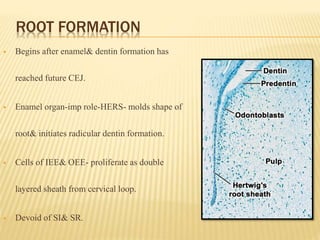
ROOT FORMATION
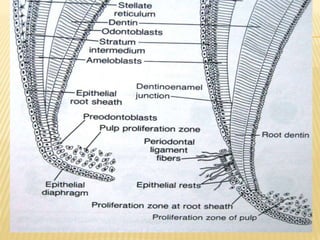
 Begins after enamel& dentin formation has
reached future CEJ.
 Enamel organ-imp role-HERS- molds shape of
root& initiates radicular dentin formation.
 Cells of IEE& OEE- proliferate as double
layered sheath from cervical loop.
 Devoid of SI& SR.
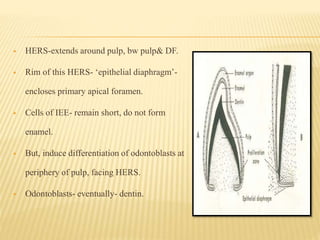
 HERS-extends around pulp, bw pulp& DF.
 Rim of this HERS- ‘epithelial diaphragm’-
encloses primary apical foramen.
 Cells of IEE- remain short, do not form
enamel.
 But, induce differentiation of odontoblasts at
periphery of pulp, facing HERS.
 Odontoblasts- eventually- dentin.
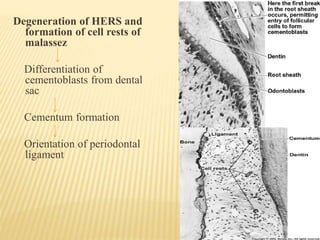
Degeneration of HERS and
formation of cell rests of
malassez
Differentiation of
cementoblasts from dental
sac
Cementum formation
Orientation of periodontal
ligament
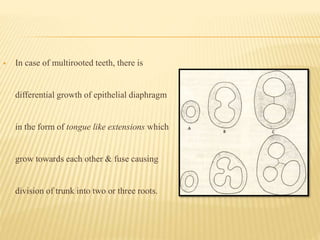
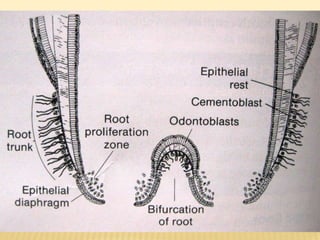
 In case of multirooted teeth, there is
differential growth of epithelial diaphragm
in the form of tongue like extensions which
grow towards each other & fuse causing
division of trunk into two or three roots.
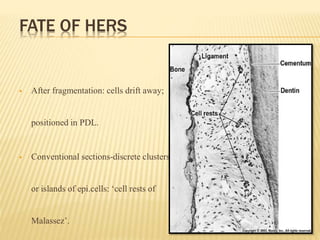
FATE OF HERS
 After fragmentation: cells drift away;
positioned in PDL.
 Conventional sections-discrete clusters
or islands of epi.cells: ‘cell rests of
Malassez’.
FORMATION OF SUPPORTING TISSUES
 The supporting tissues of the tooth form from the dental follicle.
 As root sheath fragments ectomesenchymal cells of the dental follicle penetrate
b/w the epithelial fenestrations and become apposed to the newly formed
dentin of the root.
 Cells differentiate into cementoblasts.
 The cells of periodontal ligament and fibre bundles also differentiate from
dental follicle.
HISTOPHYSIOLOGY
 A no. of physiologic growth processes.
 Overlap.
 Many are continuous through morphologic stages.
 Each process-predominate in one stage than other.
Ex.: histodifferentiation characterizes bell stage.
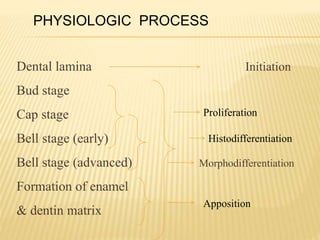
Dental lamina Initiation
Bud stage
Cap stage
Bell stage (early)
Bell stage (advanced) Morphodifferentiation
Formation of enamel
& dentin matrix
Proliferation
Histodifferentiation
Apposition
PHYSIOLOGIC PROCESS
INITIATION
 Dental lamina & tooth buds- potential for tooth formation.
 Specific cells within DL-potential to form EO of certain teeth by
responding to factors.
 Different teeth-initiated at different times.
 Requires ectomesenchymal-epithelial interactions.
CLINICAL IMPLICATION:
A lack of initiation results in absence of either single tooth or multiple teeth.
Most frequently the permanent upper lateral incisor ,third molar, and lower second
premolars.
Abnormal initiation may result in development of single or multiple
supernumerary teeth
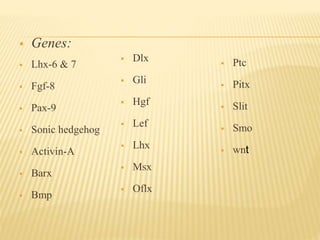
 Genes:
 Lhx-6 & 7
 Fgf-8
 Pax-9
 Sonic hedgehog
 Activin-A
 Barx
 Bmp
 Dlx
 Gli
 Hgf
 Lef
 Lhx
 Msx
 Oflx
 Ptc
 Pitx
 Slit
 Smo
 wnt
PROLIFERATION
 Enhanced proliferative activity bud, cap & bell.
 Proliferative growth causes regular changes in size & proportion of
growing tooth germ.
 Tooth germ already has potential to become more highly developed.
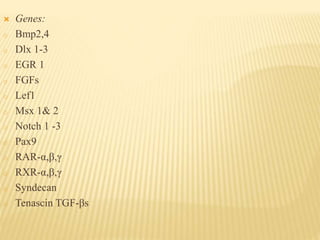
 Genes:
o Bmp2,4
o Dlx 1-3
o EGR 1
o FGFs
o Lef1
o Msx 1& 2
o Notch 1 -3
o Pax9
o RAR-α,β,γ
o RXR-α,β,γ
o Syndecan
o Tenascin TGF-βs
HISTODIFFERENTIATION
 Succeeds proliferative phase.
 Formative cells-definite morphologic as well as functional changes.
 Acquire their functional assignment.
 Cells become restricted in their functions.
 Differentiate; give up capability of multiplying.
 This phase-reaches highest development in bell stage, just preceding formation
of enamel& dentin.
 Organizing influence of IEE on mesenchyme- evident in bell stage.
 Causes differentiation of adj DP cells-odontoblasts.
 With formation of dentin: IEE -> ameloblasts; form enamel opposite to dentin.
 Enamel does not form in the absence of dentin.
 Dentin formation precedes & essential for enamel formation.
 Differentiation of epithelial cells precedes & is essential for
differentiation of odontoblasts.
Clinical implications:
In vitamin A deficiency ameloblasts fail to differentiate ,as a result of which
adjacent mesenchyme fails to differentiate & a atypical dentin known as
osteodentin is formed
Defective histodifferentiation of ameloblasts lead to Amelogenesis Imperfecta
Defective histodifferentiation of odontoblasts results in Dentiinogenesis imperfecta.
MORPHODIFFERENTIATION
 Morphologic pattern or basic form & relative size-established-differential growth.
 Therefore, morphodifferentiation-impossible without proliferation.
 Advanced bell stage - imp stage of morphodiff, in the crown, outlining future DEJ.
DEJ& DCJ- different & characteristic for each type of tooth.
 Act as a blueprint pattern.
 Enamel, dentin & cementum-in conformity with this pattern.
 Therefore- responsible for form& size.
 Ex.: size& form of cuspal portion of 1st permanent M- established at birth, before
formation of hard tissues begin.
Genes:
 Bmp4
 Collagens
 Dlxl-3
 Lef 1
 Msxl
 Msx2
 Notch1 -3
 Pax9
 RAR
 RXR
 Tuftelin
Clinical implications:
Endocrinal disturbances can affect tooth shape only during
this stage.
In hypopitutarism small clinical crown is often mistaken for a
small anatomic crown
Disturbances in morphodifferentiation
Supernumerary cusp or tooth
Twinning
Suppression of parts may occur
Peg or malformed tooth
APPOSITION
 Deposition of matrix of hard dental structures.
 Appositional growth- layer-like deposition of extracellular matrix.
 This type of growth is therefore additive.
 Fulfillment of plans outlined at histo& morphodiff.
 Regular& rhythmic deposition of extra cellular matrix.
 Periods of activity& rest- alternatively at definite intervals.
Clinical implications:
 Genetic & environmental factors may disturb the normal synthesis & secretion of
organic matrix of enamel leading to condition called enamel hypoplasia.
 If organic matter is defective, then enamel or dentin is said to be hypocalcified or
hypomineralised.
Conclusion
Teeth are serially homologous structures, which allow the localization and
quantification of the effects of specific gene mutations. It is possible to determine the
phase of odontogenesis affected by these conditions. These features make tooth
development an important system, to understand the intricate molecular mechanisms
that regulate development.
RECENT ADVANCES:
Ectodysplasin, a recently identified signal molecule in the tumor necrosis factor (TNF) family,
and its receptor Edar mediate signalling between ectodermal compartments in tooth germs. The
genes regulated by the different signals include transcription factors and signal receptors that
regulate the competence of the cells to respond to the next signals, as well as new signals that act
reciprocally and thereby continue the communication between cells and tissues (reviewed
by Jernvall and Thesleff, 2000; Thesleff and Mikkola, 2002).
The transcription factor c-Myb is involved in the control of cell proliferation, survival and
differentiatiON The expression of c-Myb in both species was strong in the odontoblasts and
ameloblasts at the stage of dentin and enamel production suggesting a possible novel role of c-
Myb during tooth mineralization
Eva Matalova, et al,. Expression and characterization of c-Myb in prenatal odontogenesis
Develop. Growth Differ. (2011) 53, 793–803
Msx1 and Pax9 interact synergistically throughout lower incisor development and affect
multiple signaling pathways that influence incisor size and symmetry and that a combined
reduction of PAX9 and MSX1 gene dosage in humans may increase the risk for orofacial
clefting and oligodontia. Mitsushiro Nakatomi, Xiu-Ping Wang,Darren Key, Jennifer J.
Lund,Annick Turbe-Doan,et al, Genetic interactions between Pax9 and Msx1 regulate lip
development and several stages of tooth morphogenesis Developmental Biology Volume
340, Issue 2, 15 April 2010, Pages 438–449
Zn affects biological events especially in tooth development, with recent progress uncovering
the roles of the Zn transporter Zip13 in mammalian health and diseases Toshiyuki
Fukada, Yoshinobu Asada, Kenji Mishima, Shinji Shimoda, Ichiro Saito Slc39a13/Zip13: A
Crucial Zinc Transporter Involved in Tooth Development and Inherited Disorders
Journal of Oral Biosciences Volume 57, Issue 1, Pages 1-44 (February 2015)
REFERENCES
B.K.B.Berkovitz, G.R.Holland, B.J.Moxham Oral Anatomy, Histology,
And Embryology 4th Edition
Oral Development And Histology James Avery Third Edition.
Tencate’s Oral Histology Antonio Nanci 8th Edition
Orban Oral Histology And Embryology 13th Edition
Javier Caton and S Tucker Current knowledge of tooth
development: patterning and mineralization of the murine dentition J
Anat. 2009 Apr; 214(4): 502–515
Jukka Jernvall and Irma Thesleff Tooth shape formation and tooth
renewal: evolving with the same signals Development 139, 3487-
3497 (2012)
 Chatterjee .Sa, Boaz Kb Molecular biology of odontogenesis.J
Orofac Sci, 3(1)2011
Irma Thesleff Epithelial mesenchymal signalling regulating tooth
morphogenesis Journal of cell science 116, 1647-1648
Odontogenesis (1)

Odontogenesis (1)

  • 1.
  • 2.
    CONTENTS INTRODUCTION NEURAL CREST PRIMARY EPITHELIALBAND DENTAL LAMINA VESTIBULAR LAMINA EPITHELIAL-MESENCHYMAL INTERACTIONS GENES EXPRESSED DURING TOOTH DEVELOPMENT
  • 3.
    STAGES IN DEVOF TOOTH ROOT FORMATION FORMATION OF SUPPORTING TISSUES CLINICAL IMPLICATIONS CONCLUSION RECENT ADVANCES
  • 4.
    In human,20 primaryand 32 permanent teeth develop from the interaction of oral epithelial cells and underlying mesenchymal cells. Each developing tooth grows as an anatomically distinct unit, but the basic developmental process is similar for all teeth. INTRODUCTION:
  • 5.
    NEURAL CREST  Groupof cells-separated from neuroectoderm-capacity to migrate& differentiate extensively within embryo.  Structures-spinal sensory ganglia, sympathetic neurons, Schwann cells, pigment cells& meninges.  Avian embryo-crest of neural folds-name  Mammalian embryo-lateral aspect of neural plate.
  • 6.
     H&N-imp role. Differentiate-most of the CT.  CT elsewhere-mesoderm: ‘mesenchyme’.  Head- ‘ectomesenchyme’-origin from neuroectoderm.  Proper migration-essential- dvp of face& teeth.  All the tissues of teeth & supporting app (exc enamel)- dvp directly from NC.  Depletion prevents proper dvp.
  • 7.
     The primitiveoral cavity or stomadeum is lined by stratified squamous epithelium called the ORAL ECTODERM.  The oral ectoderm contacts the endoderm of the foregut to form the buccopharyngeal membrane.  At about 27 th day of gestation this membrane ruptures and the primitive oral cavity establishes a connection with the foregut.  Most of the connective tissue cells underlying the oral ectoderm are neural crest or ectomesenchymal in orgin.  These cells are thought to instruct or induce the overlying ectoderm to start tooth development,which begins in anterior portion of what will be future maxilla and mandible and proceeds posteriorly.
  • 9.
    PRIMARY EPITHELIAL BAND After37 days of development, a continuous band of thickened epithelium forms Roughly horse shoeshaped Each band of epithelium called primary epithelial band gives rise to DENTAL LAMINA which forms first VESTIBULAR LAMINA A key feature of initiation of tooth development is formation of localized thickenings or placodes within primary epithelial bands.
  • 11.
    DENTAL LAMINA: o o 6weeks old basal cells of oral ectoderm proliferates This leads to the formation of DENTAL LAMINA which is a band of epithelium that has invaded the underlying ectomesenchyme along each of horse shoe shaped future dental arches. Dental lamina primodium for the ectodermal portion of deciduous teeth
  • 12.
    A-DENTAL LAMINA B-VESTIBULAR LAMINA Permanentmolars arise from distal extension of dental lamina. Development of first permanent molar is initiated at 4th month in utero. 2nd molar at first year after birth 3rd molar at 4th or 5th years
  • 13.
    The successors ofdecidous teeth lingual extension of the free end of dental lamina successional lamina and develops from 5th month in utero to tenth month of age
  • 14.
    FATE OF DENTALLAMINA Total activity of dental lamina period of 5 yrs degenerate . D L may be still active in 3rd molar region after it has disappeared elsewhere. Remnants persist as epithelial pearls or islands within the jaw as well as in gingiva (Epithelial rests of serre/ Cell rests of Serre) Proliferate odontogenic tumours or cysts
  • 15.
    VESTIBULAR LAMINA •Buccal extof Pri epi band •VESTIBULAR LAMINA OR LIP FURROW BAND. •Proliferation of vestibular lamina into the ectomesenchyme soon after formation of dental lamina VESTIBULE •V shaped •Separates the cheek and lip from tooth bearing areas
  • 16.
  • 18.
    GENES EXPRESSED DURINGTOOTH DEVELOPMENT Barx Bar H1 homologue in vertebrates(TF) Bmp Bone morphogenic proteins(SP) Dlx Distaless homologue in vertebrae(TF) Fgf Fibroblast growth factor(SP) Gli Glioma-associated oncogene homologue. Hgf Hepatic growth factor(SP) Lef Lymphoid enhances binding factor(TF) Lhx Lim-homeobox domain gene(TF) Msx Msh-like genes in vertebrae(TF)
  • 19.
    Otlx Otx-related homeoboxgene(TF). Pax Paired box homeotic gene(TF). Pitx Transcription factor named for its expression in the pituitary gland Ptc Patched cell-surface cell-surface receptor for sonic hedgehog(Shh). Shh Sonic hedgehog(SP). Slit Homologue to dorsophila slit protein(SP). Smo Smoothed PTC coreceptor for Shh. Wnt Wingless homologue in vertebrates.(SP) TF –transcription factor SP-secretory proteins
  • 20.
    INITIATION OF TOOTH DEVELOPMENT TOOTHPATTERNING REGIONALISATION OF DENTAL ECTODERM
  • 21.
    Initiation of toothdevelopment: Odontogenesis is first initiated by factors resident in the 1st arch epithelium influencing ectomesenchyme but with time this potential is assumed by ectomesenchyme
  • 22.
    1. lhx-6 &lhx-7 and lim-homeobox domain gene (transcription factor): Earliest mesnchymal markers which initiate tooth development. Induced by fgf-8 present in epithelium of 1st brachial arch. 2. pax-9 Tooth initiation & Tooth germ location Induced by fgf-8 & down regulated by BMP2 and BMP4(seen where fgf-8 not seen). 3. Gli gene 4. Lef-1  1st expressed in dental epithelial thickenings and during bud formation shifts to being expressed in condensing mesenchyme. 5.Shh-have a role in stimulating epithelial cell proliferation. 6. Dlx-1 ,Dlx-2
  • 23.
    Regionalisation of dentalectoderm: Shh is expressed where dental ectoderm is formed. Wnt is expressed throughout in oral cavity except for presumptive dental ectoderm where shh is expressed
  • 24.
    TOOTH TYPE PATTERNING:Determinationof specific tooth types at their correct positions in the jaws. In heterodonts, 3 families of shapes: oIncisiform oCaniniform oMolariform HYPOTHESIS Odontogenic homeobox code model of dental patterning(Field theory) Clone theory
  • 25.
    ODONTOGENIC HOMEOBOX CODEMODEL (FIELD MODEL) OF DENTAL PATTERNING:  The factors related to tooth shape reside within the ectomenchyme in distinct graded and overlapping fields for each tooth family
  • 26.
    CLONE THEORY Each toothis derived from a clone of ectomesenchymal cells programmed by epithelium to produce teeth of given pattern. A The molar clone ectomesenchyme has induced the dental lamina to begin tooth development. The clone and dental lamina progress posteriorly B When a clone reaches the critical size, a tooth bud is initiated at its center. C The next tooth bud is not initiated until the progress zone of the clone escapes the influence of a zone of inhibition surrounding the tooth bud
  • 27.
    DEVELOPMENTAL STAGES  Continuousprocess.  Different morphologic ‘stages’-descriptive purposes.  Different sizes& shapes; similar stages of dvp. Named after shape of EO:  Bud  Cap  Bell
  • 28.
    STAGES OF TOOTHDEVELOPMENT Morphologic Stages Dental lamina Bud stage Cap stage Bell stage- early Bell stage- advanced Formation of enamel and dentin matrix  Physiologic process  Initiation  Proliferation  Morphodifferentiation  Apposition • Histodifferentiation
  • 29.
    TOOTH DEVELOPMENT  A-BUDSTAGE  B-CAP STAGE  C-BELL STAGE  D,E-DENTINOGENESIS AND AMELOGENESIS  F-CROWN FORMATION  G-ROOT FORMATION AND ERUPTION  H-FUNCTION
  • 30.
    TOOTH GERM  Includesall the formative tissues for the entire tooth and its supporting structures.  Three main components:-  Enamel organ - ectodermal component that gives rise to enamel.  Dental papilla - ectomesenchymal component that gives rise to dentin and pulp.  Dental follicle or dental sac - ectomesenchymal component giving rise to cementum, periodontal ligament, and part of the alveolar socket
  • 31.
    BUD STAGE  Enamelorgan differentiate into round or ovoid swelling called tooth bud.  Enamel organ at this stage consists of: 1.Peripherally located low columnar cells. 2.Centrally located polygonal cells
  • 32.
    Epithelium of dentallamina is separated from underlying mesenchyme by a basement membrane. Ectomesenchymal condensation occurs in relation to enamel organ. Ectomesenchymal condensation just below enamel organ is known as dental papilla. It forms future dentin & pulp.  Ectomesenchymal condensation that surrounds tooth bud & dental papilla is known as dental sac. It forms future cementum & periodontal ligament
  • 33.
    MOLECULAR BASIS:  Msxgene expression induces ectomesnchymal condensation .  BMP4 Induces ectomesenchymal condensation . Induces Msx. Induces BMP2 & Shh which helps in transition from Bud to Cap stage.
  • 34.
    CAP STAGE  Unequalgrowths in different parts of the tooth bud leads to cap stage  Shallow invagination on the deep surface of the bud.  Resembles a cap sitting on a ball of condensed ectomesenchyme .
  • 35.
    Outer enamel epith Stellate reticulum Dentalsac Dental papilla Inner enamel epith Dental lamina
  • 36.
    OUTER AND INNERENAMEL EPITHELIUM  The peripheral cells of the cap stage: outer enamel epithelium.  The cells in the concavity of cap becomes tall,columnar : inner enamel epithelium.  The outer enamel epithelium is separated from the dental sac  Inner enamel epithelium from dental papilla by a delicate basement membrane  Hemidesmosomes
  • 37.
    STELLATE RETICULUM  BwIEE& OEE- polygonal cells- synthesize& secrete GAGs into extracellular component bw epi.cells.  GAGs-hydrophilic-osmotic pressure-drag water into EO.  Increasing amount of fluid-increases-volume of extracellular compartment.  Central cells-forced apart.
  • 38.
     Retain connectionwith each other through cytoplasmic extensions& desmosomal attachments: star shaped.  Gives central area cushion-like consistency.  Shock absorber.  Protects delicate enamel-forming cells.
  • 39.
     DENTAL PAPILLA Under proliferating epithelium of enamel organ ectomesenchyme proliferates condenses to form the dental papilla formative organ of dentin and the primodium of the pulp.  The dental papilla shows active budding of capillaries and mitotic figures
  • 40.
    DENTAL SAC  Marginalcondensation in the ectomesenchyme surrounding the enamel organ and dental papilla.  Zone a dense and fibrous layer develops : primitive dental sac.  Cells of dental sac : cementum and periodontal ligament.
  • 41.
  • 42.
    ENAMEL KNOT  Theyare clusters of non dividng epithelial cells visible in sections of molar cap stage tooth germ.  Vertical enamel knot : enamel cord  Enamel cord extends to meet OEE : Enamel septum  Each tooth germ has single primary enamel knot at the cap stage and as these disappears  Secondary enamel knots appear at the tips of future cusps in molars.
  • 43.
    ENAMEL CORD &ENAMEL NAVEL
  • 44.
     A smalldepression at the point of meeting- ‘enamel navel’.  Transient structures; disappear before enamel formation.  Function of enamel knot& cord may be- reservoir of dividing cells for the growing EO.  Fgf-4 & Slit-1: best markers; both primary& sec. knots.  Exact physical role-not yet established.  Current view-E.knot-organization centre- orchestrates cuspal morphogenesis.
  • 45.
    ENAMEL NICHE  Apparentstructure in histologic sections created because the dental lamina is a sheet : contains a concavity filled with connective tissue.  Impression that the tooth germ has double attachment to oral epithelium by 2 separate strands.
  • 46.
    BELL STAGE  Asthe invagination of epithelium deepens and its margins continue to grow, the enamel organ assumes a bell stage  EARLY BELL STAGE  Inner enamel epithelium  Outer enamel epithelium  Stratum Intermedium  Stellate reticulum  Cervical loop or zone of reflexion  Dental Papilla  Dental Sac
  • 47.
    INNER ENAMEL EPITHELIUM Single layer of cells-differentiate prior to amelogenesis into tall columnar cells- ‘ameloblasts’.  4-5 µm in diameter; 40µm high.  Contains nucleus away from basement membrane. Nucleus/cytoplasmic ratio is high.  high glycogen content.  Cytoplasm contains free ribosomes ,a few RER ,some mitochondria & few scattered tonofilaments.  Attached to one other by junctional complexes laterally& to SI by desmosomes.
  • 48.
    STRATUM INTERMEDIUM  Afew layers of squamous cells b/w IEE& OEE.  Closely packed-desmosomes& gap jn.  Desmosomal jn bw SR& IEE.  Cells-well developed cytoplasmic organelles, acid mucopolysaccharides& glycogen deposits: high mitotic activity.  High activity of alk.ph.  Responsible for enamel formation
  • 49.
    STELLATE RETICULUM  Expandsfurther-increased extracellular fluid.  Desmosomal jns-bw-SR,SI& OEE.  Before enamel formation- SR collapses.  Reduces distance bw ameloblasts& nutrient capillaries near OEE.  Then, cells-hardly distinguishable from SI.  This change begins-height of cusp, progresses cervically.
  • 50.
    OUTER ENAMEL EPITHELIUM Flatten to a low cuboidal form, centrally placed nuclei  At the end of bell stage-laid in folds.  Bw folds-DS forms papillae-contain capillary loops- nutritional supply to avascular enamel organ  Compensate for loss of nutritional supply from DP - caused due to form of mineralized dentin.  .
  • 51.
    DENTAL PAPILLA  Enclosedin the invaginated portion of EO.  Before IEE bigins to produce enamel, peripheral cells of DP- odontoblasts- organizing influence of EO.  First they assume cuboidal form, then columnar; specific potential for dentin production.  BM-separating EO& DP- ‘membrana preformativa’
  • 52.
    Dental Sac:  Consistsof undifferentiated mesenchymal cells & circularly arranged collagen fibrils around enamel organ & dental papilla.  Collagen fibrils are more in dental sac than dental papilla.  Ramifying nerves & vessels are also seen.  Dvp of root DS differentiate into perio fibres that gets embedded in dvp cementum n alv bone Cervical loop or zone of reflexion :  Its region where the inner and outer enamel epithelia meet at the rim of the enamel organ  This is the point where cells continue to divide until tooth attains its full size & which after crown formation gives rise to epithelial component of root formation.
  • 53.
     Dental sac Outer enamel epi  Ameloblasts  Stellate reticulum  Stratum intermedium  Odontoblasts  Dental papilla  Cervial loop
  • 54.
    ADVANCED BELL STAGE Characterized by commencement of mineralization & root formation.  Boundary bw IEE& odontoblasts- future DEJ.  Formation of dentin occurs first as a layer along future DEJ.  Begins at cusp tips, proceeds cervically& apically.
  • 55.
     After 1stlayer of dentin- ameloblasts- enamel- cusp area.  Proceeds coronally& cer  Cervical portion of enamel gives vically, from DEJ towards surface. rise to HERS.  Outlines future root; responsible for shape, length, size& no. of roots.
  • 56.
    BREAK OF DL&CROWN PATTERN DETERMINATION  2 imp events occur in the bell stage: 1  . Dental lamina joining tooth germ to OE fragments, eventually- separates developing tooth from OE.  Fragmentation-> discrete clusters of epithelial cells- normally degenerate.  Some may persist- epithelial pearls (formerly- glands of Serres)
  • 59.
    2.  IEE completesits folding, making it possible to recognize the shape of future crown pattern.  Folding occurs not from growth pressures within DP.  Results from intrinsic growth caused by differential rates of mitotic divisions within cells of IEE.
  • 60.
  • 61.
    AMELOGENESIS  The cellsresponsible for amelogenesis are ameloblasts.  LIFE CYCLE OF AMELOBLASTS  Presecretory stage Morphogenic stage Organizing stage  Secretory stage Formative stage  Post-secretory stage Maturative stage Protective stage Desmolytic stage
  • 62.
    MORPHOGENIC STAGE  Thefunction of ameloblasts :determination of shape of the tooth.  The IEE interacts with the underlying connective tissue and through differential growth helps to establish DEJ and thereby determine shape of the tooth.  The ameloblasts at this stage are low columnar, centrally placed nucleus.  Cytoplasmic organelles are not abundant,the centrioles and golgi apparatus are at apical part of cytoplasm and mitochondria is evenly distributed through out the cytoplasm.
  • 63.
    ORGANIZING STAGE/DIFFERENTIATION STAGE  Theameloblasts exert organizing influence on dental papilla cells and help in their differentiation to odontoblasts.  Ameloblasts increase in length about 40 microns and has abundant cytoplasmic organelles for protein synthesis  Reverse polarity is seen.
  • 64.
     It’s apreparation to secretion because organelles are moved to secretory end of cell which is at the basal region.  The cells also develop intercellular junctions at proximal and distal ends called proximal and distal terminal bars.  During the terminal phase : dentin formation begins and basal lamina supporting the ameloblasts layer disintergrates.  Ameloblasts attain secretory function only after a layer of dentin is formed.  This interdependence b/w ameloblasts and odontoblasts is called RECIPROCAL INDUCTION
  • 65.
    FORMATIVE/SECRETORY STAGE  Inthis stage ameloblasts performs functin of secretion of enamel matrix and partial mineralisation.  Here they synthesise enamel proteins  In initial stages ameloblasts have flat basal region.  As the enamel matrix is deposited, the ameloblasts move away from dentin side but a part of distal end of ameloblasts gets trapped in its own matrix and this conical trapped portion is called tomes process.  After Tomes process is formed ,the secretion of enamel takes place from 2 different sites and is responsible for the rod structure of enamel.
  • 66.
    MATURATIVE STAGE  Ameloblasts: helps in the mineralization and maturation of enamel.  Introduce the inorganic material necessary for maturation and also removes proteins and water to provide space for minerals.  Show morphologic alterations.  Ameloblasts are ruffle ended when they are reabsorbing proteins and water.  Shows slight reduction in height and decrease in volume and organelles content.
  • 67.
     The basalplasma membrane of ruffle ended ameloblasts shows a brush border with many foldings while that of smooth ended ameloblasts is smooth.  The cytoplasm of ameloblasts also has vacoules which contains material resembling enamel matrix indicating absorptive function of these cells.  Excess synthetic organelles are removed and the remaining organelles are shifted to the distal end of the cells.
  • 68.
    PROTECTIVE STAGE  Afterthe enamel formation is completed the basal plasma membrane of ameloblasts looses the brush border and become smooth.  They secrete protein : to the surface of newly formed enamel.  Dev hemidesmosomal attachments to these basal lamina structure which help in holding these firmly to the tooth surface.
  • 69.
     Columnar ameloblastsshorten to cuboidal and along with the other collasped layers of enamel organ forms 2-3 layered stratified epithelium which is termed as REE.  This reduced enamel epithelium covers the newly formed enamel and protects : till tooth erupts into the oral cavity .  Helps establishing the dentino gingival junction.
  • 70.
    DESMOLYTIC STAGE  Inthis stage the REE secretes collagenase enzyme which destroys the connective tissue between oral mucosa & erupting tooth. This facilitates eruption process.  During this stage the REE proliferates and fuses with the oral epithelium to form a solid plug of epithelial cells.  The central cells of this degenerate to form a canal through which the tooth erupts.  Amelogenesis , the process of formation of enamel involves 2 steps : Matrix deposition & Mineralization.
  • 72.
    ENAMEL MATRIX DEPOSITION: Enamel formation begins :tips and the incisal edges progresses outwards and cervical.  As matrix deposition progresses ameloblasts move outward away from the matrix.  In the early stages of amelogenesis the enamel matrix consists of 20-30% of proteins and this protein gradually decreases  Ameloblasts synthesise and secrete enamel matrix which is composed of enamel proteins. Amelogenin and non amelogenin.
  • 73.
     Enamel matrixalso contains sulphated glyco conjugates.  After a little thickness of enamel matrix is deposited ameloblasts develop a conical process at the base which is called Tome’s process.  Enamel secretion takes place through two sites in Tome’s process 1. Interod growth region 2. Rod growth region Tome’s process is responsible for the rod structure of enamel
  • 74.
    MINERALIZATION OF ENAMELMATRIX  In Immediate partial mineralization.  25-35% of total mineral content is deposited in matrix.  It begins at DEJ where the tuftelin , ameloblastin/enamel proteins are deposited on layer of dentin.  The initial enamel crystallizes to form a ribbon of minerals perpendicular to DEJ and the process continues till the entire thickness of enamel matrix secreted.  After nucleation , the ameloblasts deposit matrix rich in amelogenin..
  • 75.
     Maturation  Massivereabsorption of matrix protein and water takes place by ameloblasts and there is rapid growth of crystallites.  Initially amelogenin proteins are absorbed onto specific crystal faces , thus controlling their growth.  The amelogenin proteins are removed from mineralizing front by proteolytic cleavage mediated by proteinase enzyme and is reabsorbed by endocytic action of ameloblasts to bring about crystal growth.  The maturation process starts at DEJ and progresses to the surface similarly it proceeds from cusp/incisal tip to cervical region.
  • 76.
    DENTINOGENESIS Dentin is formedby cells called odontoblasts that differentiates from ectomesenchymal cells of dental papille following an organizing influence that emanates from inner enamel epithelium.  ODONTOBLAST DIFFERENTIATION  The dental papilla cells : small and undifferentiated , a central nucleus and a few other organelles.  Separated from the inner enamel epithelium by an acellular zone that contains some fine collagen fibrils
  • 77.
     The ectomesenchymalcells adjoining acellular zone rapidly enlarge and elongate preodontoblasts first and then odontoblasts , as their cytoplasm increases in volume to contain increasing amount of protein synthesisng organelles.  The acellular zone between the dental papilla and IEE gradually is eliminated as odontoblasts differentiate and increase in size and occupy this zone.  These cells are highly polarised with their nuclei positioned away from the IEE.
  • 78.
    FORMATION OF MANTLEDENTIN  Formation of organic matrix. Odontoblasts differentiate in the preexisting ground substance of dental papilla and 1st dentin collagen synthesised by them is deposited in this ground substance.  Von korffs fibres appear. They are type 3 associated collagen fibres.  As odontoblasts increase in size, they produce smaller type 1 collagen fibrils that orient themselves parallel to the future DEJ.  A layer of mantle predentin appears.
  • 79.
     The plasmamem of odontoblasts adjacent to IEE extends stubby process into extracellular matrix which penetrate and interpose itself b/w cells of IEE to form enamel spindle.  As odontoblasts forms these process, it also buds off a number of small mem bound vesicles known as matrix vesicles  The odontoblasts then develops a cell process odontoblast process, which is left behind in the forming dentin matrix ,as the odontoblast moves away towards the pulp.
  • 80.
     The mineralphase first appears within the matrix vesicles as single crystals seeded by phospholipids present in the vesicle membrane.  The crystals grow and rupture spread as a cluster of crystallites that fuse with adjacent clusters to form a continuous layer of mineralized matrix .  The deposition of mineral layer lags behind the formation of the organic matrix so that a layer called predentin is found between the odontoblasts and mineralization front.
  • 81.
     Following mineralseeding , non collagenous matrix proteins produced by odontoblasts come into play to regulate mineral deposition  In this way coronal mantle dentin is formed in a layer approximately 15-20 micrometer thick onto which primary dentin is added.
  • 82.
    FORMATION OF ROOTDENTIN  The epithelial cells of Hertwig’s root sheath initial differentiation of odontoblasts that form root dentin. SECONDARY AND TERTIARY DENTINOGENESIS  Secondary dentin is deposited after root formation is completed and is formed by the same odontoblasts that formed primary dentin.  Tertiary dentin is deposited at specific site in response to injury by damaged odontoblasts/replacement cells from pulp.
  • 84.
    ROOT FORMATION  Beginsafter enamel& dentin formation has reached future CEJ.  Enamel organ-imp role-HERS- molds shape of root& initiates radicular dentin formation.  Cells of IEE& OEE- proliferate as double layered sheath from cervical loop.  Devoid of SI& SR.
  • 85.
     HERS-extends aroundpulp, bw pulp& DF.  Rim of this HERS- ‘epithelial diaphragm’- encloses primary apical foramen.  Cells of IEE- remain short, do not form enamel.  But, induce differentiation of odontoblasts at periphery of pulp, facing HERS.  Odontoblasts- eventually- dentin.
  • 87.
    Degeneration of HERSand formation of cell rests of malassez Differentiation of cementoblasts from dental sac Cementum formation Orientation of periodontal ligament
  • 88.
     In caseof multirooted teeth, there is differential growth of epithelial diaphragm in the form of tongue like extensions which grow towards each other & fuse causing division of trunk into two or three roots.
  • 90.
    FATE OF HERS After fragmentation: cells drift away; positioned in PDL.  Conventional sections-discrete clusters or islands of epi.cells: ‘cell rests of Malassez’.
  • 91.
    FORMATION OF SUPPORTINGTISSUES  The supporting tissues of the tooth form from the dental follicle.  As root sheath fragments ectomesenchymal cells of the dental follicle penetrate b/w the epithelial fenestrations and become apposed to the newly formed dentin of the root.  Cells differentiate into cementoblasts.  The cells of periodontal ligament and fibre bundles also differentiate from dental follicle.
  • 92.
    HISTOPHYSIOLOGY  A no.of physiologic growth processes.  Overlap.  Many are continuous through morphologic stages.  Each process-predominate in one stage than other. Ex.: histodifferentiation characterizes bell stage.
  • 93.
    Dental lamina Initiation Budstage Cap stage Bell stage (early) Bell stage (advanced) Morphodifferentiation Formation of enamel & dentin matrix Proliferation Histodifferentiation Apposition PHYSIOLOGIC PROCESS
  • 94.
    INITIATION  Dental lamina& tooth buds- potential for tooth formation.  Specific cells within DL-potential to form EO of certain teeth by responding to factors.  Different teeth-initiated at different times.  Requires ectomesenchymal-epithelial interactions.
  • 95.
    CLINICAL IMPLICATION: A lackof initiation results in absence of either single tooth or multiple teeth. Most frequently the permanent upper lateral incisor ,third molar, and lower second premolars. Abnormal initiation may result in development of single or multiple supernumerary teeth
  • 96.
     Genes:  Lhx-6& 7  Fgf-8  Pax-9  Sonic hedgehog  Activin-A  Barx  Bmp  Dlx  Gli  Hgf  Lef  Lhx  Msx  Oflx  Ptc  Pitx  Slit  Smo  wnt
  • 97.
    PROLIFERATION  Enhanced proliferativeactivity bud, cap & bell.  Proliferative growth causes regular changes in size & proportion of growing tooth germ.  Tooth germ already has potential to become more highly developed.
  • 98.
     Genes: o Bmp2,4 oDlx 1-3 o EGR 1 o FGFs o Lef1 o Msx 1& 2 o Notch 1 -3 o Pax9 o RAR-α,β,γ o RXR-α,β,γ o Syndecan o Tenascin TGF-βs
  • 99.
    HISTODIFFERENTIATION  Succeeds proliferativephase.  Formative cells-definite morphologic as well as functional changes.  Acquire their functional assignment.  Cells become restricted in their functions.  Differentiate; give up capability of multiplying.
  • 100.
     This phase-reacheshighest development in bell stage, just preceding formation of enamel& dentin.  Organizing influence of IEE on mesenchyme- evident in bell stage.  Causes differentiation of adj DP cells-odontoblasts.  With formation of dentin: IEE -> ameloblasts; form enamel opposite to dentin.
  • 101.
     Enamel doesnot form in the absence of dentin.  Dentin formation precedes & essential for enamel formation.  Differentiation of epithelial cells precedes & is essential for differentiation of odontoblasts.
  • 102.
    Clinical implications: In vitaminA deficiency ameloblasts fail to differentiate ,as a result of which adjacent mesenchyme fails to differentiate & a atypical dentin known as osteodentin is formed Defective histodifferentiation of ameloblasts lead to Amelogenesis Imperfecta Defective histodifferentiation of odontoblasts results in Dentiinogenesis imperfecta.
  • 103.
    MORPHODIFFERENTIATION  Morphologic patternor basic form & relative size-established-differential growth.  Therefore, morphodifferentiation-impossible without proliferation.  Advanced bell stage - imp stage of morphodiff, in the crown, outlining future DEJ. DEJ& DCJ- different & characteristic for each type of tooth.  Act as a blueprint pattern.  Enamel, dentin & cementum-in conformity with this pattern.  Therefore- responsible for form& size.  Ex.: size& form of cuspal portion of 1st permanent M- established at birth, before formation of hard tissues begin.
  • 104.
    Genes:  Bmp4  Collagens Dlxl-3  Lef 1  Msxl  Msx2  Notch1 -3  Pax9  RAR  RXR  Tuftelin Clinical implications: Endocrinal disturbances can affect tooth shape only during this stage. In hypopitutarism small clinical crown is often mistaken for a small anatomic crown Disturbances in morphodifferentiation Supernumerary cusp or tooth Twinning Suppression of parts may occur Peg or malformed tooth
  • 105.
    APPOSITION  Deposition ofmatrix of hard dental structures.  Appositional growth- layer-like deposition of extracellular matrix.  This type of growth is therefore additive.  Fulfillment of plans outlined at histo& morphodiff.  Regular& rhythmic deposition of extra cellular matrix.  Periods of activity& rest- alternatively at definite intervals.
  • 106.
    Clinical implications:  Genetic& environmental factors may disturb the normal synthesis & secretion of organic matrix of enamel leading to condition called enamel hypoplasia.  If organic matter is defective, then enamel or dentin is said to be hypocalcified or hypomineralised.
  • 108.
    Conclusion Teeth are seriallyhomologous structures, which allow the localization and quantification of the effects of specific gene mutations. It is possible to determine the phase of odontogenesis affected by these conditions. These features make tooth development an important system, to understand the intricate molecular mechanisms that regulate development.
  • 109.
    RECENT ADVANCES: Ectodysplasin, arecently identified signal molecule in the tumor necrosis factor (TNF) family, and its receptor Edar mediate signalling between ectodermal compartments in tooth germs. The genes regulated by the different signals include transcription factors and signal receptors that regulate the competence of the cells to respond to the next signals, as well as new signals that act reciprocally and thereby continue the communication between cells and tissues (reviewed by Jernvall and Thesleff, 2000; Thesleff and Mikkola, 2002). The transcription factor c-Myb is involved in the control of cell proliferation, survival and differentiatiON The expression of c-Myb in both species was strong in the odontoblasts and ameloblasts at the stage of dentin and enamel production suggesting a possible novel role of c- Myb during tooth mineralization Eva Matalova, et al,. Expression and characterization of c-Myb in prenatal odontogenesis Develop. Growth Differ. (2011) 53, 793–803
  • 110.
    Msx1 and Pax9interact synergistically throughout lower incisor development and affect multiple signaling pathways that influence incisor size and symmetry and that a combined reduction of PAX9 and MSX1 gene dosage in humans may increase the risk for orofacial clefting and oligodontia. Mitsushiro Nakatomi, Xiu-Ping Wang,Darren Key, Jennifer J. Lund,Annick Turbe-Doan,et al, Genetic interactions between Pax9 and Msx1 regulate lip development and several stages of tooth morphogenesis Developmental Biology Volume 340, Issue 2, 15 April 2010, Pages 438–449 Zn affects biological events especially in tooth development, with recent progress uncovering the roles of the Zn transporter Zip13 in mammalian health and diseases Toshiyuki Fukada, Yoshinobu Asada, Kenji Mishima, Shinji Shimoda, Ichiro Saito Slc39a13/Zip13: A Crucial Zinc Transporter Involved in Tooth Development and Inherited Disorders Journal of Oral Biosciences Volume 57, Issue 1, Pages 1-44 (February 2015)
  • 111.
    REFERENCES B.K.B.Berkovitz, G.R.Holland, B.J.MoxhamOral Anatomy, Histology, And Embryology 4th Edition Oral Development And Histology James Avery Third Edition. Tencate’s Oral Histology Antonio Nanci 8th Edition Orban Oral Histology And Embryology 13th Edition
  • 112.
    Javier Caton andS Tucker Current knowledge of tooth development: patterning and mineralization of the murine dentition J Anat. 2009 Apr; 214(4): 502–515 Jukka Jernvall and Irma Thesleff Tooth shape formation and tooth renewal: evolving with the same signals Development 139, 3487- 3497 (2012)  Chatterjee .Sa, Boaz Kb Molecular biology of odontogenesis.J Orofac Sci, 3(1)2011 Irma Thesleff Epithelial mesenchymal signalling regulating tooth morphogenesis Journal of cell science 116, 1647-1648

Editor's Notes

  • #10 After 37 days of development,a continous band of thickened epithelium forms around the mouth in the presumptive upper and lower jaws. These bands are roughly horse shoeshaped and corresponds in position to future dental arches of upper and lower jaws. Each band of epithelium called primary epithelial band gives rise to DENTAL LAMINA which forms first VESTIBULAR LAMINA which forms shortly afterward and which is positioned just in front of dental lamina A key feature of initiation of tooth development is formation of localized thickenings or placodes within primary epithelial bands.
  • #12 Two or three weeks after the rupture of buccopharyngeal membrane,when the embryo is around 6 weeks old,some area of basal cells of oral ectoderm proliferates more rapidly than adjacent area.This leads to the formation of DENTAL LAMINA which is a band of epithelium that has invaded the underlying ectomesenchyme along each of horse shoe shaped future dental arches. Dental lamina serves as primodium for the ectodermal portion of deciduous teeth
  • #16 The cells of vestibular lamina rapidly enlarge and then degenerate to form a cleft that becomes vestibule between cheek and tooth bearing area
  • #32 Enamel organ differentiate into round or ovoid swelling called tooth bud. Enamel organ at this stage consists of: 1.Peripherally located low columnar cells. 2.Centrally located polygonal cells Epithelium of dental lamina is separated from underlying mesenchyme by a basement membrane. Ectomesenchymal condensation occurs in relation to enamel organ. Ectomesenchymal condensation just below enamel organ is known as dental papilla. It forms future dentin & pulp. Ectomesenchymal condensation that surrounds tooth bud & dental papilla is known as dental sac. It forms future cementum & periodontal ligament
  • #37 Outer and inner enamel epithelium The peripheral cells of the cap stage are cuboidal cover the convexity of the cap and are called the outer enamel epithelium. The cells in the concavity of cap becomes tall,columnar and represent the inner enamel epithelium. The outer enamel epithelium is separated from the dental sac and inner enamel epithelium from dental papilla by a delicate basement membrane.Hemidesmosomes anchor the cells to the basal lamina.
  • #38 Polygonal cells located in the center of epithelial enamel organ,between the outer and inner enamel epithelium begin to separate as more intercellularfluid is produced and form a cellular network called stellate reticulum. The cells assume a branched reticular form. The spaces in this reticular network are filled with a mucoid fluid that is rich in albumin,which gives the stellate reticulum a cushion like consistency that may support and protect the delicate enamel forming cells. CONTACT WITH eachother by cytoplasmic process Contain alk phoshatase Type I 2 n 3 collagen is expressed
  • #40 Under the organizing influence of the proliferating epithelium of enamel organ,the ectomesenchyme that is partially enclosed by the invaginated portion of the inner enamel epithelium proliferates. It condenses to form the dental papilla, which is the formative organ of dentin and the primodium of the pulp. The dental papilla shows active budding of capillaries and mitotic figures,and its peripheral cells adjacent to the inner enamel epithelium enlarge and later differentiate into odontoblasts.
  • #41 Marginal condensation in the ectomesenchyme surrounding the enamel organ and dental papilla. Gradually in this zone a dense and more fibrous layer develops which is the primitive dental sac. The cells of dental sac gives rise to cementum and periodontal ligament.
  • #43 E cord can distinguished by ste reticullum by their elongated nuclei
  • #46 Its an apparent structure in histologic sections created because the dental lamina is a sheet rather than a single strand and often contains a concavity filled with connective tissue. It creates an impression that the tooth germ has double attachment to oral epithelium by 2 separate strands.
  • #63 MORPHOGENIC STAGE The function of ameloblasts during this stage is determination of shape of the tooth. The IEE interacts with the underlying connective tissue and through differential growth helps to establish DEJ and thereby determine shape of the tooth. The ameloblasts at this stage are low columnar in shape with centrally placed nucleus. Cytoplasmic organelles are not abundant,the centrioles and golgi apparatus are at apical part of cytoplasm and mitochondria is evenly distributed through out the cytoplasm.
  • #78  The ectomesenchymal cells adjoining acellular zone rapidly enlarge and elongate and become preodontoblasts first and then odontoblasts , as their cytoplasm increases in volume to contain increasing amount of protein synthesisng organelles. The acellular zone between the dental papilla and IEE gradually is eliminated as odontoblasts differentiate and increase in size and occupy this zone. These newly differentiated cells are highly polarised with their nuclei positioned away from the IEE.
  • #81 The mineral phase first appears within the matrix vesicles as single crystals, believed to be seeded by phospholipids present in the vesicle membrane. The crystals grow and rupture from the confines of the vesicle to spread as a cluster of crystallites that fuse with adjacent clusters to form a continuous layer of mineralized matrix . The deposition of mineral layer lags behind the formation of the organic matrix so that a layer called predentin is found between the odontoblasts and mineralization front.
  • #85 It begins after enamel & dentin formation has reached cemento enamel junction. The enamel organ plays important role by forming Hertwig’s epithelial root sheath. It is formed by proliferation of cervical loop cells . It consists of only inner & outer enamel epithelium. It molds the shape of root & initiate radicular dentin formation.
  • #110 Expression and characterization of c-Myb in prenatal odontogenesis Eva Matalova, Marcela Buchtova , Abigail S. Tucker, Timothy P. Bender, Eva Janec kova , Vlasta Lungova , Simona Balkova and Jan S marda. Develop. Growth Differ. (2011) 53, 793–803 The transcription factor c-Myb is involved in the control of cell proliferation, survival and differentiatiON The expression of c-Myb in both species was strong in the odontoblasts and ameloblasts at the stage of dentin and enamel production suggesting a possible novel role of c-Myb during tooth mineralization. Genetic interactions between Pax9 and Msx1 regulate lip development and several stages of tooth morphogenesis Mitsushiro Nakatomi, Xiu-Ping Wang,Darren Key, Jennifer J. Lund,Annick Turbe-Doan,et al, Developmental Biology Volume 340, Issue 2, 15 April 2010, Pages 438–449 Msx1 and Pax9 interact synergistically throughout lower incisor development and affect multiple signaling pathways that influence incisor size and symmetry. The data also suggest that a combined reduction of PAX9 and MSX1 gene dosage in humans may increase the risk for orofacial clefting and oligodontia. Slc39a13/Zip13: A Crucial Zinc Transporter Involved in Tooth Development and Inherited Disorders Toshiyuki Fukada, Yoshinobu Asada, Kenji Mishima, Shinji Shimoda, Ichiro Saito Journal of Oral Biosciences Volume 57, Issue 1, Pages 1-44 (February 2015) Zn affects biological events especially in tooth development, with recent progress uncovering the roles of the Zn transporter Zip13 in mammalian health and diseases . Wnt/β-catenin signaling in the dental mesenchyme regulates incisor development by regulating Bmp4 Sayumi Fujimori, Hermann Novak, Martina Weissenböck, Maria Jussila, Alexandre Gonçalves, Rolf Zeller,Jenna Galloway, Irma Thesleff, Christine Hartmann Developmental BiologyVolume 348, Issue 1, 1 December 2010, Pages 97–106  Wnt/β-catenin signaling is required in the dental mesenchyme for normal incisor development, as locally restricted genetic inactivation of β-catenin results in a splitting of the incisor placode, giving rise to two incisors. Molecularly this is first associated with down-regulation of Bmp4 and subsequent splitting of the Shh domain at a subsequent stage. β-catenin together with Lef1 and Tcf1 are required to activate Bmp4 expression in order to maintain Shh expression in the dental ectoderm. This provides a mechanism whereby the number of incisors arising from one placode can be varied through local alterations of a mesenchymal signaling circuit involving β-catenin, Lef1, Tcf1 and Bmp4.