Dr Monika Negi
MDS Oral Pathology Microbiology and Forensic Odontology
 Crown is narrower than
Maxillary canine
 Variation: Bifurcated roots
 Crown outline is trapezoidal
 Mesiodistal dimensions less
than maxillary
 Crowns appears longer than
maxillary, higher contact areas
 Contact Areas:
 Mesial – incisal 3rd, just
below the incisal angle or near
the angle
 Distal – near junction of
middle and incisal 3rd
 Mesial crown outline nearly
straight
 Cusp angle is in line with the
center of the root; mesial cusp
ridge is shorter
 Crown slightly bent distally
 Root is shorter by 1 or 2 mm
than maxillary, apex more
sharply pointed
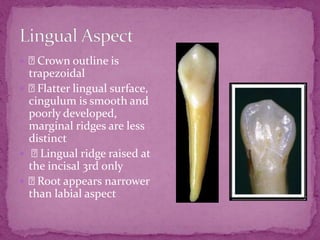
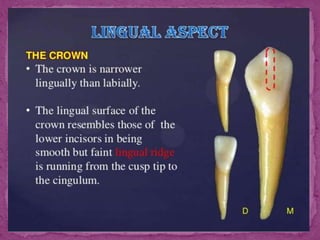
 Crown outline is
trapezoidal
 Flatter lingual surface,
cingulum is smooth and
poorly developed,
marginal ridges are less
distinct
 Lingual ridge raised at
the incisal 3rd only
 Root appears narrower
than labial aspect
 Crown outline is triangular
 Less pronounced cingulum
 Incisal portion is thinner
labiolingually, thus cusp appears
more pointed, cusp ridges more
slender
 Tip of cusp more nearly
centered over root
 Developmental depressions are
more pronounced and sometime
quite deep
 The labial outline: has less curvature
than that of upper canine with very
little crest of curvature directly above
the cervical line.•
 The lingual outline: is similar to that of
the upper canine, but differs in degree.
 The cingulum is not prominent.
 Same as mesial aspect, except:
 Less curvature of CEJ
 Less pronounced cingulum
 Less depressions on the root
surface
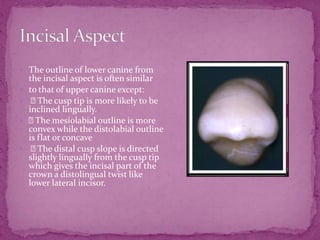
 The outline of lower canine from
the incisal aspect is often similar
 to that of upper canine except:
 The cusp tip is more likely to be
inclined lingually.
 The mesiolabial outline is more
convex while the distolabial outline
is flat or concave
 The distal cusp slope is directed
slightly lingually from the cusp tip
which gives the incisal part of the
crown a distolingual twist like
lower lateral incisor.
The root surface is
similar to that of the
upper canine from
the mesial aspect
except:
The root tip is
more pointed than
that of upper canine.
The developmental
depression mesially is
more pronounced
than that on upper
canine.
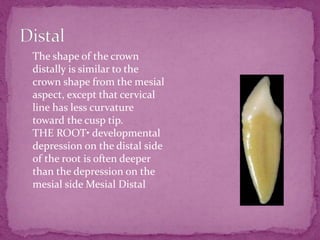
The shape of the crown
distally is similar to the
crown shape from the mesial
aspect, except that cervical
line has less curvature
toward the cusp tip.
THE ROOT• developmental
depression on the distal side
of the root is often deeper
than the depression on the
mesial side Mesial Distal
Permanent Mandibular Canine

Permanent Mandibular Canine

  • 1.
    Dr Monika Negi MDSOral Pathology Microbiology and Forensic Odontology
  • 2.
     Crown isnarrower than Maxillary canine  Variation: Bifurcated roots
  • 5.
     Crown outlineis trapezoidal  Mesiodistal dimensions less than maxillary  Crowns appears longer than maxillary, higher contact areas  Contact Areas:  Mesial – incisal 3rd, just below the incisal angle or near the angle  Distal – near junction of middle and incisal 3rd
  • 6.
     Mesial crownoutline nearly straight  Cusp angle is in line with the center of the root; mesial cusp ridge is shorter  Crown slightly bent distally  Root is shorter by 1 or 2 mm than maxillary, apex more sharply pointed
  • 8.
     Crown outlineis trapezoidal  Flatter lingual surface, cingulum is smooth and poorly developed, marginal ridges are less distinct  Lingual ridge raised at the incisal 3rd only  Root appears narrower than labial aspect
  • 11.
     Crown outlineis triangular  Less pronounced cingulum  Incisal portion is thinner labiolingually, thus cusp appears more pointed, cusp ridges more slender  Tip of cusp more nearly centered over root  Developmental depressions are more pronounced and sometime quite deep
  • 12.
     The labialoutline: has less curvature than that of upper canine with very little crest of curvature directly above the cervical line.•  The lingual outline: is similar to that of the upper canine, but differs in degree.  The cingulum is not prominent.
  • 15.
     Same asmesial aspect, except:  Less curvature of CEJ  Less pronounced cingulum  Less depressions on the root surface
  • 16.
     The outlineof lower canine from the incisal aspect is often similar  to that of upper canine except:  The cusp tip is more likely to be inclined lingually.  The mesiolabial outline is more convex while the distolabial outline is flat or concave  The distal cusp slope is directed slightly lingually from the cusp tip which gives the incisal part of the crown a distolingual twist like lower lateral incisor.
  • 18.
    The root surfaceis similar to that of the upper canine from the mesial aspect except: The root tip is more pointed than that of upper canine. The developmental depression mesially is more pronounced than that on upper canine.
  • 20.
    The shape ofthe crown distally is similar to the crown shape from the mesial aspect, except that cervical line has less curvature toward the cusp tip. THE ROOT• developmental depression on the distal side of the root is often deeper than the depression on the mesial side Mesial Distal