HERTWIG’S EPITHELIAL
ROOTH SHEATH
By SOFIA ALAM
DEFINITION
• HERS derives from the most apical extension of
the enamel organ and consists of two cell
layers, the inner and outer enamel epithelium.
BILAYERED
• Hertwig’s epithelial root sheath does not include
stratum intermedium or stellate reticulum.
WHY IS THERE NO ENAMEL
FORMATION IN HERS
 Absence of stellate reticulum.
 Cells of inner enamel epithelium remain short
columnar and do not convert into tall
columar(ameloblasts).
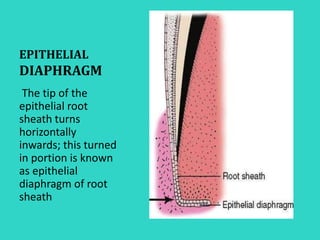
EPITHELIAL
DIAPHRAGM
The tip of the
epithelial root
sheath turns
horizontally
inwards; this turned
in portion is known
as epithelial
diaphragm of root
sheath
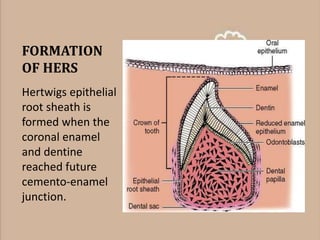
FORMATION
OF HERS
Hertwigs epithelial
root sheath is
formed when the
coronal enamel
and dentine
reached future
cemento-enamel
junction.
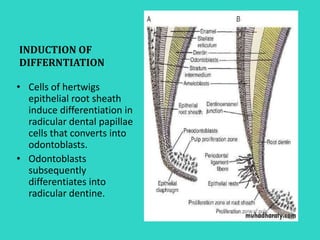
INDUCTION OF
DIFFERNTIATION
• Cells of hertwigs
epithelial root sheath
induce differentiation in
radicular dental papillae
cells that converts into
odontoblasts.
• Odontoblasts
subsequently
differentiates into
radicular dentine.
RESTS OF MALASSEZ
• After the first layer of
radicular dentine has been
laid down, the epithelial root
sheath loses its structural
continuity and its close
relation to the surface of root.
• Its remnants persists as an
epithelial network of strands
near the external surface of
root. The remnants are known
as Rests of Malassez.
• These epithelial remnants are
later found in periodontal
ligament of erupted tooth.
ENAMEL PEARLS
o Also known as droplets of
enamel.
o Fully functional cells that
have the ability to form
enamel.
o IF rest cells of malassez are
still attached with dentine,
then they become fully
functional enamel
producing cells called
enamel pearls.
 Determines the shape, size and number of
roots.
 Plays a main character in differentiation of
odontoblasts into radicular dentine.
FUNCTIONS OF HERTWIGS
EPITHELIAL ROOT SHEATH
 Essential for the differentiation of
dental follicle cells into periodontal
structures.
 Rests of malassez play a fundamental
role in root development, protect
against root resorption.
THANK YOU
HERTWIG’S EPITHELIAL ROOTH SHEATH

HERTWIG’S EPITHELIAL ROOTH SHEATH

  • 1.
  • 2.
    DEFINITION • HERS derivesfrom the most apical extension of the enamel organ and consists of two cell layers, the inner and outer enamel epithelium.
  • 3.
    BILAYERED • Hertwig’s epithelialroot sheath does not include stratum intermedium or stellate reticulum.
  • 4.
    WHY IS THERENO ENAMEL FORMATION IN HERS  Absence of stellate reticulum.  Cells of inner enamel epithelium remain short columnar and do not convert into tall columar(ameloblasts).
  • 5.
    EPITHELIAL DIAPHRAGM The tip ofthe epithelial root sheath turns horizontally inwards; this turned in portion is known as epithelial diaphragm of root sheath
  • 6.
    FORMATION OF HERS Hertwigs epithelial rootsheath is formed when the coronal enamel and dentine reached future cemento-enamel junction.
  • 7.
    INDUCTION OF DIFFERNTIATION • Cellsof hertwigs epithelial root sheath induce differentiation in radicular dental papillae cells that converts into odontoblasts. • Odontoblasts subsequently differentiates into radicular dentine.
  • 8.
    RESTS OF MALASSEZ •After the first layer of radicular dentine has been laid down, the epithelial root sheath loses its structural continuity and its close relation to the surface of root. • Its remnants persists as an epithelial network of strands near the external surface of root. The remnants are known as Rests of Malassez. • These epithelial remnants are later found in periodontal ligament of erupted tooth.
  • 9.
    ENAMEL PEARLS o Alsoknown as droplets of enamel. o Fully functional cells that have the ability to form enamel. o IF rest cells of malassez are still attached with dentine, then they become fully functional enamel producing cells called enamel pearls.
  • 10.
     Determines theshape, size and number of roots.  Plays a main character in differentiation of odontoblasts into radicular dentine. FUNCTIONS OF HERTWIGS EPITHELIAL ROOT SHEATH
  • 11.
     Essential forthe differentiation of dental follicle cells into periodontal structures.  Rests of malassez play a fundamental role in root development, protect against root resorption.
  • 12.