



Dr. Sonal Aggarwal
M.D.S. Oral Pathology & Microbiology
Dentinogenesis
• The dynamic process of formation of dentin
involves a chain of different mechanisms:
 Cell differentiation and interactions
 The synthesis of an organic matrix
 Mineralization of the matrix.
• It is a highly regulated and well-controlled process
that starts in the bell stage of tooth development.
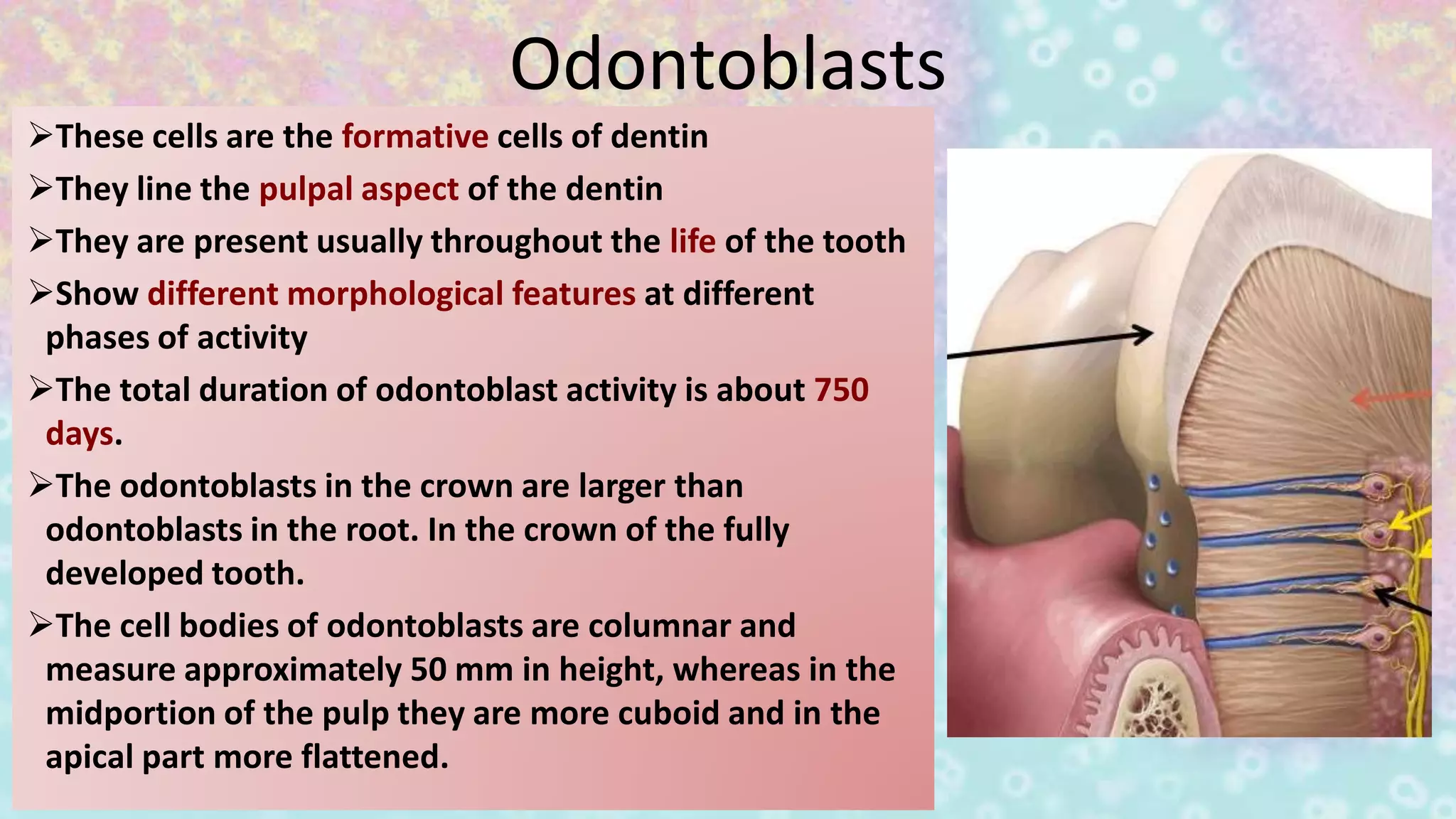
Odontoblasts
These cells are the formative cells of dentin
They line the pulpal aspect of the dentin
They are present usually throughout the life of the tooth
Show different morphological features at different
phases of activity
The total duration of odontoblast activity is about 750
days.
The odontoblasts in the crown are larger than
odontoblasts in the root. In the crown of the fully
developed tooth.
The cell bodies of odontoblasts are columnar and
measure approximately 50 mm in height, whereas in the
midportion of the pulp they are more cuboid and in the
apical part more flattened.
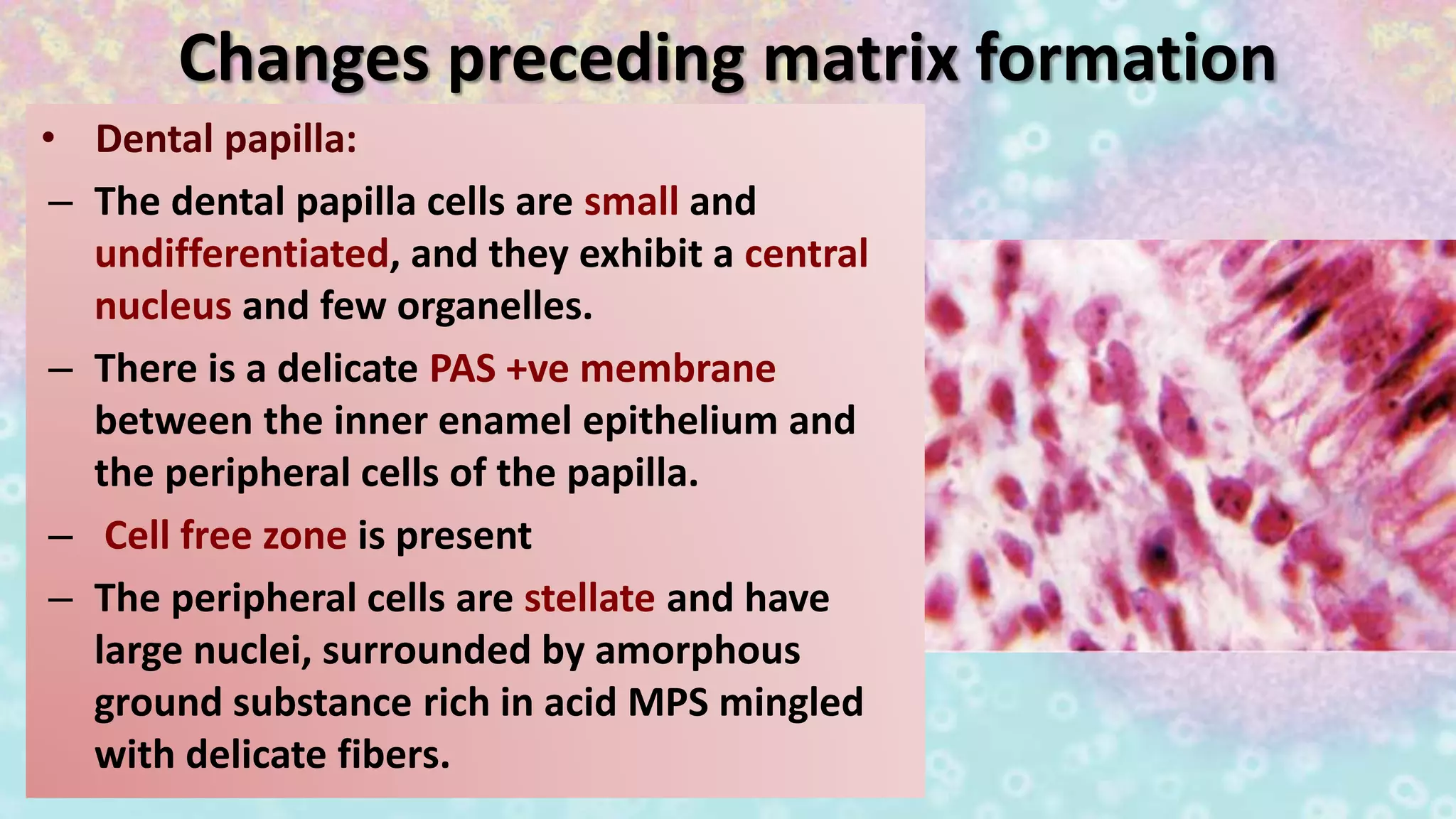
• Dental papilla:
– The dental papilla cells are small and
undifferentiated, and they exhibit a central
nucleus and few organelles.
– There is a delicate PAS +ve membrane
between the inner enamel epithelium and
the peripheral cells of the papilla.
– Cell free zone is present
– The peripheral cells are stellate and have
large nuclei, surrounded by amorphous
ground substance rich in acid MPS mingled
with delicate fibers.
Changes preceding matrix formation
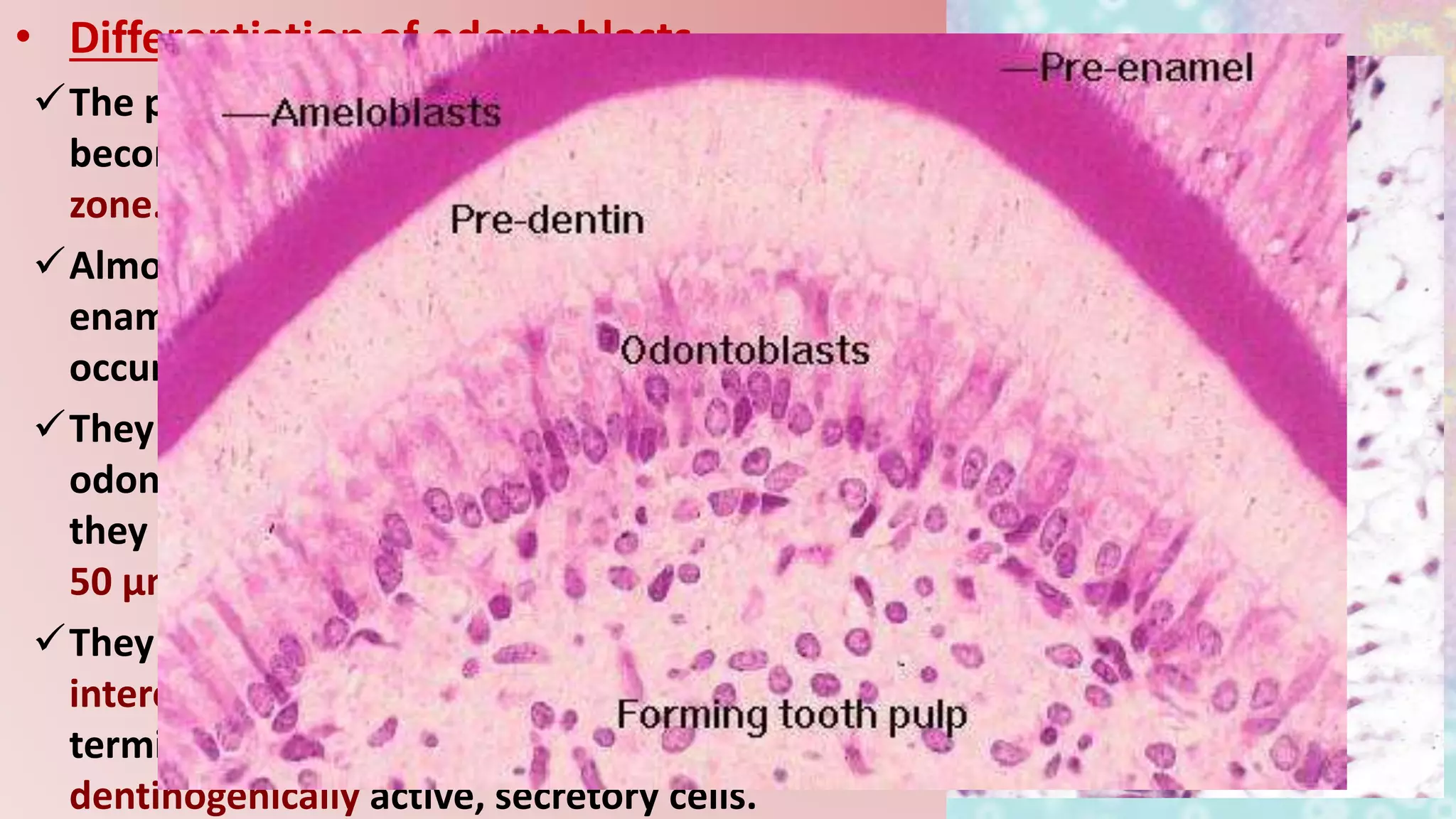
• Differentiation of odontoblasts
The peripheral cells get closely packed and
become low columnar, eliminate the cell free
zone.
Almost immediately after cells of the inner
enamel epithelium reverse polarity, changes also
occur in the adjacent dental papilla.
They are the pre-odontoblasts. When the pre-
odontoblasts withdraw from the mitotic cycle,
they become polarizing odontoblasts, measuring
50 μm in length
They establish a palisade- like structure forming
intercellular junctions. They finally acquire their
terminal polarization and become
dentinogenically active, secretory cells.
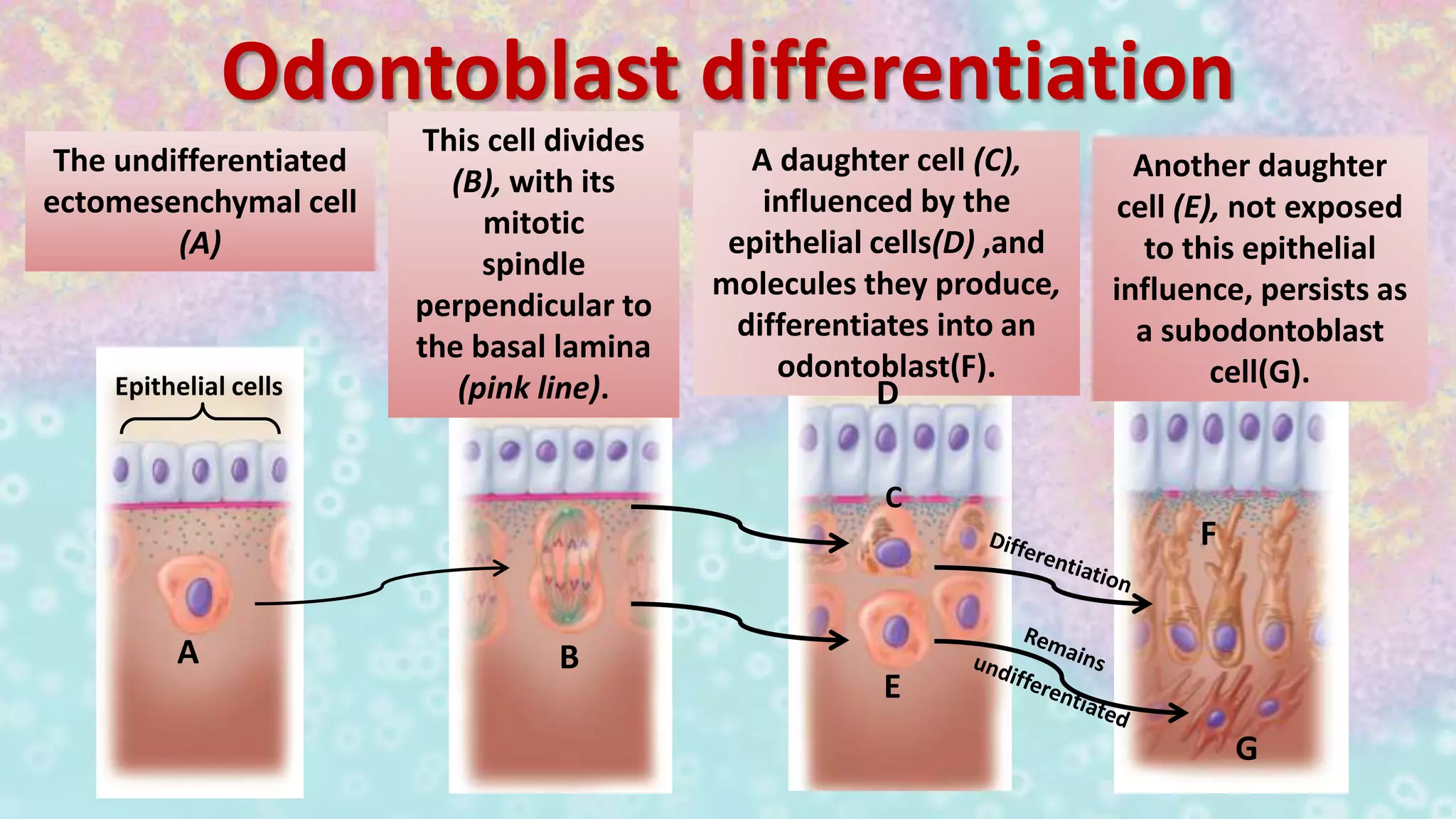
Epithelial cells
The undifferentiated
ectomesenchymal cell
(A)
This cell divides
(B), with its
mitotic
spindle
perpendicular to
the basal lamina
(pink line).
A daughter cell (C),
influenced by the
epithelial cells(D) ,and
molecules they produce,
differentiates into an
odontoblast(F).
Another daughter
cell (E), not exposed
to this epithelial
influence, persists as
a subodontoblast
cell(G).
A B
D
C
E
F
G
Odontoblast differentiation
• The terminal differentiation of odontoblasts, as well as ameloblasts,
seems to be dependent on specific cell membrane/cytoskeleton
interactions with BM constituents and other extracellular
components.
• The ectomesenchymal cells adjoining the acellular zone rapidly
enlarge and elongate to become preodontoblasts first and then
odontoblasts as their cytoplasm increases in volume to contain
increasing amounts of protein-synthesizing organelles.
• The acellular zone between the dental papilla and the inner enamel
epithelium gradually is eliminated as the odontoblasts differentiate
and increase in size and occupy this zone.
• These newly differentiated cells are characterized by being highly
polarized, with their nuclei positioned away from the inner enamel
epithelium.
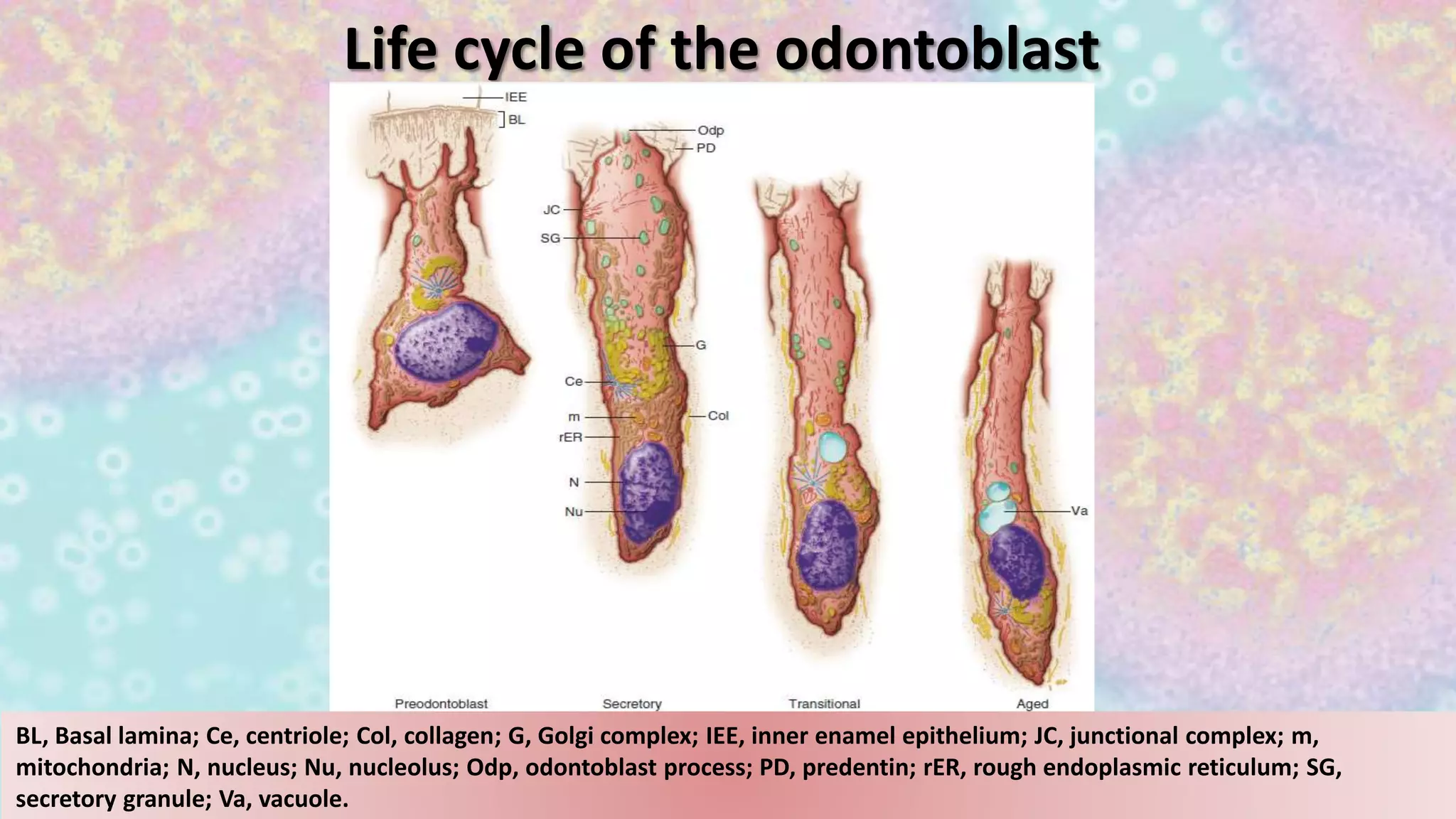
Life cycle of the odontoblast
BL, Basal lamina; Ce, centriole; Col, collagen; G, Golgi complex; IEE, inner enamel epithelium; JC, junctional complex; m,
mitochondria; N, nucleus; Nu, nucleolus; Odp, odontoblast process; PD, predentin; rER, rough endoplasmic reticulum; SG,
secretory granule; Va, vacuole.
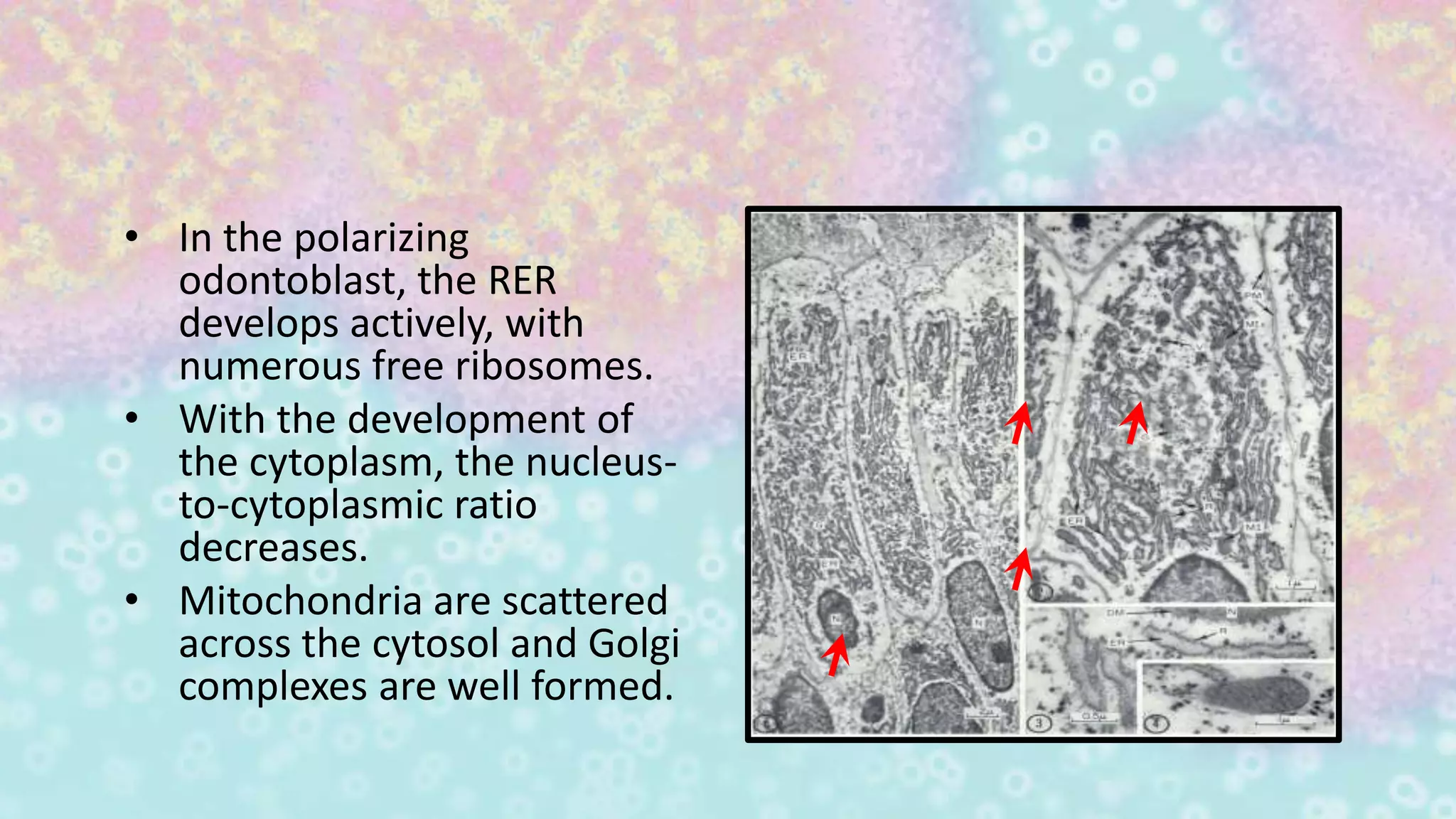
• In the polarizing
odontoblast, the RER
develops actively, with
numerous free ribosomes.
• With the development of
the cytoplasm, the nucleus-
to-cytoplasmic ratio
decreases.
• Mitochondria are scattered
across the cytosol and Golgi
complexes are well formed.
• In the junction between the odontoblast cell
body and the process, there exist junctional
complexes.
• Mostly adherent complexes and some tight
junctions.
• Permeability of this region is variable.
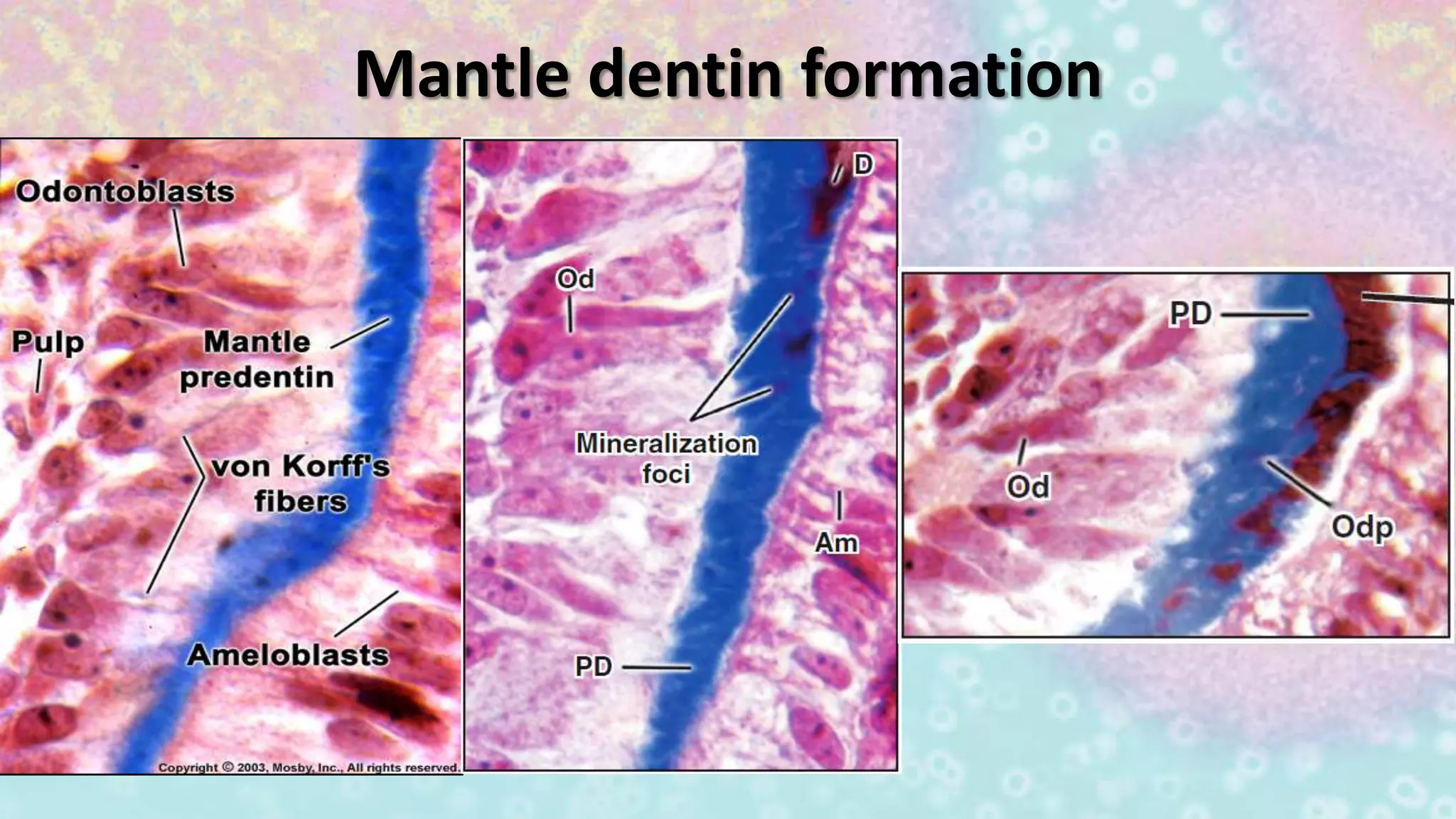
• Mantle dentin
– The young odontoblasts secrete collagen and
non-collagenous proteins
– This constitutes the predentin. After 10-20 μm of
thickness is laid, mineralization starts.
– The initial crystal formation takes place inside 100-200
nm membrane-bound matrix vesicles.
Initial Dentin Formation
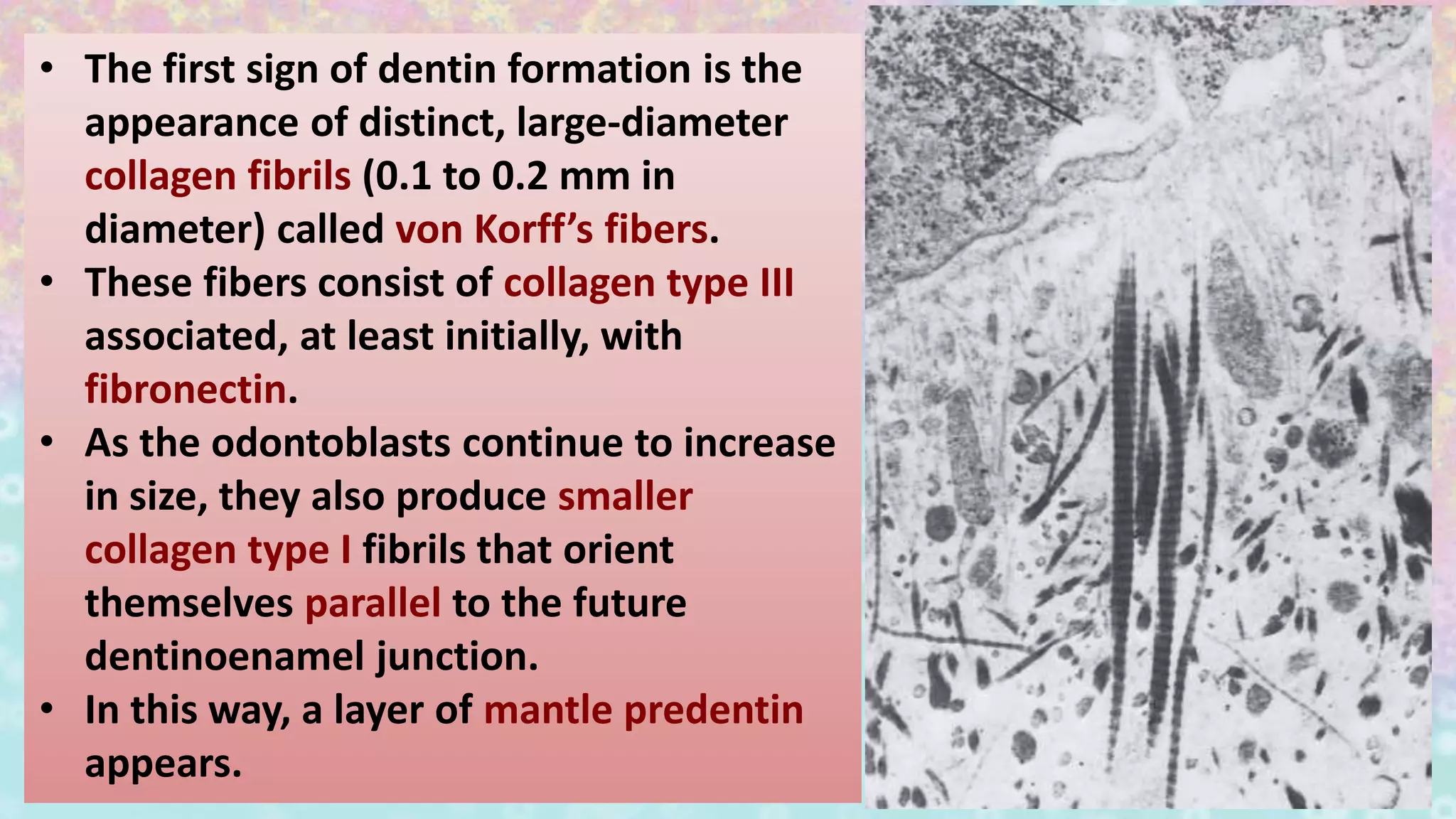
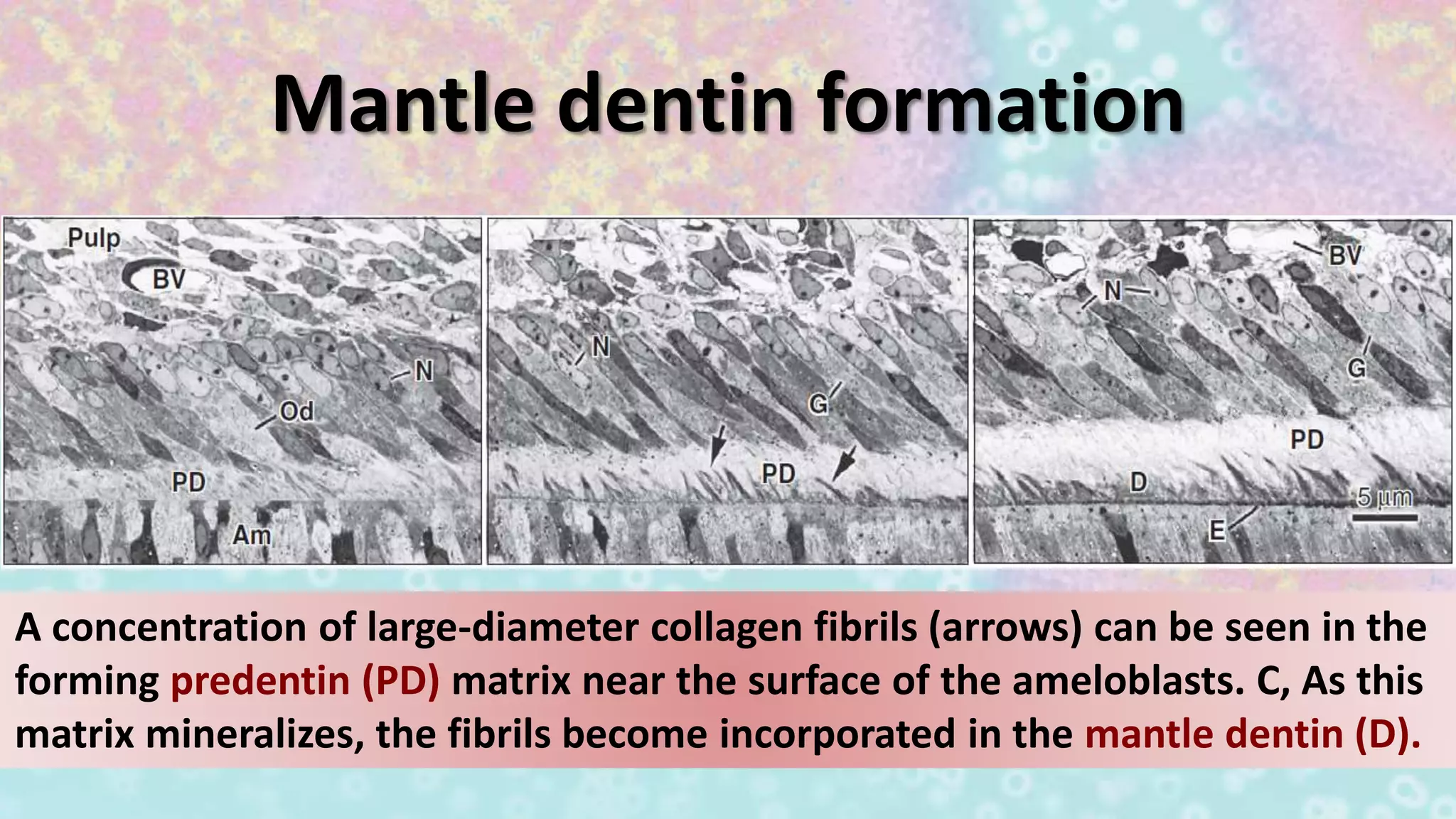
• The first sign of dentin formation is the
appearance of distinct, large-diameter
collagen fibrils (0.1 to 0.2 mm in
diameter) called von Korff’s fibers.
• These fibers consist of collagen type III
associated, at least initially, with
fibronectin.
• As the odontoblasts continue to increase
in size, they also produce smaller
collagen type I fibrils that orient
themselves parallel to the future
dentinoenamel junction.
• In this way, a layer of mantle predentin
appears.
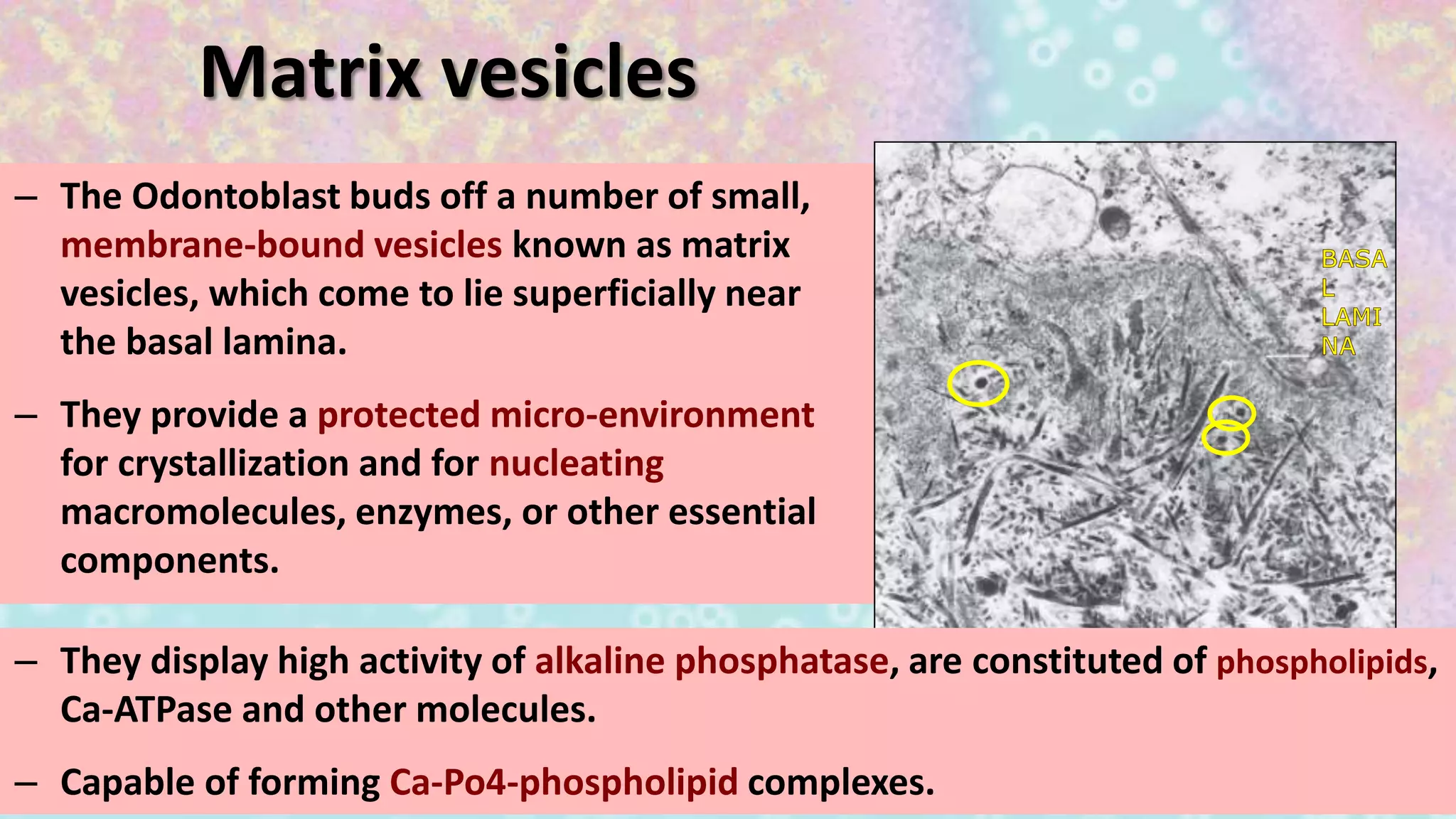
Matrix vesicles
– The Odontoblast buds off a number of small,
membrane-bound vesicles known as matrix
vesicles, which come to lie superficially near
the basal lamina.
– They provide a protected micro-environment
for crystallization and for nucleating
macromolecules, enzymes, or other essential
components.
– They display high activity of alkaline phosphatase, are constituted of phospholipids,
Ca-ATPase and other molecules.
– Capable of forming Ca-Po4-phospholipid complexes.
Mantle dentin formation
A concentration of large-diameter collagen fibrils (arrows) can be seen in the
forming predentin (PD) matrix near the surface of the ameloblasts. C, As this
matrix mineralizes, the fibrils become incorporated in the mantle dentin (D).
Mantle dentin formation
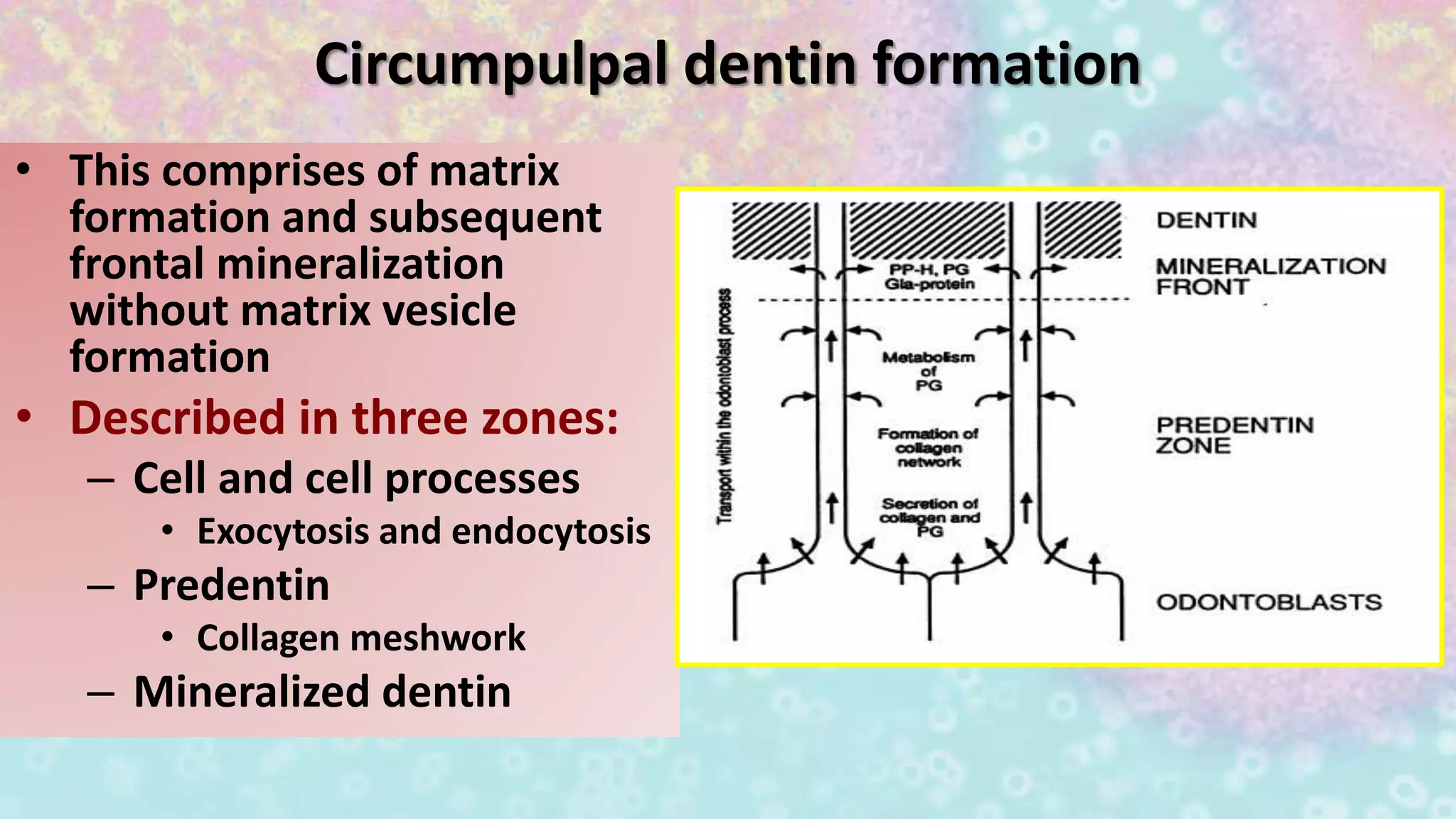
Circumpulpal dentin formation
• This comprises of matrix
formation and subsequent
frontal mineralization
without matrix vesicle
formation
• Described in three zones:
– Cell and cell processes
• Exocytosis and endocytosis
– Predentin
• Collagen meshwork
– Mineralized dentin
Mineralization
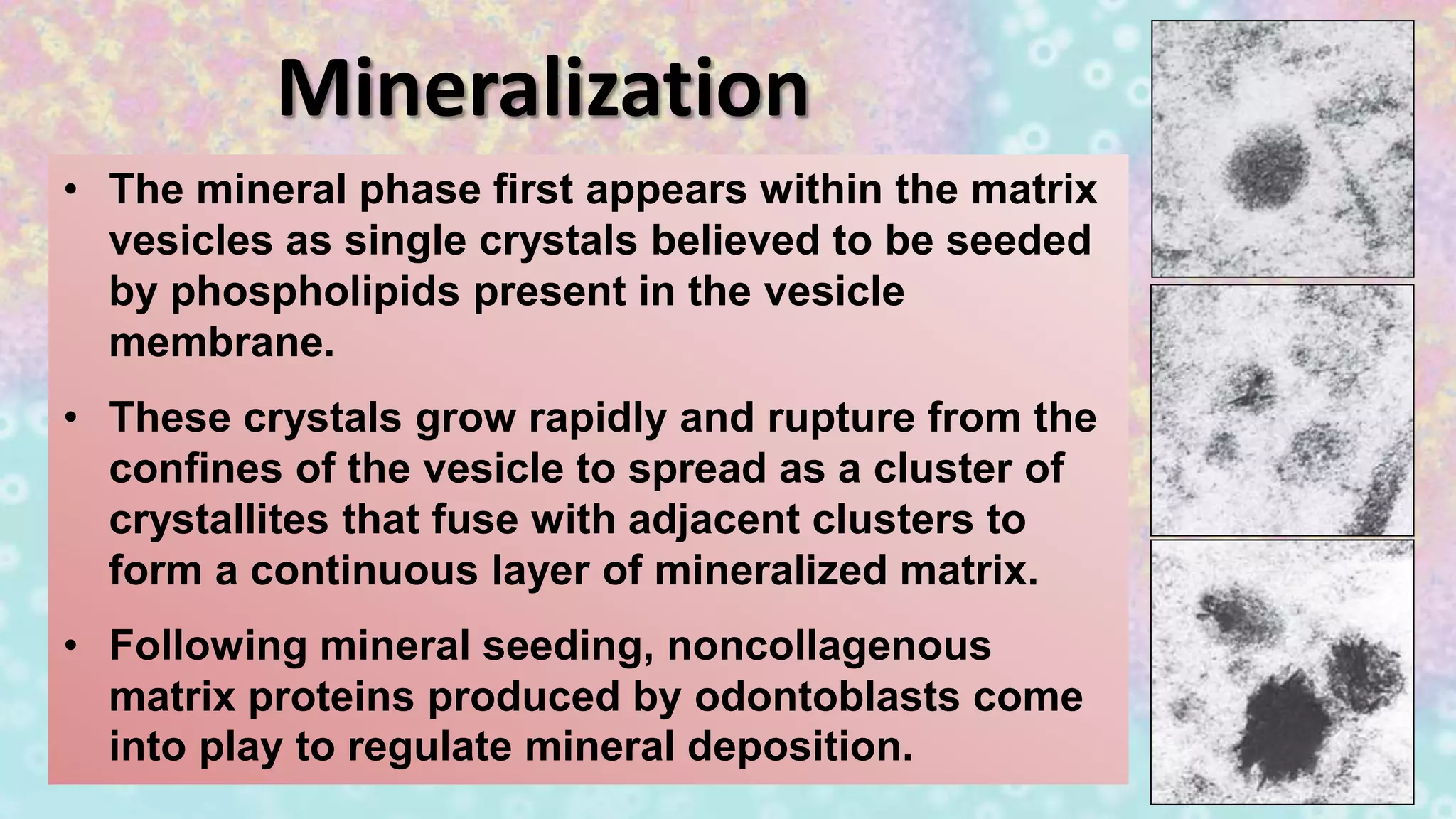
• The mineral phase first appears within the matrix
vesicles as single crystals believed to be seeded
by phospholipids present in the vesicle
membrane.
• These crystals grow rapidly and rupture from the
confines of the vesicle to spread as a cluster of
crystallites that fuse with adjacent clusters to
form a continuous layer of mineralized matrix.
• Following mineral seeding, noncollagenous
matrix proteins produced by odontoblasts come
into play to regulate mineral deposition.
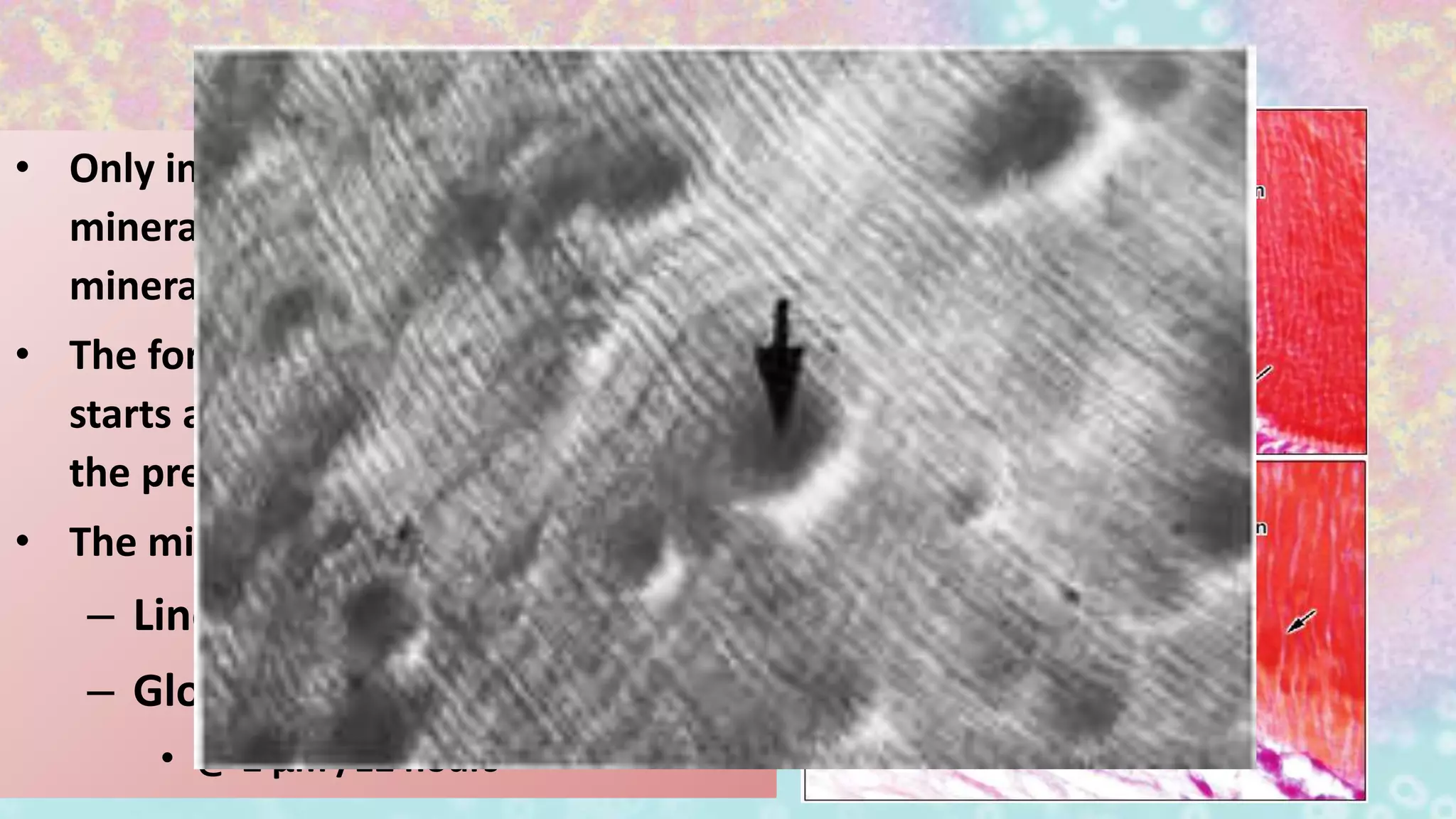
• Only intertubular dentin is
mineralized close to the
mineralization front.
• The formation of intratubular dentin
starts at some distance away from
the predentin/dentin junction.
• The mineralization is of two types:
– Linear
– Globular
• @ 2 μm /12 hours
• The type of mineralization depends on the rate of
formation.
• Largest globules appear in the fastest deposition regions
• Slower deposition leads to uniform linear mineralization
• The process can occur either due to matrix vesicles or by
heterogenous nucleation
• The crystal size is 3 nm X 100 nm, three hundred times
smaller than enamel crystals
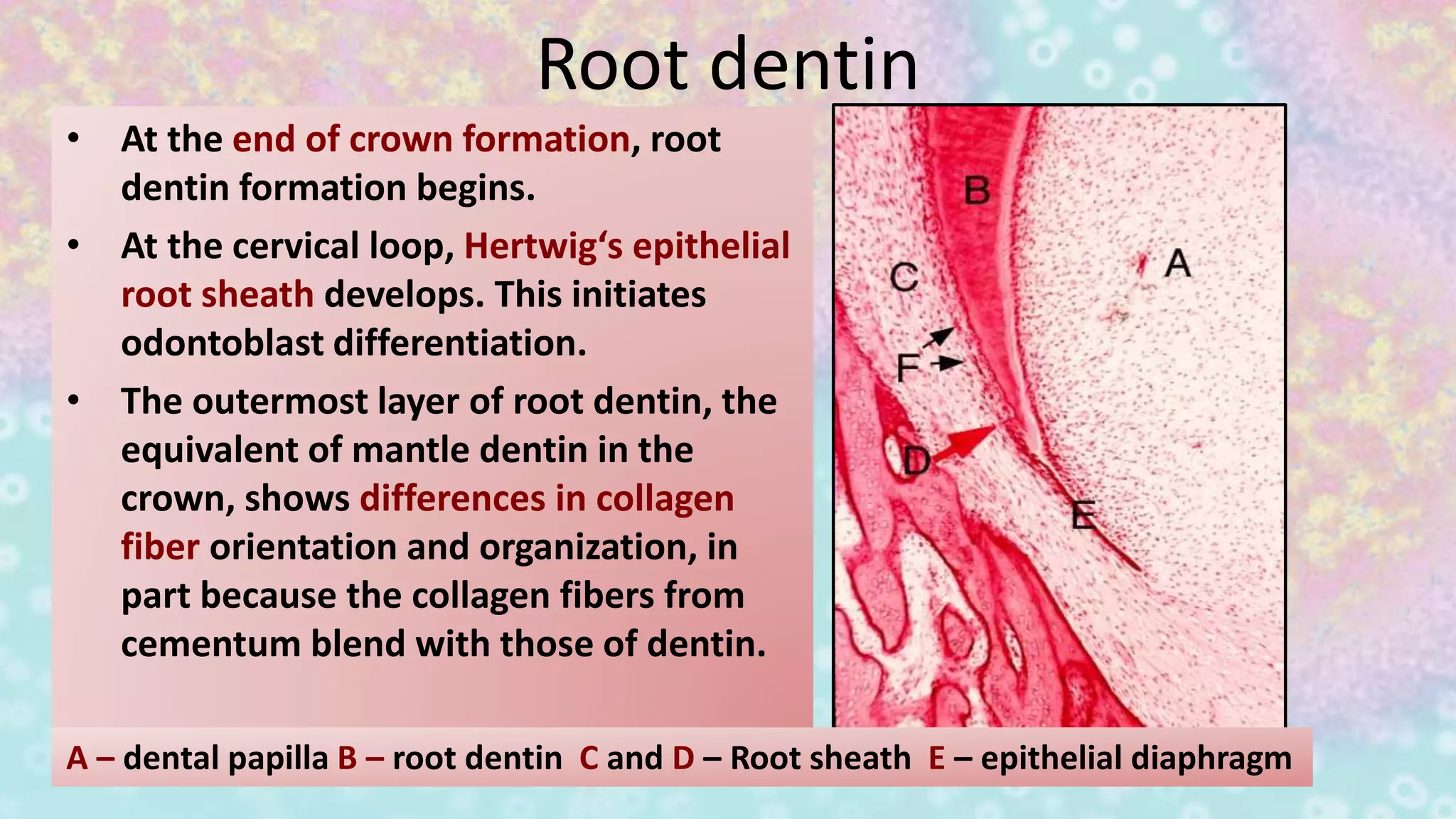
Root dentin
• At the end of crown formation, root
dentin formation begins.
• At the cervical loop, Hertwig‘s epithelial
root sheath develops. This initiates
odontoblast differentiation.
• The outermost layer of root dentin, the
equivalent of mantle dentin in the
crown, shows differences in collagen
fiber orientation and organization, in
part because the collagen fibers from
cementum blend with those of dentin.
A – dental papilla B – root dentin C and D – Root sheath E – epithelial diaphragm
Dentinogenesis _ Lecture

Dentinogenesis _ Lecture

  • 1.
    Dr. Sonal Aggarwal M.D.S.Oral Pathology & Microbiology Dentinogenesis
  • 2.
    • The dynamicprocess of formation of dentin involves a chain of different mechanisms:  Cell differentiation and interactions  The synthesis of an organic matrix  Mineralization of the matrix. • It is a highly regulated and well-controlled process that starts in the bell stage of tooth development.
  • 3.
    Odontoblasts These cells arethe formative cells of dentin They line the pulpal aspect of the dentin They are present usually throughout the life of the tooth Show different morphological features at different phases of activity The total duration of odontoblast activity is about 750 days. The odontoblasts in the crown are larger than odontoblasts in the root. In the crown of the fully developed tooth. The cell bodies of odontoblasts are columnar and measure approximately 50 mm in height, whereas in the midportion of the pulp they are more cuboid and in the apical part more flattened.
  • 4.
    • Dental papilla: –The dental papilla cells are small and undifferentiated, and they exhibit a central nucleus and few organelles. – There is a delicate PAS +ve membrane between the inner enamel epithelium and the peripheral cells of the papilla. – Cell free zone is present – The peripheral cells are stellate and have large nuclei, surrounded by amorphous ground substance rich in acid MPS mingled with delicate fibers. Changes preceding matrix formation
  • 5.
    • Differentiation ofodontoblasts The peripheral cells get closely packed and become low columnar, eliminate the cell free zone. Almost immediately after cells of the inner enamel epithelium reverse polarity, changes also occur in the adjacent dental papilla. They are the pre-odontoblasts. When the pre- odontoblasts withdraw from the mitotic cycle, they become polarizing odontoblasts, measuring 50 μm in length They establish a palisade- like structure forming intercellular junctions. They finally acquire their terminal polarization and become dentinogenically active, secretory cells.
  • 6.
    Epithelial cells The undifferentiated ectomesenchymalcell (A) This cell divides (B), with its mitotic spindle perpendicular to the basal lamina (pink line). A daughter cell (C), influenced by the epithelial cells(D) ,and molecules they produce, differentiates into an odontoblast(F). Another daughter cell (E), not exposed to this epithelial influence, persists as a subodontoblast cell(G). A B D C E F G Odontoblast differentiation
  • 7.
    • The terminaldifferentiation of odontoblasts, as well as ameloblasts, seems to be dependent on specific cell membrane/cytoskeleton interactions with BM constituents and other extracellular components. • The ectomesenchymal cells adjoining the acellular zone rapidly enlarge and elongate to become preodontoblasts first and then odontoblasts as their cytoplasm increases in volume to contain increasing amounts of protein-synthesizing organelles. • The acellular zone between the dental papilla and the inner enamel epithelium gradually is eliminated as the odontoblasts differentiate and increase in size and occupy this zone. • These newly differentiated cells are characterized by being highly polarized, with their nuclei positioned away from the inner enamel epithelium.
  • 8.
    Life cycle ofthe odontoblast BL, Basal lamina; Ce, centriole; Col, collagen; G, Golgi complex; IEE, inner enamel epithelium; JC, junctional complex; m, mitochondria; N, nucleus; Nu, nucleolus; Odp, odontoblast process; PD, predentin; rER, rough endoplasmic reticulum; SG, secretory granule; Va, vacuole.
  • 9.
    • In thepolarizing odontoblast, the RER develops actively, with numerous free ribosomes. • With the development of the cytoplasm, the nucleus- to-cytoplasmic ratio decreases. • Mitochondria are scattered across the cytosol and Golgi complexes are well formed.
  • 10.
    • In thejunction between the odontoblast cell body and the process, there exist junctional complexes. • Mostly adherent complexes and some tight junctions. • Permeability of this region is variable.
  • 13.
    • Mantle dentin –The young odontoblasts secrete collagen and non-collagenous proteins – This constitutes the predentin. After 10-20 μm of thickness is laid, mineralization starts. – The initial crystal formation takes place inside 100-200 nm membrane-bound matrix vesicles. Initial Dentin Formation
  • 14.
    • The firstsign of dentin formation is the appearance of distinct, large-diameter collagen fibrils (0.1 to 0.2 mm in diameter) called von Korff’s fibers. • These fibers consist of collagen type III associated, at least initially, with fibronectin. • As the odontoblasts continue to increase in size, they also produce smaller collagen type I fibrils that orient themselves parallel to the future dentinoenamel junction. • In this way, a layer of mantle predentin appears.
  • 15.
    Matrix vesicles – TheOdontoblast buds off a number of small, membrane-bound vesicles known as matrix vesicles, which come to lie superficially near the basal lamina. – They provide a protected micro-environment for crystallization and for nucleating macromolecules, enzymes, or other essential components. – They display high activity of alkaline phosphatase, are constituted of phospholipids, Ca-ATPase and other molecules. – Capable of forming Ca-Po4-phospholipid complexes.
  • 16.
    Mantle dentin formation Aconcentration of large-diameter collagen fibrils (arrows) can be seen in the forming predentin (PD) matrix near the surface of the ameloblasts. C, As this matrix mineralizes, the fibrils become incorporated in the mantle dentin (D).
  • 17.
  • 18.
    Circumpulpal dentin formation •This comprises of matrix formation and subsequent frontal mineralization without matrix vesicle formation • Described in three zones: – Cell and cell processes • Exocytosis and endocytosis – Predentin • Collagen meshwork – Mineralized dentin
  • 19.
    Mineralization • The mineralphase first appears within the matrix vesicles as single crystals believed to be seeded by phospholipids present in the vesicle membrane. • These crystals grow rapidly and rupture from the confines of the vesicle to spread as a cluster of crystallites that fuse with adjacent clusters to form a continuous layer of mineralized matrix. • Following mineral seeding, noncollagenous matrix proteins produced by odontoblasts come into play to regulate mineral deposition.
  • 20.
    • Only intertubulardentin is mineralized close to the mineralization front. • The formation of intratubular dentin starts at some distance away from the predentin/dentin junction. • The mineralization is of two types: – Linear – Globular • @ 2 μm /12 hours
  • 21.
    • The typeof mineralization depends on the rate of formation. • Largest globules appear in the fastest deposition regions • Slower deposition leads to uniform linear mineralization • The process can occur either due to matrix vesicles or by heterogenous nucleation • The crystal size is 3 nm X 100 nm, three hundred times smaller than enamel crystals
  • 22.
    Root dentin • Atthe end of crown formation, root dentin formation begins. • At the cervical loop, Hertwig‘s epithelial root sheath develops. This initiates odontoblast differentiation. • The outermost layer of root dentin, the equivalent of mantle dentin in the crown, shows differences in collagen fiber orientation and organization, in part because the collagen fibers from cementum blend with those of dentin. A – dental papilla B – root dentin C and D – Root sheath E – epithelial diaphragm