DR MONIKA NEGI
MDS
ORAL PATHOLOGY, MICROBIOLOGY &
FORENSIC ODONTOLOGY
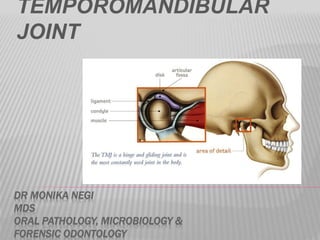
TEMPOROMANDIBULAR
JOINT
INTRODUCTION
 The TMJ is a complex and precisely integrated bilateral
joint structure .
 Formed by the articulation of lower jaw with cranium
and the upper facial skeleton .
 BONES TAKING PART ARE –MANDIBULAR
+TEMPORAL BONES = TEMPOROMANDIBULAR
JOINT .
 The head of the condyle of the mandible articulates with
the articular fossa and articular eminence of the
temporal bone .
 It functions in speech ,mastication and deglutition .
 The downward and forward sliding action of the
condylar heads can be felt opening and closing the
mouth and during symmetric protrusion and retrusion
and asymmetric lateral shift .
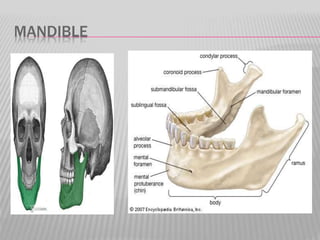
MANDIBLE
TEMPOROMANDIBULAR JOINT (TMJ ) ANATOMY
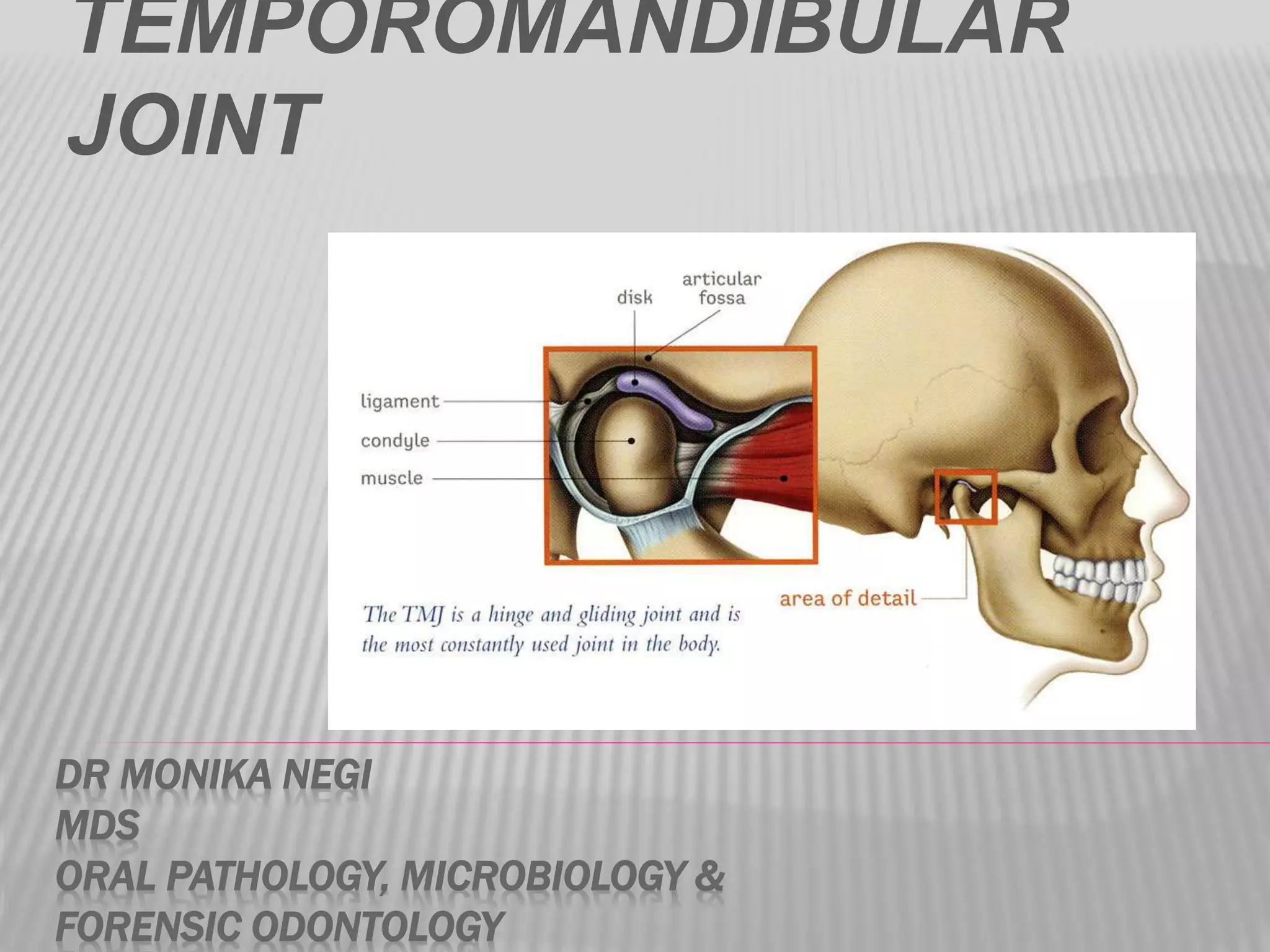
 The TMJ is a synovial bilateral joint that permits
the mandible to move as a unit with 2 functional
patterns (gliding and hinge movements)
 The TMJ is a ginglymoarthrodial joint, a term
that is derived from ginglymus, meaning a
hinge joint, allowing motion only backward and
forward in one plane, and arthrodia, meaning a
joint of which permits a gliding motion of the
surfaces..
 The common features of the synovial joints
exhibited by this joint include a disk, bone,
fibrous capsule, fluid, synovial membrane,
and ligaments.
However the features that differentiate and
make this joint unique are its articular surface
covered by fibrocartilage instead of hyaline
cartilage.
PECULIARITY OF TMJ
 1. Bilateral diarthrosis– right & left function
together
 2. Articular surface covered by fibrocartilage
instead of hyaline cartilage
 3. Only joint in human body to have a rigid
end point of closure that of the teeth making
occlusal contact.
COMPONENTS
 (Bone/Hard components )
 Mandibular condyle
 Glenoid fossa of the temporal bone
 Articular eminence
 (Soft tissue components )
 Capsule
 Articular disc
 Ligaments
 Muscular component
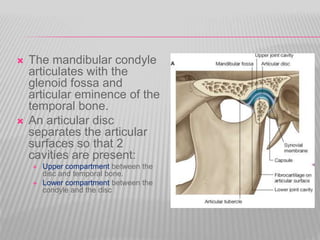
 The mandibular condyle
articulates with the
glenoid fossa and
articular eminence of the
temporal bone.
 An articular disc
separates the articular
surfaces so that 2
cavities are present:
 Upper compartment between the
disc and temporal bone.
 Lower compartment between the
condyle and the disc
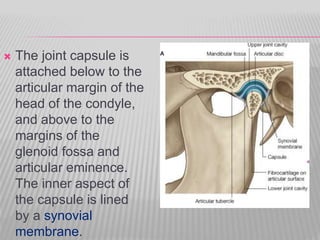
 The joint capsule is
attached below to the
articular margin of the
head of the condyle,
and above to the
margins of the
glenoid fossa and
articular eminence.
The inner aspect of
the capsule is lined
by a synovial
membrane.
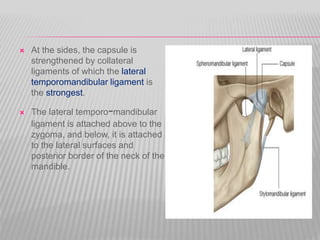
 At the sides, the capsule is
strengthened by collateral
ligaments of which the lateral
temporomandibular ligament is
the strongest.
 The lateral temporo-mandibular
ligament is attached above to the
zygoma, and below, it is attached
to the lateral surfaces and
posterior border of the neck of the
mandible.
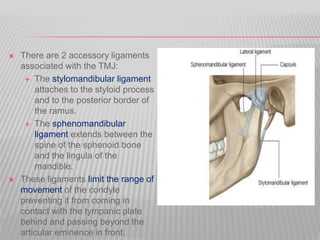
 There are 2 accessory ligaments
associated with the TMJ:
 The stylomandibular ligament
attaches to the styloid process
and to the posterior border of
the ramus.
 The sphenomandibular
ligament extends between the
spine of the sphenoid bone
and the lingula of the
mandible.
 These ligaments limit the range of
movement of the condyle
preventing it from coming in
contact with the tympanic plate
behind and passing beyond the
articular eminence in front.
THE MANDIBULAR CONDYLE
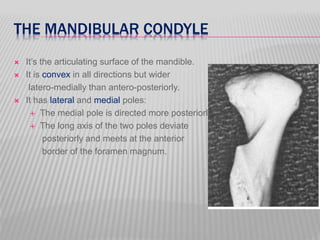
 It’s the articulating surface of the mandible.
 It is convex in all directions but wider
latero-medially than antero-posteriorly.
 It has lateral and medial poles:
 The medial pole is directed more posteriorly.
 The long axis of the two poles deviate
posteriorly and meets at the anterior
border of the foramen magnum.
HISTOLOGY
 Composed of cancellous bone covered by a
thin layer of compact bone.
 Trabeculae: of the cancellous bone is arranged
in a radiating manner from the neck to reach
the surface of the condyle at a right angle (to
give maximum strength.)
 Bone marrow is of myeloid or cellular type and
becomes fatty with age.
 Outer layer of compact bone is covered by thick layers of fibrous tissues
composed of:
 Superficial layer : network of strong collagen fibers, chondrocytes
and fibroblasts.
 Deep layer: thin collagen fibers rich in chondroid cells during growth
period (hyaline cartilage).
 Growth occur by apposition from the deepest layer – the deepest
surface of the cartilaginous plate is replaced by bone.
 Growth continues till 21 years of age.
 Remnants of cartilage may persist in old age.
MANDIBULAR (GLENOID) FOSSA AND
ARTICULAR EMINENCE
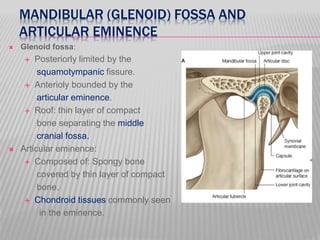
 Glenoid fossa:
 Posteriorly limited by the
squamotympanic fissure.
 Anterioly bounded by the
articular eminence.
 Roof: thin layer of compact
bone separating the middle
cranial fossa.
 Articular eminence:
 Composed of: Spongy bone
covered by thin layer of compact
bone.
 Chondroid tissues commonly seen
in the eminence.
 Fibrous layer covering the articulating surface of
temporal bone.
 Thin on the articular fossa and thickens on
the posterior slope of the eminence
 Over the eminence the fibrous tissues are
arranged in 3 zones:
 Inner zone – fibers arranged at right angle
to surface
 Outer zone – fibers run parallel to the
bone surface
 Intermediate zone – transitional zone.
Fibers are interlaced.
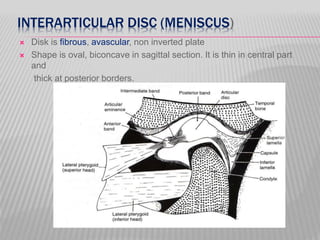
INTERARTICULAR DISC (MENISCUS)
 Disk is fibrous, avascular, non inverted plate
 Shape is oval, biconcave in sagittal section. It is thin in central part
and
thick at posterior borders.
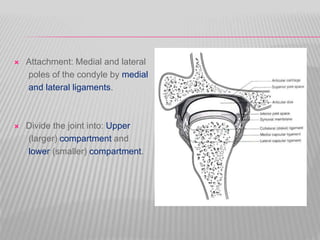
 Attachment: Medial and lateral
poles of the condyle by medial
and lateral ligaments.
 Divide the joint into: Upper
(larger) compartment and
lower (smaller) compartment.
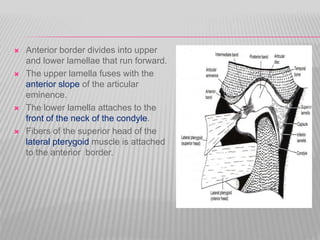
 Anterior border divides into upper
and lower lamellae that run forward.
 The upper lamella fuses with the
anterior slope of the articular
eminence.
 The lower lamella attaches to the
front of the neck of the condyle.
 Fibers of the superior head of the
lateral pterygoid muscle is attached
to the anterior border.
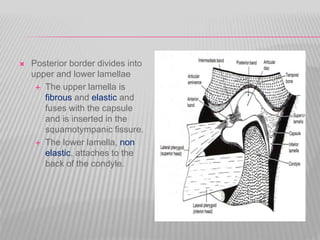
 Posterior border divides into
upper and lower lamellae
 The upper lamella is
fibrous and elastic and
fuses with the capsule
and is inserted in the
squamotympanic fissure.
 The lower lamella, non
elastic, attaches to the
back of the condyle.
HISTOLOGY
Composed of dense fibrous tissue containing:
 Straight and tightly packed collagenous fibers
 Few elastic fibers.
 Some chondroid cells appear with age.
 Chondrocytes may be seen.
 The space between upper and lower posterior is filled with highly
vascular loose connective tissue.
ARTICULATING CAPSULE AND LIGAMENTS AND
SYNOVIAL MEMBRANE
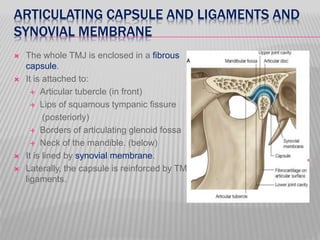
 The whole TMJ is enclosed in a fibrous
capsule.
 It is attached to:
 Articular tubercle (in front)
 Lips of squamous tympanic fissure
(posteriorly)
 Borders of articulating glenoid fossa
 Neck of the mandible. (below)
 It is lined by synovial membrane.
 Laterally, the capsule is reinforced by TMJ
ligaments.
HISTOLOGY
Consists of 2 layers:
 Outer fibrous capsule – strengthen laterally to form the
temporomandibular ligament.
 Inner synovial layer – composed of thin connective tissue layer lined
with:
 Synovial cells
 Type A : secretes hyaluronic acid
 Type B : produces protein rich secretion.
 Synovial folds and villi protrude from the surface into the joint
cavity.
 Synovial layer of cells line the entire capsule of both upper and
lower joint spaces.
 Synovial membrane is very rich in blood supply and contains
lymphatic vessels.
SYNOVIAL FLUID
 It is clear, straw-colored viscous fluid.
 It diffuses out from the rich cappillary network
of the synovial membrane.
Contains:
 Hyaluronic acid which is highly viscous
 May also contain some free cells mostly
macrophages.
Functions:
 Lubricant for articulating surfaces.
 Carry nutrients to the avascular tissue of the
joint.
 Clear the tissue debris caused by normal
wear and tear of the articulating surfaces.
BLOOD SUPPLY
 4 arteries supply the joint:
 Superficial temporal
 Deep auricular
 Anterior tympanic
 Ascending pharyngeal
 Branches from the 4 approach the joint and penetrate the capsule.
NERVE SUPPLY
 Branches from the mandibular nerve
 Auriculotemporal nerve
 Masseteric nerve
 Deep temporal nerves
 Supply all surfaces of the head, fossa, capsule and part of the disk.
DEVELOPMENT OF TMJ
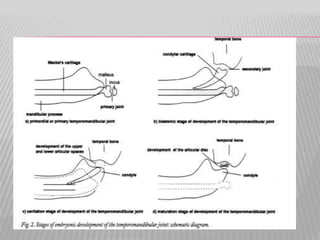
 Ontogenetically & Phylogenitically TMJ is a secondary joint. i.e
it is developed from primary reptilian type .in reptilian type ,the
TMJ is formed at dorsal end of meckel’s cartilage ,which in
humans appear as joint between malleus and incus bones of
the middle year showing adaptation of bones of primitive jaw to
sound conduction.
 Meckel’s cartilage forms and provide skeletal support for
developing lower jaw .
 Cartilage extends backward and dorsally and terminates as
malleus
 7th week - Articulation between malleus and incus at the
dorsal end of Meckel’s cartilage – PRIMARY JOINT .
 • 8th week- Membranous Bone laid down in a plate like form
lateral to Meckels cartilage.
 • 10 week (IU) -from 2 widely separated centers that grow
toward each other evidence of future joint as mesenchyme
between the condylar cartilage & developing temporal bone.
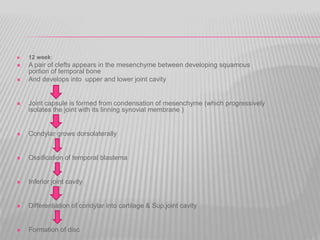
 12 week:
 A pair of clefts appears in the mesenchyme between developing squamous
portion of temporal bone
 And develops into upper and lower joint cavity
 Joint capsule is formed from condensation of mesenchyme (which progressively
isolates the joint with its linning synovial membrane )
 Condylar grows dorsolaterally
 Ossification of temporal blastema
 Inferior joint cavity
 Differentiation of condylar into cartilage & Sup.joint cavity
 Formation of disc
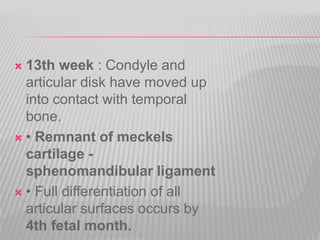
 13th week : Condyle and
articular disk have moved up
into contact with temporal
bone.
 • Remnant of meckels
cartilage -
sphenomandibular ligament
 • Full differentiation of all
articular surfaces occurs by
4th fetal month.
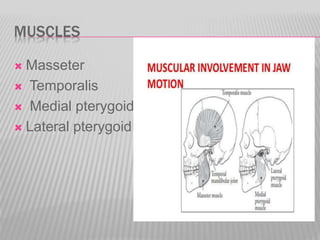
MUSCLES
 Masseter
 Temporalis
 Medial pterygoid
 Lateral pterygoid
Elevation of Mandible
 Temporalis
 Masseter
 Medial Pterygoids
Depression Of Mandible
 Lateral pterygoid
 Digastric
 Geniohyoid
Protrusion of Mandible
 Lateral Pterygoids
 Medial Pterygoids
Retraction of Mandible
 Posterior fibres of Temporalis
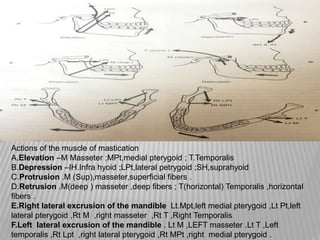
Actions of the muscle of mastication
A.Elevation –M Masseter ;MPt,medial pterygoid ; T.Temporalis
B.Depression –IH.Infra hyoid ;LPt,lateral petrygoid ;SH,suprahyoid
C.Protrusion .M (Sup),masseter,superficial fibers .
D.Retrusion .M(deep ) masseter ,deep fibers ; T(horizontal) Temporalis ,horizontal
fibers .
E.Right lateral excrusion of the mandible Lt.Mpt,left medial pterygoid ,Lt Pt,left
lateral pterygoid ,Rt M ,right masseter ,Rt T ,Right Temporalis
F.Left lateral excrusion of the mandible . Lt M ,LEFT masseter .Lt T ,Left
temporalis ,Rt Lpt ,right lateral pterygoid ,Rt MPt ,right medial pterygoid .
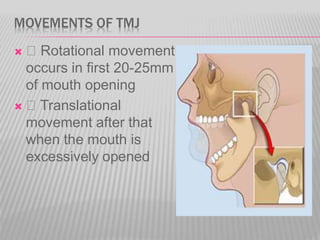
MOVEMENTS OF TMJ
 Rotational movement
occurs in first 20-25mm
of mouth opening
 Translational
movement after that
when the mouth is
excessively opened
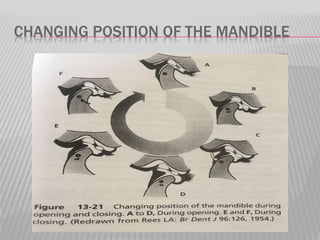
CHANGING POSITION OF THE MANDIBLE
AGE CHANGES
 Condyle:
 Becomes more flattened
 Fibrous capsule becomes thicker.
 Osteoporosis of underlying bone.
 Thinning or absence of cartilaginous zone.
 Disk:
 Becomes thinner.
 Shows hyalinization and chondroid changes.
 Synovial fold:
 Become fibrotic with thick basement membrane.
 Blood vessels and nerves:
 Walls of blood vessels thickened.
 Nerves decrease in number
CHANGES COULD LEAD TO:
 Dysfunction in old age
 Impairment of motion due to decrease in the extensibility of the disk and
the capsule.
 Decrease in the secretion of the synovial fluid.
 The term myofacial pain dysfucntion syndrome (MPDS) is used to
indicate a dysfunction of TMJ
 Characterized by
 Masticatory muscle tenderness (mostly lateral pterygoid ,temporalis
,medial pterygoid and masseter .)
 Limited opening of the mandible <37 mm .
 Joint sounds .
 Dislocation of the TMJ may take place without impact of external force
.
 It is usually bilateral and displacement is anterior .
 When mouth is opened wide during yawning ,head of the mandible slip
forward into the infra temporal fossa causing articular dislocation of
the joint .
 Recent diagnostic techniques such as CT
(COMPUTERIZED TOMOGRAPHY ) and
MRI (MAGNETIC RESONANCE IMAGING)
permit the visualization of the TMJ disk in
patients
 The disk ,for reasons not yet determined
,becomes displaced anteromedially and
creates one or more of the following signs
and symptoms :pain ,clicking ,limitation of
jaw movement ,deviation or opening or
locking .
 If remains untreated it leads to
osteoarthrosis .
Temporomandibular Joint  (TMJ )

Temporomandibular Joint (TMJ )

  • 1.
    DR MONIKA NEGI MDS ORALPATHOLOGY, MICROBIOLOGY & FORENSIC ODONTOLOGY TEMPOROMANDIBULAR JOINT
  • 2.
    INTRODUCTION  The TMJis a complex and precisely integrated bilateral joint structure .  Formed by the articulation of lower jaw with cranium and the upper facial skeleton .  BONES TAKING PART ARE –MANDIBULAR +TEMPORAL BONES = TEMPOROMANDIBULAR JOINT .  The head of the condyle of the mandible articulates with the articular fossa and articular eminence of the temporal bone .  It functions in speech ,mastication and deglutition .  The downward and forward sliding action of the condylar heads can be felt opening and closing the mouth and during symmetric protrusion and retrusion and asymmetric lateral shift .
  • 3.
  • 4.
    TEMPOROMANDIBULAR JOINT (TMJ) ANATOMY  The TMJ is a synovial bilateral joint that permits the mandible to move as a unit with 2 functional patterns (gliding and hinge movements)  The TMJ is a ginglymoarthrodial joint, a term that is derived from ginglymus, meaning a hinge joint, allowing motion only backward and forward in one plane, and arthrodia, meaning a joint of which permits a gliding motion of the surfaces..
  • 5.
     The commonfeatures of the synovial joints exhibited by this joint include a disk, bone, fibrous capsule, fluid, synovial membrane, and ligaments. However the features that differentiate and make this joint unique are its articular surface covered by fibrocartilage instead of hyaline cartilage.
  • 6.
    PECULIARITY OF TMJ 1. Bilateral diarthrosis– right & left function together  2. Articular surface covered by fibrocartilage instead of hyaline cartilage  3. Only joint in human body to have a rigid end point of closure that of the teeth making occlusal contact.
  • 7.
    COMPONENTS  (Bone/Hard components)  Mandibular condyle  Glenoid fossa of the temporal bone  Articular eminence  (Soft tissue components )  Capsule  Articular disc  Ligaments  Muscular component
  • 8.
     The mandibularcondyle articulates with the glenoid fossa and articular eminence of the temporal bone.  An articular disc separates the articular surfaces so that 2 cavities are present:  Upper compartment between the disc and temporal bone.  Lower compartment between the condyle and the disc
  • 9.
     The jointcapsule is attached below to the articular margin of the head of the condyle, and above to the margins of the glenoid fossa and articular eminence. The inner aspect of the capsule is lined by a synovial membrane.
  • 10.
     At thesides, the capsule is strengthened by collateral ligaments of which the lateral temporomandibular ligament is the strongest.  The lateral temporo-mandibular ligament is attached above to the zygoma, and below, it is attached to the lateral surfaces and posterior border of the neck of the mandible.
  • 11.
     There are2 accessory ligaments associated with the TMJ:  The stylomandibular ligament attaches to the styloid process and to the posterior border of the ramus.  The sphenomandibular ligament extends between the spine of the sphenoid bone and the lingula of the mandible.  These ligaments limit the range of movement of the condyle preventing it from coming in contact with the tympanic plate behind and passing beyond the articular eminence in front.
  • 12.
    THE MANDIBULAR CONDYLE It’s the articulating surface of the mandible.  It is convex in all directions but wider latero-medially than antero-posteriorly.  It has lateral and medial poles:  The medial pole is directed more posteriorly.  The long axis of the two poles deviate posteriorly and meets at the anterior border of the foramen magnum.
  • 13.
    HISTOLOGY  Composed ofcancellous bone covered by a thin layer of compact bone.  Trabeculae: of the cancellous bone is arranged in a radiating manner from the neck to reach the surface of the condyle at a right angle (to give maximum strength.)  Bone marrow is of myeloid or cellular type and becomes fatty with age.
  • 14.
     Outer layerof compact bone is covered by thick layers of fibrous tissues composed of:  Superficial layer : network of strong collagen fibers, chondrocytes and fibroblasts.  Deep layer: thin collagen fibers rich in chondroid cells during growth period (hyaline cartilage).  Growth occur by apposition from the deepest layer – the deepest surface of the cartilaginous plate is replaced by bone.  Growth continues till 21 years of age.  Remnants of cartilage may persist in old age.
  • 15.
    MANDIBULAR (GLENOID) FOSSAAND ARTICULAR EMINENCE  Glenoid fossa:  Posteriorly limited by the squamotympanic fissure.  Anterioly bounded by the articular eminence.  Roof: thin layer of compact bone separating the middle cranial fossa.  Articular eminence:  Composed of: Spongy bone covered by thin layer of compact bone.  Chondroid tissues commonly seen in the eminence.
  • 16.
     Fibrous layercovering the articulating surface of temporal bone.  Thin on the articular fossa and thickens on the posterior slope of the eminence  Over the eminence the fibrous tissues are arranged in 3 zones:  Inner zone – fibers arranged at right angle to surface  Outer zone – fibers run parallel to the bone surface  Intermediate zone – transitional zone. Fibers are interlaced.
  • 17.
    INTERARTICULAR DISC (MENISCUS) Disk is fibrous, avascular, non inverted plate  Shape is oval, biconcave in sagittal section. It is thin in central part and thick at posterior borders.
  • 18.
     Attachment: Medialand lateral poles of the condyle by medial and lateral ligaments.  Divide the joint into: Upper (larger) compartment and lower (smaller) compartment.
  • 19.
     Anterior borderdivides into upper and lower lamellae that run forward.  The upper lamella fuses with the anterior slope of the articular eminence.  The lower lamella attaches to the front of the neck of the condyle.  Fibers of the superior head of the lateral pterygoid muscle is attached to the anterior border.
  • 20.
     Posterior borderdivides into upper and lower lamellae  The upper lamella is fibrous and elastic and fuses with the capsule and is inserted in the squamotympanic fissure.  The lower lamella, non elastic, attaches to the back of the condyle.
  • 21.
    HISTOLOGY Composed of densefibrous tissue containing:  Straight and tightly packed collagenous fibers  Few elastic fibers.  Some chondroid cells appear with age.  Chondrocytes may be seen.  The space between upper and lower posterior is filled with highly vascular loose connective tissue.
  • 22.
    ARTICULATING CAPSULE ANDLIGAMENTS AND SYNOVIAL MEMBRANE  The whole TMJ is enclosed in a fibrous capsule.  It is attached to:  Articular tubercle (in front)  Lips of squamous tympanic fissure (posteriorly)  Borders of articulating glenoid fossa  Neck of the mandible. (below)  It is lined by synovial membrane.  Laterally, the capsule is reinforced by TMJ ligaments.
  • 23.
    HISTOLOGY Consists of 2layers:  Outer fibrous capsule – strengthen laterally to form the temporomandibular ligament.  Inner synovial layer – composed of thin connective tissue layer lined with:  Synovial cells  Type A : secretes hyaluronic acid  Type B : produces protein rich secretion.  Synovial folds and villi protrude from the surface into the joint cavity.  Synovial layer of cells line the entire capsule of both upper and lower joint spaces.  Synovial membrane is very rich in blood supply and contains lymphatic vessels.
  • 24.
    SYNOVIAL FLUID  Itis clear, straw-colored viscous fluid.  It diffuses out from the rich cappillary network of the synovial membrane. Contains:  Hyaluronic acid which is highly viscous  May also contain some free cells mostly macrophages. Functions:  Lubricant for articulating surfaces.  Carry nutrients to the avascular tissue of the joint.  Clear the tissue debris caused by normal wear and tear of the articulating surfaces.
  • 25.
    BLOOD SUPPLY  4arteries supply the joint:  Superficial temporal  Deep auricular  Anterior tympanic  Ascending pharyngeal  Branches from the 4 approach the joint and penetrate the capsule.
  • 26.
    NERVE SUPPLY  Branchesfrom the mandibular nerve  Auriculotemporal nerve  Masseteric nerve  Deep temporal nerves  Supply all surfaces of the head, fossa, capsule and part of the disk.
  • 27.
    DEVELOPMENT OF TMJ Ontogenetically & Phylogenitically TMJ is a secondary joint. i.e it is developed from primary reptilian type .in reptilian type ,the TMJ is formed at dorsal end of meckel’s cartilage ,which in humans appear as joint between malleus and incus bones of the middle year showing adaptation of bones of primitive jaw to sound conduction.  Meckel’s cartilage forms and provide skeletal support for developing lower jaw .  Cartilage extends backward and dorsally and terminates as malleus  7th week - Articulation between malleus and incus at the dorsal end of Meckel’s cartilage – PRIMARY JOINT .  • 8th week- Membranous Bone laid down in a plate like form lateral to Meckels cartilage.  • 10 week (IU) -from 2 widely separated centers that grow toward each other evidence of future joint as mesenchyme between the condylar cartilage & developing temporal bone.
  • 28.
     12 week: A pair of clefts appears in the mesenchyme between developing squamous portion of temporal bone  And develops into upper and lower joint cavity  Joint capsule is formed from condensation of mesenchyme (which progressively isolates the joint with its linning synovial membrane )  Condylar grows dorsolaterally  Ossification of temporal blastema  Inferior joint cavity  Differentiation of condylar into cartilage & Sup.joint cavity  Formation of disc
  • 29.
     13th week: Condyle and articular disk have moved up into contact with temporal bone.  • Remnant of meckels cartilage - sphenomandibular ligament  • Full differentiation of all articular surfaces occurs by 4th fetal month.
  • 31.
    MUSCLES  Masseter  Temporalis Medial pterygoid  Lateral pterygoid
  • 32.
    Elevation of Mandible Temporalis  Masseter  Medial Pterygoids Depression Of Mandible  Lateral pterygoid  Digastric  Geniohyoid Protrusion of Mandible  Lateral Pterygoids  Medial Pterygoids Retraction of Mandible  Posterior fibres of Temporalis
  • 33.
    Actions of themuscle of mastication A.Elevation –M Masseter ;MPt,medial pterygoid ; T.Temporalis B.Depression –IH.Infra hyoid ;LPt,lateral petrygoid ;SH,suprahyoid C.Protrusion .M (Sup),masseter,superficial fibers . D.Retrusion .M(deep ) masseter ,deep fibers ; T(horizontal) Temporalis ,horizontal fibers . E.Right lateral excrusion of the mandible Lt.Mpt,left medial pterygoid ,Lt Pt,left lateral pterygoid ,Rt M ,right masseter ,Rt T ,Right Temporalis F.Left lateral excrusion of the mandible . Lt M ,LEFT masseter .Lt T ,Left temporalis ,Rt Lpt ,right lateral pterygoid ,Rt MPt ,right medial pterygoid .
  • 34.
    MOVEMENTS OF TMJ Rotational movement occurs in first 20-25mm of mouth opening  Translational movement after that when the mouth is excessively opened
  • 35.
  • 36.
    AGE CHANGES  Condyle: Becomes more flattened  Fibrous capsule becomes thicker.  Osteoporosis of underlying bone.  Thinning or absence of cartilaginous zone.  Disk:  Becomes thinner.  Shows hyalinization and chondroid changes.  Synovial fold:  Become fibrotic with thick basement membrane.  Blood vessels and nerves:  Walls of blood vessels thickened.  Nerves decrease in number
  • 37.
    CHANGES COULD LEADTO:  Dysfunction in old age  Impairment of motion due to decrease in the extensibility of the disk and the capsule.  Decrease in the secretion of the synovial fluid.  The term myofacial pain dysfucntion syndrome (MPDS) is used to indicate a dysfunction of TMJ  Characterized by  Masticatory muscle tenderness (mostly lateral pterygoid ,temporalis ,medial pterygoid and masseter .)  Limited opening of the mandible <37 mm .  Joint sounds .  Dislocation of the TMJ may take place without impact of external force .  It is usually bilateral and displacement is anterior .  When mouth is opened wide during yawning ,head of the mandible slip forward into the infra temporal fossa causing articular dislocation of the joint .
  • 38.
     Recent diagnostictechniques such as CT (COMPUTERIZED TOMOGRAPHY ) and MRI (MAGNETIC RESONANCE IMAGING) permit the visualization of the TMJ disk in patients  The disk ,for reasons not yet determined ,becomes displaced anteromedially and creates one or more of the following signs and symptoms :pain ,clicking ,limitation of jaw movement ,deviation or opening or locking .  If remains untreated it leads to osteoarthrosis .