Maxillary Canine
DR MONIKA NEGI
MDS ORAL PATHOLOGY
,MICROBIOLOGY AND FORENSIC
ODONTOLOGY
CONTENTS
 • Introduction.
 • Chronology.
 • Average Dimension.
 • Labial Aspect.
 • Lingual Aspect.
 • Mesial Aspect.
 • Distal Aspect.
 • Incisal Aspect
INTRODUCTION
 • Canines are very long and
stable teeth.
 • Develops from
 4 lobes, 3 labial and 1
lingual.
 • Middle labial lobe
developes into a cusp.
 There are 4 canines (2 Maxillary & 2
Mandibular) placed at corner of mouth &
hence called ‘corner tooth ’ of the dentition.
 • Single pointed cusp present so also called
cuspids.
 • The canine's role in mastication is mainly
tearing, which is intermediate between
incising of anterior teeth & grinding of the
posterior teeth
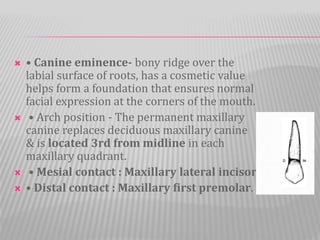
 • Canine eminence- bony ridge over the
labial surface of roots, has a cosmetic value
helps form a foundation that ensures normal
facial expression at the corners of the mouth.
 • Arch position - The permanent maxillary
canine replaces deciduous maxillary canine
& is located 3rd from midline in each
maxillary quadrant.
 • Mesial contact : Maxillary lateral incisor
 • Distal contact : Maxillary first premolar.
CHRONOLOGY
 • First evidence of calcification : 4-5
mo
 • Enamel completed : 6-7 yr
 • Eruption : 11-12yr
 • Root completed : 13-15y
LABIAL ASPECT
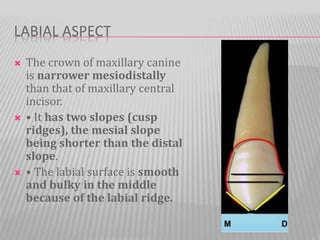
 The crown of maxillary canine
is narrower mesiodistally
than that of maxillary central
incisor.
 • It has two slopes (cusp
ridges), the mesial slope
being shorter than the distal
slope.
 • The labial surface is smooth
and bulky in the middle
because of the labial ridge.
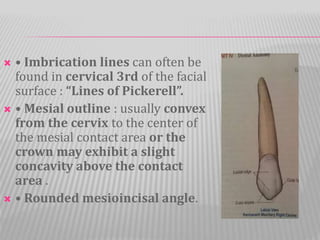
 • Imbrication lines can often be
found in cervical 3rd of the facial
surface : “Lines of Pickerell”.
 • Mesial outline : usually convex
from the cervix to the center of
the mesial contact area or the
crown may exhibit a slight
concavity above the contact
area .
 • Rounded mesioincisal angle.
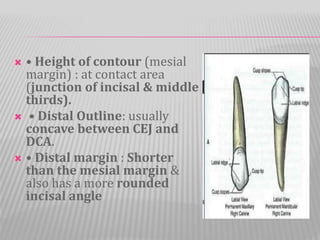
 • Height of contour (mesial
margin) : at contact area
(junction of incisal & middle
thirds).
 • Distal Outline: usually
concave between CEJ and
DCA.
 • Distal margin : Shorter
than the mesial margin &
also has a more rounded
incisal angle
 • Height of contour : at contact area (middle
3rd)
 • Cusp tip is in line with the center of the
root. • Cusp slopes shows tendency toward
concavity(notch) before wear has taken.
 • Labial surface is convex in all directions,
but curvature is more pronounced
mesiodistally.
 • General outline of the surface is pentagonal.
 • Incisal aspect has a large cusp
with a pointed cusp tip.
 • Incisal margin - divided into two
components by tip of cusp & are
termed the mesioincisal and
distoincisal slopes (or mesial &
distal cusp ridges).
 • Root appears slender, conical in
form with a blunt apex, root may
curve mesially or distally.
 Labial aspect Labial ridge Cusp tip
Distal cusp ridge Mesial Cusp Ridge
LINGUAL ASPECT
 • Crown and root are
narrower lingually.
 • Cingulum is well
developed, large &
sometimes pointed like
a cusp.
 • Cervical line curves
asymmetrically toward
the apex with a slight
offset to the distal.
 • Strongly developed
marginal ridges,
occasionally a well-
developed lingual rigde at
the center with two shallow
concavities namely; Mesial
and Distal lingual fossa.
 • Root narrower than
labial, mesial and distal
surface of root is visible
lingually.
 • Developmental
depressions M and D may
be seen.
MESIAL ASPECT
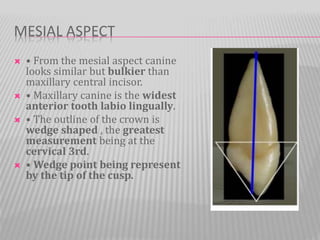
 • From the mesial aspect canine
looks similar but bulkier than
maxillary central incisor.
 • Maxillary canine is the widest
anterior tooth labio lingually.
 • The outline of the crown is
wedge shaped , the greatest
measurement being at the
cervical 3rd.
 • Wedge point being represent
by the tip of the cusp.
 Below the cervical 3rd of the crown , the labial
face may be presented by a line only slightly
convex from the crest of curvature at the cervical
third to the tip of the cusp.
 • Labial outline exhibits more convexity.
 • The lingual outline of the crown may
represented by a convex line describing the
cingulum , which convexity straightens out as
the middle 3rd is reached , becoming convex
again in the incisal 3rd.
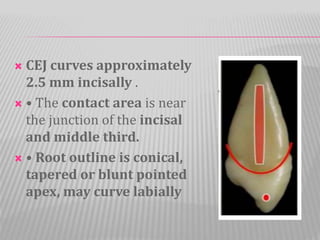
 CEJ curves approximately
2.5 mm incisally .
 • The contact area is near
the junction of the incisal
and middle third.
 • Root outline is conical,
tapered or blunt pointed
apex, may curve labially
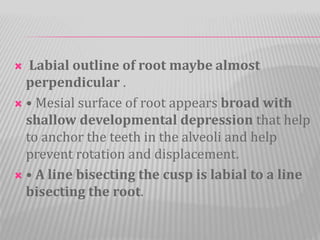
 Labial outline of root maybe almost
perpendicular .
 • Mesial surface of root appears broad with
shallow developmental depression that help
to anchor the teeth in the alveoli and help
prevent rotation and displacement.
 • A line bisecting the cusp is labial to a line
bisecting the root.
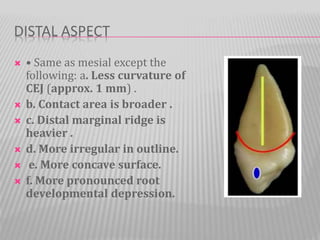
DISTAL ASPECT
 • Same as mesial except the
following: a. Less curvature of
CEJ (approx. 1 mm) .
 b. Contact area is broader .
 c. Distal marginal ridge is
heavier .
 d. More irregular in outline.
 e. More concave surface.
 f. More pronounced root
developmental depression.
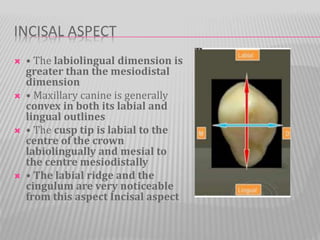
INCISAL ASPECT
 • The labiolingual dimension is
greater than the mesiodistal
dimension
 • Maxillary canine is generally
convex in both its labial and
lingual outlines
 • The cusp tip is labial to the
centre of the crown
labiolingually and mesial to
the centre mesiodistally
 • The labial ridge and the
cingulum are very noticeable
from this aspect Incisal aspect
 When cut cross-sectionally,
mesial section, shows greater
labiolingual bulk, crown gives
impression of having all the
distal portion stretched to
contact first premolar.
 • Line bisecting cusp and cusps
ridges in the MD direction is
almost always straight .
 • Distal slope is longer than
mesial slope
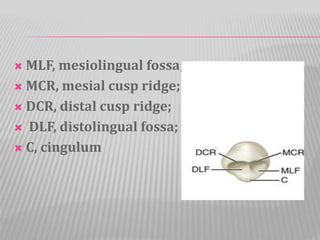
 MLF, mesiolingual fossa;
 MCR, mesial cusp ridge;
 DCR, distal cusp ridge;
 DLF, distolingual fossa;
 C, cingulum
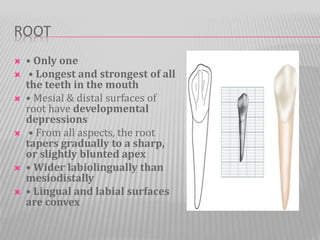
ROOT
 • Only one
 • Longest and strongest of all
the teeth in the mouth
 • Mesial & distal surfaces of
root have developmental
depressions
 • From all aspects, the root
tapers gradually to a sharp,
or slightly blunted apex
 • Wider labiolingually than
mesiodistally
 • Lingual and labial surfaces
are convex
REFERENCES
 • WHEELER’S dental anatomy, physiology , and
occlusion 8th edition .
Peramanent Maxillary Canine

Peramanent Maxillary Canine

  • 1.
    Maxillary Canine DR MONIKANEGI MDS ORAL PATHOLOGY ,MICROBIOLOGY AND FORENSIC ODONTOLOGY
  • 2.
    CONTENTS  • Introduction. • Chronology.  • Average Dimension.  • Labial Aspect.  • Lingual Aspect.  • Mesial Aspect.  • Distal Aspect.  • Incisal Aspect
  • 3.
    INTRODUCTION  • Caninesare very long and stable teeth.  • Develops from  4 lobes, 3 labial and 1 lingual.  • Middle labial lobe developes into a cusp.
  • 4.
     There are4 canines (2 Maxillary & 2 Mandibular) placed at corner of mouth & hence called ‘corner tooth ’ of the dentition.  • Single pointed cusp present so also called cuspids.  • The canine's role in mastication is mainly tearing, which is intermediate between incising of anterior teeth & grinding of the posterior teeth
  • 5.
     • Canineeminence- bony ridge over the labial surface of roots, has a cosmetic value helps form a foundation that ensures normal facial expression at the corners of the mouth.  • Arch position - The permanent maxillary canine replaces deciduous maxillary canine & is located 3rd from midline in each maxillary quadrant.  • Mesial contact : Maxillary lateral incisor  • Distal contact : Maxillary first premolar.
  • 6.
    CHRONOLOGY  • Firstevidence of calcification : 4-5 mo  • Enamel completed : 6-7 yr  • Eruption : 11-12yr  • Root completed : 13-15y
  • 8.
    LABIAL ASPECT  Thecrown of maxillary canine is narrower mesiodistally than that of maxillary central incisor.  • It has two slopes (cusp ridges), the mesial slope being shorter than the distal slope.  • The labial surface is smooth and bulky in the middle because of the labial ridge.
  • 9.
     • Imbricationlines can often be found in cervical 3rd of the facial surface : “Lines of Pickerell”.  • Mesial outline : usually convex from the cervix to the center of the mesial contact area or the crown may exhibit a slight concavity above the contact area .  • Rounded mesioincisal angle.
  • 10.
     • Heightof contour (mesial margin) : at contact area (junction of incisal & middle thirds).  • Distal Outline: usually concave between CEJ and DCA.  • Distal margin : Shorter than the mesial margin & also has a more rounded incisal angle
  • 11.
     • Heightof contour : at contact area (middle 3rd)  • Cusp tip is in line with the center of the root. • Cusp slopes shows tendency toward concavity(notch) before wear has taken.  • Labial surface is convex in all directions, but curvature is more pronounced mesiodistally.  • General outline of the surface is pentagonal.
  • 12.
     • Incisalaspect has a large cusp with a pointed cusp tip.  • Incisal margin - divided into two components by tip of cusp & are termed the mesioincisal and distoincisal slopes (or mesial & distal cusp ridges).  • Root appears slender, conical in form with a blunt apex, root may curve mesially or distally.  Labial aspect Labial ridge Cusp tip Distal cusp ridge Mesial Cusp Ridge
  • 13.
    LINGUAL ASPECT  •Crown and root are narrower lingually.  • Cingulum is well developed, large & sometimes pointed like a cusp.  • Cervical line curves asymmetrically toward the apex with a slight offset to the distal.
  • 14.
     • Stronglydeveloped marginal ridges, occasionally a well- developed lingual rigde at the center with two shallow concavities namely; Mesial and Distal lingual fossa.  • Root narrower than labial, mesial and distal surface of root is visible lingually.  • Developmental depressions M and D may be seen.
  • 16.
    MESIAL ASPECT  •From the mesial aspect canine looks similar but bulkier than maxillary central incisor.  • Maxillary canine is the widest anterior tooth labio lingually.  • The outline of the crown is wedge shaped , the greatest measurement being at the cervical 3rd.  • Wedge point being represent by the tip of the cusp.
  • 17.
     Below thecervical 3rd of the crown , the labial face may be presented by a line only slightly convex from the crest of curvature at the cervical third to the tip of the cusp.  • Labial outline exhibits more convexity.  • The lingual outline of the crown may represented by a convex line describing the cingulum , which convexity straightens out as the middle 3rd is reached , becoming convex again in the incisal 3rd.
  • 18.
     CEJ curvesapproximately 2.5 mm incisally .  • The contact area is near the junction of the incisal and middle third.  • Root outline is conical, tapered or blunt pointed apex, may curve labially
  • 19.
     Labial outlineof root maybe almost perpendicular .  • Mesial surface of root appears broad with shallow developmental depression that help to anchor the teeth in the alveoli and help prevent rotation and displacement.  • A line bisecting the cusp is labial to a line bisecting the root.
  • 20.
    DISTAL ASPECT  •Same as mesial except the following: a. Less curvature of CEJ (approx. 1 mm) .  b. Contact area is broader .  c. Distal marginal ridge is heavier .  d. More irregular in outline.  e. More concave surface.  f. More pronounced root developmental depression.
  • 21.
    INCISAL ASPECT  •The labiolingual dimension is greater than the mesiodistal dimension  • Maxillary canine is generally convex in both its labial and lingual outlines  • The cusp tip is labial to the centre of the crown labiolingually and mesial to the centre mesiodistally  • The labial ridge and the cingulum are very noticeable from this aspect Incisal aspect
  • 22.
     When cutcross-sectionally, mesial section, shows greater labiolingual bulk, crown gives impression of having all the distal portion stretched to contact first premolar.  • Line bisecting cusp and cusps ridges in the MD direction is almost always straight .  • Distal slope is longer than mesial slope
  • 23.
     MLF, mesiolingualfossa;  MCR, mesial cusp ridge;  DCR, distal cusp ridge;  DLF, distolingual fossa;  C, cingulum
  • 24.
    ROOT  • Onlyone  • Longest and strongest of all the teeth in the mouth  • Mesial & distal surfaces of root have developmental depressions  • From all aspects, the root tapers gradually to a sharp, or slightly blunted apex  • Wider labiolingually than mesiodistally  • Lingual and labial surfaces are convex
  • 25.
    REFERENCES  • WHEELER’Sdental anatomy, physiology , and occlusion 8th edition .