dr shabeel pn
Dentin is formed by cells called odontoblasts that differentiate from ectomesyncymal cells of dental papilla following an organizing influence that emanates from the inner dental epithelium. Thus dental papilla is the formative organ of dentin and eventually becomes the pulp of tooth, a change in terminology generally associated with the moment dentin formation begins.
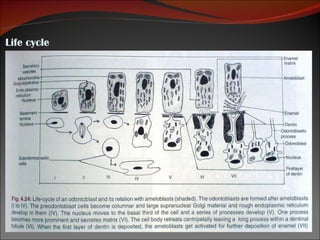
Life cycle
Dentin is a hard yellowish substance. It is about 70% inorganic hydroxy apatite crystals; the remaining 30 % is primarily organic composed of  collagen  and mucopolysaccride ground substance, as well as water. Dentin forms the bulk and general form of tooth and is characterized as a hard tissue with tubules throughout its thickness. Since it begins to form slightly before the enamel, it determines the shape of crown, including the cusp, ridges and number, size of root.
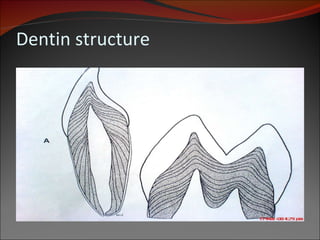
Dentin structure
Physically and chemically the dentin closely resembles bone. The main morphologic difference between bone and dentin is that some of the osteoblast exists on the surface of bone, and one of these cells when enclosed within this matrix called the osteocites.   The odotoblast cell bodies remain external to dentin but their processes exist within tubules in dentin. It is somewhat harder than bone but softer than enamel. Dentin is somewhat harder in its central part than near the pulp or in its periphery.
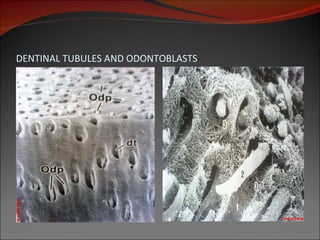
Dentin in cross section is composed of the following distinct areas microscopically. Long tube Running from DEJ or DCJ to the pulp Filled with a cellular extension of odontoblastic process Cytoplasmic extension of odontoblasts Processes are larger in diameter near the pulp(3-4 micro meter) and taper to one micrometer further into the dentin Dentinal tubule
DENTINAL TUBULES AND ODONTOBLASTS
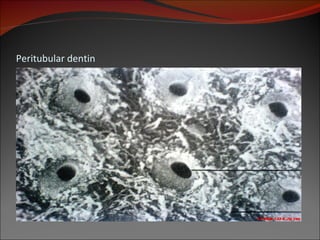
An area of higher crystalline content Immediately surrounds dentinal tubules Forms the walls of tubules in all but the dentin near the pulp According to several investigators calcified tubule wall has an inner organic lining termed lamina limitans. These inner organic lining is described as a thin organic lining high in GAG Peritubular dentin
Peritubular dentin
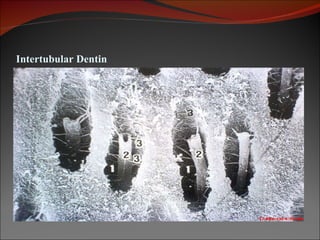
Bulk of the dentin material Located between dentinal tubules or more specifically between the zones of Peritubular dentine One half of its volume is organic matrix (collagen fibers)  The ground substance consists of non collaginous proteins proper to calcified tissues and some plasma proteins. Intertubular dentin
Intertubular Dentin
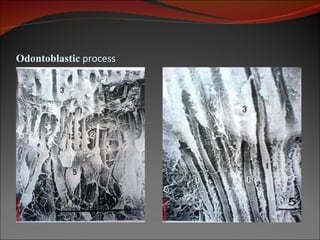
Cytoplasmic extensions of odontoblastic processes Similar to osteocyte processes running canalicules than traverse the dentin layer and are referred as dentinal tubules. They follow an S shaped path from the outer surface of dentin to the perimeter of pulp in coronal dentine. They branch to the extent that dentin is permeated by a profuse anasthamosing canicular system. Odontoblastic process
Odontoblastic  process
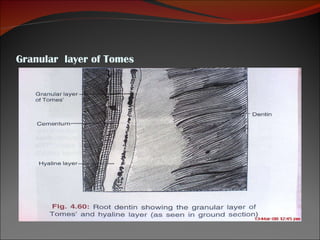
Caused by a coalescing and looping of terminal portion of dentinal tubules Development probably similar to branching and beveling of tubules at DEJ Recent interpretations relates this layer to a special arrangement of collagen and non collaginous matrix proteins at the interface between dentin and cementum Granular layer of  Tomes
Granular  layer of Tomes
Mantle dentin  - First formed dentin in the crown underling the DEJ Thus it’s the more outer or peripheral part of primary dentin and is about 20 micro meter thick Fibrils formed in this zone are perpendicular to DEJ Circumpulpal dentin  – the primary dentin or bulk of tooth Represents all of the dentin formed before root completion Slightly contain more mineral than mantle dentine Primary dentin
Narrow bent of dentin bordering the pulp Represent the dentin formed after root completion Contains fewer tubules than dentine Considered as it protects pulp from exposture in older teeth Secondary dentin
Also called repertory, response or reactive dentine Localized formation of dentine on the pulp dentin border formed in reaction of trauma such as caries or restorative procedure Rate of deposition depends on the degree of injury. Tertiary dentin
Abnormalities of dentin formation Seen when mineralization of dentin begins in small globular areas that fail to coalesce into a homogenous mass. Resulted as zones of hyperminerilization called globular dentin or interglobular spaces  Dentin gets entrapped Found next to DEJ in crown and DCJ in root The root interglobular dentin is  granular layer of tomes Interglobular dentin
Empty dentinal tubules due to death of odontoblastic  cells Empty tubule give rise to pathway for bacteria in decay More rapid penetration of decay once it had reached the DEJ They appear black in transmitted and white in reflected light Their degeneration is often observed in the area of narrow pulpal horns because of crowding of odontoblasts Where reparative dentine seals dentinal tubules fill with fluid or gaseous substances and may entrap air as per their above Dead tracks
When dentinal tubules  filled with dentin material Cause due to occlusal trauma and trauma In the area of trauma the odontoblastic processes retract and begin secreting matrix substances Odontoblast degenerate and the tubules of degenerated odontoblasts are filled Stimulate may not only induce additional formation of reparative dentin but also lead to protective changes in existing dentin Sclerotic dentin (transparent dentin)
Seen in cases of caries attrition abrasion erosion or cavity preparation, sufficient stimuli are generated leading to the appearance of collagen fibers and appetite crystals in the dentinal tubules  Seen mostly in older individuals Considered as a defensive mechanism of dentin It appears very much like the Peritubular dentin when the tubule becomes filled with fine meshwork of crystals and gradually obliterated with minerals.
Thank You

Dentinogenesis

  • 1.
  • 2.
    Dentin is formedby cells called odontoblasts that differentiate from ectomesyncymal cells of dental papilla following an organizing influence that emanates from the inner dental epithelium. Thus dental papilla is the formative organ of dentin and eventually becomes the pulp of tooth, a change in terminology generally associated with the moment dentin formation begins.
  • 3.
  • 4.
    Dentin is ahard yellowish substance. It is about 70% inorganic hydroxy apatite crystals; the remaining 30 % is primarily organic composed of collagen and mucopolysaccride ground substance, as well as water. Dentin forms the bulk and general form of tooth and is characterized as a hard tissue with tubules throughout its thickness. Since it begins to form slightly before the enamel, it determines the shape of crown, including the cusp, ridges and number, size of root.
  • 5.
  • 6.
    Physically and chemicallythe dentin closely resembles bone. The main morphologic difference between bone and dentin is that some of the osteoblast exists on the surface of bone, and one of these cells when enclosed within this matrix called the osteocites.   The odotoblast cell bodies remain external to dentin but their processes exist within tubules in dentin. It is somewhat harder than bone but softer than enamel. Dentin is somewhat harder in its central part than near the pulp or in its periphery.
  • 7.
    Dentin in crosssection is composed of the following distinct areas microscopically. Long tube Running from DEJ or DCJ to the pulp Filled with a cellular extension of odontoblastic process Cytoplasmic extension of odontoblasts Processes are larger in diameter near the pulp(3-4 micro meter) and taper to one micrometer further into the dentin Dentinal tubule
  • 8.
  • 9.
    An area ofhigher crystalline content Immediately surrounds dentinal tubules Forms the walls of tubules in all but the dentin near the pulp According to several investigators calcified tubule wall has an inner organic lining termed lamina limitans. These inner organic lining is described as a thin organic lining high in GAG Peritubular dentin
  • 10.
  • 11.
    Bulk of thedentin material Located between dentinal tubules or more specifically between the zones of Peritubular dentine One half of its volume is organic matrix (collagen fibers) The ground substance consists of non collaginous proteins proper to calcified tissues and some plasma proteins. Intertubular dentin
  • 12.
  • 13.
    Cytoplasmic extensions ofodontoblastic processes Similar to osteocyte processes running canalicules than traverse the dentin layer and are referred as dentinal tubules. They follow an S shaped path from the outer surface of dentin to the perimeter of pulp in coronal dentine. They branch to the extent that dentin is permeated by a profuse anasthamosing canicular system. Odontoblastic process
  • 14.
  • 15.
    Caused by acoalescing and looping of terminal portion of dentinal tubules Development probably similar to branching and beveling of tubules at DEJ Recent interpretations relates this layer to a special arrangement of collagen and non collaginous matrix proteins at the interface between dentin and cementum Granular layer of Tomes
  • 16.
  • 17.
    Mantle dentin - First formed dentin in the crown underling the DEJ Thus it’s the more outer or peripheral part of primary dentin and is about 20 micro meter thick Fibrils formed in this zone are perpendicular to DEJ Circumpulpal dentin – the primary dentin or bulk of tooth Represents all of the dentin formed before root completion Slightly contain more mineral than mantle dentine Primary dentin
  • 18.
    Narrow bent ofdentin bordering the pulp Represent the dentin formed after root completion Contains fewer tubules than dentine Considered as it protects pulp from exposture in older teeth Secondary dentin
  • 19.
    Also called repertory,response or reactive dentine Localized formation of dentine on the pulp dentin border formed in reaction of trauma such as caries or restorative procedure Rate of deposition depends on the degree of injury. Tertiary dentin
  • 20.
    Abnormalities of dentinformation Seen when mineralization of dentin begins in small globular areas that fail to coalesce into a homogenous mass. Resulted as zones of hyperminerilization called globular dentin or interglobular spaces Dentin gets entrapped Found next to DEJ in crown and DCJ in root The root interglobular dentin is granular layer of tomes Interglobular dentin
  • 21.
    Empty dentinal tubulesdue to death of odontoblastic cells Empty tubule give rise to pathway for bacteria in decay More rapid penetration of decay once it had reached the DEJ They appear black in transmitted and white in reflected light Their degeneration is often observed in the area of narrow pulpal horns because of crowding of odontoblasts Where reparative dentine seals dentinal tubules fill with fluid or gaseous substances and may entrap air as per their above Dead tracks
  • 22.
    When dentinal tubules filled with dentin material Cause due to occlusal trauma and trauma In the area of trauma the odontoblastic processes retract and begin secreting matrix substances Odontoblast degenerate and the tubules of degenerated odontoblasts are filled Stimulate may not only induce additional formation of reparative dentin but also lead to protective changes in existing dentin Sclerotic dentin (transparent dentin)
  • 23.
    Seen in casesof caries attrition abrasion erosion or cavity preparation, sufficient stimuli are generated leading to the appearance of collagen fibers and appetite crystals in the dentinal tubules Seen mostly in older individuals Considered as a defensive mechanism of dentin It appears very much like the Peritubular dentin when the tubule becomes filled with fine meshwork of crystals and gradually obliterated with minerals.
  • 24.