MYCOTICMYCOTIC
INFECTIONS OFINFECTIONS OF
THE ORAL CAVITYTHE ORAL CAVITY
(candidiasis)(candidiasis)
 Mycotic infections are fungal infection of
animals, including humans.
 • Mycotic infections are common and a variety of
environmental and physiological
conditions can contribute to the
development of fungal diseases. • Inhalation
of fungal spores or localized colonization
of the skin may initiate persistent
infections; therefore,
 Mycotic infections often start in the lungs
or on the skin.
 The fungi that cause subcutaneous Mycotic infections
normally reside in soil or on vegetation.
 They enter the skin or subcutaneous tissue by traumatic
inoculation with contaminated material.
 In general, the lesions become granulomatous
and expand slowly from the area of
implantation to local lymph nodes.
 Extension via the lymphatics draining the
lesion is slow except in sporotrichosis. Mycotic
infections are usually confined to the subcutaneous
tissues, but in rare cases they become systemic
and produce life-threatening disease.
 Morphological Classification
 • Moulds : hyphae in form. Eg: ringworm or dermatophytes.
 • Yeasts : Single cell that bud to reproduce. Eg: cryptococcus
neoformans.
 Yeast like: Form Pseudohyphae. Eg: candida albicans.
 • Dimorphic fungi: have both a yeast form ( at human body temp)
and a mold form ( at room temp ) eg: Blastomyces dermatitides.
  Classification
 • According to pathogenicity
 1.Superficial mycoses
 2.Mucocutaneous mycoses
 3.Subcutaneous mycoses
 4.Deep Mycoses / systemic.
 People are at risk of fungal infections when
they are taking strong antibiotics for a long
period of time because antibiotics kill not only
damaging bacteria, but healthy bacteria as
well.
 This alters the balance of
microorganisms in the mouth, vagina,
intestines and other places in the body, and
results in an overgrowth of fungus.
 Individuals with weakened immune systems
 • with HIV/AIDS,
 • under steroid treatments, and taking
chemotherapy.
 • with diabetes also tend to develop fungal
infections.
 • Very young and very old people, also, are
groups at risk.
 The response to infection with many fungi is the
formation of granulomas.
 • Granulomas are produced in the major systemic
fungal diseases, e.g., coccidioidomycosis,
histoplasmosis, and blastomycosis, as well as
several others.
 • The cell-mediated immune response is
involved in granuloma formation.
  • Activation of the cell-mediated immune
system results in a delayed hypersensitivity
skin test response to certain fungal antigens
injected intradermally.
 • Acute suppuration( pyogenic response ),
characterized by the presence of neutrophils in the
exudate, also occurs in certain fungal diseases such as
aspergillosis and sporotrichosis.
  • Intact skin is an effective host defense
against certain fungi (e.g., Candida, dermatophytes), but
if the skin is damaged, organisms can become
established.
 • The normal flora of the skin and mucous
membranes suppress fungi.
 • When the normal flora is inhibited, e.g., by
antibiotics, overgrowth of fungi such as C.
albicans can occur
Candidiasis *C. albicans, C. tropicalis, C. glabrata, C.
parapsilosis, C. krusei, C. kyfer, C. dubliniensis
Aspergillosis Aspergillus fumigatus
Cryptococcosis Cryptococcus neoformans
Histoplasmosis Histoplasma capsulatum
Blastomycosis Blastomyces dermatitidis
Zygomycosis Orders Mucorales and Entomophthorales
Coccidioidomycosis Coccidioides immitis
Paracoccidiomycosis Paracoccidioides brasiliensis
Penicilliosis Penicillium marneffei
Sporotrichosis Sporothrix schenckii
Geotrichosis Geotrichum candidum
 CAUSATIVE AGENT-
 Yeast like fungus, candida (monilia)
albicans.
 Although other species such as
C.tropicalis,
C.parapsilosis,C.stellatoidea &
C.glabrata may also be involved.
 These species grow rapidly at 25-37◦C.
 This microorganism is a relatively common
inhabitant of the oral cavity,
gastrointestinal tract and vagina of
clinically normal persons.
 Mere presence of the fungus is not sufficient
to produce the disease. There must be
actual penetration of the tissues.
 The disease is said to be the most
OPPORTUNISTIC INFECTION in the world.
 Its occurrence has increased remarkably
since the prevalent use of antibiotics,
which destroy the normal inhibitory
bacterial flora & immunosupressive
drugs,particularly corticosteroids and
cytotoxic drugs.
 Predisposing factors
 Acute and chronic diseases
 • TB, diabetes mellitus, anemia
 – Hormonal disturbances
 • Myxedema (severe hypothyroidism ),
Hyperparathyroidism, Addison’s disease –
Immunodeficiency
 • AIDS
 – Prolonged use of antibiotics,
corticosteroids, anticancer drugs
 – Radiation therapy
 – Old age, infancy, pregnancy
 Infection ranges from mild to superficial
mucosal involvement to severe, fatal,
disseminated form.
 Candidiasis is frequently classified into 2
major categories-
1. MUCOCUTANEOUS CANDIDIASIS (PRIMARY
ORAL CANDIDIAIS )
2. SYSTEMIC CANDIDIASIS (SECONDARY ORAL
CANDIDIAIS )
1.MUCOCUTANEOUS CANDIDIASIS-
 This includes-
 Oral or oropharyngeal candidiasis
 Thrush
 Candidal esophagitis
 Intestinal candidiasis
 Candidal vulganitis
2.SYSTEMIC CANDIDASIS-
 Bronchial
 Pulmonary
 CLASSIFICATION-
 ACUTE-
 1.Acute pseudomembranous oral candidiasis (thrush)
 2.Acute atrophic oral candidiasis
 CHRONIC-
 1.Chronic hyperplastic oral candidiasis
 2.Chronic mucocutaneous candidiasis-
 A)chronic familial mucocutaneos candidiasis
 B)chronic localized
 C)chronic diffuse
 D)candidiasis endocrinopathy syndrome
 CHRONIC ATROPHIC ORAL CANDIDIASIS
 Can occur at any age
 Especially prone to occur in debilitated or chronically
ill patients.
 Oral lesions- soft, white, slightly elevated
plaques mostly on buccal mucosa & tongue, but
also seen on palate,gingiva and floor of the
mouth.
 Plaques have often been described as resembling Milk
Curds, consisting of tangled masses of fungal
hyphae with intermingled desquamated
epithelium, keratin, fibrin,necrotic debris,
leukocytes & bacteria.
 The white plaque can usually be wiped away with
a gauze ,leaving either a relatively normal
appearing mucosa or an erythematous area.
Thrush on buccal mucosa-
 Also known as Antibiotic Sore Mouth.
 Usually occurs as a sequelae to a course of broad
spectrum antibiotics.
 Lesions appear red or erythematous rather than
white.
 Only variety of oral candidiasis which is consistently
painful
 This lesion comes under the category of erythematous
candidiasis which includes central papillary atrophy
of tongue & cheilocandidiasis.
 This is ‘Leukoplakia’ type of candidiasis.
 Oral lesions consist of firm,white persistent
plaques,usually on lips, tongue & cheeks.
 HOMOGENOUS OR SPECKLED
 Lesions may persist for period of years.
 Hyperplastic Candidiasis-
 This is a group of different forms of the infection.
 In general chronic mucocutaneous candidiasis is
characterized by chronic candidal involvement of
skin, scalp,nails & mucous membranes.
 As a group ,the patients exhibit varying abnormalities in
their immune system- impaired cell mediated
immunity, isolated IgA def. & they are usually
resistant to common forms of the treatment.
 Widespread skin involvement &
granulomatous and horny masses on
the face & scalp.
 Mouth is common primary site for
typical white plaques.
 Nail involvement also seen.
 Genetically transmitted condition
characterized by candida infection of the
skin ,scalp,nails & mucous membranes,
classically oral cavity, in association with
either hypoadrenalism (Addison’s disease),
hypoparathyroidism, hypothyroidism, ovarian
insufficiency or diabetes mellitus.
 Endocrine manifestations which may be
multiple may not appear clinically for
years.
 Enamel hypoplasia commonly seen.
 Least common form
 Exhibit extensive raised crusted sheets
involving the limbs,groin, face, scalp &
shoulders, mouth and nails.
 No familial history.
 Better known as ‘DENTURE SORE MOUTH’.
 Diffuse inflammation of the denture bearing
area often occuring with angular chelitis.
 Women affected more frequently than men.
 Denture related candidiasis may be the most
common form of oral disease.
 Fragments of plaque material may be smeared on a
microscopic slide, macerated with 20% KOH & examined
for typical hyphae.
 Culture media- blood agar, cornmeal agar & Sabouraud’s
Broth –also aid in diagnosis.
 Presence of yeast cells & hyphae or mycelia in the
superficial and deeper layers of involved epithelium.
 Colonies are creamy,white, smooth with a yeasty odour.
 Cytological preperation demonstrates
tubular appearing fungal hyphae & ovoid
yeasts of C.albicans (PAS stain)
 PAS positive candidal hyphae invading the
epithelium .
 Epithelium may hyperkeratosis and elongated
rete ridges .
 Collection of neutrophils in epithelium .
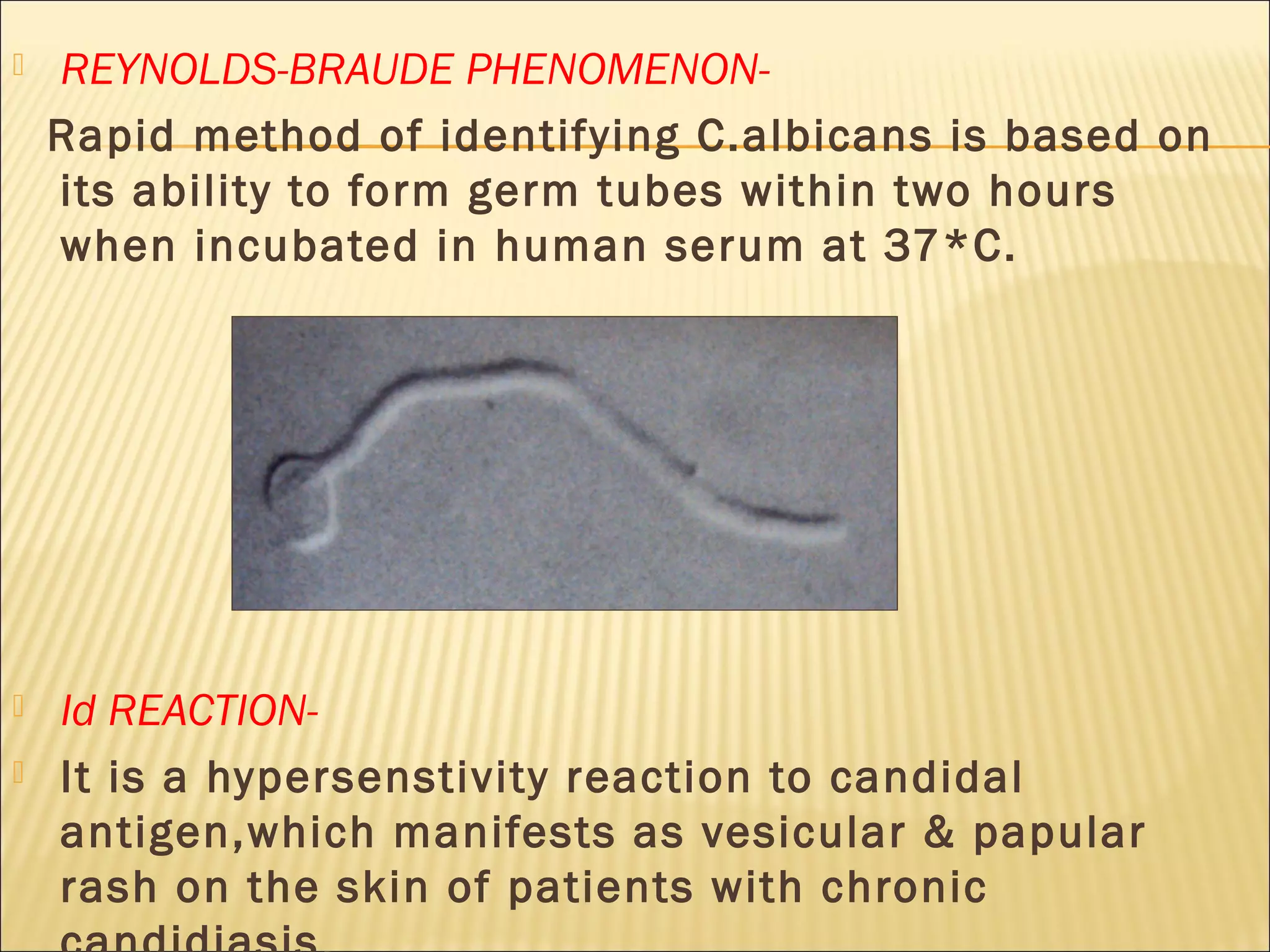
 REYNOLDS-BRAUDE PHENOMENON-
Rapid method of identifying C.albicans is based on
its ability to form germ tubes within two hours
when incubated in human serum at 37*C.
 Id REACTION-
 It is a hypersenstivity reaction to candidal
antigen,which manifests as vesicular & papular
rash on the skin of patients with chronic
 Any kind of clinical material (swab, sputum, etc.) for microscopy or
culture should be examined as quickly as possible, because drying
may impair the viability of yeasts.
 Frequently, Sabouraud's dextrose agar is used as a primary
culture medium.
 SMEARS-
 Detection of yeasts in a clinical specimen should start with direct
microscopic examination of smears from the lesion.
 After fixation, one slide is stained by periodic acid Schiff (PAS)
technique.
 Advantage: simple and quick
 Disadvantage: low sensitivity
.
 SWAB-
 Rubbing a sterile cotton-tipped swab over the lesional
tissue or all surfaces irrespective of the clinical signs is a
useful assay for the presence or absence of Candida.
 PAPER POINTS-
 C. albicans has been detected previously in the
subgingival flora or in the gingival tissues of PD
abscesses.
 An absorbent sterile paper point is inserted to the
depth of the pocket and then transferred to a
transport medium.
 Then plated out on appropriate media
 Sabouraud’s agar slant.
 Estimates of hemoglobin, lymphocyte and
WBC counts, whole blood folate, vitamin B
12 and serum ferritin can be important.
(Scully and Cawson, 1987).
 Mainly by resolving the predisposing causes.
 All candida stains are sensitive to Nystatin but
as it is poorly absorbed from gut,it is not useful
in systemic diseases.
 Amphotericin B, 5-fluorocytosine ,
Clotrimazole & Iconazole also used.
Mycotic Infections of the Oral cavity . ( Candidiasis )

Mycotic Infections of the Oral cavity . ( Candidiasis )

  • 1.
    MYCOTICMYCOTIC INFECTIONS OFINFECTIONS OF THEORAL CAVITYTHE ORAL CAVITY (candidiasis)(candidiasis)
  • 2.
     Mycotic infectionsare fungal infection of animals, including humans.  • Mycotic infections are common and a variety of environmental and physiological conditions can contribute to the development of fungal diseases. • Inhalation of fungal spores or localized colonization of the skin may initiate persistent infections; therefore,  Mycotic infections often start in the lungs or on the skin.
  • 3.
     The fungithat cause subcutaneous Mycotic infections normally reside in soil or on vegetation.  They enter the skin or subcutaneous tissue by traumatic inoculation with contaminated material.  In general, the lesions become granulomatous and expand slowly from the area of implantation to local lymph nodes.  Extension via the lymphatics draining the lesion is slow except in sporotrichosis. Mycotic infections are usually confined to the subcutaneous tissues, but in rare cases they become systemic and produce life-threatening disease.
  • 4.
     Morphological Classification • Moulds : hyphae in form. Eg: ringworm or dermatophytes.  • Yeasts : Single cell that bud to reproduce. Eg: cryptococcus neoformans.  Yeast like: Form Pseudohyphae. Eg: candida albicans.  • Dimorphic fungi: have both a yeast form ( at human body temp) and a mold form ( at room temp ) eg: Blastomyces dermatitides.   Classification  • According to pathogenicity  1.Superficial mycoses  2.Mucocutaneous mycoses  3.Subcutaneous mycoses  4.Deep Mycoses / systemic.
  • 5.
     People areat risk of fungal infections when they are taking strong antibiotics for a long period of time because antibiotics kill not only damaging bacteria, but healthy bacteria as well.  This alters the balance of microorganisms in the mouth, vagina, intestines and other places in the body, and results in an overgrowth of fungus.
  • 6.
     Individuals withweakened immune systems  • with HIV/AIDS,  • under steroid treatments, and taking chemotherapy.  • with diabetes also tend to develop fungal infections.  • Very young and very old people, also, are groups at risk.
  • 7.
     The responseto infection with many fungi is the formation of granulomas.  • Granulomas are produced in the major systemic fungal diseases, e.g., coccidioidomycosis, histoplasmosis, and blastomycosis, as well as several others.  • The cell-mediated immune response is involved in granuloma formation.   • Activation of the cell-mediated immune system results in a delayed hypersensitivity skin test response to certain fungal antigens injected intradermally.
  • 8.
     • Acutesuppuration( pyogenic response ), characterized by the presence of neutrophils in the exudate, also occurs in certain fungal diseases such as aspergillosis and sporotrichosis.   • Intact skin is an effective host defense against certain fungi (e.g., Candida, dermatophytes), but if the skin is damaged, organisms can become established.  • The normal flora of the skin and mucous membranes suppress fungi.  • When the normal flora is inhibited, e.g., by antibiotics, overgrowth of fungi such as C. albicans can occur
  • 9.
    Candidiasis *C. albicans,C. tropicalis, C. glabrata, C. parapsilosis, C. krusei, C. kyfer, C. dubliniensis Aspergillosis Aspergillus fumigatus Cryptococcosis Cryptococcus neoformans Histoplasmosis Histoplasma capsulatum Blastomycosis Blastomyces dermatitidis Zygomycosis Orders Mucorales and Entomophthorales Coccidioidomycosis Coccidioides immitis Paracoccidiomycosis Paracoccidioides brasiliensis Penicilliosis Penicillium marneffei Sporotrichosis Sporothrix schenckii Geotrichosis Geotrichum candidum
  • 11.
     CAUSATIVE AGENT- Yeast like fungus, candida (monilia) albicans.  Although other species such as C.tropicalis, C.parapsilosis,C.stellatoidea & C.glabrata may also be involved.
  • 12.
     These speciesgrow rapidly at 25-37◦C.  This microorganism is a relatively common inhabitant of the oral cavity, gastrointestinal tract and vagina of clinically normal persons.  Mere presence of the fungus is not sufficient to produce the disease. There must be actual penetration of the tissues.  The disease is said to be the most OPPORTUNISTIC INFECTION in the world.  Its occurrence has increased remarkably since the prevalent use of antibiotics, which destroy the normal inhibitory bacterial flora & immunosupressive drugs,particularly corticosteroids and cytotoxic drugs.
  • 13.
     Predisposing factors Acute and chronic diseases  • TB, diabetes mellitus, anemia  – Hormonal disturbances  • Myxedema (severe hypothyroidism ), Hyperparathyroidism, Addison’s disease – Immunodeficiency  • AIDS  – Prolonged use of antibiotics, corticosteroids, anticancer drugs  – Radiation therapy  – Old age, infancy, pregnancy
  • 14.
     Infection rangesfrom mild to superficial mucosal involvement to severe, fatal, disseminated form.  Candidiasis is frequently classified into 2 major categories- 1. MUCOCUTANEOUS CANDIDIASIS (PRIMARY ORAL CANDIDIAIS ) 2. SYSTEMIC CANDIDIASIS (SECONDARY ORAL CANDIDIAIS )
  • 16.
    1.MUCOCUTANEOUS CANDIDIASIS-  Thisincludes-  Oral or oropharyngeal candidiasis  Thrush  Candidal esophagitis  Intestinal candidiasis  Candidal vulganitis 2.SYSTEMIC CANDIDASIS-  Bronchial  Pulmonary
  • 17.
     CLASSIFICATION-  ACUTE- 1.Acute pseudomembranous oral candidiasis (thrush)  2.Acute atrophic oral candidiasis  CHRONIC-  1.Chronic hyperplastic oral candidiasis  2.Chronic mucocutaneous candidiasis-  A)chronic familial mucocutaneos candidiasis  B)chronic localized  C)chronic diffuse  D)candidiasis endocrinopathy syndrome  CHRONIC ATROPHIC ORAL CANDIDIASIS
  • 18.
     Can occurat any age  Especially prone to occur in debilitated or chronically ill patients.  Oral lesions- soft, white, slightly elevated plaques mostly on buccal mucosa & tongue, but also seen on palate,gingiva and floor of the mouth.  Plaques have often been described as resembling Milk Curds, consisting of tangled masses of fungal hyphae with intermingled desquamated epithelium, keratin, fibrin,necrotic debris, leukocytes & bacteria.
  • 19.
     The whiteplaque can usually be wiped away with a gauze ,leaving either a relatively normal appearing mucosa or an erythematous area.
  • 20.
  • 21.
     Also knownas Antibiotic Sore Mouth.  Usually occurs as a sequelae to a course of broad spectrum antibiotics.  Lesions appear red or erythematous rather than white.  Only variety of oral candidiasis which is consistently painful  This lesion comes under the category of erythematous candidiasis which includes central papillary atrophy of tongue & cheilocandidiasis.
  • 23.
     This is‘Leukoplakia’ type of candidiasis.  Oral lesions consist of firm,white persistent plaques,usually on lips, tongue & cheeks.  HOMOGENOUS OR SPECKLED  Lesions may persist for period of years.
  • 24.
  • 25.
     This isa group of different forms of the infection.  In general chronic mucocutaneous candidiasis is characterized by chronic candidal involvement of skin, scalp,nails & mucous membranes.  As a group ,the patients exhibit varying abnormalities in their immune system- impaired cell mediated immunity, isolated IgA def. & they are usually resistant to common forms of the treatment.
  • 27.
     Widespread skininvolvement & granulomatous and horny masses on the face & scalp.  Mouth is common primary site for typical white plaques.  Nail involvement also seen.
  • 28.
     Genetically transmittedcondition characterized by candida infection of the skin ,scalp,nails & mucous membranes, classically oral cavity, in association with either hypoadrenalism (Addison’s disease), hypoparathyroidism, hypothyroidism, ovarian insufficiency or diabetes mellitus.  Endocrine manifestations which may be multiple may not appear clinically for years.  Enamel hypoplasia commonly seen.
  • 29.
     Least commonform  Exhibit extensive raised crusted sheets involving the limbs,groin, face, scalp & shoulders, mouth and nails.  No familial history.
  • 30.
     Better knownas ‘DENTURE SORE MOUTH’.  Diffuse inflammation of the denture bearing area often occuring with angular chelitis.  Women affected more frequently than men.  Denture related candidiasis may be the most common form of oral disease.
  • 32.
     Fragments ofplaque material may be smeared on a microscopic slide, macerated with 20% KOH & examined for typical hyphae.  Culture media- blood agar, cornmeal agar & Sabouraud’s Broth –also aid in diagnosis.  Presence of yeast cells & hyphae or mycelia in the superficial and deeper layers of involved epithelium.  Colonies are creamy,white, smooth with a yeasty odour.
  • 33.
     Cytological preperationdemonstrates tubular appearing fungal hyphae & ovoid yeasts of C.albicans (PAS stain)
  • 34.
     PAS positivecandidal hyphae invading the epithelium .  Epithelium may hyperkeratosis and elongated rete ridges .  Collection of neutrophils in epithelium .
  • 35.
     REYNOLDS-BRAUDE PHENOMENON- Rapidmethod of identifying C.albicans is based on its ability to form germ tubes within two hours when incubated in human serum at 37*C.  Id REACTION-  It is a hypersenstivity reaction to candidal antigen,which manifests as vesicular & papular rash on the skin of patients with chronic
  • 36.
     Any kindof clinical material (swab, sputum, etc.) for microscopy or culture should be examined as quickly as possible, because drying may impair the viability of yeasts.  Frequently, Sabouraud's dextrose agar is used as a primary culture medium.  SMEARS-  Detection of yeasts in a clinical specimen should start with direct microscopic examination of smears from the lesion.  After fixation, one slide is stained by periodic acid Schiff (PAS) technique.  Advantage: simple and quick  Disadvantage: low sensitivity
  • 37.
    .  SWAB-  Rubbinga sterile cotton-tipped swab over the lesional tissue or all surfaces irrespective of the clinical signs is a useful assay for the presence or absence of Candida.  PAPER POINTS-  C. albicans has been detected previously in the subgingival flora or in the gingival tissues of PD abscesses.  An absorbent sterile paper point is inserted to the depth of the pocket and then transferred to a transport medium.  Then plated out on appropriate media
  • 38.
  • 39.
     Estimates ofhemoglobin, lymphocyte and WBC counts, whole blood folate, vitamin B 12 and serum ferritin can be important. (Scully and Cawson, 1987).
  • 40.
     Mainly byresolving the predisposing causes.  All candida stains are sensitive to Nystatin but as it is poorly absorbed from gut,it is not useful in systemic diseases.  Amphotericin B, 5-fluorocytosine , Clotrimazole & Iconazole also used.