DEMOGRAPHIC INDICATORS
Sharon Treesa Antony
Assistant Professor
Govt.College of Nursing
Alappuzha
 Demographic characteristics of a country
provide an overview of its population size,
composition, territorial distribution, changes
therein and the components of changes such
as natality, mortality and social mobility
SOURCES
 Census
 Vital events registers
 Sample registration system ( dual record
system consisting of continuous enumeration
of births and deaths by an enumerator and
an independent survey every 6 months by an
investigator )
 Surveys
CLASSIFICATION
 Population Statistics
 Vital Statistics
POPULATION STATISTICS
 Population size
 Age and sex composition
 Sex ratio
 Population density
 Dependency ratio
VITAL STATISTICS
 Birth rate
 Death rate
 Natural growth rate
 Life expectancy at birth
 Mortality rate
 Fertility rate
POPULATION SIZE
 Number of people living in the country
 India’s population, as per census 2011 stood
at 12108.5 Lakh.
 The growth rate of population for India in the
last decade – 17.64%
AGE AND SEX COMPOSITION
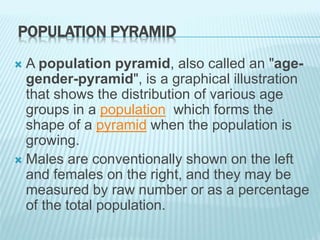
 Proportion of population < 14 yrs. -
“DECLINING Trend” .
 Proportion of the elderly “INCREASING”.
 This Imposes a greater BURDEN on Health
services in India.
POPULATION PYRAMID
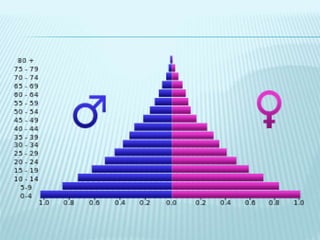
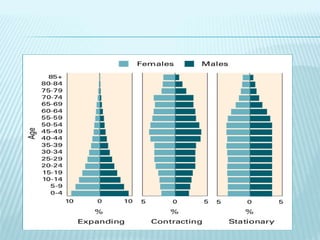
 A population pyramid, also called an "age-
gender-pyramid", is a graphical illustration
that shows the distribution of various age
groups in a population which forms the
shape of a pyramid when the population is
growing.
 Males are conventionally shown on the left
and females on the right, and they may be
measured by raw number or as a percentage
of the total population.
SEX RATIO
 The number of females per 1000 males
POPULATION DENSITY
 Number of persons living per square
kilometer
DEPENDENCY RATIO
 The proportion of persons above 65 years of
age and children below 15 years of age are
considered to be dependent on the
economically productive age group (15-64
years).
 Total dependency ratio/Societal dependency
ratio=
Children 0-14 years + Population more than 65
years of age
Population of 15-64 years
 Can be divided into:
1. Young age dependency ratio(0-14 years)
2. Old age dependency ratio (65 years and
more)
LITERACY
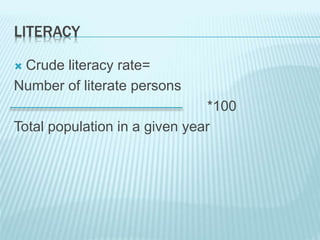
 Crude literacy rate=
Number of literate persons
*100
Total population in a given year
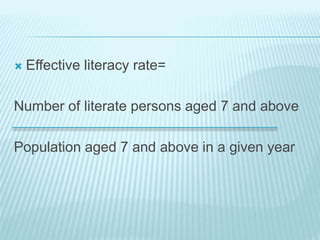
 Effective literacy rate=
Number of literate persons aged 7 and above
Population aged 7 and above in a given year
CRUDE BIRTH RATE
 The crude birth rate is the number of
live births occurring among the population of
a given geographical area during a given
year, per 1,000 mid-year total population of
the given geographical area during the same
year.
CRUDE DEATH RATE
 The crude death rate is the number of deaths
occurring among the population of a given
geographical area during a given year, per
1,000 mid-year total population of the given
geographical area during the same year.
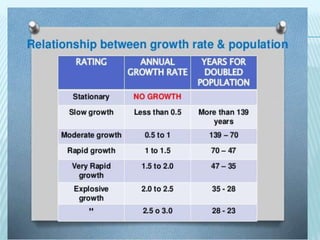
NATURAL GROWTH RATE
 When the crude death rate is subtracted from
the crude birth rate, the net residual is the
current annual growth rate, exclusive of
migration.
LIFE EXPECTANCY AT BIRTH
 Life expectancy at birth is defined as the
average number of years that a newborn
could expect to live according to the
mortality pattern prevalent in that country.
 Indicator of country’s level of development &
overall health status of the population.” •
MORTALITY RATE
 A mortality rate is a measure of the
frequency of occurrence of death in a defined
population during a specified interval.
Eg: Crude mortality rate (crude death rate),
Cause-specific mortality rate, Age-specific
mortality rate, Sex-specific mortality rate
FERTILITY RATE
 By fertility is meant actual bearing of
children.
 Also called natality
 May be measured by number of indicators
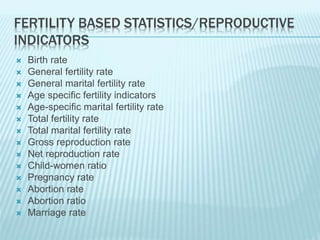
FERTILITY BASED STATISTICS/REPRODUCTIVE
INDICATORS
 Birth rate
 General fertility rate
 General marital fertility rate
 Age specific fertility indicators
 Age-specific marital fertility rate
 Total fertility rate
 Total marital fertility rate
 Gross reproduction rate
 Net reproduction rate
 Child-women ratio
 Pregnancy rate
 Abortion rate
 Abortion ratio
 Marriage rate
CRUDE BIRTH RATE
 The crude birth rate is the annual number of
live births per 1,000 population.
GENERAL FERTILITY RATE
 It is the number of live births per 1000
women in the reproductive age group (15-44
or 49 years) in a given year.
GENERAL MARITAL FERTILITY RATE (GMFR)
 It is the number of live births per 1000
married women in the reproductive age-
group (15 – 49 yr.) in a given year
AGE- SPECIFIC FERTILITY RATE
 It is the number of the live births in a year to
1000 women in any specified age-group
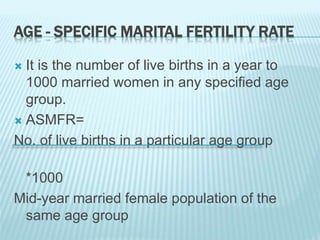
AGE - SPECIFIC MARITAL FERTILITY RATE
 It is the number of live births in a year to
1000 married women in any specified age
group.
 ASMFR=
No. of live births in a particular age group
*1000
Mid-year married female population of the
same age group
TOTAL FERTILITY RATE
 It is the average no. of children a woman
would have if she were to pass through her
reproductive years, bearing children at the
same rate as the woman now in each age
group
TOTAL MARITAL FERTILITY RATE
 Average no. of children that would be born to
a married woman if she experiences the
current fertility pattern throughout her
reproductive span.
GROSS REPRODUCTION RATE
 Average number of girls that would be born
to a woman if she experiences the current
fertility pattern throughout her reproductive
span (15-49 yr.) assuming no mortality.
NET REPRODUCTION RATE
 It is defined as the number of daughters a
new born girl will bear during her lifetime,
assuming fixed age specific fertility and
mortality rates.
CHILD-WOMEN RATIO
 It is the number of children 0-4 years of age
per 1000 women of child-bearing age,
usually defined as 15-44 or 49 years of age.
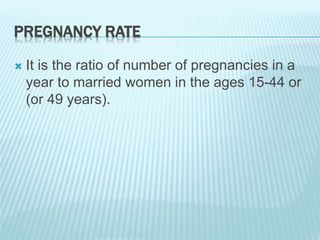
PREGNANCY RATE
 It is the ratio of number of pregnancies in a
year to married women in the ages 15-44 or
(or 49 years).
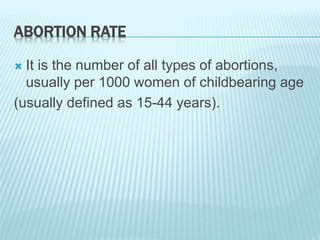
ABORTION RATE
 It is the number of all types of abortions,
usually per 1000 women of childbearing age
(usually defined as 15-44 years).
ABORTION RATIO
 This is calculated by dividing the number of
abortions performed during a particular time
period by the number of live births over the
same period.
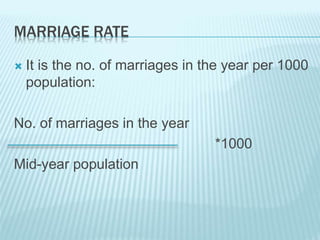
MARRIAGE RATE
 It is the no. of marriages in the year per 1000
population:
No. of marriages in the year
*1000
Mid-year population
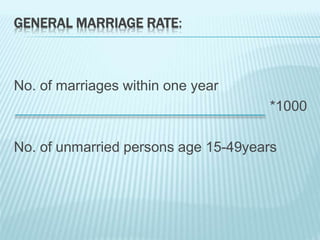
GENERAL MARRIAGE RATE:
No. of marriages within one year
*1000
No. of unmarried persons age 15-49years
THANK YOU

Demographic indicators

  • 1.
    DEMOGRAPHIC INDICATORS Sharon TreesaAntony Assistant Professor Govt.College of Nursing Alappuzha
  • 2.
     Demographic characteristicsof a country provide an overview of its population size, composition, territorial distribution, changes therein and the components of changes such as natality, mortality and social mobility
  • 3.
    SOURCES  Census  Vitalevents registers  Sample registration system ( dual record system consisting of continuous enumeration of births and deaths by an enumerator and an independent survey every 6 months by an investigator )  Surveys
  • 4.
  • 5.
    POPULATION STATISTICS  Populationsize  Age and sex composition  Sex ratio  Population density  Dependency ratio
  • 6.
    VITAL STATISTICS  Birthrate  Death rate  Natural growth rate  Life expectancy at birth  Mortality rate  Fertility rate
  • 7.
    POPULATION SIZE  Numberof people living in the country  India’s population, as per census 2011 stood at 12108.5 Lakh.  The growth rate of population for India in the last decade – 17.64%
  • 8.
    AGE AND SEXCOMPOSITION  Proportion of population < 14 yrs. - “DECLINING Trend” .  Proportion of the elderly “INCREASING”.  This Imposes a greater BURDEN on Health services in India.
  • 9.
    POPULATION PYRAMID  Apopulation pyramid, also called an "age- gender-pyramid", is a graphical illustration that shows the distribution of various age groups in a population which forms the shape of a pyramid when the population is growing.  Males are conventionally shown on the left and females on the right, and they may be measured by raw number or as a percentage of the total population.
  • 12.
    SEX RATIO  Thenumber of females per 1000 males
  • 13.
    POPULATION DENSITY  Numberof persons living per square kilometer
  • 14.
    DEPENDENCY RATIO  Theproportion of persons above 65 years of age and children below 15 years of age are considered to be dependent on the economically productive age group (15-64 years).  Total dependency ratio/Societal dependency ratio= Children 0-14 years + Population more than 65 years of age Population of 15-64 years
  • 15.
     Can bedivided into: 1. Young age dependency ratio(0-14 years) 2. Old age dependency ratio (65 years and more)
  • 16.
    LITERACY  Crude literacyrate= Number of literate persons *100 Total population in a given year
  • 17.
     Effective literacyrate= Number of literate persons aged 7 and above Population aged 7 and above in a given year
  • 18.
    CRUDE BIRTH RATE The crude birth rate is the number of live births occurring among the population of a given geographical area during a given year, per 1,000 mid-year total population of the given geographical area during the same year.
  • 19.
    CRUDE DEATH RATE The crude death rate is the number of deaths occurring among the population of a given geographical area during a given year, per 1,000 mid-year total population of the given geographical area during the same year.
  • 20.
    NATURAL GROWTH RATE When the crude death rate is subtracted from the crude birth rate, the net residual is the current annual growth rate, exclusive of migration.
  • 22.
    LIFE EXPECTANCY ATBIRTH  Life expectancy at birth is defined as the average number of years that a newborn could expect to live according to the mortality pattern prevalent in that country.  Indicator of country’s level of development & overall health status of the population.” •
  • 23.
    MORTALITY RATE  Amortality rate is a measure of the frequency of occurrence of death in a defined population during a specified interval. Eg: Crude mortality rate (crude death rate), Cause-specific mortality rate, Age-specific mortality rate, Sex-specific mortality rate
  • 24.
    FERTILITY RATE  Byfertility is meant actual bearing of children.  Also called natality  May be measured by number of indicators
  • 25.
    FERTILITY BASED STATISTICS/REPRODUCTIVE INDICATORS Birth rate  General fertility rate  General marital fertility rate  Age specific fertility indicators  Age-specific marital fertility rate  Total fertility rate  Total marital fertility rate  Gross reproduction rate  Net reproduction rate  Child-women ratio  Pregnancy rate  Abortion rate  Abortion ratio  Marriage rate
  • 26.
    CRUDE BIRTH RATE The crude birth rate is the annual number of live births per 1,000 population.
  • 27.
    GENERAL FERTILITY RATE It is the number of live births per 1000 women in the reproductive age group (15-44 or 49 years) in a given year.
  • 28.
    GENERAL MARITAL FERTILITYRATE (GMFR)  It is the number of live births per 1000 married women in the reproductive age- group (15 – 49 yr.) in a given year
  • 29.
    AGE- SPECIFIC FERTILITYRATE  It is the number of the live births in a year to 1000 women in any specified age-group
  • 30.
    AGE - SPECIFICMARITAL FERTILITY RATE  It is the number of live births in a year to 1000 married women in any specified age group.  ASMFR= No. of live births in a particular age group *1000 Mid-year married female population of the same age group
  • 31.
    TOTAL FERTILITY RATE It is the average no. of children a woman would have if she were to pass through her reproductive years, bearing children at the same rate as the woman now in each age group
  • 32.
    TOTAL MARITAL FERTILITYRATE  Average no. of children that would be born to a married woman if she experiences the current fertility pattern throughout her reproductive span.
  • 33.
    GROSS REPRODUCTION RATE Average number of girls that would be born to a woman if she experiences the current fertility pattern throughout her reproductive span (15-49 yr.) assuming no mortality.
  • 34.
    NET REPRODUCTION RATE It is defined as the number of daughters a new born girl will bear during her lifetime, assuming fixed age specific fertility and mortality rates.
  • 35.
    CHILD-WOMEN RATIO  Itis the number of children 0-4 years of age per 1000 women of child-bearing age, usually defined as 15-44 or 49 years of age.
  • 36.
    PREGNANCY RATE  Itis the ratio of number of pregnancies in a year to married women in the ages 15-44 or (or 49 years).
  • 37.
    ABORTION RATE  Itis the number of all types of abortions, usually per 1000 women of childbearing age (usually defined as 15-44 years).
  • 38.
    ABORTION RATIO  Thisis calculated by dividing the number of abortions performed during a particular time period by the number of live births over the same period.
  • 39.
    MARRIAGE RATE  Itis the no. of marriages in the year per 1000 population: No. of marriages in the year *1000 Mid-year population
  • 40.
    GENERAL MARRIAGE RATE: No.of marriages within one year *1000 No. of unmarried persons age 15-49years
  • 41.