DEMOGRAPHIC TRENDS IN INDIA
Dr. Shwetha
Assistant Professor
Dept of Community Medicine
RIMS Raichur
2
• Demography: sizes, structure, distribution, composition
• scientific study of human population.
Introduction
Demographic cycle
3
1ST STAGE [ HIGHSTATIONARY]
High birth rate
High death rate
Ppopulation remains stationary
INDIA was in this stage till 1920
4
2nd STAGE [EARLYEXPANDING]
- This stage is characterized by :-
Many countries like
SOUTH ASIA AND
AFRICA as in this stage.
5
Birth rate: Unchanged
Death rate: starts to decline
3rd STAGE [LATE EXPANDING]
- This stage is characterized by :-
BR: starts to decline BR > DR
DR: Starts to decline INDIA has entered this phase
6
4TH STAGE [LOW STATIONARY]
- This stage is characterized by :-
 Low birth rate
 Low death rate
ZERO POPULATION GROWTH
HAS ALREADY BEEN REPORTED
IN AUSTRIA DURING 1980-1985.
So the population
becomes stationary.
7
5TH STAGE [DECLINING]
- This stage is characterized by :-
 Low birth rate
 Low death rate
SOME EAST EUROPEAN
COUNTRIES – HUNGARY AND
GERMANY ARE EXPERIENCING
THIS STAGE.
LOWER BIRTH
8
RATE THAN THE
DEATH RATE SO
THE POPULATION
BEGINS TO
DECLINE
DR> BR
9
INDIA’s : 2nd populous country in the world
UNITED NATION projections
INDIA’s : 1.53 billion by the year 2050
will be the highest population in the world.
Demographic trends in India
1. 1. Demographic indicators
2. 2. Age and sex composition
3. 3. Age pyramids
4. 4. Sex ratio
5. 5. Dependency ratio
6. 6. Density of population
7. 7. Urbanization
8. 8. Family size
9. 9. Literacy and education
10.10. Life expectancy 18
Demographic Indicators
1. Population Statistics : population size,
sex ratio,
density and dependency ratio
2. vital statistics : birth rate,
death rate,
natural growth rate,
life expectancy at birth,
mortality
fertility rates

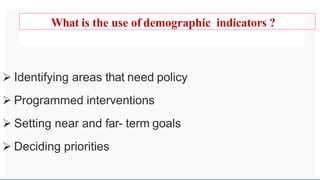
What is the use of demographic indicators ?
 Identifying areas that need policy
 Programmed interventions
 Setting near and far- term goals
 Deciding priorities
YEAR
TOTALPOPULATION(IN
AVERAGEANNUAL
EXPONENTIALGROWTH DECADALGROWTHRATE(%)
MILLION)
RATE(%)
1901 238.4 - -
1911 252.1 0.56 0.75
1921 251.3 (-) 0.03 (-) 0.31
1931 279.0 1.04 11.00
1941 318.7 1.33 14.22
1951 361.1 1.25 13.31
1961 439.2 1.96 21.64
1971 548.2 2.20 24.80
1981 683.3 2.22 24.66
1991 846.4 2.16 23.87
2001 1028.6 1.7 21.52
2011 1210.1 1.64 17.2
6
2 4
RANK
STATE
PROJECTED
POPULATION
31.3.2011
PERCENT TOTOTAL
POPULATION OF
INDIA
31-3-2011
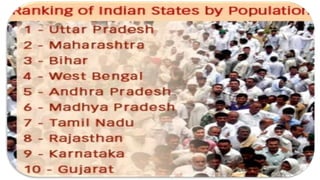
1 Uttar Pradesh 199,581 16.50
2 Maharashtra 112,372 9.28
3 Bihar 103,804 8.60
4 West Bengal 91,347 7.54
5 Andhra Pradesh 84,665 6.99
6 Madhya Pradesh 72,597 6.00
7 Tamil Nadu 72,138 5.96
8 Rajasthan 68,621 5.66
9 Karnataka 61,130 5.05
10 Gujarat 60,383 4.9925
A) India's population has been steadily increasing
since 1921. The year 1921 is called the "big divide"
because the absolute number of people added to the
population during each decade has been on the
increase since 1921. India's population is currently
increasing at the rate of 16 million each year.
16
17
Age and Sex composition
• 0-14 years: male population 1.3 per cent more than female,
• age group 60+ : female population is 0.6 per cent more than
male population.
• The proportion of population, 0-14 years: rural > urban areas
(both male and female)
18
This age structure of a population is best representation
Age pyramid
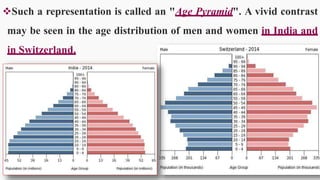
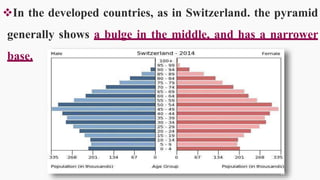
Such a representation is called an "Age Pyramid". A vivid contrast
may be seen in the age distribution of men and women in India and
in Switzerland.
20
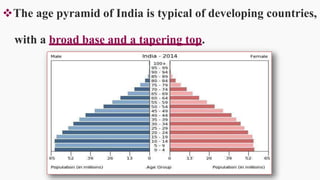
The age pyramid of India is typical of developing countries,
with a broad base and a tapering top.
21
In the developed countries, as in Switzerland. the pyramid
generally shows a bulge in the middle, and has a narrower
base.
22
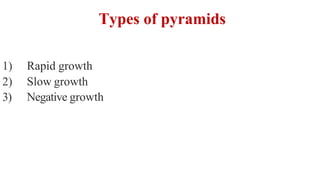
Types of pyramids
1) Rapid growth
2) Slow growth
3) Negative growth
1. RAPID GROWTH
We can see the distinctive pyramid-like shape to this graph,
which displays a high birth rate and a high death rate
2. SLOW GROWTH
We can see the growth rate is reflected in the more square-like
structure of the pyramid.
In the United States, the population is growing at a very
slow rate
3. Negative Growth
As of 2015, Japan is experiencing a negative population growth. As Japan's age-
sex pyramid shows, the country has a huge number of elderly and middle-age
adults, and the country is experiencing a dearth in the number of babies and
children. In fact, Japan has experienced a record low no. of births over the past
four years.
SEX Ratio
 number of females per 1000 males: 940/1000males (2011)
low sex ratio indicates: strong male-child preference
consequent gender inequities,
neglect of a girl child
 female deficit syndrome: Higher mortality at youngerage
Female infanticide
Female foeticide
Higher maternal mortality
Male bias 43
IN 2011 - 940
28
Kerala with 1084 females for every 1000 males
has the highest sex ratio according to Census of
India.
The union territory of Chandigarh has only 818
females for every 1000 males.
According to Census of India, the child sex ratio
(0-6 years) in India is one of the poorest
50, last
Dependency Ratio
1. Old age: 65 yrs
1. Younger age: < 15yrs
 need for a society to provide for their younger and older
population groups
Called total dependency ratio
societal dependency ratio
Dependency ratio: % population 0-15yrs + > 65yrs x 100
% of population 15-64yrs
• Jan 2018: young age DR- 41.1%
Old age DR – 9.3 %
population concentration
In het Indian census, density is defined as the number of persons,
living per square kilometre.
Density of population
URBANIZATION
Urbanpopulation isthe number of persons residing in urban localities.
In Indian context, the urban areas are the towns.
the urban population
in India was
projected to be 385
million in 2011 as
compared to 217.17
million in 1991.
56
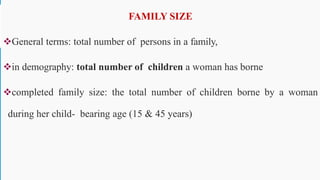
FAMILY SIZE
General terms: total number of persons in a family,
in demography: total number of children a woman has borne
completed family size: the total number of children borne by a woman
during her child- bearing age (15 & 45 years)
35
 The family size depends upon
1. duration of marriage,
2. education of the couple,
3. the number of live births and living children,
4. preference of male children.
5. desired family size, etc.
36
Literacy and education
37
39
Life expectancy
average number of years which a person of that age may be
expected to live
best indicators of a country's level of development and
overall health status of its population
 2011: male: 64yrs
females: 67yrs 40
FERTILITY RELATED STATISTICS
• FERTILITY/ natality: meant the actual bearing of children
Fertility may be measured by number of indicators are as follows:-
1. Birth rate
2. General fertility rate
3. General marital fertilityrate
4. Age specific fertility rate
5. Age specific marital fertility rate
6. Total fertility rate
7. Total marital fertilityrate
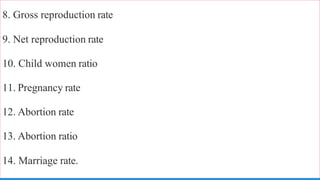
8. Gross reproduction rate
9. Net reproduction rate
10. Child women ratio
11. Pregnancy rate
12. Abortion rate
13. Abortion ratio
14. Marriage rate.
BIRTH RATE
The number of live births per 1000 estimated mid year
population, in a given year.
number of live births
During the year
X 1,000
Estimated mid-year
population
GENERAL FERTILITY RATE[GFR]
The number of live births per 1000 women in the reproductive
age group (15-44 or 49 years) in a given year.
number of live births in an
area during the year
X 1,000
Mid year female population age
15-44(or49)in the same area in
same year
GENERAL MARITAL FERTILITY RATE[GMFR]
The number of live births per 1000 married women in the
reproductive age group (15-44 or 49 years) in a given year.
number of live births in a
year
Mid -year married female X 1,000
population age 15-44(or 49)
AGE SPECIFIC FERTILITY RATE[ASFR]
The number of live births in a year to 1000 women in any
specified age-group.
number of live births in a
particular age group
Mid -year female X 1,000
population of the same age
group
AGE –SPECIFIC MARITAL FERTILITY RATE [ASMFR]
The number of live births in a year to 1000 married women in
any specified age-group.
number of live births in a particular
age group
Mid -year married female X 1000
population of the same age group
TOTAL FERTILITYRATE[TFR]
The number of children who would be born per woman (or per 1,000 women) if
she/they were to pass through the childbearing years bearing children according to a
current schedule of age-specific fertility rates.
(45-49)
TFR = 5 × ∑ASFR
(15-19)
1000
TOTAL MARITAL FERTILITY RATE [TMFR]
Average number of children that would be born to a married women if
she experiences the current fertility pattern throughout her reproductive
span.
(45-49)
TFR = 5 × ∑ASMFR
(15-19)
1000
GROSS REPRODUCTIVE RATE [GRR]
Average number of girls that would be born to a women if she
experiences the current fertility pattern throughout her reproductive
span 9(15-44 OR 49), assuming no mortality.
(45-49)
TFR = 5 × ∑ASMFR for female live births
(15-19)
1000
NET REPRODUCTION RATE [NRR]
Number of daughters a newborn girl will bear during her
lifetime assuming fixed age specific fertility and mortality rates
[CHILD WOMEN RATIO [CWR]
Number of children 0 – 4 years of age per 1000 women of child
bearing age, usually defined as 15-44 or 49 years age.
PREGNANCY RATE
It is the ratio of no. of pregnancies in a year to a married
women in the ages 15-44 (or 49 years).
ABORTION RATE
The annual no. of all types of abortions, usually per 1000
women of child bearing age usually 15-44 years.
Thank you

demographictrendsinindia-class.pptx

  • 1.
    DEMOGRAPHIC TRENDS ININDIA Dr. Shwetha Assistant Professor Dept of Community Medicine RIMS Raichur
  • 2.
    2 • Demography: sizes,structure, distribution, composition • scientific study of human population. Introduction
  • 3.
  • 4.
    1ST STAGE [HIGHSTATIONARY] High birth rate High death rate Ppopulation remains stationary INDIA was in this stage till 1920 4
  • 5.
    2nd STAGE [EARLYEXPANDING] -This stage is characterized by :- Many countries like SOUTH ASIA AND AFRICA as in this stage. 5 Birth rate: Unchanged Death rate: starts to decline
  • 6.
    3rd STAGE [LATEEXPANDING] - This stage is characterized by :- BR: starts to decline BR > DR DR: Starts to decline INDIA has entered this phase 6
  • 7.
    4TH STAGE [LOWSTATIONARY] - This stage is characterized by :-  Low birth rate  Low death rate ZERO POPULATION GROWTH HAS ALREADY BEEN REPORTED IN AUSTRIA DURING 1980-1985. So the population becomes stationary. 7
  • 8.
    5TH STAGE [DECLINING] -This stage is characterized by :-  Low birth rate  Low death rate SOME EAST EUROPEAN COUNTRIES – HUNGARY AND GERMANY ARE EXPERIENCING THIS STAGE. LOWER BIRTH 8 RATE THAN THE DEATH RATE SO THE POPULATION BEGINS TO DECLINE DR> BR
  • 9.
  • 10.
    INDIA’s : 2ndpopulous country in the world UNITED NATION projections INDIA’s : 1.53 billion by the year 2050 will be the highest population in the world.
  • 11.
    Demographic trends inIndia 1. 1. Demographic indicators 2. 2. Age and sex composition 3. 3. Age pyramids 4. 4. Sex ratio 5. 5. Dependency ratio 6. 6. Density of population 7. 7. Urbanization 8. 8. Family size 9. 9. Literacy and education 10.10. Life expectancy 18
  • 12.
    Demographic Indicators 1. PopulationStatistics : population size, sex ratio, density and dependency ratio 2. vital statistics : birth rate, death rate, natural growth rate, life expectancy at birth, mortality fertility rates
  • 13.
     What is theuse of demographic indicators ?  Identifying areas that need policy  Programmed interventions  Setting near and far- term goals  Deciding priorities
  • 14.
    YEAR TOTALPOPULATION(IN AVERAGEANNUAL EXPONENTIALGROWTH DECADALGROWTHRATE(%) MILLION) RATE(%) 1901 238.4- - 1911 252.1 0.56 0.75 1921 251.3 (-) 0.03 (-) 0.31 1931 279.0 1.04 11.00 1941 318.7 1.33 14.22 1951 361.1 1.25 13.31 1961 439.2 1.96 21.64 1971 548.2 2.20 24.80 1981 683.3 2.22 24.66 1991 846.4 2.16 23.87 2001 1028.6 1.7 21.52 2011 1210.1 1.64 17.2 6 2 4
  • 15.
    RANK STATE PROJECTED POPULATION 31.3.2011 PERCENT TOTOTAL POPULATION OF INDIA 31-3-2011 1Uttar Pradesh 199,581 16.50 2 Maharashtra 112,372 9.28 3 Bihar 103,804 8.60 4 West Bengal 91,347 7.54 5 Andhra Pradesh 84,665 6.99 6 Madhya Pradesh 72,597 6.00 7 Tamil Nadu 72,138 5.96 8 Rajasthan 68,621 5.66 9 Karnataka 61,130 5.05 10 Gujarat 60,383 4.9925
  • 16.
    A) India's populationhas been steadily increasing since 1921. The year 1921 is called the "big divide" because the absolute number of people added to the population during each decade has been on the increase since 1921. India's population is currently increasing at the rate of 16 million each year. 16
  • 17.
  • 18.
    Age and Sexcomposition • 0-14 years: male population 1.3 per cent more than female, • age group 60+ : female population is 0.6 per cent more than male population. • The proportion of population, 0-14 years: rural > urban areas (both male and female) 18
  • 19.
    This age structureof a population is best representation Age pyramid
  • 20.
    Such a representationis called an "Age Pyramid". A vivid contrast may be seen in the age distribution of men and women in India and in Switzerland. 20
  • 21.
    The age pyramidof India is typical of developing countries, with a broad base and a tapering top. 21
  • 22.
    In the developedcountries, as in Switzerland. the pyramid generally shows a bulge in the middle, and has a narrower base. 22
  • 23.
    Types of pyramids 1)Rapid growth 2) Slow growth 3) Negative growth
  • 24.
    1. RAPID GROWTH Wecan see the distinctive pyramid-like shape to this graph, which displays a high birth rate and a high death rate
  • 25.
    2. SLOW GROWTH Wecan see the growth rate is reflected in the more square-like structure of the pyramid. In the United States, the population is growing at a very slow rate
  • 26.
    3. Negative Growth Asof 2015, Japan is experiencing a negative population growth. As Japan's age- sex pyramid shows, the country has a huge number of elderly and middle-age adults, and the country is experiencing a dearth in the number of babies and children. In fact, Japan has experienced a record low no. of births over the past four years.
  • 27.
    SEX Ratio  numberof females per 1000 males: 940/1000males (2011) low sex ratio indicates: strong male-child preference consequent gender inequities, neglect of a girl child  female deficit syndrome: Higher mortality at youngerage Female infanticide Female foeticide Higher maternal mortality Male bias 43
  • 28.
    IN 2011 -940 28
  • 29.
    Kerala with 1084females for every 1000 males has the highest sex ratio according to Census of India. The union territory of Chandigarh has only 818 females for every 1000 males. According to Census of India, the child sex ratio (0-6 years) in India is one of the poorest 50, last
  • 30.
    Dependency Ratio 1. Oldage: 65 yrs 1. Younger age: < 15yrs  need for a society to provide for their younger and older population groups Called total dependency ratio societal dependency ratio
  • 31.
    Dependency ratio: %population 0-15yrs + > 65yrs x 100 % of population 15-64yrs • Jan 2018: young age DR- 41.1% Old age DR – 9.3 %
  • 32.
    population concentration In hetIndian census, density is defined as the number of persons, living per square kilometre. Density of population
  • 34.
    URBANIZATION Urbanpopulation isthe numberof persons residing in urban localities. In Indian context, the urban areas are the towns. the urban population in India was projected to be 385 million in 2011 as compared to 217.17 million in 1991. 56
  • 35.
    FAMILY SIZE General terms:total number of persons in a family, in demography: total number of children a woman has borne completed family size: the total number of children borne by a woman during her child- bearing age (15 & 45 years) 35
  • 36.
     The familysize depends upon 1. duration of marriage, 2. education of the couple, 3. the number of live births and living children, 4. preference of male children. 5. desired family size, etc. 36
  • 37.
  • 39.
  • 40.
    Life expectancy average numberof years which a person of that age may be expected to live best indicators of a country's level of development and overall health status of its population  2011: male: 64yrs females: 67yrs 40
  • 41.
    FERTILITY RELATED STATISTICS •FERTILITY/ natality: meant the actual bearing of children Fertility may be measured by number of indicators are as follows:- 1. Birth rate 2. General fertility rate 3. General marital fertilityrate 4. Age specific fertility rate 5. Age specific marital fertility rate 6. Total fertility rate 7. Total marital fertilityrate
  • 42.
    8. Gross reproductionrate 9. Net reproduction rate 10. Child women ratio 11. Pregnancy rate 12. Abortion rate 13. Abortion ratio 14. Marriage rate.
  • 43.
    BIRTH RATE The numberof live births per 1000 estimated mid year population, in a given year. number of live births During the year X 1,000 Estimated mid-year population
  • 44.
    GENERAL FERTILITY RATE[GFR] Thenumber of live births per 1000 women in the reproductive age group (15-44 or 49 years) in a given year. number of live births in an area during the year X 1,000 Mid year female population age 15-44(or49)in the same area in same year
  • 45.
    GENERAL MARITAL FERTILITYRATE[GMFR] The number of live births per 1000 married women in the reproductive age group (15-44 or 49 years) in a given year. number of live births in a year Mid -year married female X 1,000 population age 15-44(or 49)
  • 46.
    AGE SPECIFIC FERTILITYRATE[ASFR] The number of live births in a year to 1000 women in any specified age-group. number of live births in a particular age group Mid -year female X 1,000 population of the same age group
  • 47.
    AGE –SPECIFIC MARITALFERTILITY RATE [ASMFR] The number of live births in a year to 1000 married women in any specified age-group. number of live births in a particular age group Mid -year married female X 1000 population of the same age group
  • 48.
    TOTAL FERTILITYRATE[TFR] The numberof children who would be born per woman (or per 1,000 women) if she/they were to pass through the childbearing years bearing children according to a current schedule of age-specific fertility rates. (45-49) TFR = 5 × ∑ASFR (15-19) 1000
  • 49.
    TOTAL MARITAL FERTILITYRATE [TMFR] Average number of children that would be born to a married women if she experiences the current fertility pattern throughout her reproductive span. (45-49) TFR = 5 × ∑ASMFR (15-19) 1000
  • 50.
    GROSS REPRODUCTIVE RATE[GRR] Average number of girls that would be born to a women if she experiences the current fertility pattern throughout her reproductive span 9(15-44 OR 49), assuming no mortality. (45-49) TFR = 5 × ∑ASMFR for female live births (15-19) 1000
  • 51.
    NET REPRODUCTION RATE[NRR] Number of daughters a newborn girl will bear during her lifetime assuming fixed age specific fertility and mortality rates
  • 52.
    [CHILD WOMEN RATIO[CWR] Number of children 0 – 4 years of age per 1000 women of child bearing age, usually defined as 15-44 or 49 years age.
  • 53.
    PREGNANCY RATE It isthe ratio of no. of pregnancies in a year to a married women in the ages 15-44 (or 49 years).
  • 54.
    ABORTION RATE The annualno. of all types of abortions, usually per 1000 women of child bearing age usually 15-44 years.
  • 55.

Editor's Notes

  • #3 Demography addresses human populations as population per se, that is, their sizes and structures.
  • #4 A nation’s population passes through 5 phases during it’s development
  • #52 specific fertility and mortality rates