FIRST AID NURSING
Sharon Treesa Antony
Junior Lecturer
FIRST AID
First aid is the temporary and immediate
treatment given to a person who is
injured/suddenly becomes ill, using facilities
or materials available at that time before
regular medical help is imparted.
OBJECTIVES
 To preserve life
 To prevent further injury and deterioration of the
condition
 To make the victim as comfortable as possible to
conserve strength
 To put the injured person under professional
medical care at the earliest
QUALITIES OF A FIRST AIDER
 ;Observant
 Able to act quickly
 Should not get panic or excited
 Ability to lead and control the crowd and take help
from the onlookers
 Self confidence
 Able to reassure the victim and his/her relative by
demonstrating competence, expressing sympathy
and providing good counselling
 Resourceful
PRINCIPLES
 Be in control, both of yourself and the problem
 Act calmly and logically
 Be gentle but firm
 Build up while talking to the casualty throughout the
examination and treatment
 Explain what you are going to do
 Answer honestly
 Never leave casualty alone
 Reassure the casualty
 Do not separate a child from its parents or guardian
 Casualty should be sent to a hospital or doctor by
quickest means of transport. Always inform police about
serious accidents
 Inform the relatives
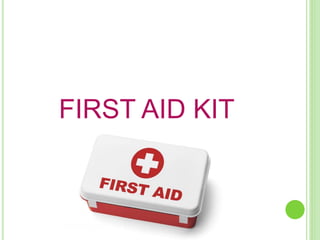
FIRST AID KIT
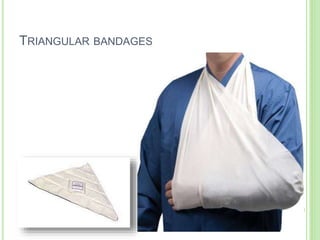
TRIANGULAR BANDAGES
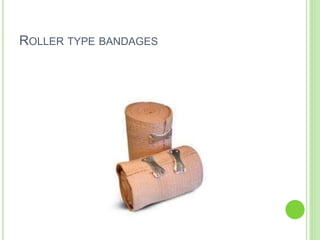
ROLLER TYPE BANDAGES
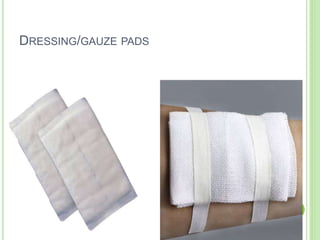
DRESSING/GAUZE PADS
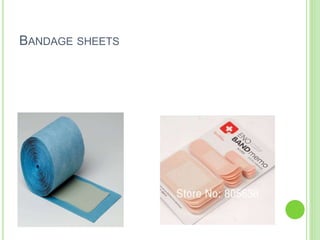
BANDAGE SHEETS
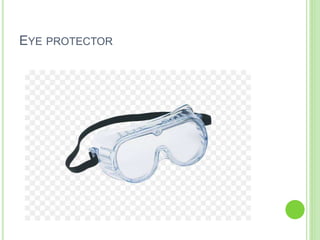
EYE PROTECTOR
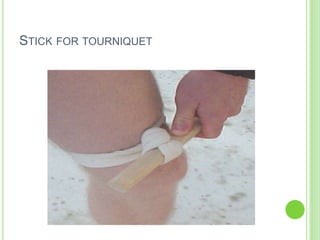
STICK FOR TOURNIQUET
BLANKET
PILLOW
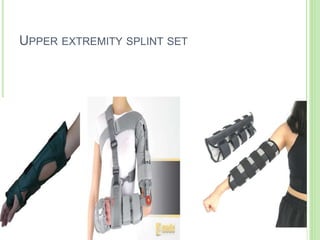
UPPER EXTREMITY SPLINT SET
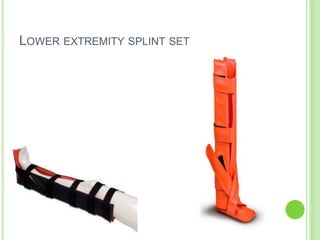
LOWER EXTREMITY SPLINT SET
CONT..
 An up to date first aid manual
 A list of emergency phone numbers
 Adhesive tapes
 Antiseptic wipes
 Soap
 Tooth preservation kit
 Sharp scissors
 Flash light with extra batteries
 Mouth piece for giving CPR
CONCEPT OF EMERGENCY
 An emergency is an acute injury or illness that
poses an immediate risk to a person’s life or long
term health.
Eg: severe bleeding, choking, fractures, shortness of
breath, severe burns, poisoning
POISONING
Poisons are harmful substances and when sufficient
doses are taken may kill the person
POISONS MAY BE CONSUMED:
 Accidently
 For suicidal purpose
 Intentionally for killing a person
ROUTES OF TAKING POISON
 By mouth
 Inhaling
 By injection
 Absorption through skin
GENERAL SIGNS AND SYMPTOMS
 Others/ the casualty informs about poisoning
 Seeing a container having poison
 Delirious convulsions
 Signs and symptoms of asphyxia
 Unconsciousness
 Vomiting/diarrhoea
 Burns of lips/mouth after contact with corrosive
poisons
TREATMENT
 Inform police
 Remove from offending agent like gaseous
atmosphere
 Collect information from any witness available
 Preserve any suspicious container for information
to doctor
 If the person has vomited, preserve the vomitus
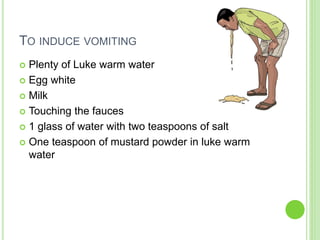
TO INDUCE VOMITING
 Plenty of Luke warm water
 Egg white
 Milk
 Touching the fauces
 1 glass of water with two teaspoons of salt
 One teaspoon of mustard powder in luke warm
water
(CONT..)
 In case of burns to lips/mouth, cool them by
giving water/milk.
DO NOT INDUCE VOMITING
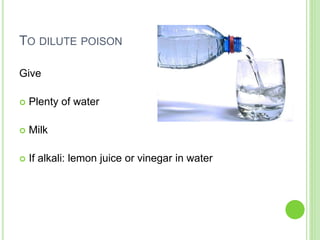
TO DILUTE POISON
Give
 Plenty of water
 Milk
 If alkali: lemon juice or vinegar in water
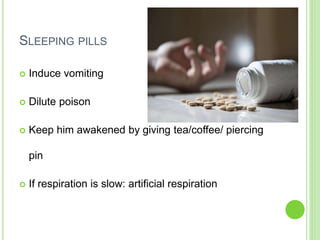
SLEEPING PILLS
 Induce vomiting
 Dilute poison
 Keep him awakened by giving tea/coffee/ piercing
pin
 If respiration is slow: artificial respiration
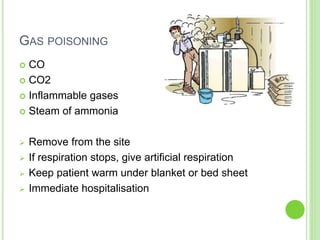
GAS POISONING
 CO
 CO2
 Inflammable gases
 Steam of ammonia
 Remove from the site
 If respiration stops, give artificial respiration
 Keep patient warm under blanket or bed sheet
 Immediate hospitalisation
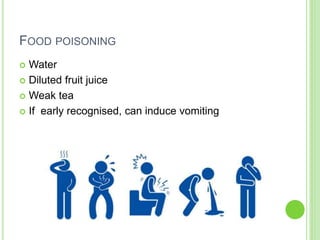
FOOD POISONING
 Water
 Diluted fruit juice
 Weak tea
 If early recognised, can induce vomiting
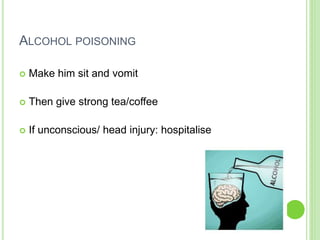
ALCOHOL POISONING
 Make him sit and vomit
 Then give strong tea/coffee
 If unconscious/ head injury: hospitalise
CONT
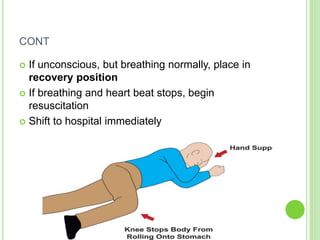
 If unconscious, but breathing normally, place in
recovery position
 If breathing and heart beat stops, begin
resuscitation
 Shift to hospital immediately
TAKE CARE
 Do not contaminate yourself with any poison that may
be around the casualty’s mouth
 DO NOT INDUCE VOMITING IF the casualty has
swallowed:
 Any strong acid/alkali
 Ammonia
 Turpentine
 Bleachers
 Toilet cleaners
 Petrol
 Kerosene
 Paint thinner
 Polish
ANTIDOTES
 Acetyl salicylic acid:1 tsp soda bicarb in 1 glass of
water
 Conc. Acid: excess water& chalk/ soda bicarbonate
in 1 glass of water
 Conc. alkali: 1 tsp vinegar, orange/lemon
 CO: O2
 Cresol/lysol/dettol/lead: epsum salt in 1 glass water
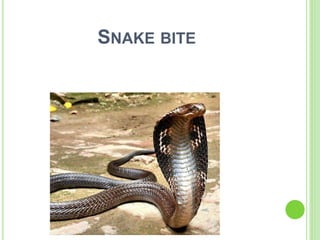
SNAKE BITE
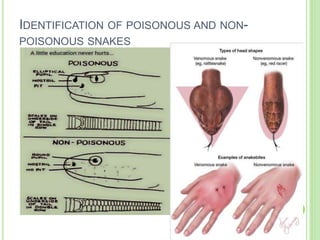
IDENTIFICATION OF POISONOUS AND NON-
POISONOUS SNAKES
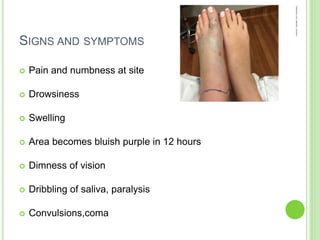
SIGNS AND SYMPTOMS
 Pain and numbness at site
 Drowsiness
 Swelling
 Area becomes bluish purple in 12 hours
 Dimness of vision
 Dribbling of saliva, paralysis
 Convulsions,coma
FIRST AID
 Help the patient to lie down. Keep the head above
the level of wounded part
 Reassure and help to be calm and still
 Gently wash the wound and pat dry with clean
swabs
 Lightly compress the limb above wound with a roller
bandage
 Use triangular bandages to immobilise the affected
area
 Take the killed snake if available to hospital for
identification
DO NOT
 Apply a tourniquet, slash the wound with a knife or
suck out the venom
 If the casualty becomes unconscious, open the
airway and check breathing, be prepared for cardio
pulmonary resuscitation
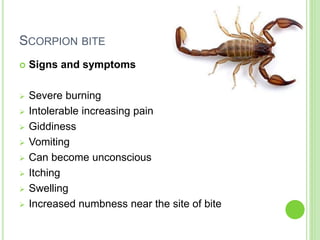
SCORPION BITE
 Signs and symptoms
 Severe burning
 Intolerable increasing pain
 Giddiness
 Vomiting
 Can become unconscious
 Itching
 Swelling
 Increased numbness near the site of bite
FIRST AID
 Help the casualty to sit or lie down , reassure her
 Raise the affected part if possible
 Apply ice packs/cold compress on the region to
slow down the absorption of poison
 Monitor vital signs-pulse, breathing, level of
response
 Watch for signs of allergy like wheezing
 Hospitalise
 If stings to mouth or throat, give ice cubes to suck
or cold water to drink
OTHER INSECT STINGS AND BITES
 Like bees
 Reassure the casualty. If the sting is visible,
brush/scrape it off sideways with your finger nail or
the blunt edge of a knife . Do not use tweezers
because more poison may be injected into the
casualty.
 Raise the affected part if possible and apply an ice
pack or cold compress .
 See doctor if pain and swelling persists
 Stings to mouth and throat: drink cold water or suck
ice cubes
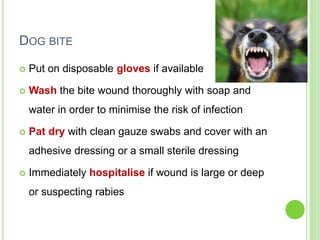
DOG BITE
 Put on disposable gloves if available
 Wash the bite wound thoroughly with soap and
water in order to minimise the risk of infection
 Pat dry with clean gauze swabs and cover with an
adhesive dressing or a small sterile dressing
 Immediately hospitalise if wound is large or deep
or suspecting rabies
CONT....
 If the wound is deep, control bleeding by applying
direct pressure and raising the injured part or apply
a tight dressing and bandage
 Seek medical advice if tetanus immunisation not
taken/ it is more than 10 years since the casualty’s
last injection
FOREIGN BODY IN THE EYE
 Can be a speck of dust, a loose eyelash etc
 Usually such objects can be easily be rinsed off
 Do not touch anything that
 Sticks to the eye
 Penetrates the eyeball
 Rests on the iris
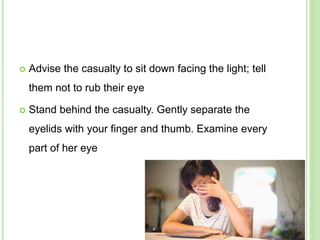
 Advise the casualty to sit down facing the light; tell
them not to rub their eye
 Stand behind the casualty. Gently separate the
eyelids with your finger and thumb. Examine every
part of her eye
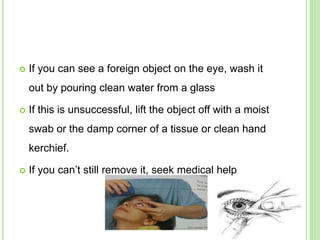
 If you can see a foreign object on the eye, wash it
out by pouring clean water from a glass
 If this is unsuccessful, lift the object off with a moist
swab or the damp corner of a tissue or clean hand
kerchief.
 If you can’t still remove it, seek medical help
FOREIGN BODY UNDER THE UPPER EYELID
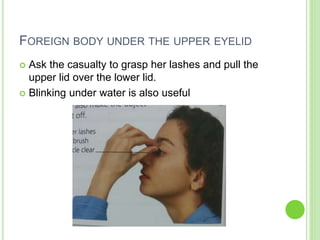
 Ask the casualty to grasp her lashes and pull the
upper lid over the lower lid.
 Blinking under water is also useful
FOREIGN OBJECT IN THE EAR
 Young children push objects into their ears
 Adults may leave cotton in ear
 Arrange to take or send the casualty to hospital as
soon as possible. Do not try to remove a lodged
foreign object yourself.
 Reassure the casualty during the journey or until
medical help arrives
INSECT INSIDE THE EAR
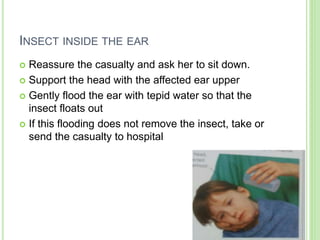
 Reassure the casualty and ask her to sit down.
 Support the head with the affected ear upper
 Gently flood the ear with tepid water so that the
insect floats out
 If this flooding does not remove the insect, take or
send the casualty to hospital
FOREIGN BODY IN THE NOSE
 Young children may push small objects up their
nose
 There may be:
 Difficult or noisy breathing through the nose
 Swelling of the nose
 Smelly or blood stained discharge
CONT.....
 Do not try to remove the objects ; you may cause
injury or push it further into the airway
 Try to keep the casualty quiet and calm
 Tell him to breathe through his mouth at a normal
rate. Advise him not to poke inside his nose to try to
remove the object himself
 Send to hospital
INHALED FOREIGN OBJECT
 There may be
 Some noise of choking, which quickly passes
 Persistent dry coughing
 Difficulty breathing
 Small smooth objects can slip past the throat and
enter into the air passages leading to lungs
 Dry peanuts which can swell up when in contact
with body fluids can be a real danger
 Peanuts can be inhaled into the lungs , resulting in
serious damage
 Management same as choking
CHOKING ADULT
 A foreign object that is stuck at the back of the
throat may block the throat or cause muscular
spasm
 Ask the casualty ΄΄ Are you choking? ˝
Mild obstruction
 Casualty able to speak, cough and breathe
Complete obstruction
 Casualty unable to speak, cough or breathe and
eventual loss of consciousness
CONT..
 If the casualty is breathing, encourage him to
continue coughing. Remove any obvious
obstruction from the mouth
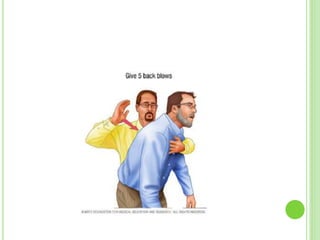
 If the casualty cannot speak or stops coughing or
speaking, carry out back blows.
 Stand to the side and slightly behind him
 Support his chest with one hand and help him to
lean well forwards .
 Give upto 5 sharp blows between the scapulas
with the heel of your hand.
 Stop if the obstruction clears. Check his mouth.
CONT..
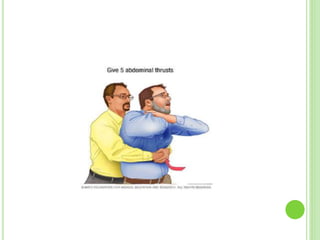
 If back blows fail to clear the obstruction, try abdominal
thrusts. ( Heimlich manoeuvre)
 Stand behind the casualty put both arms around the
upper part of his abdomen
 Make sure that he is still bending well forwards.
 Clench your fist and place it (thumb inwards) between
the navel and the bottom of the sternum. Grasp your fist
with your other hand. Pull sharply inwards and upwards
up to five times
CONT..
 Check his mouth if the obstruction is still not
cleared, repeat back blows and abdominal thrusts
up to 3 times, checking the mouth after each step.
 If the obstruction still has not cleared, continue until
help arrives or the casualty becomes unconscious
 If at any stage casualty becomes unconscious
Open the airway and check breathing
 If not breathing,
Give 30 chest compressions to try to relieve the
obstructions, then two rescue breaths
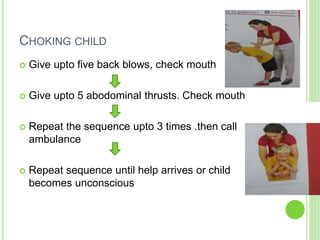
CHOKING CHILD
 Give upto five back blows, check mouth
 Give upto 5 abodominal thrusts. Check mouth
 Repeat the sequence upto 3 times .then call
ambulance
 Repeat sequence until help arrives or child
becomes unconscious
CHOKING INFANT
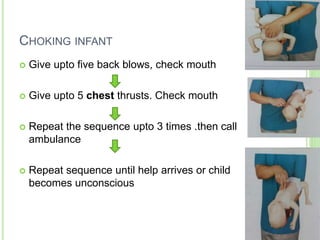
 Give upto five back blows, check mouth
 Give upto 5 chest thrusts. Check mouth
 Repeat the sequence upto 3 times .then call
ambulance
 Repeat sequence until help arrives or child
becomes unconscious
SWALLOWED FOREIGN BODY
 Reassure the casualty and try to find out exactly
what has swallowed
 If the swallowed object is small and smooth, take
or send the casualty to hospital
 Always seek medical advice if you know the
casualty has swallowed a battery
 If he has swallowed something large or sharp, or
has difficulty breathing or swallowing, get an
ambulance to reach hospital soon
 Do not allow the victim to eat or drink or smoke
because a general anaesthetic may need to be
given
ASPHYXIA
 Asphyxia is a deficiency of oxygen in blood and
an increase of carbon dioxide in the blood and
tissues.
 It occurs due to an interruption in the normal
exchange of oxygen and carbon dioxide between
the lungs and outside air
 Lungs do not get sufficient supply of oxygen for
breathing
CAUSES
 Drowning
 Electric shock
 Foreign body in air passages (choking)
 Inhalation of smoke and poisnous gases
 Suffocation under earth
 Hanging, strangulation by tight rope
SIGNS AND SYMPTOMS
 First stage
 Increased rate of breathing
 Breath gets shorter
 Veins of the neck becomes swollen
 Face , lips, nails, fingers and toes turns blue
 Pulse gets feebler and faster
CONT......
 Second stage
 Partial or complete loss of consciousness
 Froth may appear at the mouth and nostrils
MANAGEMENT
 Remove the cause if possible
 Ensure the airway is not obstructed Eg: loosen the tight
collar
 Place the individual on his back. Support the nape of the
neck on your palm and press neck back wards. Then
press the angle of the jaw forward from behind.
 Provide 5 mouth to mouth breathing
 Give artificial respiration until natural breathing is
established to ensure proper ventilation of lungs
 If heart beat stops, give external cardiac massage
 After breathing is restored, arrange for medical help
DROWNING
 Death by drowning occurs when air cannot get into
the lungs
 While a drowning person is rescued, do not attempt
to force water from stomach because the casualty
may vomit and then inhale it
 If you are rescuing a casualty from water to safety,
keep his head lower than the rest of body to reduce
the risk of him inhaling water
 Lay the casualty down on her back on a cloth.
 If breathing, place in recovery position
 Be prepared to give chest compressions and
rescue breaths if necessary
CONT..
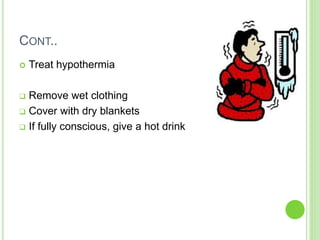
 Treat hypothermia
 Remove wet clothing
 Cover with dry blankets
 If fully conscious, give a hot drink
SHOCK
 Life threatening condition
 Occurs when the circulatory system fails and as a
result, vital organs such as heart and brain are
deprived of oxygen
CAUSES
 Severe blood loss(>1.2 litres)
 Diarrhea
 Vomiting
 Blockage in intestine
 Severe burns
 Inability of heart to pump
 Overwhelming infections
 ....
RECOGNITION
Initially
 A rapid pulse
 Pale, cold, clammy skin, sweating
As shock develops,
 Cyanosis of lips, fingernails
 Weakness and dizziness
 Nausea, possibly vomiting
 Thirst
 Rapid, shallow breathing
 Weak, thready pulse
 Change in level of consciousness
FIRST AID
 Treat any possible causes that you can detect Eg:
bleeding
 Lay the casualty down on a blanket to insulate him
from cold ground.
 Constantly reassure her
 Raise and support her legs to improve the blood
supply to the vital organs. Take care if you suspect
a fracture
 Loosen tight clothing at the neck, chest, waist
 Keep him warm by covering her body and legs
with coats or blankets
CONT..
 Keeping head low may prevent casualty from losing
consciousness
 Do not let the casualty eat, drink, smoke or move
unnecessarily. If thirsty, moisten lips with a little water
 Monitor and record vital signs
 Be prepared to give resuscitation
FROST BITE
 Occurs in freezing or cold and windly conditions
 Usually the fingers or toes freeze due to low
temperatures
 can lead to permanent loss of sensation and
gangrene
RECOGNITION
 At first “ pins-and- needles’’ sensation
 Pallor, followed by numbness
 Hardening and stiffening of the skin
 A colour change to the skin of the affected area, first
white, then mottled and blue.
 On recovery, the skin may be red, hot, painful and
blistered.
 Where gangrene occurs, the tissue may become black
due to loss of blood supply
FIRST AID
 Move casualty into warmth
 Remove constricting clothes (rings, boots)
 Warm the affected part with your hands/in your lap/
in the casualty’s armpits
 DO NOT RUB AFFECTED AREA (????)
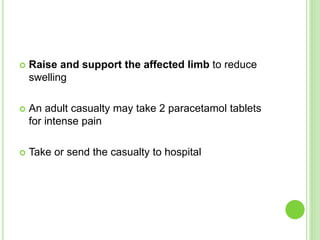
Place the affected part in warm water at around 40˚c
Dry carefully
Apply light dressing with dry gauze
 Raise and support the affected limb to reduce
swelling
 An adult casualty may take 2 paracetamol tablets
for intense pain
 Take or send the casualty to hospital
 Do not put the affected part near direct heat
 Do not allow the casualty to smoke
HEAT STROKE
 Caused by failure of the thermostat in the brain
 Body becomes dangerously overheated, usually
due to a high fever or prolonged exposure to heat
 Can develop with little warning, causing
unconsciousness within minutes of the casualty
feeling unwell
RECOGNITION
 Headache, dizziness, discomfort
 Restlessness, confusion
 Hot flushed and dry skin
 Rapid deterioration in the level of response
 Full bounding pulse
 Body temperature above 40˚C
FIRST AID
 Quickly move the casualty to a cool place.
 Remove as much of his outer clothing as possible
 Wrap the casualty in a cold, wet sheet until his
temperature falls to 37.5˚C
 If no sheet is available, fan the casualty, or sponge
him with cold water
 Once the casualty’s temperature appears to have
returned to normal, replace the wet sheet with a dry
one
CONT...
 Monitor and record vital signs
 If his temperature rises again, repeat the cooling
process again
 Be prepared to give resuscitation
BURNS AND SCALDS
 Skin has mainly 3 layers
 Epidermis
 Dermis
 Layer of fat tissue
 Blood vessels, nerves and hair roots are contained
within the dermis
TYPES OF BURNS
 Dry burns: flames, hot objects
 Scald :steam, hot liquids
 Electrical burns
 Cold injury: frost bite, contact with freezing metals,
freezing vapours
 Chemical burns: strong acids/ alkalies
 Radiation burns: sunburn, over exposure UV rays,
radioactive source
DEPTH OF BURNS
 Superficial burns: involves only the outer most
layer, epidermis
Eg: sunburn
 Partial thickness burns: destroy the epidermis
and are very painful. The skin becomes red and
blistered
 Full- thickness burns: pain sensation is usually
lost. Skin looks waxy, pale or charred.
BURNS THAT NEED HOSPITAL TREATMENT
 All cases of burns to children
 All full-thickness burns
 All burns involving the face, hands, feet or genital
area
 All burns that extend right around an arm or leg
 All partial thickness burns larger than 1% of the
body surface ( an with the size of the palm of
casualty’s hand)
 All superficial burns larger than 5% of the casualty’s
body surface
 Burns with a mixed pattern of varying depths
 Unsure about severity of burns
SEVERE BURNS AND SCALDS
 Help the casualty to lie down if possible. Try to
prevent burnt area from coming in contact with
ground.
 Douse the burn with plenty of cold liquid or at least
10 minutes, but do not delay the casualty’s removal
to hospital
 Continue cooling the affected area until the pain is
relieved
 Put on disposable gloves if available. Gently
remove any rings, watches, belts or shoes.
Carefully remove burnt clothing , unless it is sticking
to the burn
CONT....
 Cover the injured area with a sterile dressing to
protect it from infection. If a sterile dressing is not
available, use a folded triangular bandage or part of
a sheet. A clean plastic bag can be used to cover a
hand or foot,; secure it with a bandage or adhesive
tape applied over the plastic not the skin
CONT...
 Gather and record details of the casualty’s injuries.
Regularly monitor and record her vital signs
 While waiting for help to arrive, reassure the
casualty and treat her for stroke.
 If the casualty has a facial burn, do not cover the
injury. Keep cooling the area with water to relieve
pain until help arrives
CAUTION
 Do not over cool the casualty. ( babies and elder
people)
 Do not remove anything sticking to the burn
 Do not touch or otherwise interfere with the burnt
area
 Do not burst any blisters
 Do not apply lotions, ointment or adhesive tape to
the burnt area
MINOR BURNS AND SCALDS
 Caused by touching a hot iron or spilling boiling
water on the skin
 Flood the injured part with cold water for at least 10
minutes to stop the burning and relieve pain.
 Put on disposable gloves if available.
 Gently remove any jewellery, watches, belts or
constricting clothing from the injured area before it
begins to swell
 cover the area with a sterile dressing or a clean,
pad and bandage loosely in place
 Do not break blisters/ apply adhesive tape to skin
 Do not apply ointments to damaged tissues
BURNS TO THE AIRWAY
 Air passages rapidly become swollen
 Suspect damage to airway if burns have sustained
in a confined space
RECOGNITION
 Soot around nose or mouth
 Singeing of the nasal hairs
 Redness, swelling or actual burning of tongue
 Damage to skin around mouth
 Hoarseness of voice
 Breathing difficulties
FIRST AID
 Call ambulance and inform that you suspect burns to
airway
 Take any steps possible to improve the casualty’s air
supply, such as loosening clothing around his neck
 Offer ice or small sips of cold water to reduce swelling
and/or pain
 Reassure the casualty. Monitor and record vital signs
ELECTRICAL INJURIES/ELECTROCUTION
 Passage of electric current through the body may cause
the breathing and heart to stop
 Electrical current may cause burns both where it enters
the body and where it exits the body
 Can cause muscular spasms which may prevent the
casualty from breaking contact with source
 People who are electrocuted by a high voltage current
rarely survive
LIGHTNING
 A natural burst of electricity discharged from the
atmosphere, lightning forms an intense trail of light
and heat
 May set clothing on fire, knock the casualty down,
or even cause instant death
 Clear everyone from the site of a lightning strike as
soon as possible
HIGH VOLTAGE CURRENT
 Power lines and over-head high tension cables
 Contact is usually immediately FATAL
 If survived will have severe burns
 Muscular spasm may propel the victim some
distance causing fractures