FERTILTY
NIMRA ZAMAN
MPH- II (2017-19)
LIAQUAT UNIVERSITY OF MEDICAL AND
HEALTH SCIENCES JAMSHORO
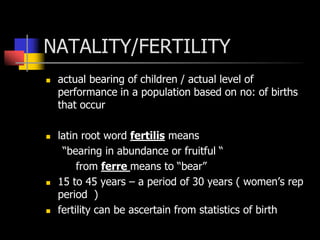
NATALITY/FERTILITY
 actual bearing of children / actual level of
performance in a population based on no: of births
that occur
 latin root word fertilis means
“bearing in abundance or fruitful “
from ferre means to “bear”
 15 to 45 years – a period of 30 years ( women’s rep
period )
 fertility can be ascertain from statistics of birth
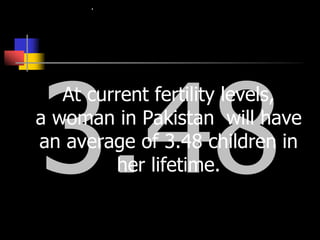
At current fertility levels,
a woman in Pakistan will have
an average of 3.48 children in
her lifetime.
.
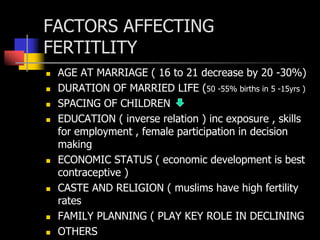
FACTORS AFFECTING
FERTITLITY
 AGE AT MARRIAGE ( 16 to 21 decrease by 20 -30%)
 DURATION OF MARRIED LIFE (50 -55% births in 5 -15yrs )
 SPACING OF CHILDREN
 EDUCATION ( inverse relation ) inc exposure , skills
for employment , female participation in decision
making
 ECONOMIC STATUS ( economic development is best
contraceptive )
 CASTE AND RELIGION ( muslims have high fertility
rates
 FAMILY PLANNING ( PLAY KEY ROLE IN DECLINING
 OTHERS
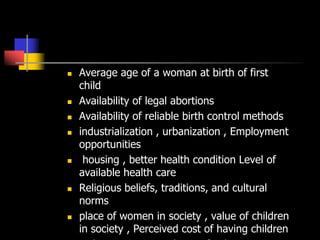
 Average age of a woman at birth of first
child
 Availability of legal abortions
 Availability of reliable birth control methods
 industrialization , urbanization , Employment
opportunities
 housing , better health condition Level of
available health care
 Religious beliefs, traditions, and cultural
norms
 place of women in society , value of children
in society , Perceived cost of having children
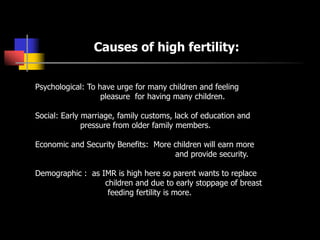
Psychological: To have urge for many children and feeling
pleasure for having many children.
Social: Early marriage, family customs, lack of education and
pressure from older family members.
Economic and Security Benefits: More children will earn more
and provide security.
Demographic : as IMR is high here so parent wants to replace
children and due to early stoppage of breast
feeding fertility is more.
Causes of high fertility:
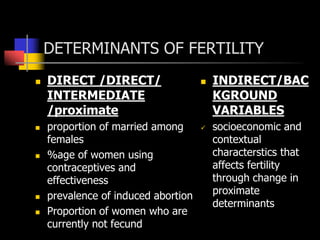
DETERMINANTS OF FERTILITY
 DIRECT /DIRECT/
INTERMEDIATE
/proximate
 proportion of married among
females
 %age of women using
contraceptives and
effectiveness
 prevalence of induced abortion
 Proportion of women who are
currently not fecund
 INDIRECT/BAC
KGROUND
VARIABLES
 socioeconomic and
contextual
characterstics that
affects fertility
through change in
proximate
determinants
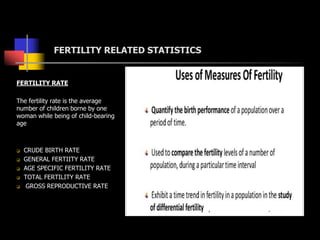
FERTILITY RELATED STATISTICS
FERTILITY RATE
The fertility rate is the average
number of children borne by one
woman while being of child-bearing
age
 CRUDE BIRTH RATE
 GENERAL FERTIITY RATE
 AGE SPECIFIC FERTILITY RATE
 TOTAL FERTILITY RATE
 GROSS REPRODUCTIVE RATE
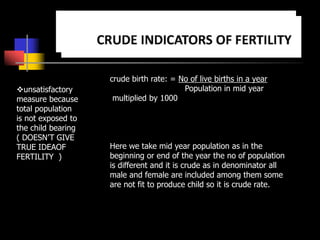
unsatisfactory
measure because
total population
is not exposed to
the child bearing
( DOESN’T GIVE
TRUE IDEAOF
FERTILITY )
crude birth rate: = No of live births in a year
Population in mid year
multiplied by 1000
Here we take mid year population as in the
beginning or end of the year the no of population
is different and it is crude as in denominator all
male and female are included among them some
are not fit to produce child so it is crude rate.
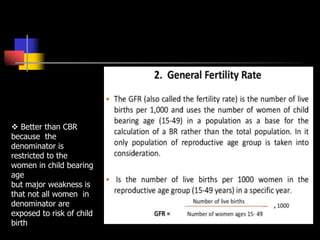
 Better than CBR
because the
denominator is
restricted to the
women in child bearing
age
but major weakness is
that not all women in
denominator are
exposed to risk of child
birth
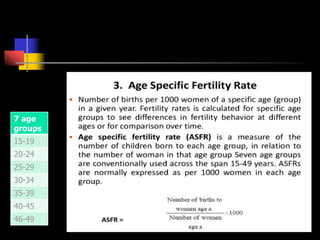
7 age
groups
15-19
20-24
25-29
30-34
35-39
40-45
46-49
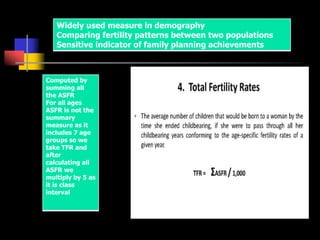
Widely used measure in demography
Comparing fertility patterns between two populations
Sensitive indicator of family planning achievements
Computed by
summing all
the ASFR
For all ages
ASFR is not the
summary
measure as it
includes 7 age
groups so we
take TFR and
after
calculating all
ASFR we
multiply by 5 as
it is class
interval
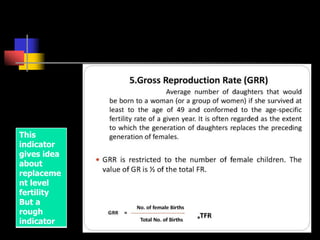
This
indicator
gives idea
about
replaceme
nt level
fertility
But a
rough
indicator
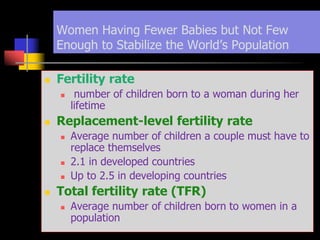
Women Having Fewer Babies but Not Few
Enough to Stabilize the World’s Population
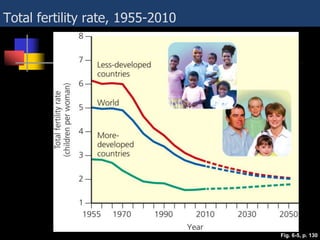
 Fertility rate
 number of children born to a woman during her
lifetime
 Replacement-level fertility rate
 Average number of children a couple must have to
replace themselves
 2.1 in developed countries
 Up to 2.5 in developing countries
 Total fertility rate (TFR)
 Average number of children born to women in a
population
Total fertility rate, 1955-2010
Fig. 6-5, p. 130
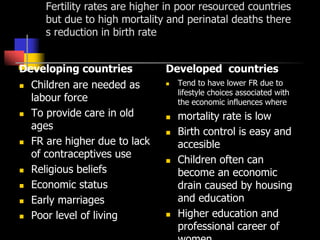
Fertility rates are higher in poor resourced countries
but due to high mortality and perinatal deaths there
s reduction in birth rate
Developing countries
 Children are needed as
labour force
 To provide care in old
ages
 FR are higher due to lack
of contraceptives use
 Religious beliefs
 Economic status
 Early marriages
 Poor level of living
Developed countries
 Tend to have lower FR due to
lifestyle choices associated with
the economic influences where
 mortality rate is low
 Birth control is easy and
accesible
 Children often can
become an economic
drain caused by housing
and education
 Higher education and
professional career of
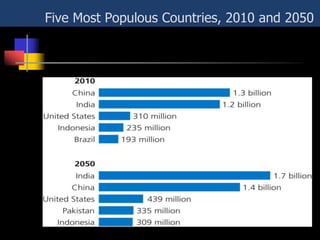
Five Most Populous Countries, 2010 and 2050
THANK
YOU

FERTILITY

  • 1.
    FERTILTY NIMRA ZAMAN MPH- II(2017-19) LIAQUAT UNIVERSITY OF MEDICAL AND HEALTH SCIENCES JAMSHORO
  • 2.
    NATALITY/FERTILITY  actual bearingof children / actual level of performance in a population based on no: of births that occur  latin root word fertilis means “bearing in abundance or fruitful “ from ferre means to “bear”  15 to 45 years – a period of 30 years ( women’s rep period )  fertility can be ascertain from statistics of birth
  • 4.
    At current fertilitylevels, a woman in Pakistan will have an average of 3.48 children in her lifetime. .
  • 6.
    FACTORS AFFECTING FERTITLITY  AGEAT MARRIAGE ( 16 to 21 decrease by 20 -30%)  DURATION OF MARRIED LIFE (50 -55% births in 5 -15yrs )  SPACING OF CHILDREN  EDUCATION ( inverse relation ) inc exposure , skills for employment , female participation in decision making  ECONOMIC STATUS ( economic development is best contraceptive )  CASTE AND RELIGION ( muslims have high fertility rates  FAMILY PLANNING ( PLAY KEY ROLE IN DECLINING  OTHERS
  • 7.
     Average ageof a woman at birth of first child  Availability of legal abortions  Availability of reliable birth control methods  industrialization , urbanization , Employment opportunities  housing , better health condition Level of available health care  Religious beliefs, traditions, and cultural norms  place of women in society , value of children in society , Perceived cost of having children
  • 9.
    Psychological: To haveurge for many children and feeling pleasure for having many children. Social: Early marriage, family customs, lack of education and pressure from older family members. Economic and Security Benefits: More children will earn more and provide security. Demographic : as IMR is high here so parent wants to replace children and due to early stoppage of breast feeding fertility is more. Causes of high fertility:
  • 10.
    DETERMINANTS OF FERTILITY DIRECT /DIRECT/ INTERMEDIATE /proximate  proportion of married among females  %age of women using contraceptives and effectiveness  prevalence of induced abortion  Proportion of women who are currently not fecund  INDIRECT/BAC KGROUND VARIABLES  socioeconomic and contextual characterstics that affects fertility through change in proximate determinants
  • 11.
    FERTILITY RELATED STATISTICS FERTILITYRATE The fertility rate is the average number of children borne by one woman while being of child-bearing age  CRUDE BIRTH RATE  GENERAL FERTIITY RATE  AGE SPECIFIC FERTILITY RATE  TOTAL FERTILITY RATE  GROSS REPRODUCTIVE RATE
  • 12.
    unsatisfactory measure because total population isnot exposed to the child bearing ( DOESN’T GIVE TRUE IDEAOF FERTILITY ) crude birth rate: = No of live births in a year Population in mid year multiplied by 1000 Here we take mid year population as in the beginning or end of the year the no of population is different and it is crude as in denominator all male and female are included among them some are not fit to produce child so it is crude rate.
  • 13.
     Better thanCBR because the denominator is restricted to the women in child bearing age but major weakness is that not all women in denominator are exposed to risk of child birth
  • 14.
  • 15.
    Widely used measurein demography Comparing fertility patterns between two populations Sensitive indicator of family planning achievements Computed by summing all the ASFR For all ages ASFR is not the summary measure as it includes 7 age groups so we take TFR and after calculating all ASFR we multiply by 5 as it is class interval
  • 16.
  • 17.
    Women Having FewerBabies but Not Few Enough to Stabilize the World’s Population  Fertility rate  number of children born to a woman during her lifetime  Replacement-level fertility rate  Average number of children a couple must have to replace themselves  2.1 in developed countries  Up to 2.5 in developing countries  Total fertility rate (TFR)  Average number of children born to women in a population
  • 18.
    Total fertility rate,1955-2010 Fig. 6-5, p. 130
  • 19.
    Fertility rates arehigher in poor resourced countries but due to high mortality and perinatal deaths there s reduction in birth rate Developing countries  Children are needed as labour force  To provide care in old ages  FR are higher due to lack of contraceptives use  Religious beliefs  Economic status  Early marriages  Poor level of living Developed countries  Tend to have lower FR due to lifestyle choices associated with the economic influences where  mortality rate is low  Birth control is easy and accesible  Children often can become an economic drain caused by housing and education  Higher education and professional career of
  • 21.
    Five Most PopulousCountries, 2010 and 2050
  • 22.

Editor's Notes

  • #3 Women married at 15 and ive till 45 yrs is exposed too risk of pregnancy for 3 0 years and may give birth to 15 children
  • #4 Fertility = actual outcome of conception Fecundity= physiological capacity of a women to bear a children
  • #5 The fertility rate is the average number of children borne by one woman while being of child-bearing age. In 2016, the fertility rate in Pakistan amounted to 3.48 children per woman
  • #6 Imp component of pop that can bring changes in its age sex structure Broad base pop consisting of lrge no of children causing issues related to healt heducation schoolings creation of jobs etc
  • #19 Figure 6.5: This graph tracks the total fertility rate for both the more-developed and less-developed regions of the world, 1955–2010, with projections to 2050 (based on medium population projections). Although the world’s average TFR has dropped to 2.5, it will have to drop to around 2.1 to eventually halt the world’s population growth. (Data from United Nations Population Division)
  • #22 Figure 6.4: This chart shows the populations of the world’s five most populous countries in 2010 and 2050 (projected). In 2010, more than one of every three persons on the earth lived in China (with 19% of the world’s population) or India (with 17%). (Data from United Nations Population Division)