ConCepts of
Demography
Dr. Priyanka Mahawar
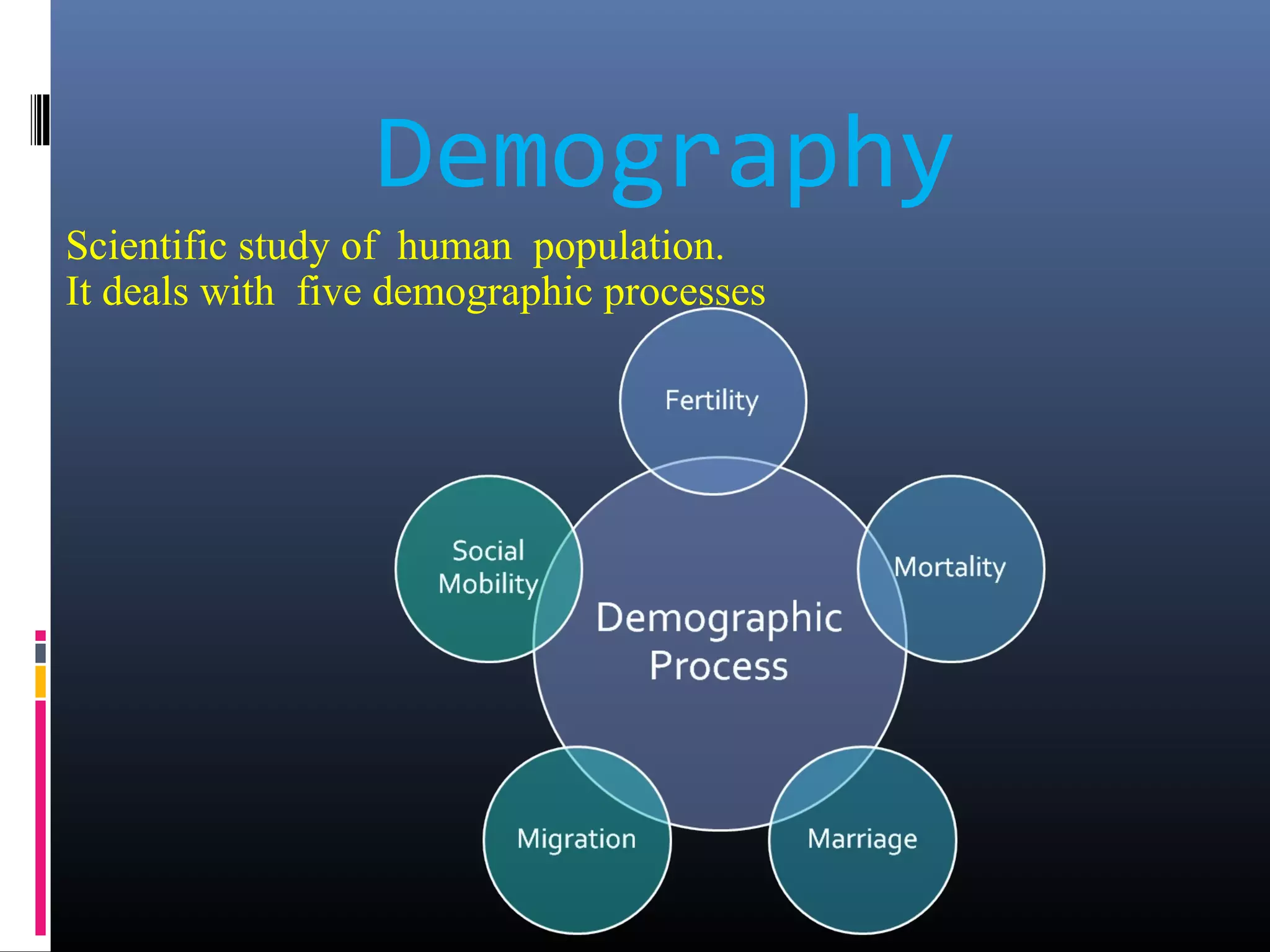
Demography
Scientific study of human population.
It deals with five demographic processes
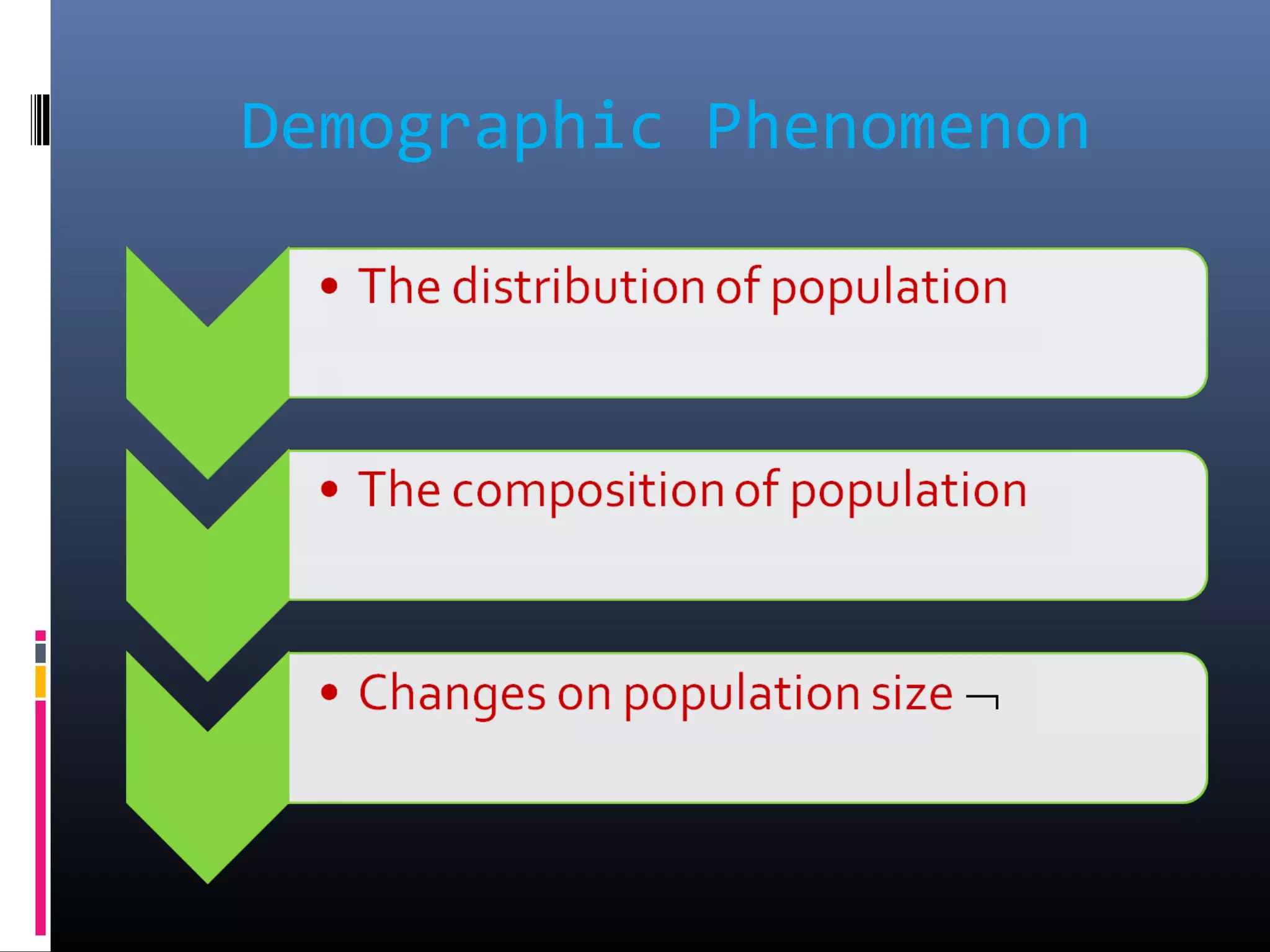
Demographic Phenomenon
Definition of Key Words
Size : the number of persons in
the population
Distribution :arrangement of
the population in space at a given
time
Structure :distribution of
population among its sex & age
groupings
Change : the growth or
decline of the total population .
births
deaths
migrations
 Ethnicity
race
mother tongue
Social characteristics
marital status
literacy
educational attainment
women’s status
Additional characteristics
 Economic characteristics
employment status,
occupation,
income
Sources of Data
1. Census
2. National Survey
3. Registration of vital events
4. Demographic Studies
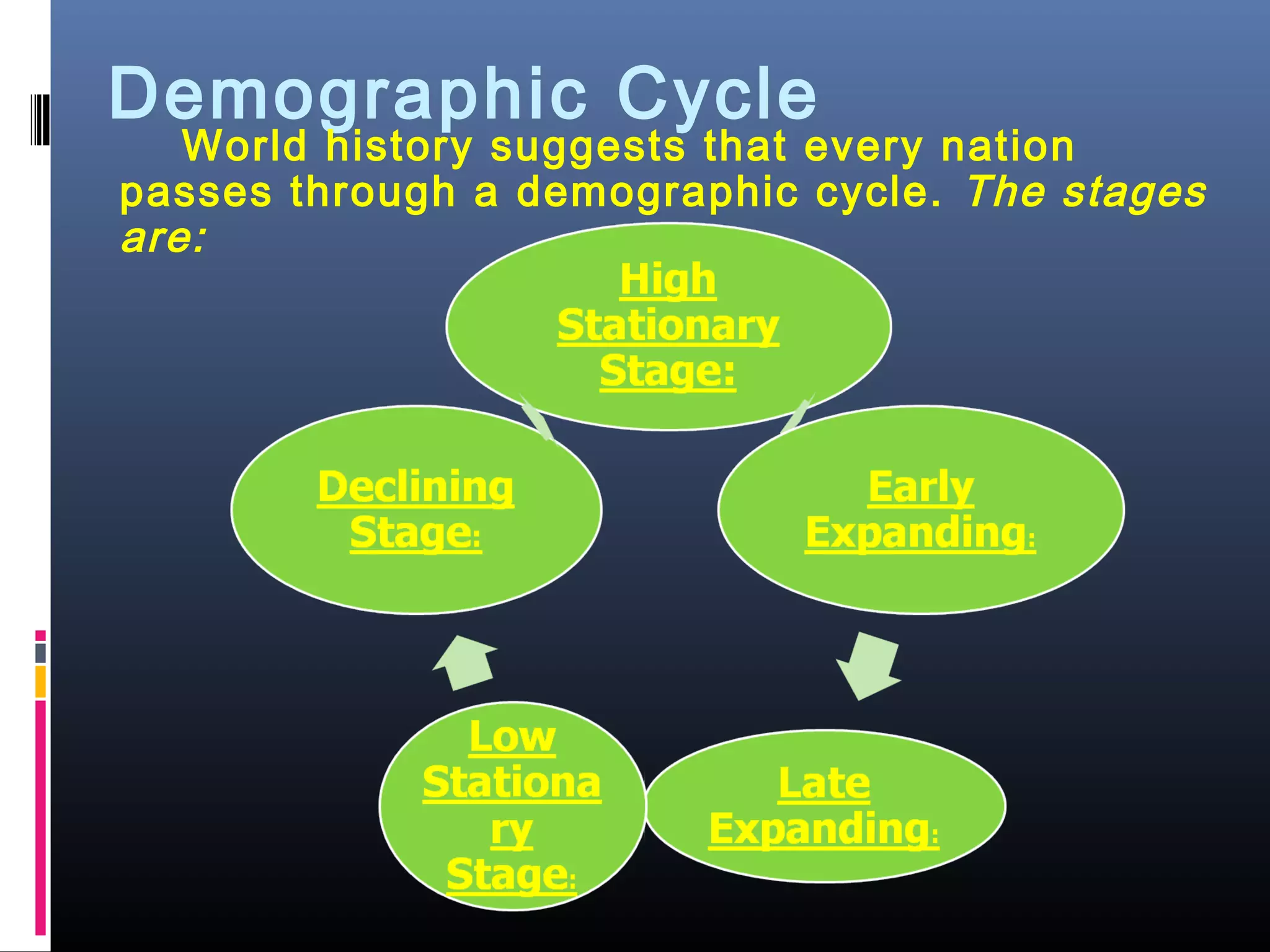
Demographic Cycle
World history suggests that every nation
passes through a demographic cycle. The stages
are:
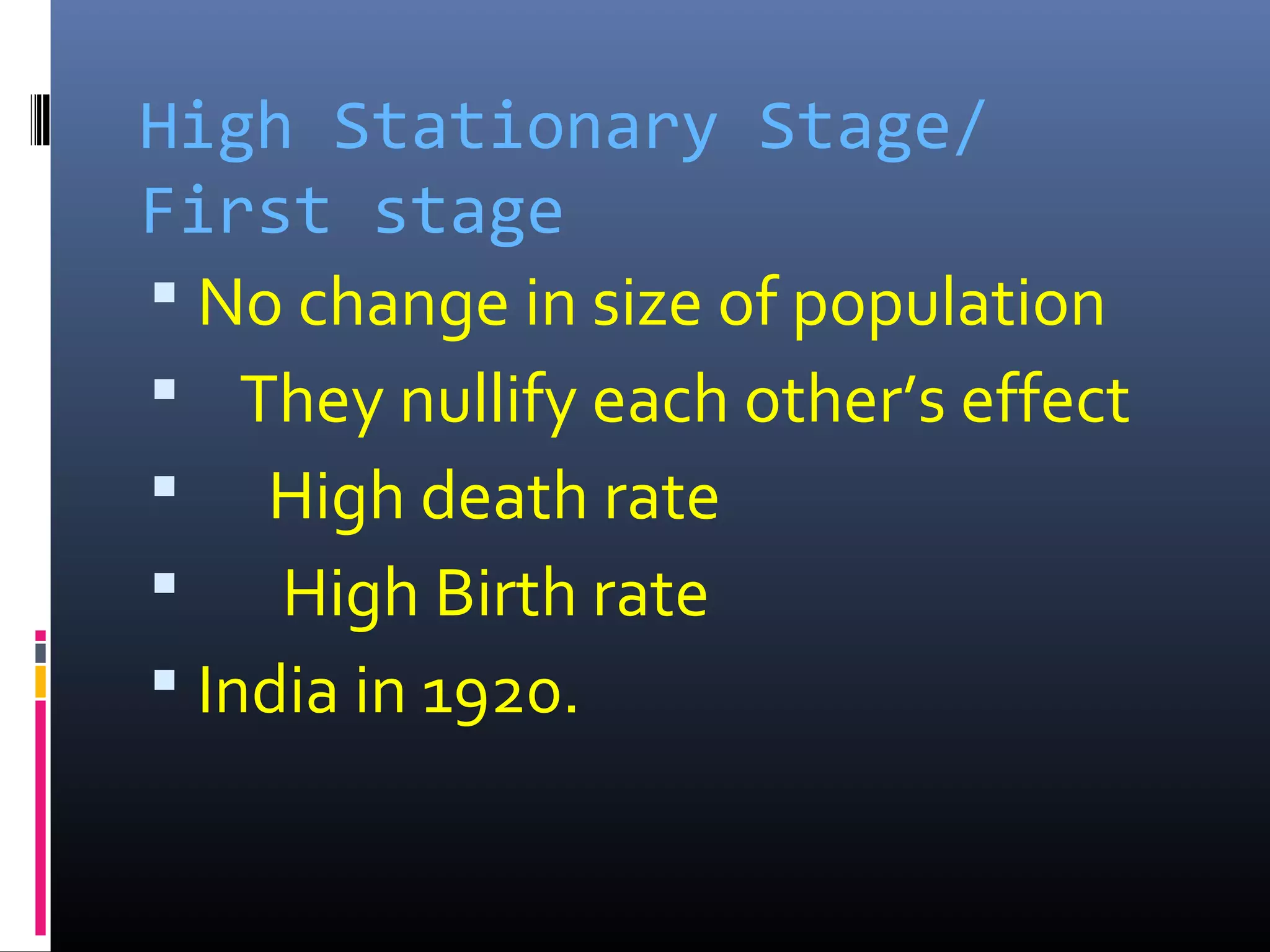
High Stationary Stage/
First stage
 No change in size of population
 They nullify each other’s effect
 High death rate
 High Birth rate
 India in 1920.
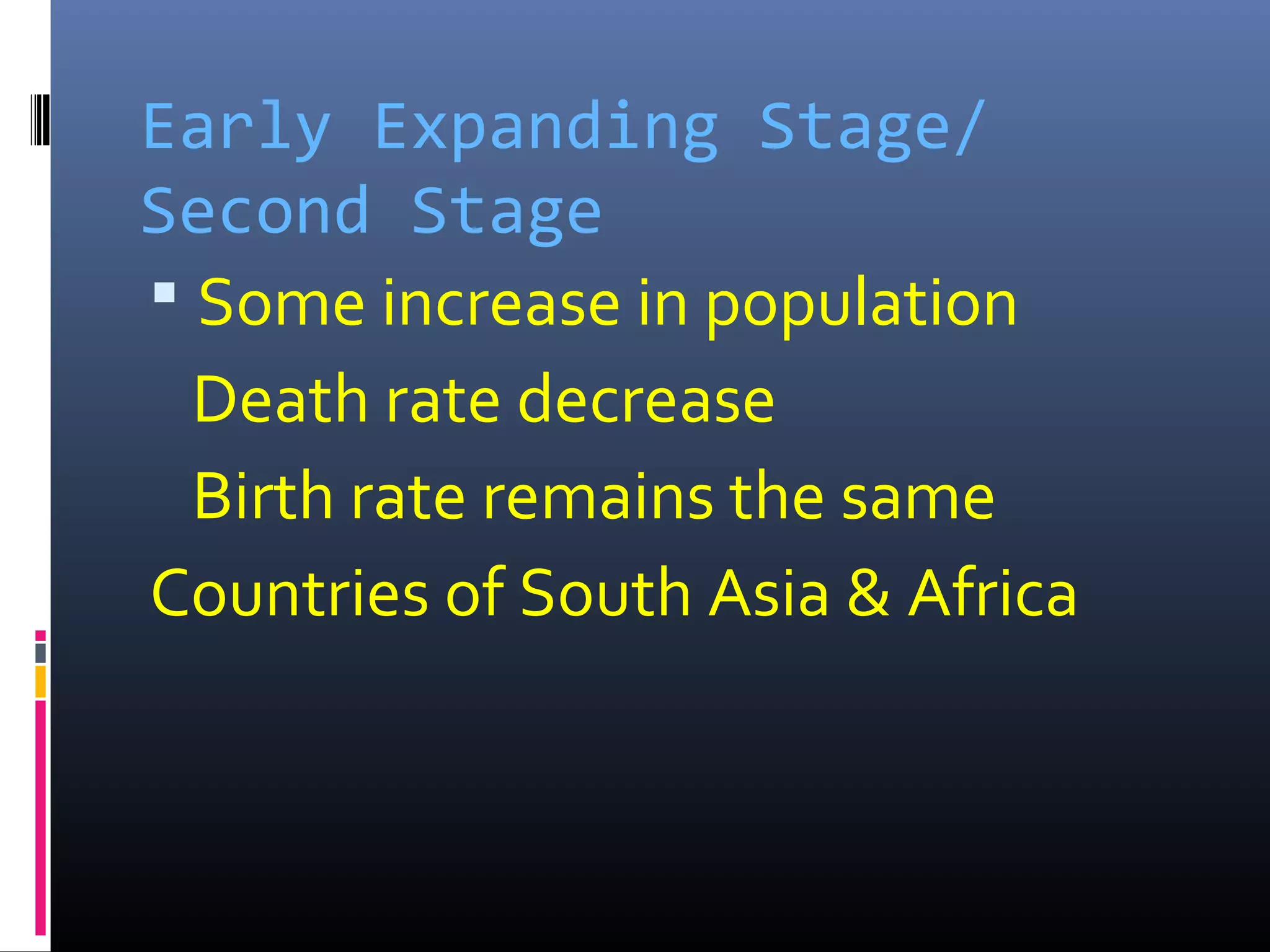
Early Expanding Stage/
Second Stage
 Some increase in population
Death rate decrease
Birth rate remains the same
Countries of South Asia & Africa
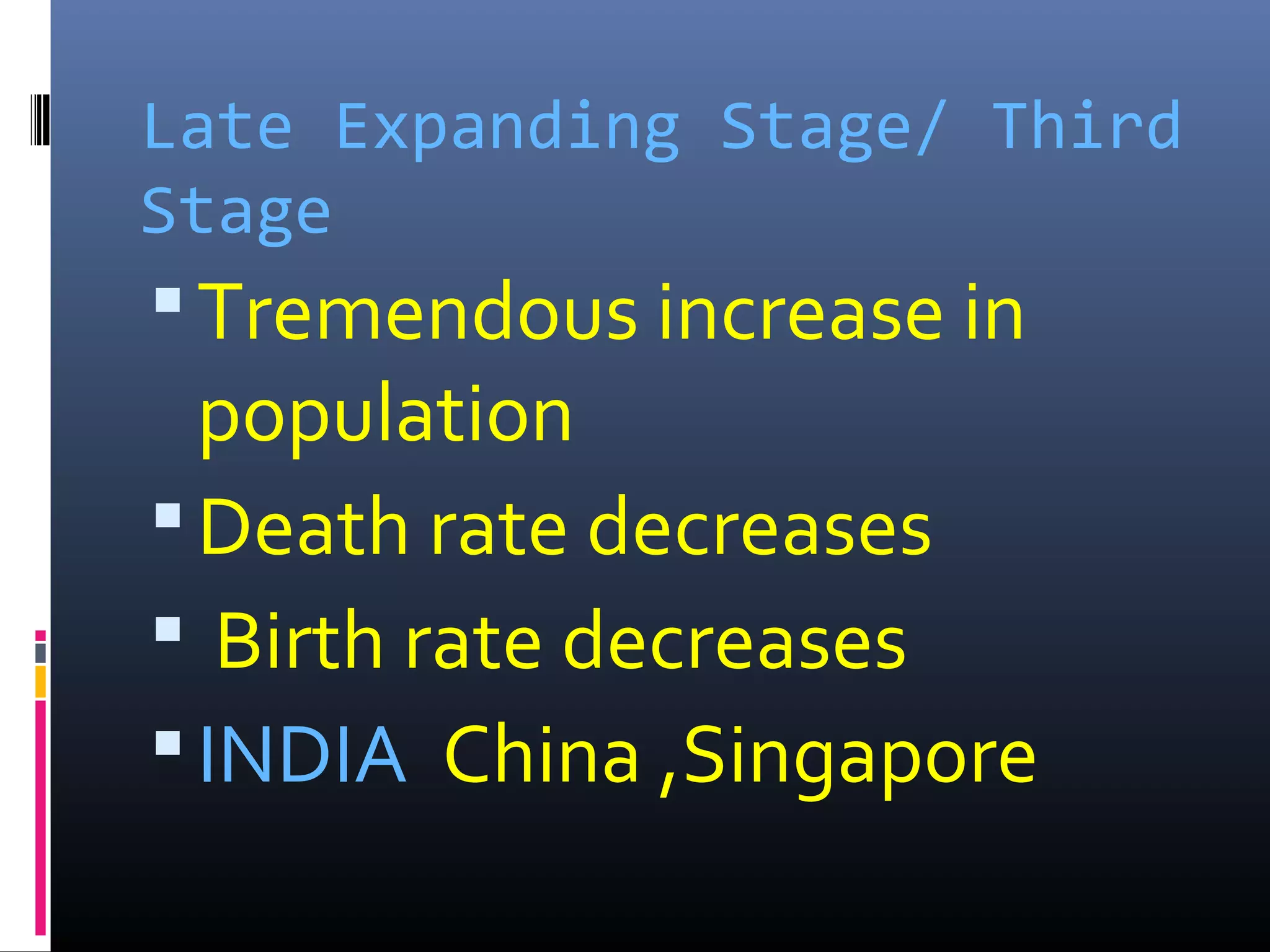
Late Expanding Stage/ Third
Stage
Tremendous increase in
population
Death rate decreases
 Birth rate decreases
INDIA China ,Singapore
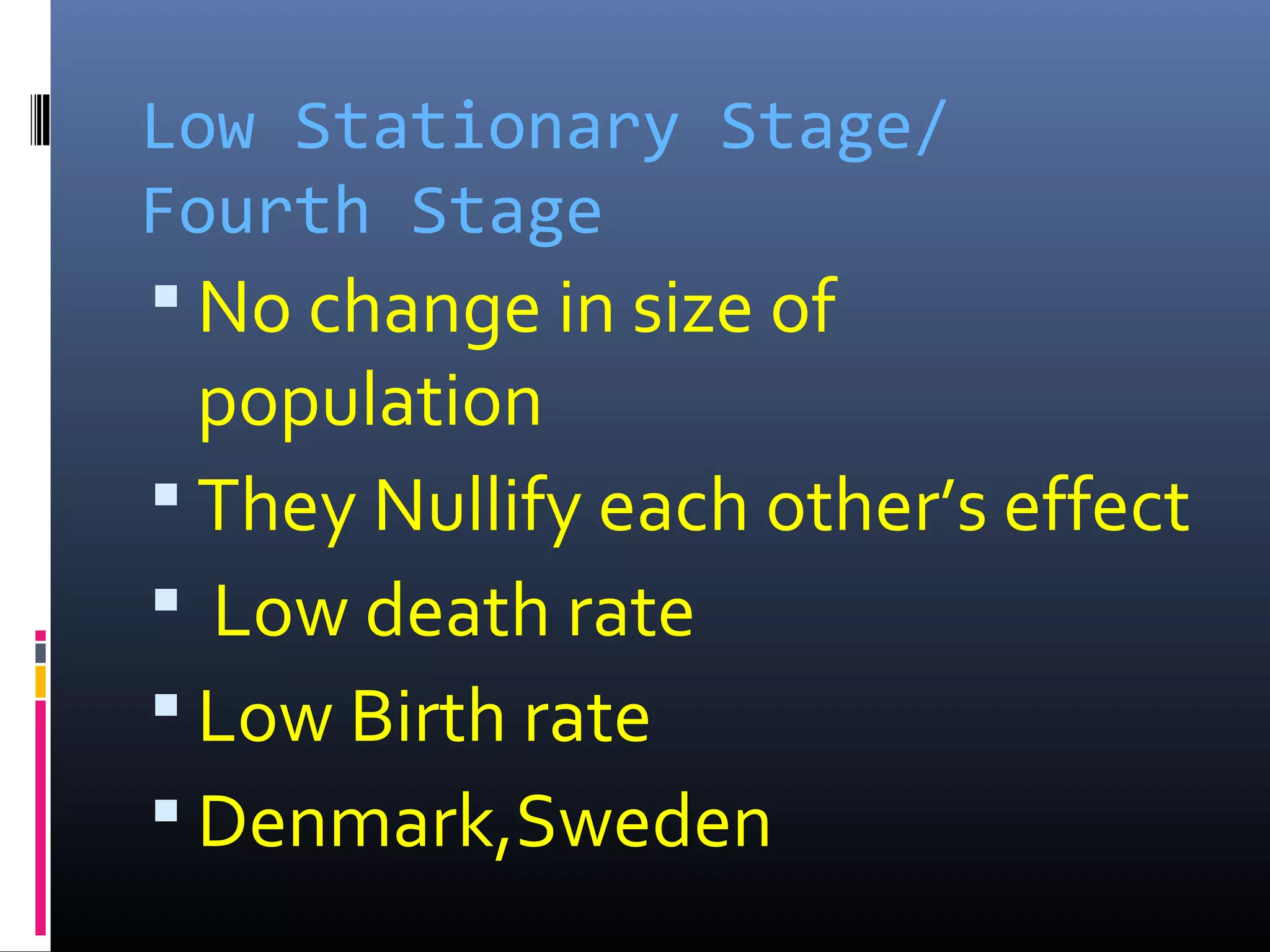
Low Stationary Stage/
Fourth Stage
 No change in size of
population
 They Nullify each other’s effect
 Low death rate
 Low Birth rate
 Denmark,Sweden
Declining Stage/ Fifth
Stage
 Negative growth in population
 Birth rate lower than death
rate.
 Germany,Hungary.
DEMOGRAPHIC
INDICATORS
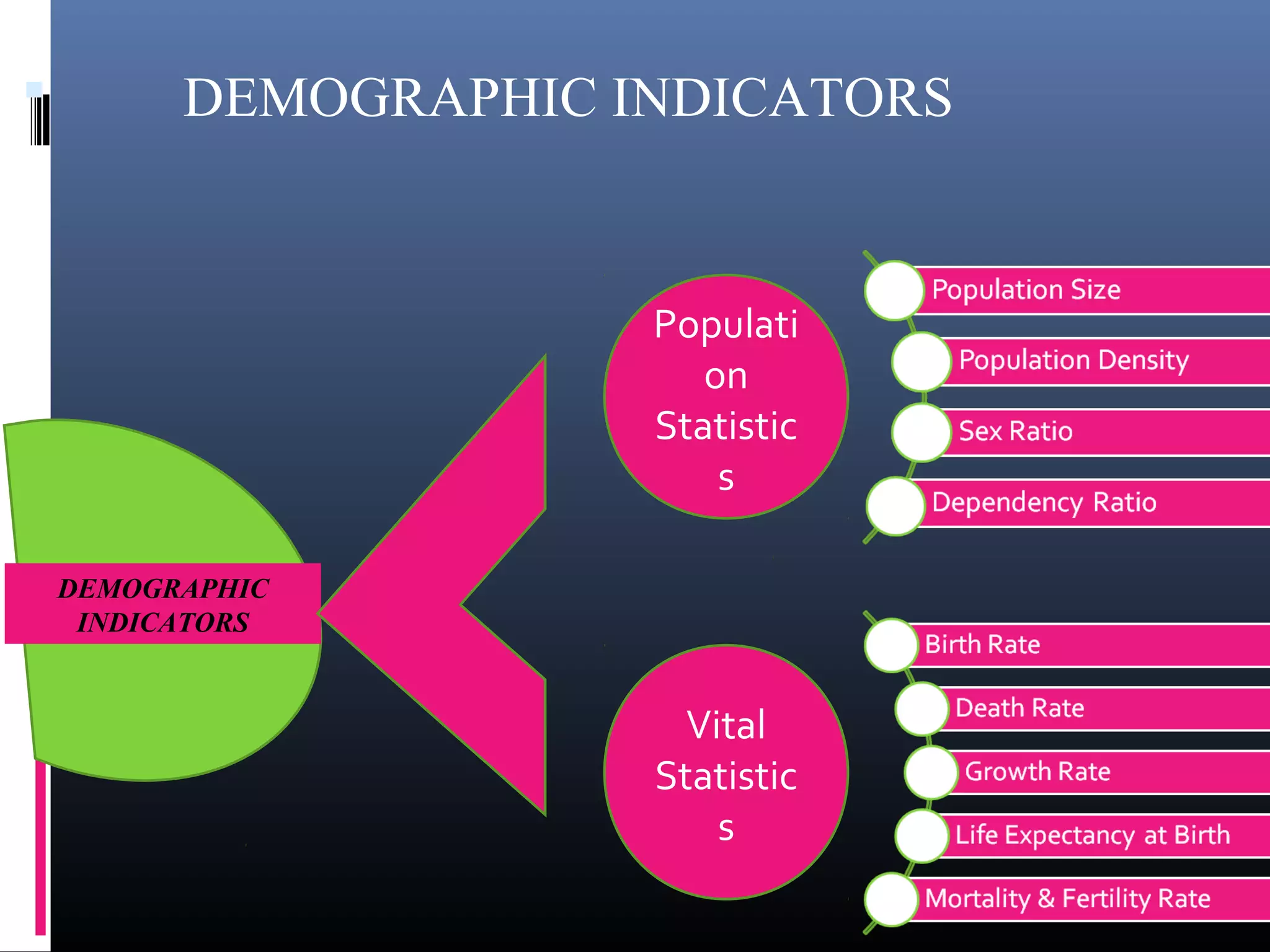
 DEMOGRAPHIC INDICATORS
Populati
on
Statistic
s
Vital
Statistic
s
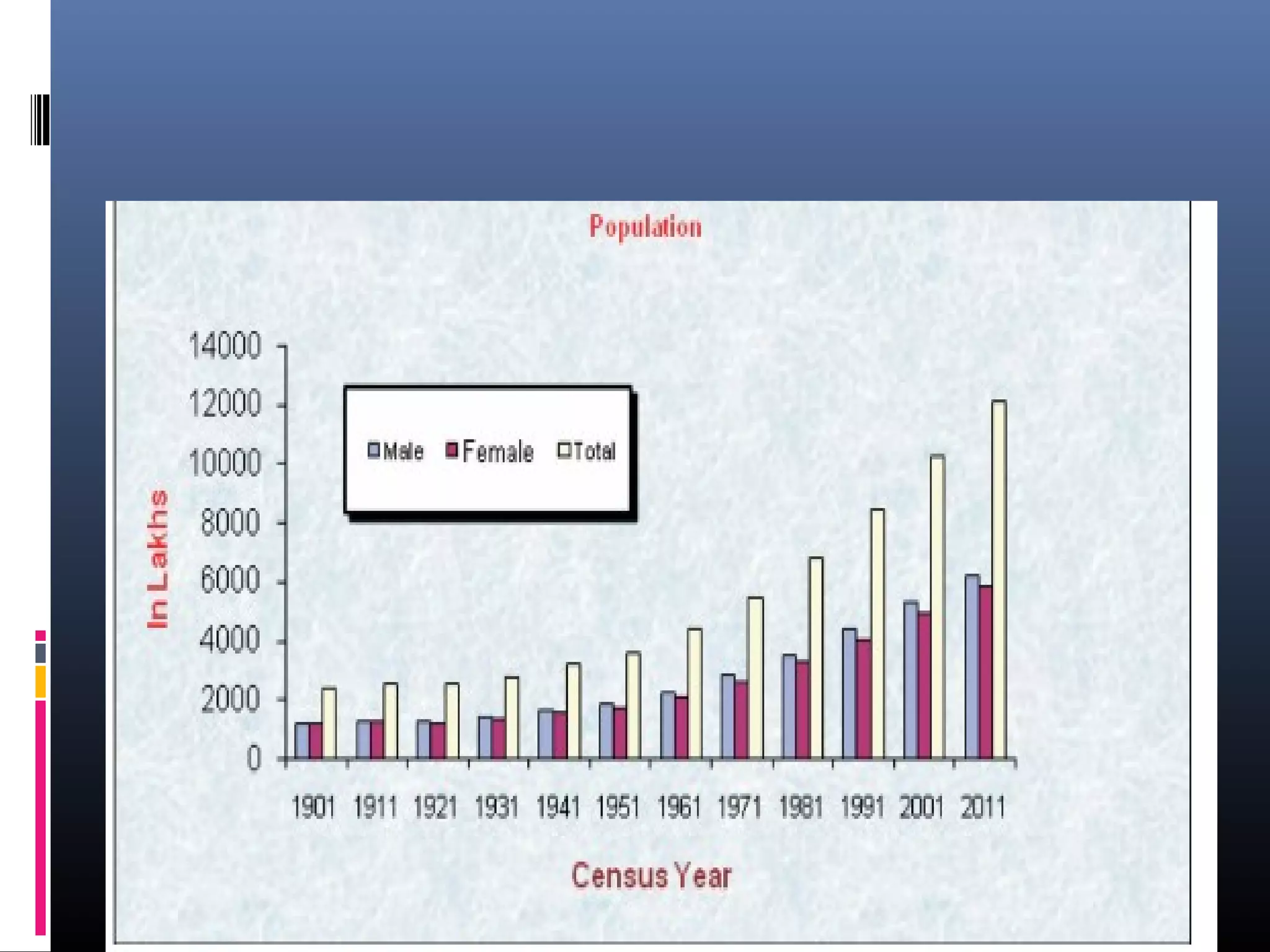
 India’s population, as on 1
March 2011 stood at 1.2
BILLION (6237 lakhs males
and 5864 lakhs females). India
accounts for a meagre 2.4 per
cent of the total world surface
area of 1357.9 lakhs sq km.
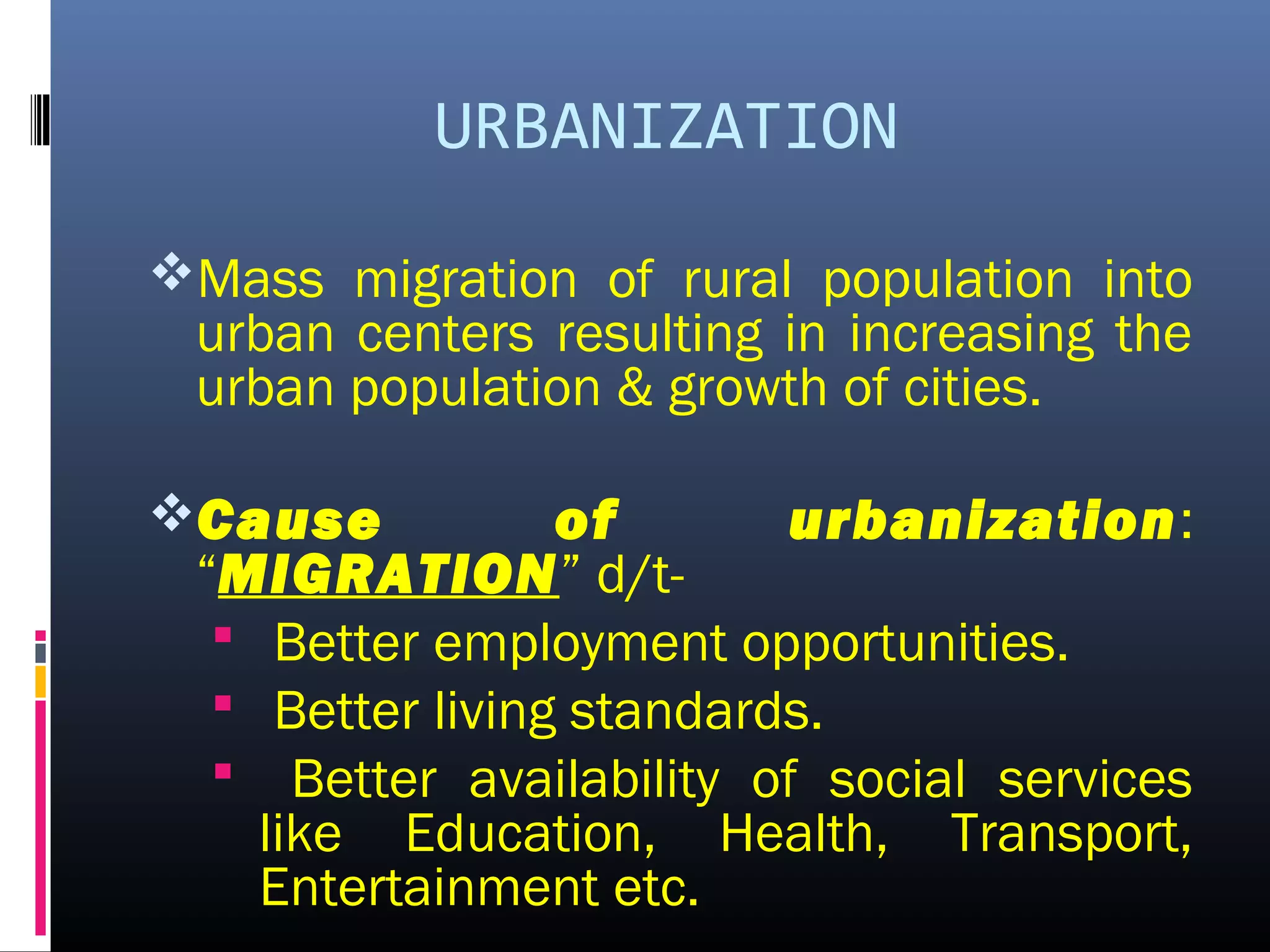
URBANIZATION
Mass migration of rural population into
urban centers resulting in increasing the
urban population & growth of cities.
Cause of urbanization:
“MIGRATION” d/t-
 Better employment opportunities.
 Better living standards.
 Better availability of social services
like Education, Health, Transport,
Entertainment etc.
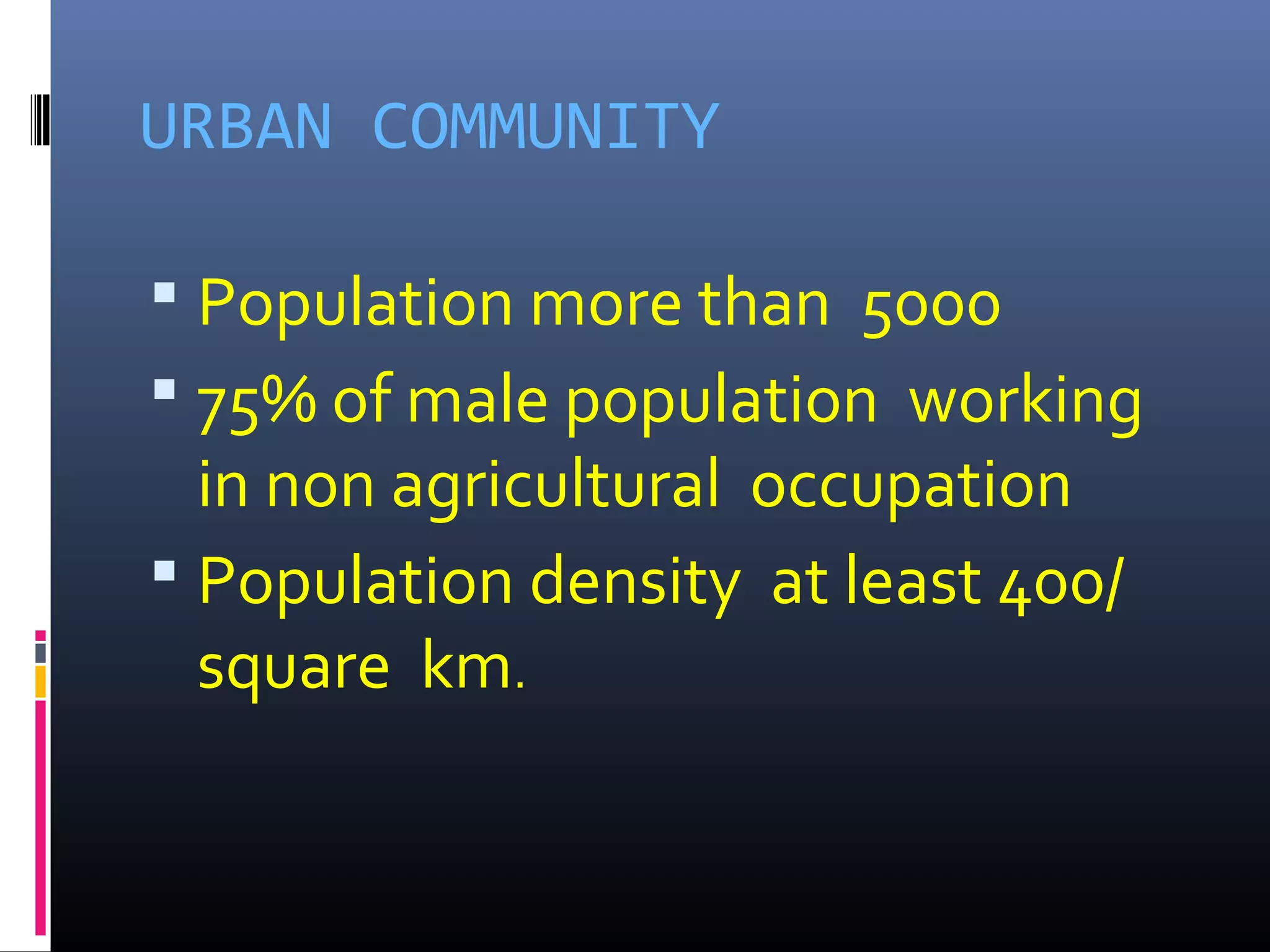
URBAN COMMUNITY
 Population more than 5000
 75% of male population working
in non agricultural occupation
 Population density at least 400/
square km.
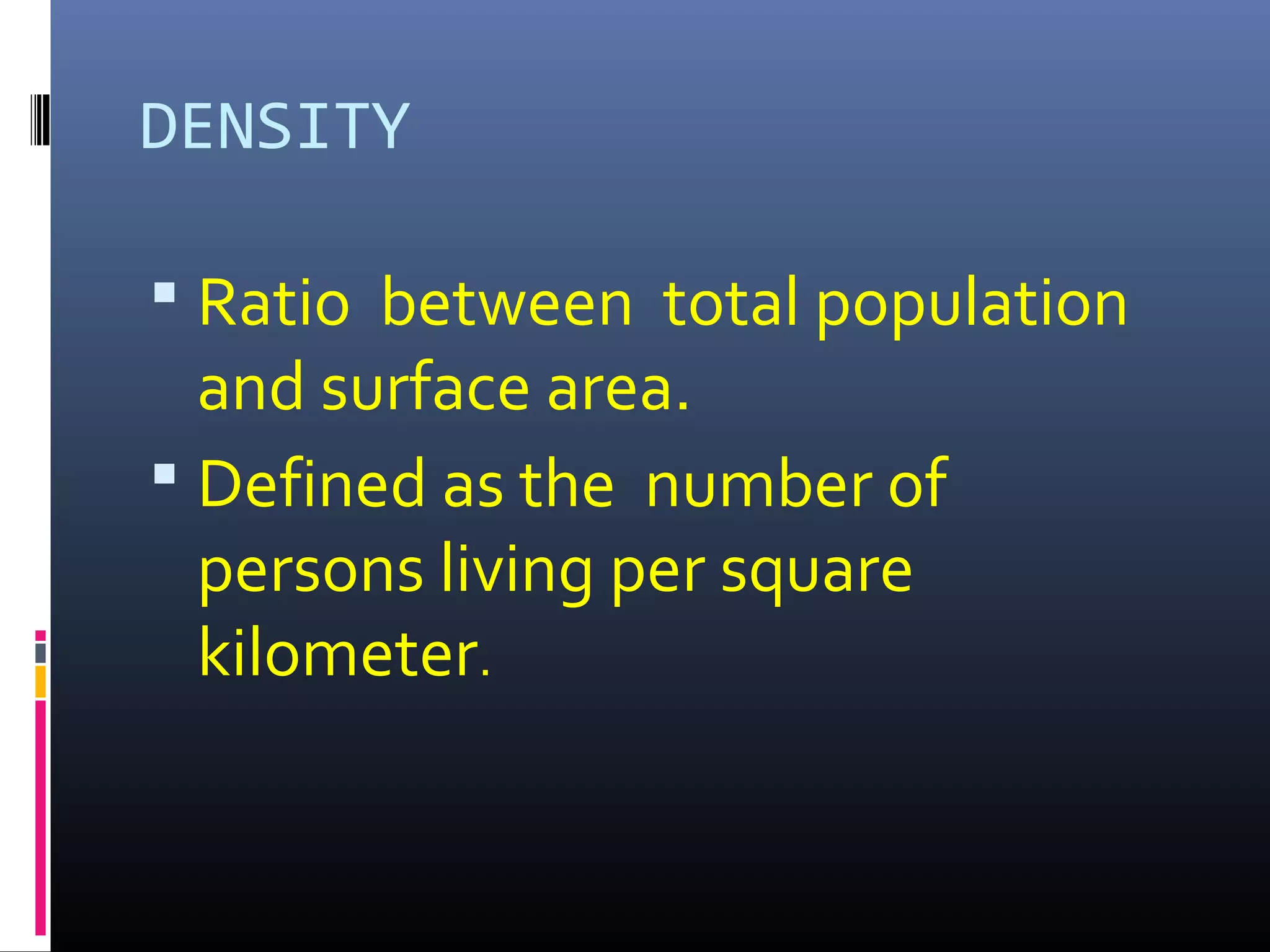
DENSITY
 Ratio between total population
and surface area.
 Defined as the number of
persons living per square
kilometer.
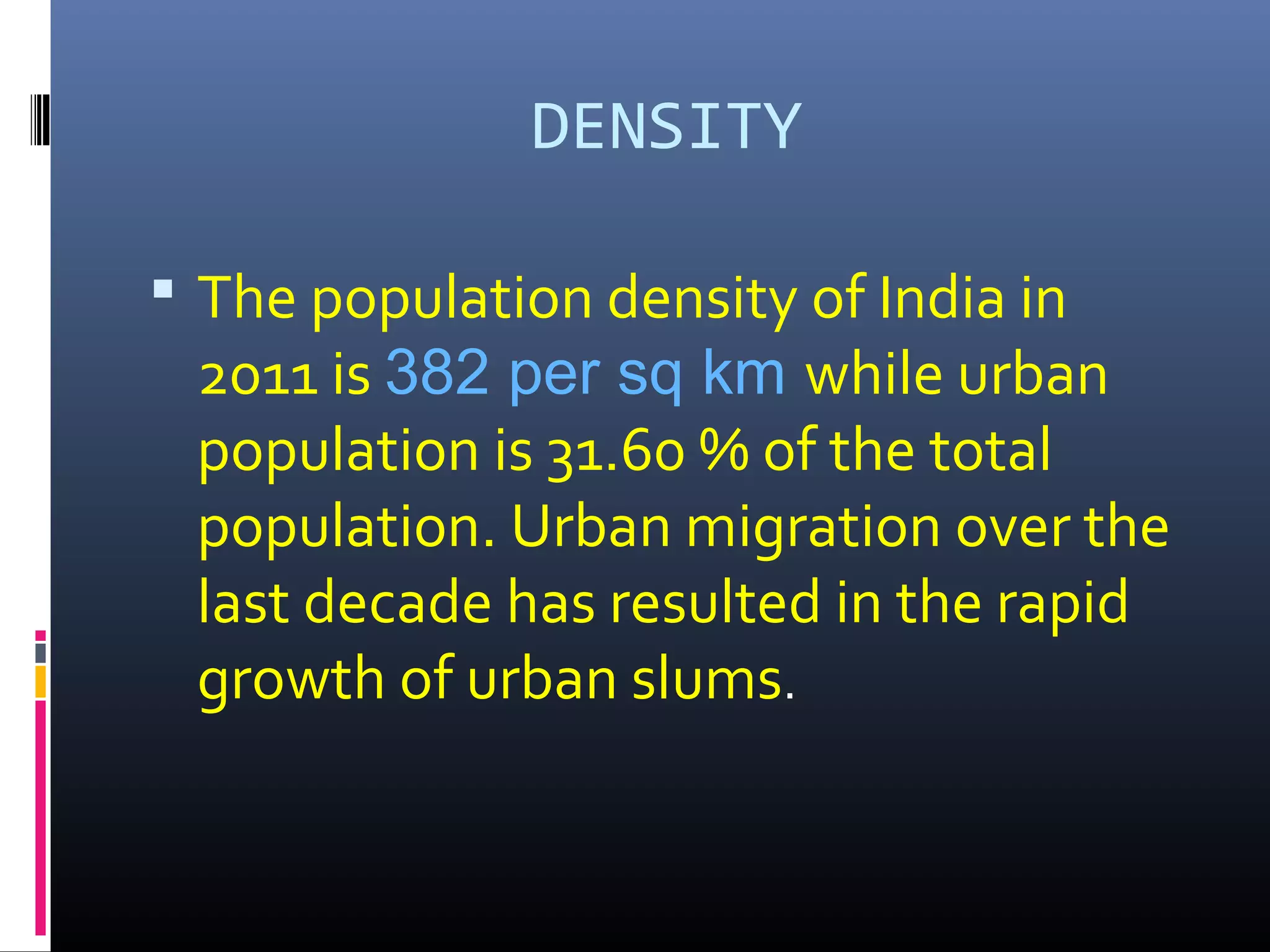
DENSITY
 The population density of India in
2011 is 382 per sq km while urban
population is 31.60 % of the total
population. Urban migration over the
last decade has resulted in the rapid
growth of urban slums.
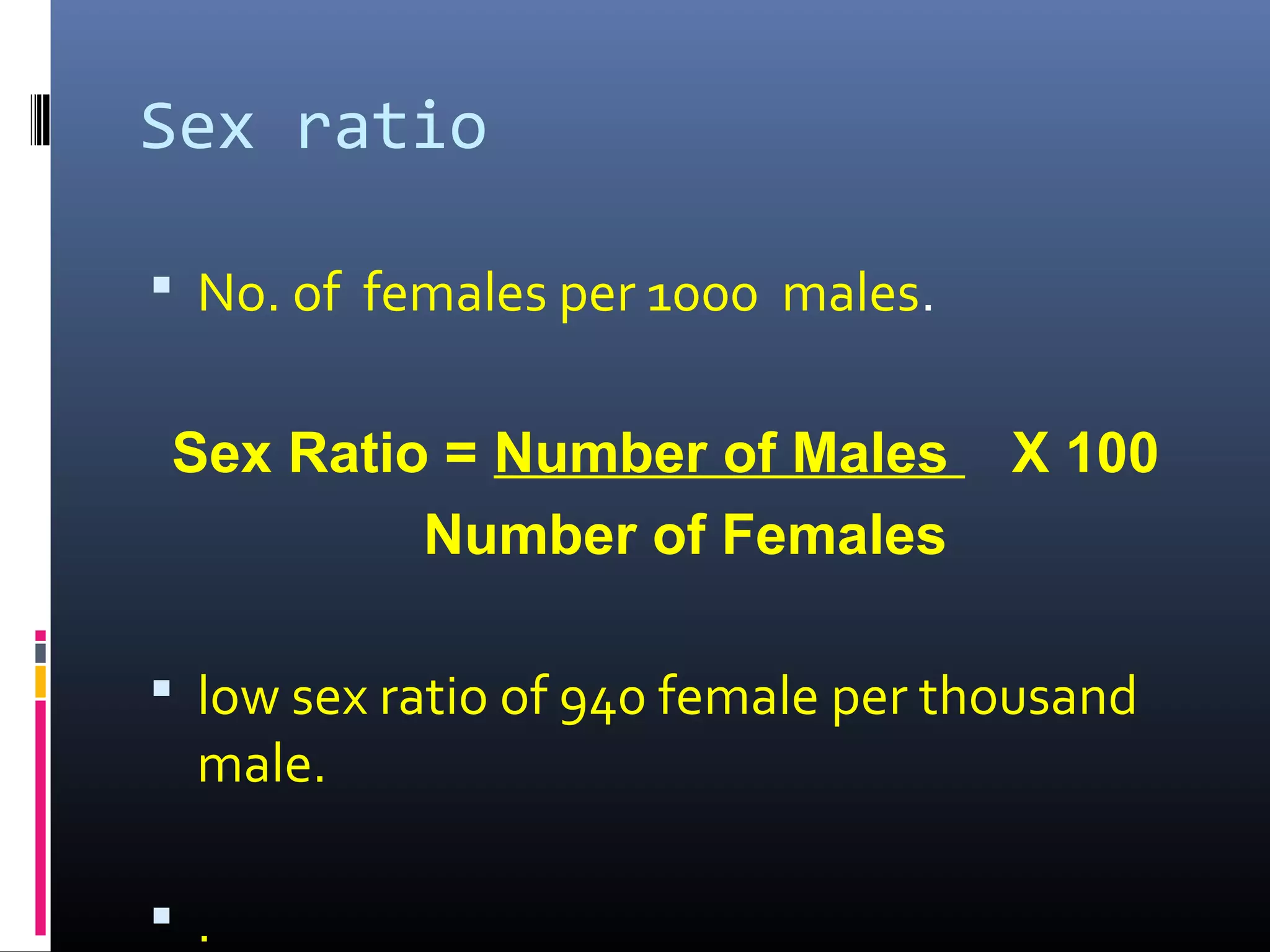
Sex ratio
 No. of females per 1000 males.
Sex Ratio = Number of Males X 100
Number of Females
 low sex ratio of 940 female per thousand
male.
 .
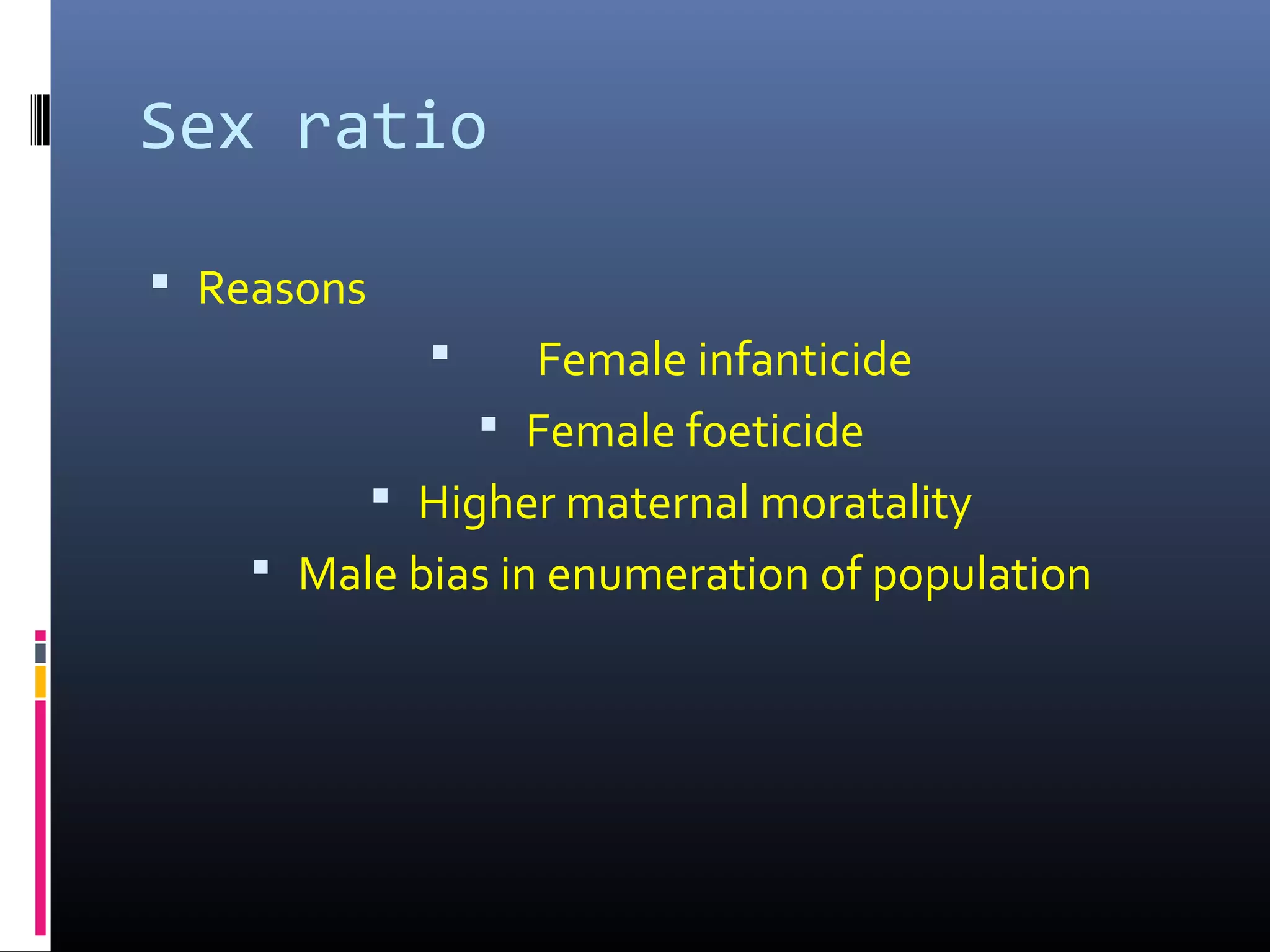
Sex ratio
 Reasons
 Female infanticide
 Female foeticide
 Higher maternal moratality
 Male bias in enumeration of population
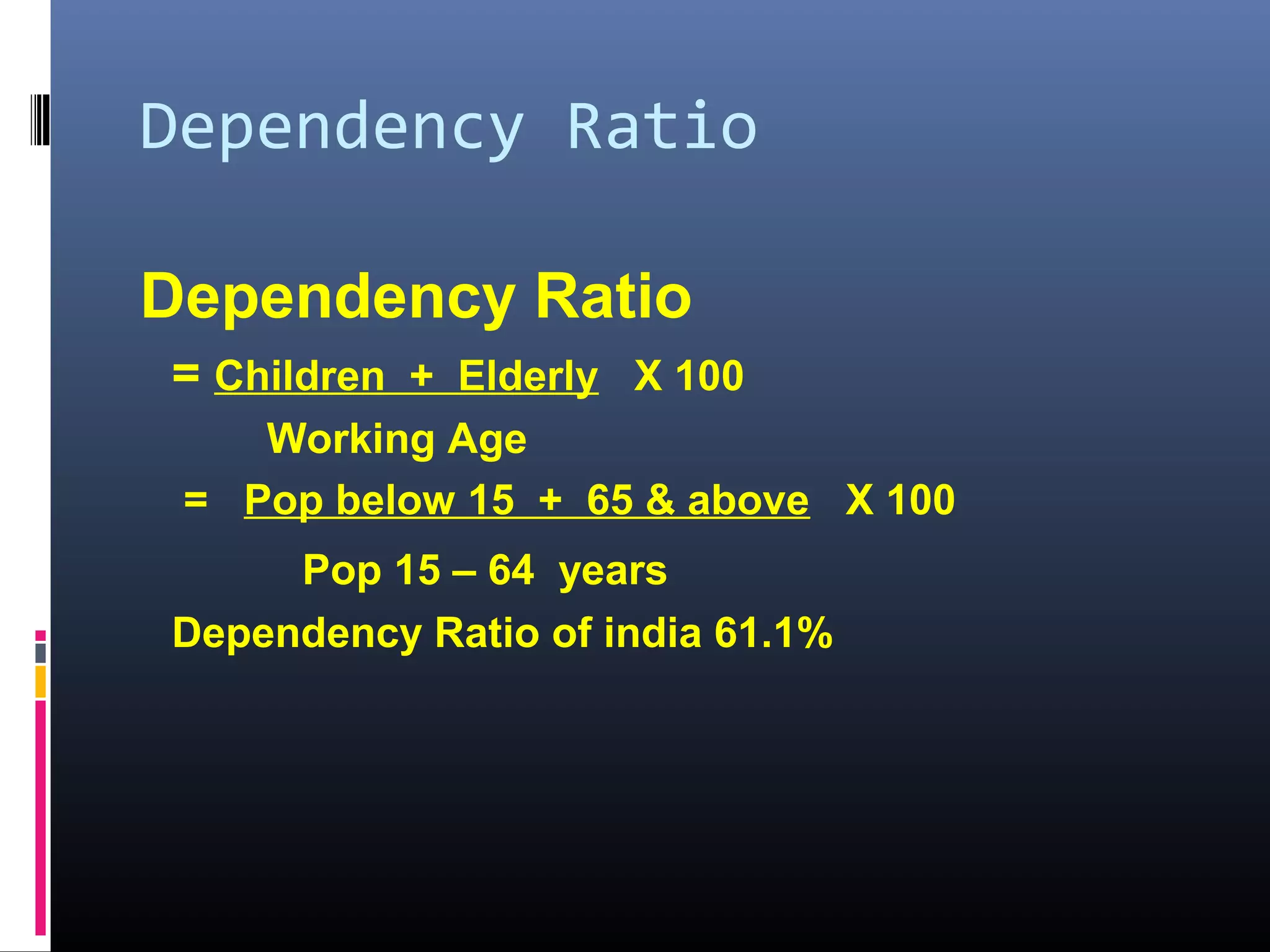
Dependency Ratio
Dependency Ratio
= Children + Elderly X 100
Working Age
= Pop below 15 + 65 & above X 100
Pop 15 – 64 years
Dependency Ratio of india 61.1%
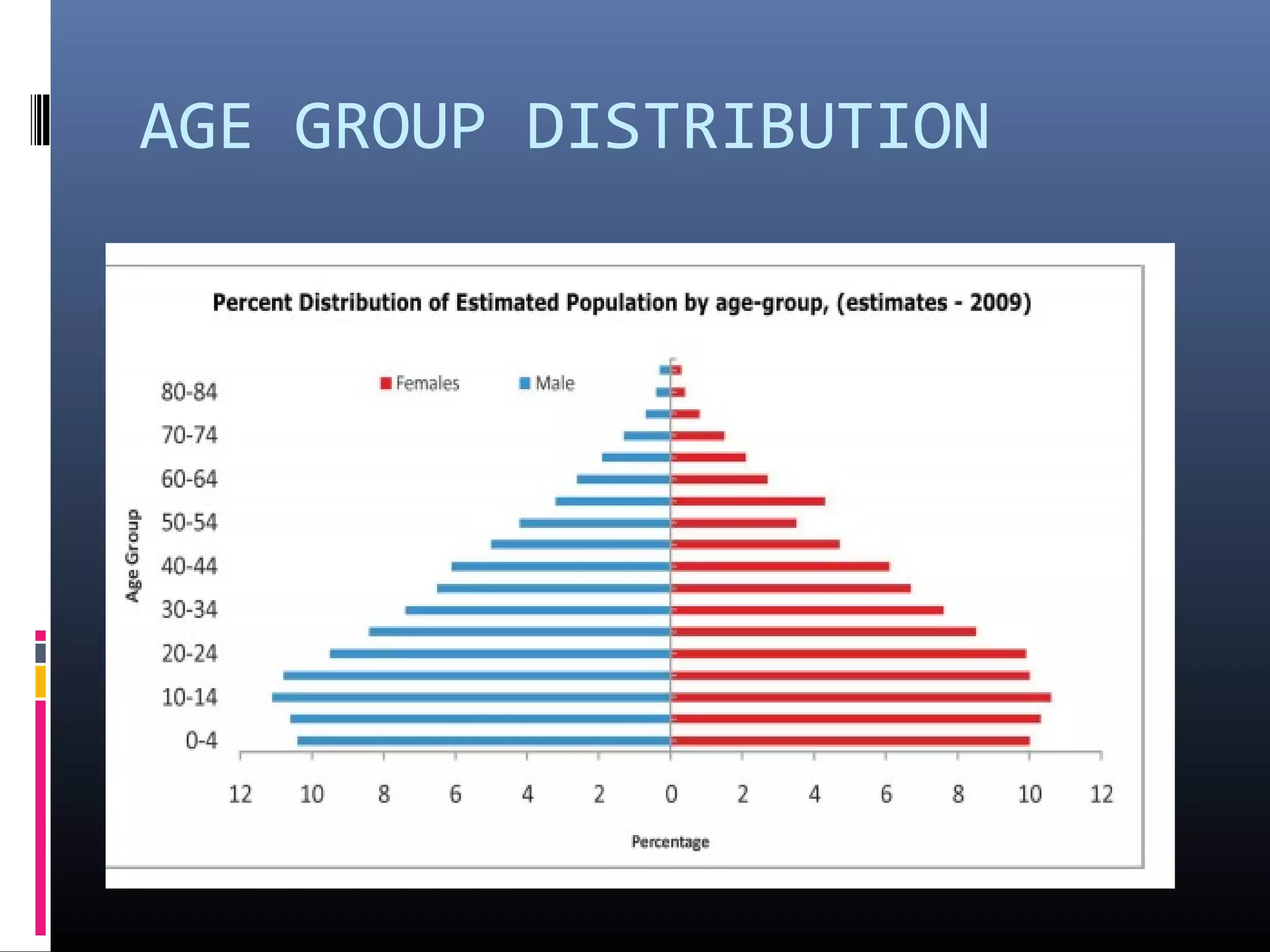
AGE GROUP DISTRIBUTION
Vital Statistics
 Birth Rate
 Death rate
 Growth rate
 Life Expectancy at birth
 Mortality and fertility rates
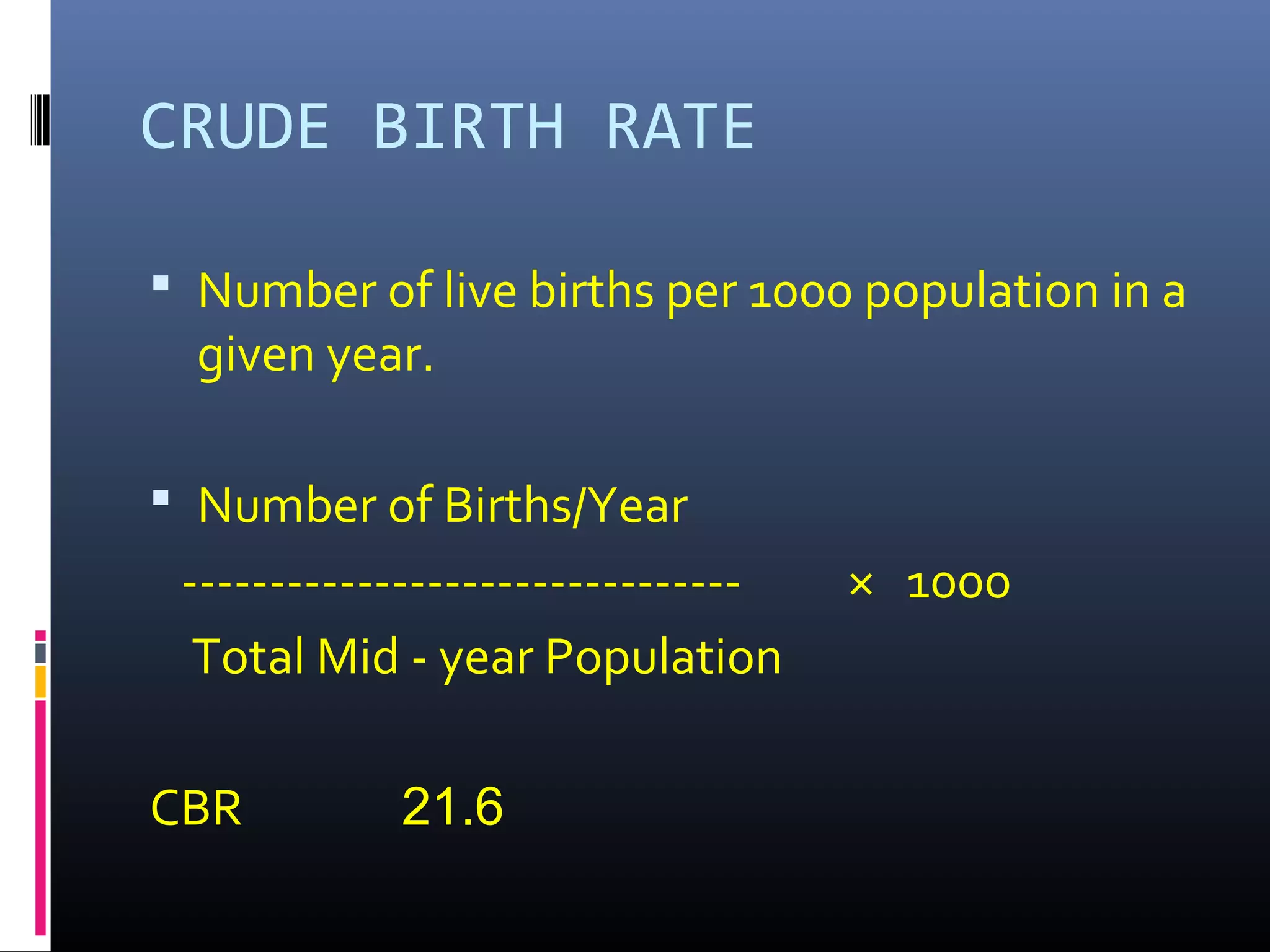
CRUDE BIRTH RATE
 Number of live births per 1000 population in a
given year.
 Number of Births/Year
-------------------------------- × 1000
Total Mid - year Population
CBR 21.6
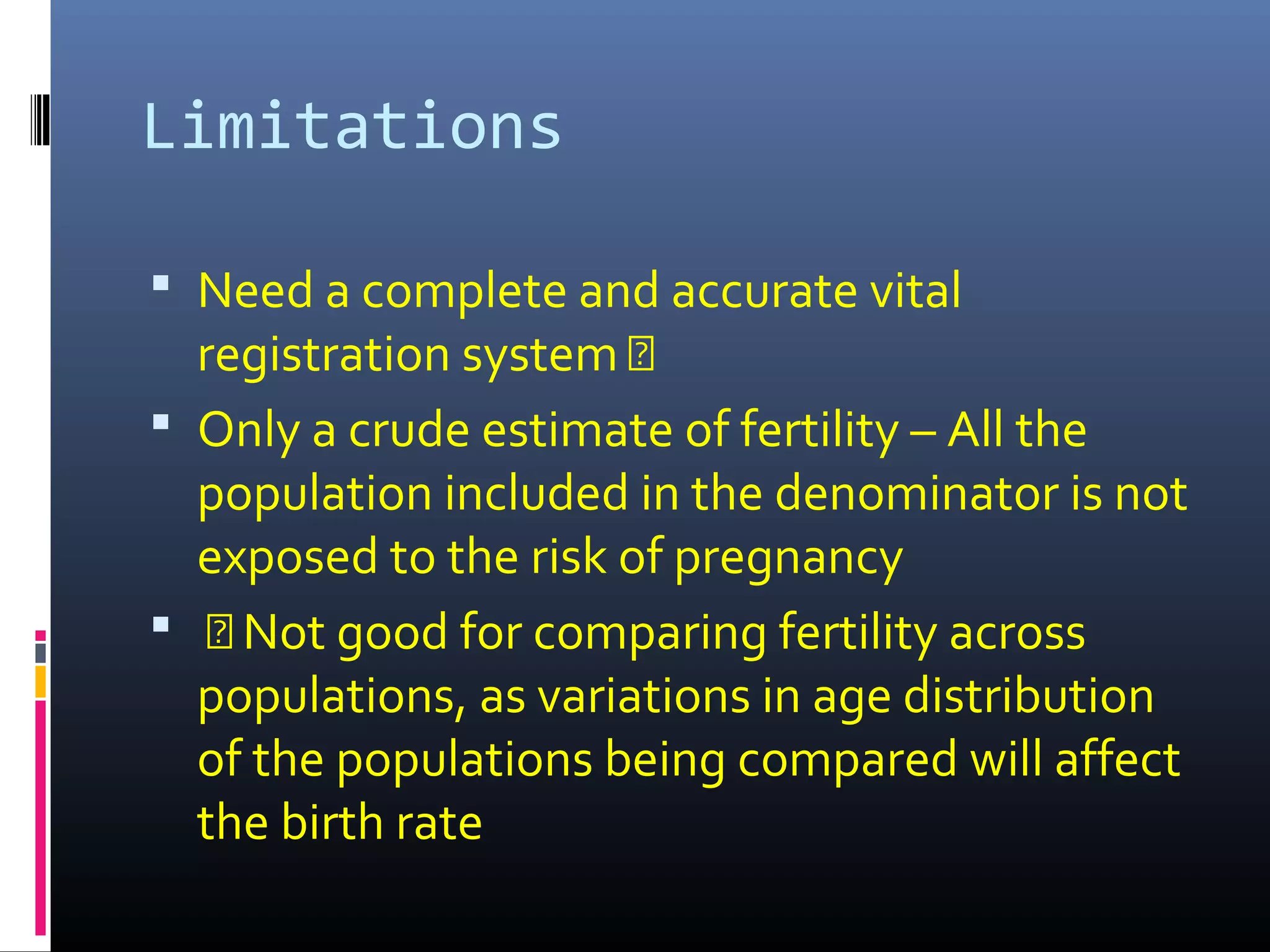
Limitations
 Need a complete and accurate vital
registration system Š
 Only a crude estimate of fertility – All the
population included in the denominator is not
exposed to the risk of pregnancy
 Š Not good for comparing fertility across
populations, as variations in age distribution
of the populations being compared will affect
the birth rate
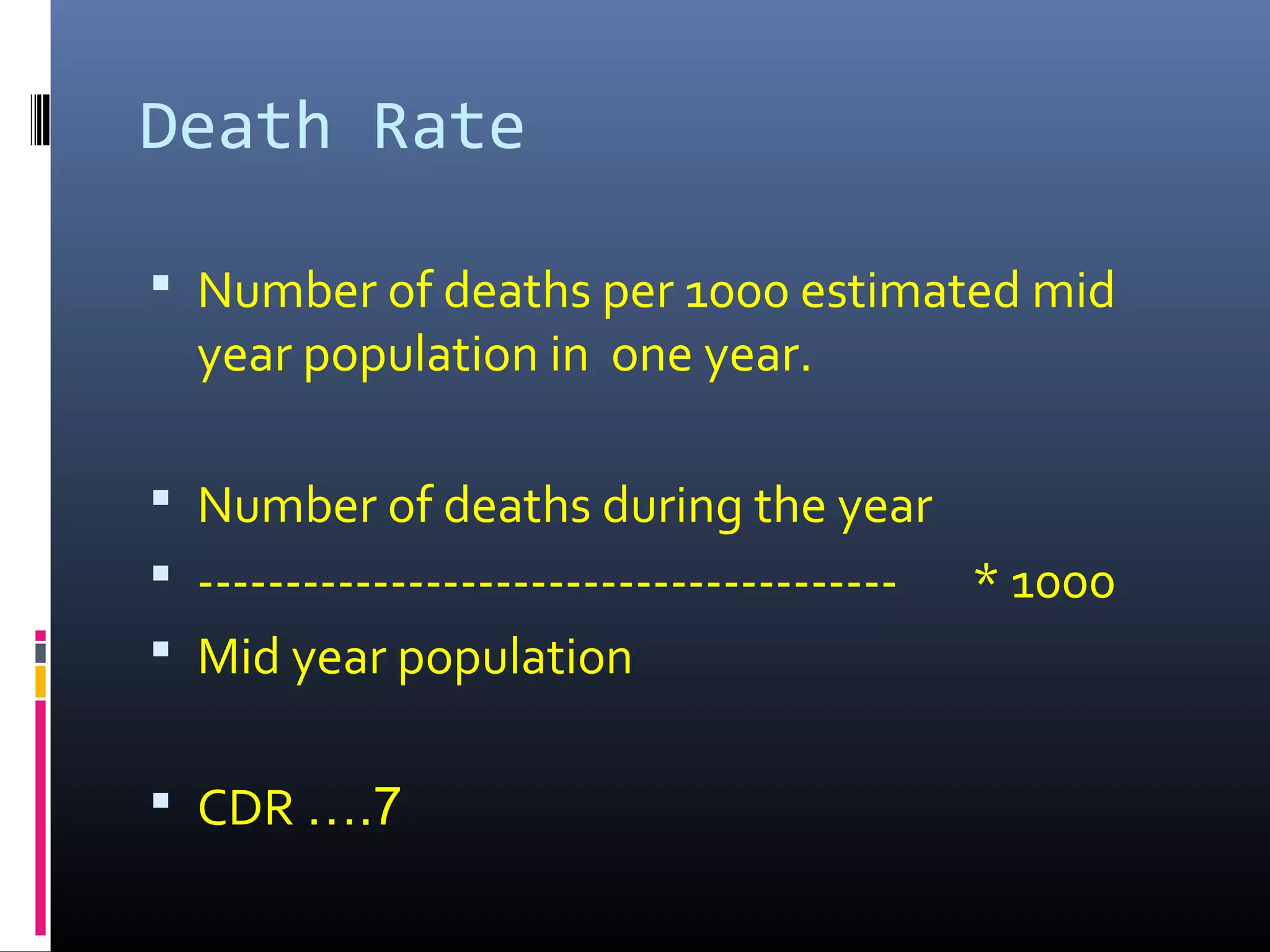
Death Rate
 Number of deaths per 1000 estimated mid
year population in one year.
 Number of deaths during the year
 ---------------------------------------- * 1000
 Mid year population
 CDR ….7
Growth Rate
 Net gain in population
 Second populous country.
Life Expectancy at age one
 Life expectancy is a statistical
measure of how long a person or
organism may live, based on the year
of their birth, their current age and
other demographic factors including
gender.
 Mortality and fertility rates
ANSWER FAST.
 25 births were reported in a
population of 1000 .calculate
CBR.

Concepts of demography

  • 1.
  • 2.
    Demography Scientific study ofhuman population. It deals with five demographic processes
  • 3.
  • 4.
    Definition of KeyWords Size : the number of persons in the population Distribution :arrangement of the population in space at a given time Structure :distribution of population among its sex & age groupings
  • 5.
    Change : thegrowth or decline of the total population . births deaths migrations
  • 6.
     Ethnicity race mother tongue Socialcharacteristics marital status literacy educational attainment women’s status Additional characteristics
  • 7.
     Economic characteristics employmentstatus, occupation, income
  • 8.
    Sources of Data 1.Census 2. National Survey 3. Registration of vital events 4. Demographic Studies
  • 9.
    Demographic Cycle World historysuggests that every nation passes through a demographic cycle. The stages are:
  • 10.
    High Stationary Stage/ Firststage  No change in size of population  They nullify each other’s effect  High death rate  High Birth rate  India in 1920.
  • 11.
    Early Expanding Stage/ SecondStage  Some increase in population Death rate decrease Birth rate remains the same Countries of South Asia & Africa
  • 12.
    Late Expanding Stage/Third Stage Tremendous increase in population Death rate decreases  Birth rate decreases INDIA China ,Singapore
  • 13.
    Low Stationary Stage/ FourthStage  No change in size of population  They Nullify each other’s effect  Low death rate  Low Birth rate  Denmark,Sweden
  • 14.
    Declining Stage/ Fifth Stage Negative growth in population  Birth rate lower than death rate.  Germany,Hungary.
  • 15.
  • 16.
     India’s population,as on 1 March 2011 stood at 1.2 BILLION (6237 lakhs males and 5864 lakhs females). India accounts for a meagre 2.4 per cent of the total world surface area of 1357.9 lakhs sq km.
  • 18.
    URBANIZATION Mass migration ofrural population into urban centers resulting in increasing the urban population & growth of cities. Cause of urbanization: “MIGRATION” d/t-  Better employment opportunities.  Better living standards.  Better availability of social services like Education, Health, Transport, Entertainment etc.
  • 19.
    URBAN COMMUNITY  Populationmore than 5000  75% of male population working in non agricultural occupation  Population density at least 400/ square km.
  • 20.
    DENSITY  Ratio betweentotal population and surface area.  Defined as the number of persons living per square kilometer.
  • 21.
    DENSITY  The populationdensity of India in 2011 is 382 per sq km while urban population is 31.60 % of the total population. Urban migration over the last decade has resulted in the rapid growth of urban slums.
  • 22.
    Sex ratio  No.of females per 1000 males. Sex Ratio = Number of Males X 100 Number of Females  low sex ratio of 940 female per thousand male.  .
  • 23.
    Sex ratio  Reasons Female infanticide  Female foeticide  Higher maternal moratality  Male bias in enumeration of population
  • 24.
    Dependency Ratio Dependency Ratio =Children + Elderly X 100 Working Age = Pop below 15 + 65 & above X 100 Pop 15 – 64 years Dependency Ratio of india 61.1%
  • 25.
  • 26.
    Vital Statistics  BirthRate  Death rate  Growth rate  Life Expectancy at birth  Mortality and fertility rates
  • 27.
    CRUDE BIRTH RATE Number of live births per 1000 population in a given year.  Number of Births/Year -------------------------------- × 1000 Total Mid - year Population CBR 21.6
  • 28.
    Limitations  Need acomplete and accurate vital registration system Š  Only a crude estimate of fertility – All the population included in the denominator is not exposed to the risk of pregnancy  Š Not good for comparing fertility across populations, as variations in age distribution of the populations being compared will affect the birth rate
  • 29.
    Death Rate  Numberof deaths per 1000 estimated mid year population in one year.  Number of deaths during the year  ---------------------------------------- * 1000  Mid year population  CDR ….7
  • 30.
    Growth Rate  Netgain in population  Second populous country.
  • 31.
    Life Expectancy atage one  Life expectancy is a statistical measure of how long a person or organism may live, based on the year of their birth, their current age and other demographic factors including gender.
  • 32.
     Mortality andfertility rates
  • 33.
    ANSWER FAST.  25births were reported in a population of 1000 .calculate CBR.