DEMOGRAPHY
1
Dr. Vineetha K.
Department of public health dentistry
BASIC PRINCIPLES
CONTENTS
01
02
03
05
04
06
POPULATION GROWTH
CAUSES OF POPULATION GROWTH
FUNCTIONS OF DEMOGRAPHY
INTRODUCTION
IBN KHALDUN
JOHN GRAUNT
EDMUND HALLEY
JOHN SNOW
HISTORY
MALTHUSIAN
MARXIAN
OPTIMUM POPULATION
DEMOGRAPHIC TRANSITION
THEORIES
DEMOGRAPHIC
PROCESSES
CYCLE
MODEL
INDIA IN NUMBERS
-POPULATION STATISTICS
-VITAL STATISTICS
DEMOGRAPHIC
INDICATORS
POPULATION
TRENDS
2
TIMELINE
• Few million years ago 10 MILLION
• 8000 BC 500 MILLION
• 1800 1 BILLION
• 1930 2 BILLION
• 1975 4 BILLION
• 1999 6 BILLION
• 2011 7 BILLION
FUTURE POPULATION PROJECTION
• 2030 9.5 BILLION
• 2100 12.6 BILLION
Population growth – an epidemic of homo sapiens
3
Population Reference Beaureu
INTRODUCTION
CAUSAL LOOP DIAGRAM
4
DEMOGRAPHY
Demos – People Graphy - Measurement
Scientific study of human population
5
FUNCTIONS OF DEMOGRAPHY
6
HISTORY
IBN KHALDUN (1332-1406)
• Father of demography
7
Economic analysis of social organization which produce the
first scientific and theoretical work on population,
development and group dynamics
JOHN GRAUNT
Credited for producing the first life table,
giving probabilities of survival to each age.
8
EDMUND HAILLEY
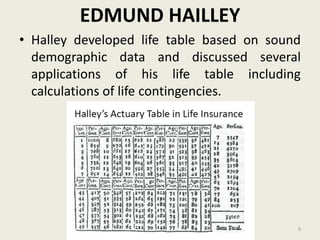
• Halley developed life table based on sound
demographic data and discussed several
applications of his life table including
calculations of life contingencies.
9
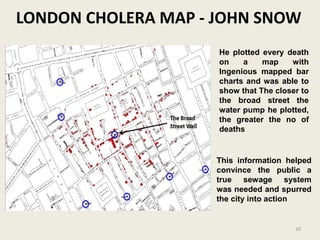
LONDON CHOLERA MAP - JOHN SNOW
10
He plotted every death
on a map with
Ingenious mapped bar
charts and was able to
show that The closer to
the broad street the
water pump he plotted,
the greater the no of
deaths
This information helped
convince the public a
true sewage system
was needed and spurred
the city into action
THEORIES OF POPULATION
GROWTH AND DECLINE
• Malthusian theory
• Marxian theory
• Optimum population theory
• The demographic transition theory
11
MALTHUSIAN THEORY
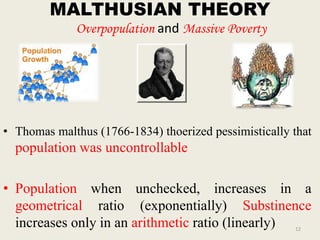
• Thomas malthus (1766-1834) thoerized pessimistically that
population was uncontrollable
• Population when unchecked, increases in a
geometrical ratio (exponentially) Substinence
increases only in an arithmetic ratio (linearly) 12
Overpopulation and Massive Poverty
MARXIAN THEORY
• KARL MARX believed that the problem was not
primarily one of the population but one of the
ownership of the means of production and the
inequitable distribution of the societies wealth.
• Marx felt that population could ultimately be controlled
by the complex workings of market economics and that
the economic markets, as they expanded, would be able
to sustain population at whatever level it had reached.13
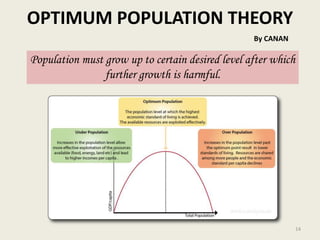
OPTIMUM POPULATION THEORY
14
Population must grow up to certain desired level after which
further growth is harmful.
By CANAN
DEMOGRAPHIC TRANSITION
THEORY
15
1. High birth rate and high death rate
2. High birth rate and low death rate (population
explosion)
3. Low birth rate and low death rate
Industrial and commercial development first cuts the
death rate but creates a desire for smaller families and
eventually cuts the birth rate.
-Proposed by F. Notestein
16
To describe population dynamics is the
Demographic Transition Cycle and Model.
o First stage - High stationary
o Second stage - Early expanding
o Third stage - Late expanding
o Fourth stage - Low stationary
o Fifth stage - Declining
HIGH
STATIONARY
EARLY
EXPANDING
LATE
EXPANDING
LOW
STATIONARY
DECLINING
by C.P Blacker
DEMOGRAPHIC CYCLE
5 STAGES OF DEMOGRAPHI CYCLE
STAGE BR DR EXAMPLES
Stage HIGH India was in this
1 STATIONARY stage till 1920
Stage EARLY South Asia & Africa
2 EXPANDING
Stage LATE India, China
3 EXPANDING Singapore
Stage LOW UK, Denmark, Sweden
4 STATIONARY Belgium
Stage DECLINING Germany & Hungary
5
17
INDIA 1920 High stationary
INDIA PRESENT Late expanding
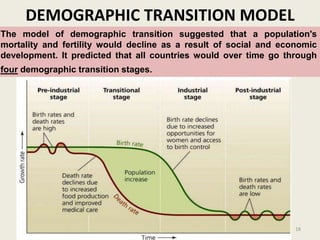
DEMOGRAPHIC TRANSITION MODEL
18
The model of demographic transition suggested that a population's
mortality and fertility would decline as a result of social and economic
development. It predicted that all countries would over time go through
four demographic transition stages.
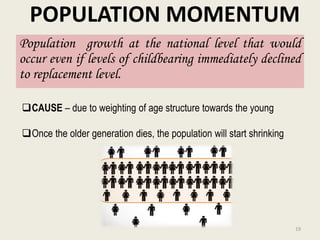
POPULATION MOMENTUM
19
Population growth at the national level that would
occur even if levels of childbearing immediately declined
to replacement level.
CAUSE – due to weighting of age structure towards the young
Once the older generation dies, the population will start shrinking
DEMOGRAPHIC PROCESSES :
Demographic
Process
Fertility
Mortality
Marriage
Social
Mobility
Migration
20
DEMOGRAPHIC INDICATORS
POPULATION SIZE
POPULATION DENSITY
SEX RATIO
DEPENDENCY RATIO
21
BIRTH RATE
DEATH RATE
GROWTH RATE
LIFE EXPECTANCY AT BIRTH
MORTALITY AND FERTILITY RATE
POPULATION
STATISTICS
VITAL
STATISTICS
INDIA IN NUMBERS
22
POPULATION SIZE
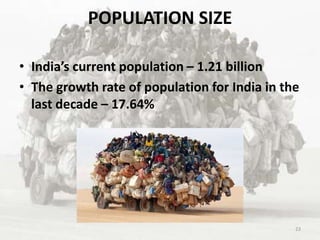
• India’s current population – 1.21 billion
• The growth rate of population for India in the
last decade – 17.64%
23
POPULATION DENSITY
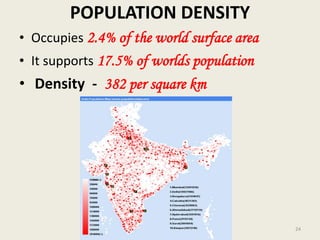
• Occupies 2.4% of the world surface area
• It supports 17.5% of worlds population
• Density - 382 per square km
24
SEX RATIO
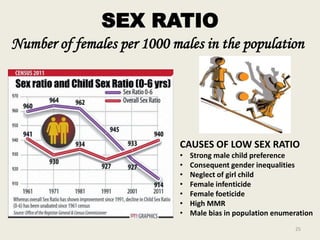
Number of females per 1000 males in the population
25
CAUSES OF LOW SEX RATIO
• Strong male child preference
• Consequent gender inequalities
• Neglect of girl child
• Female infenticide
• Female foeticide
• High MMR
• Male bias in population enumeration
AGE COMPOSITION
• Proportion of population < 14 yrs. – “DECLINING TREND”
• Proportion of the elderly “INCREASING”
26
POPULATION PYRAMID
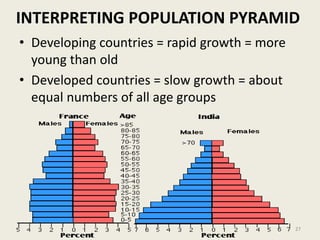
Represents age structure of a population
A type of double sided bar graph
- % of population Males Vs. Females on opposite sides
- Shape of graph correlates with rate of population growth
INTERPRETING POPULATION PYRAMID
• Developing countries = rapid growth = more
young than old
• Developed countries = slow growth = about
equal numbers of all age groups
27
28
ACCORDING TO DEMOGRAPHIC TRANSITION STAGES
• Most developed countries have completed the
demographic transition and have low birth rates;
• Most developing countries are in the process of this
transition.[
FERTILITY
• Total number of children borne by a women at a point
of time during her child bearing age (15 to 45 years)
29
• Total fertility rate(TFR) gives an idea of total family size
• TFR in India: 2.68 (NFHS -3)
Family size depends upon
Duration of marriage
Education of couple
No of live births
Contraception method
Socio economic status
“2 CHILD FAMILY NORM :
LONG TERM GOAL NRR=1
MORTALITY
Refers to the number of deaths.
30
MATERNAL MORTALITY RATE INFANT MORTALITY RATE
(maternal deaths per 1,00,000 live births)
INDIA 2007 to 09 - 212
2011 to 12 - 178
CAUSES
 Haemorrhage
 Infection(sepsis)
 Eclampsia
 Obstructed Labour
LIFE EXPECTANCY
• Expectation of life – at a given age is the average number of
years which a person of that age may expect to live, according
to the mortality pattern prevalent in that country
31
Indicator of country’s level of development & overall health status of the population
Expectation of life
at birth – world
1950 : 46.5 years
2002 :63 years
Census 2011 : the value of life expectancy at birth in India- 65.48 as of 2011
DEPENDENCY RATIO
FOR THE YEAR 2010 :
• Young age dependency ratio -47.9%
• Old age dependency ratio - 7.7%
DEMOGRAPHIC BURDEN
• Increase TDR
• Cause of economic burden
32
Total Dependency Ratio = 0-14 Years + 65 Years And Above
15 To 65 Years
LITERACY AND EDUCATION
A person (7 yrs or more) is considered as literate if he or she
can read & write with understanding in any language.
33
Highest literacy rate in India – KERALA (93.91)
Low for – Bihar (63.82)
MIGRATION
IMMIGRATION
Happens when one
enters the country of
destination but not
permanently.
34
Migration affects population patterns.
EMIGRATION
Happens when one
leaves ones’s country
in order to move into
another permanently.
URBANIZATION
35
CENSUS 2011 Rural Population
(million)
Urban Population
(million)
Increase in Urban
Population (%)
INDIA 833.1 377.1 3.35
CAUSES OF URBANIZATION:
MIGRATION
• Better employment opportunities
• Better living standards
• Better availability of social services like Education,
Health, Transport, Entertainment etc
INTERNAL MIGRATION
Within the country
Rural Urban
URBANIZATION
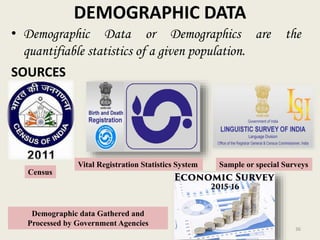
DEMOGRAPHIC DATA
• Demographic Data or Demographics are the
quantifiable statistics of a given population.
SOURCES
36
Census
Vital Registration Statistics System Sample or special Surveys
Demographic data Gathered and
Processed by Government Agencies
• China is the most populated country with approximately
1.39 billion people in 2014.
• India’s population will reach 1.53 billion by 2050 and
will be the highest in world
37
CAUSE - Higher population growth of india 1.2 %
compared to 5% of china.
POPULATION EXPLOSION
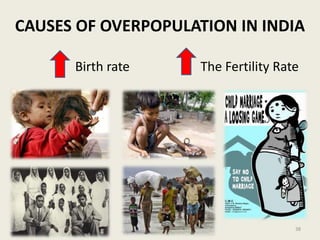
CAUSES OF OVERPOPULATION IN INDIA
Birth rate The Fertility Rate
38
IS POPULATION GROWTH A BLESSING
OR A CURSE?
BLESSING
• Better economy
• Efficient utilization of resources
• Medical, agricultural and industrial growth
• Better Labour Force
• Greater Investments and Capital Formation
40
CURSE
• Shortage of Food and land
• Environmental Problems
• Problem of Unemployment
• Poverty and Low Standard of Living
• Inflation
• Conflict and war
41
National Population Policy -2000,
India aims at
SHORT TERM: Fullfill unmet need for contraception,
strengthening the health infrastructure, integrating
the services for Reproductive and Child Health.
MEDIUM TERM: Effective implementation of inter
sector strategies to substantially reduce the TFR by
2010.
LONG TERM : To sustain the economic growth,
social development and eco- conservation, stabilise
the population by 2045.
42
CONCLUSION
• Health status of a community depends upon
the dynamic relationship between the number
of people, their composition and distribution.
• Planning of health services can be guided by
demographic variables.
43
REFERENCES
44
1. 2011 Census Of India
2. Population Reference Bureau, 2005 World
Population Data Sheet
3. K. Park, Park’s Textbook of Preventive
&Social Medicine ,21st Edition
4. MC Gupta & BK Mahajan,Text Book of
Preventive & Social Medicine,3rd Edition
5. Soben Peter, Essentials of Preventive
&Community Dentistry, 4th Edition
Thank You!
45

Demography

  • 1.
    DEMOGRAPHY 1 Dr. Vineetha K. Departmentof public health dentistry BASIC PRINCIPLES
  • 2.
    CONTENTS 01 02 03 05 04 06 POPULATION GROWTH CAUSES OFPOPULATION GROWTH FUNCTIONS OF DEMOGRAPHY INTRODUCTION IBN KHALDUN JOHN GRAUNT EDMUND HALLEY JOHN SNOW HISTORY MALTHUSIAN MARXIAN OPTIMUM POPULATION DEMOGRAPHIC TRANSITION THEORIES DEMOGRAPHIC PROCESSES CYCLE MODEL INDIA IN NUMBERS -POPULATION STATISTICS -VITAL STATISTICS DEMOGRAPHIC INDICATORS POPULATION TRENDS 2
  • 3.
    TIMELINE • Few millionyears ago 10 MILLION • 8000 BC 500 MILLION • 1800 1 BILLION • 1930 2 BILLION • 1975 4 BILLION • 1999 6 BILLION • 2011 7 BILLION FUTURE POPULATION PROJECTION • 2030 9.5 BILLION • 2100 12.6 BILLION Population growth – an epidemic of homo sapiens 3 Population Reference Beaureu INTRODUCTION
  • 4.
  • 5.
    DEMOGRAPHY Demos – PeopleGraphy - Measurement Scientific study of human population 5
  • 6.
  • 7.
    HISTORY IBN KHALDUN (1332-1406) •Father of demography 7 Economic analysis of social organization which produce the first scientific and theoretical work on population, development and group dynamics
  • 8.
    JOHN GRAUNT Credited forproducing the first life table, giving probabilities of survival to each age. 8
  • 9.
    EDMUND HAILLEY • Halleydeveloped life table based on sound demographic data and discussed several applications of his life table including calculations of life contingencies. 9
  • 10.
    LONDON CHOLERA MAP- JOHN SNOW 10 He plotted every death on a map with Ingenious mapped bar charts and was able to show that The closer to the broad street the water pump he plotted, the greater the no of deaths This information helped convince the public a true sewage system was needed and spurred the city into action
  • 11.
    THEORIES OF POPULATION GROWTHAND DECLINE • Malthusian theory • Marxian theory • Optimum population theory • The demographic transition theory 11
  • 12.
    MALTHUSIAN THEORY • Thomasmalthus (1766-1834) thoerized pessimistically that population was uncontrollable • Population when unchecked, increases in a geometrical ratio (exponentially) Substinence increases only in an arithmetic ratio (linearly) 12 Overpopulation and Massive Poverty
  • 13.
    MARXIAN THEORY • KARLMARX believed that the problem was not primarily one of the population but one of the ownership of the means of production and the inequitable distribution of the societies wealth. • Marx felt that population could ultimately be controlled by the complex workings of market economics and that the economic markets, as they expanded, would be able to sustain population at whatever level it had reached.13
  • 14.
    OPTIMUM POPULATION THEORY 14 Populationmust grow up to certain desired level after which further growth is harmful. By CANAN
  • 15.
    DEMOGRAPHIC TRANSITION THEORY 15 1. Highbirth rate and high death rate 2. High birth rate and low death rate (population explosion) 3. Low birth rate and low death rate Industrial and commercial development first cuts the death rate but creates a desire for smaller families and eventually cuts the birth rate. -Proposed by F. Notestein
  • 16.
    16 To describe populationdynamics is the Demographic Transition Cycle and Model. o First stage - High stationary o Second stage - Early expanding o Third stage - Late expanding o Fourth stage - Low stationary o Fifth stage - Declining HIGH STATIONARY EARLY EXPANDING LATE EXPANDING LOW STATIONARY DECLINING by C.P Blacker
  • 17.
    DEMOGRAPHIC CYCLE 5 STAGESOF DEMOGRAPHI CYCLE STAGE BR DR EXAMPLES Stage HIGH India was in this 1 STATIONARY stage till 1920 Stage EARLY South Asia & Africa 2 EXPANDING Stage LATE India, China 3 EXPANDING Singapore Stage LOW UK, Denmark, Sweden 4 STATIONARY Belgium Stage DECLINING Germany & Hungary 5 17 INDIA 1920 High stationary INDIA PRESENT Late expanding
  • 18.
    DEMOGRAPHIC TRANSITION MODEL 18 Themodel of demographic transition suggested that a population's mortality and fertility would decline as a result of social and economic development. It predicted that all countries would over time go through four demographic transition stages.
  • 19.
    POPULATION MOMENTUM 19 Population growthat the national level that would occur even if levels of childbearing immediately declined to replacement level. CAUSE – due to weighting of age structure towards the young Once the older generation dies, the population will start shrinking
  • 20.
  • 21.
    DEMOGRAPHIC INDICATORS POPULATION SIZE POPULATIONDENSITY SEX RATIO DEPENDENCY RATIO 21 BIRTH RATE DEATH RATE GROWTH RATE LIFE EXPECTANCY AT BIRTH MORTALITY AND FERTILITY RATE POPULATION STATISTICS VITAL STATISTICS
  • 22.
  • 23.
    POPULATION SIZE • India’scurrent population – 1.21 billion • The growth rate of population for India in the last decade – 17.64% 23
  • 24.
    POPULATION DENSITY • Occupies2.4% of the world surface area • It supports 17.5% of worlds population • Density - 382 per square km 24
  • 25.
    SEX RATIO Number offemales per 1000 males in the population 25 CAUSES OF LOW SEX RATIO • Strong male child preference • Consequent gender inequalities • Neglect of girl child • Female infenticide • Female foeticide • High MMR • Male bias in population enumeration
  • 26.
    AGE COMPOSITION • Proportionof population < 14 yrs. – “DECLINING TREND” • Proportion of the elderly “INCREASING” 26 POPULATION PYRAMID Represents age structure of a population A type of double sided bar graph - % of population Males Vs. Females on opposite sides - Shape of graph correlates with rate of population growth
  • 27.
    INTERPRETING POPULATION PYRAMID •Developing countries = rapid growth = more young than old • Developed countries = slow growth = about equal numbers of all age groups 27
  • 28.
    28 ACCORDING TO DEMOGRAPHICTRANSITION STAGES • Most developed countries have completed the demographic transition and have low birth rates; • Most developing countries are in the process of this transition.[
  • 29.
    FERTILITY • Total numberof children borne by a women at a point of time during her child bearing age (15 to 45 years) 29 • Total fertility rate(TFR) gives an idea of total family size • TFR in India: 2.68 (NFHS -3) Family size depends upon Duration of marriage Education of couple No of live births Contraception method Socio economic status “2 CHILD FAMILY NORM : LONG TERM GOAL NRR=1
  • 30.
    MORTALITY Refers to thenumber of deaths. 30 MATERNAL MORTALITY RATE INFANT MORTALITY RATE (maternal deaths per 1,00,000 live births) INDIA 2007 to 09 - 212 2011 to 12 - 178 CAUSES  Haemorrhage  Infection(sepsis)  Eclampsia  Obstructed Labour
  • 31.
    LIFE EXPECTANCY • Expectationof life – at a given age is the average number of years which a person of that age may expect to live, according to the mortality pattern prevalent in that country 31 Indicator of country’s level of development & overall health status of the population Expectation of life at birth – world 1950 : 46.5 years 2002 :63 years Census 2011 : the value of life expectancy at birth in India- 65.48 as of 2011
  • 32.
    DEPENDENCY RATIO FOR THEYEAR 2010 : • Young age dependency ratio -47.9% • Old age dependency ratio - 7.7% DEMOGRAPHIC BURDEN • Increase TDR • Cause of economic burden 32 Total Dependency Ratio = 0-14 Years + 65 Years And Above 15 To 65 Years
  • 33.
    LITERACY AND EDUCATION Aperson (7 yrs or more) is considered as literate if he or she can read & write with understanding in any language. 33 Highest literacy rate in India – KERALA (93.91) Low for – Bihar (63.82)
  • 34.
    MIGRATION IMMIGRATION Happens when one entersthe country of destination but not permanently. 34 Migration affects population patterns. EMIGRATION Happens when one leaves ones’s country in order to move into another permanently.
  • 35.
    URBANIZATION 35 CENSUS 2011 RuralPopulation (million) Urban Population (million) Increase in Urban Population (%) INDIA 833.1 377.1 3.35 CAUSES OF URBANIZATION: MIGRATION • Better employment opportunities • Better living standards • Better availability of social services like Education, Health, Transport, Entertainment etc INTERNAL MIGRATION Within the country Rural Urban URBANIZATION
  • 36.
    DEMOGRAPHIC DATA • DemographicData or Demographics are the quantifiable statistics of a given population. SOURCES 36 Census Vital Registration Statistics System Sample or special Surveys Demographic data Gathered and Processed by Government Agencies
  • 37.
    • China isthe most populated country with approximately 1.39 billion people in 2014. • India’s population will reach 1.53 billion by 2050 and will be the highest in world 37 CAUSE - Higher population growth of india 1.2 % compared to 5% of china. POPULATION EXPLOSION
  • 38.
    CAUSES OF OVERPOPULATIONIN INDIA Birth rate The Fertility Rate 38
  • 39.
    IS POPULATION GROWTHA BLESSING OR A CURSE?
  • 40.
    BLESSING • Better economy •Efficient utilization of resources • Medical, agricultural and industrial growth • Better Labour Force • Greater Investments and Capital Formation 40
  • 41.
    CURSE • Shortage ofFood and land • Environmental Problems • Problem of Unemployment • Poverty and Low Standard of Living • Inflation • Conflict and war 41
  • 42.
    National Population Policy-2000, India aims at SHORT TERM: Fullfill unmet need for contraception, strengthening the health infrastructure, integrating the services for Reproductive and Child Health. MEDIUM TERM: Effective implementation of inter sector strategies to substantially reduce the TFR by 2010. LONG TERM : To sustain the economic growth, social development and eco- conservation, stabilise the population by 2045. 42
  • 43.
    CONCLUSION • Health statusof a community depends upon the dynamic relationship between the number of people, their composition and distribution. • Planning of health services can be guided by demographic variables. 43
  • 44.
    REFERENCES 44 1. 2011 CensusOf India 2. Population Reference Bureau, 2005 World Population Data Sheet 3. K. Park, Park’s Textbook of Preventive &Social Medicine ,21st Edition 4. MC Gupta & BK Mahajan,Text Book of Preventive & Social Medicine,3rd Edition 5. Soben Peter, Essentials of Preventive &Community Dentistry, 4th Edition
  • 45.

Editor's Notes

  • #2 GOOD MORNING TODAY I WILL BE PRESENTING A SEMINAR ON THE TOPIC demography. As it is a very vast topic , and as I can not cover everything in 1 hour time, I ll be concentrating on basic principles of demography
  • #5 In order for a population to grow, there should be two things An increase in birth rates and a decrease in death rate.
  • #6 So what we did now was to study
  • #7 To ascertain the no of people in a given area. To know the resources available for their support To detrmine what changes, growth or decline this number represents and explain the causes of the change To estimate on this basis of future trends To know diff kinds of people who may make up any given population with regard to their physicla, mental and cultural characteristics. To catogorize ppl based on age sex marital status, occupatino Distribution of people among diff countries both rural and urban Anamorphosis map
  • #8 Arab scholar. Born in tunisia His work muqaddmah – includes first mention of demography moderation in geographical conditions promoted population growth and population growth promoted prosperity. He classsififed earth into 7 regions and said that the population is distributed unevenly
  • #9 Graunt, along with William Petty, developed early human statistical and census methods that later provided a framework for modern demography. He is credited with producing the first life table, giving probabilities of survival to each age. LIFE TABLE- a table of statistics relating to life expectancy and mortality for a given category of people.
  • #13 MALTHUS 1st axiom POPULATION when unchecked, increases in a geometrical ratio (exponentially) Substinence increases only in an arithmetic ratio (linearly) Dis adv Formulation wrong Manpower Food instead of wealth
  • #14 Population is dependent on economic and social organization.
  • #16 Two different interpretations have been given for this theory.One by Frank Notestein says that every country passes through three stages of population growth; 1. High birth rate and high death rate ii.High birth rate and low death rate (population explosion) iii.Low birth rate and low death rate. In western nations the desire for high standard of living led to the reductions in the birthrate .These nations are approaching a new equilibrium with both birthrates and death rates quite low and little population growth. This is explained by the theory of demographic transition -the theory that industrial and commercial development first cuts the death rate but creates a desire for smaller families and eventually cuts the birthrate. The Demographic Transition Model was constructed from the European experience, in which the decline in death rates was gradual. It remains to be seen how this model will play out in the developing world of today, in which the decline in death rates has occurred much more rapidly and in which social change takes place against a backdrop of and in interaction with the post-industrial world of electronic communications, multi-national production and marketing, and international travel. timetable for completion of the demographic transition in the developing world will determine the ultimate size of the world’s population.
  • #20 Phenomenon that population will continue to grow for decades even after total fertility rates equal only the replacement rate... Due to weighting of age structure towards the young… So, work toward zero population growth... high-fertility countries in the developing world- these countries will continue to grow despite large and rapid declines in fertility lowest-low fertility countries in Europe- population decline even if they bring their fertility levels up to replacement
  • #25 While india accounts for merely 2.4 percent of the world surface area, it supports and sustains a whopping 17.5% of worlds population.
  • #26 The sex ratio in the country has always remained unfavourable to females. Alarming: Census 2011 marks a considerable fall in child sex ratio (0-6 yrs) and has reached an all time low of 914 since 1961.
  • #28 Developing country population pyramid will have broad base and tapering top
  • #31 Highest assam 390
  • #33 The dependency ratio tells us how many young people (age group 0 to 19) and older people (age group 66 and older) depend on people of working age (age group)
  • #38 1.27 billion people india.
  • #39 The birth rate is still higher than the death rate. The fertility rate due to the population policies and other measures has been falling but even then it is much higher compared to other countries. Poverty and Illiteracy: Another factor for the rapid growth of population is poverty. Impoverished families have this notion that more the number of members in the family, more will be the numbers to earn income. Some feel that more children are needed to look after them in their old age. Also hunger can be cause of death of their children and hence the need for more children. Strange but true, Indian still lag behind the use of contraceptives and birth control methods. Many of them are not willing to discuss or are totally unaware about them. Illiteracy is thus another cause of over population Early Marriage and Universal Marriage System: Even though legally the marriageable age of a girl is 18 years, the concept of early marriage still prevails and getting married at an young age prolongs the child bearing age. Also, in India, marriage is a sacred obligation and a universal practice, where almost every woman is married at the reproductive age
  • #46 © Copyright Showeet.com