POPULATION PYRAMID
Sharon Treesa Antony
Assistant professor
Govt. College of Nursing
Alappuzha
POPULATION PYRAMID
 A population pyramid is a graphical illustration that
shows the distribution of various age groups in a
population
 also called age‐sex pyramid
THREE GENERAL KINDS OF POPULATION
PYRAMIDS
 1. Stationary
 2. Expansive
 3. Constrictive
EXPANSIVE PYRAMID
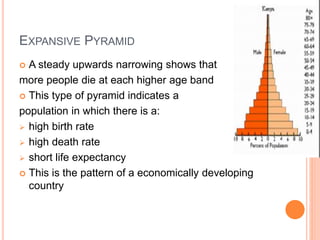
 A steady upwards narrowing shows that
more people die at each higher age band
 This type of pyramid indicates a
population in which there is a:
 high birth rate
 high death rate
 short life expectancy
 This is the pattern of a economically developing
country
STATIONARY PYRAMID
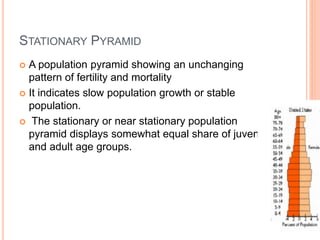
 A population pyramid showing an unchanging
pattern of fertility and mortality
 It indicates slow population growth or stable
population.
 The stationary or near stationary population
pyramid displays somewhat equal share of juvenile
and adult age groups.
CONSTRICTIVE PYRAMID
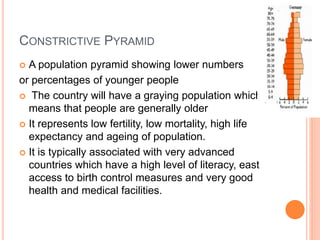
 A population pyramid showing lower numbers
or percentages of younger people
 The country will have a graying population which
means that people are generally older
 It represents low fertility, low mortality, high life
expectancy and ageing of population.
 It is typically associated with very advanced
countries which have a high level of literacy, east
access to birth control measures and very good
health and medical facilities.
THANK YOU

Population pyramid

  • 1.
    POPULATION PYRAMID Sharon TreesaAntony Assistant professor Govt. College of Nursing Alappuzha
  • 2.
    POPULATION PYRAMID  Apopulation pyramid is a graphical illustration that shows the distribution of various age groups in a population  also called age‐sex pyramid
  • 3.
    THREE GENERAL KINDSOF POPULATION PYRAMIDS  1. Stationary  2. Expansive  3. Constrictive
  • 4.
    EXPANSIVE PYRAMID  Asteady upwards narrowing shows that more people die at each higher age band  This type of pyramid indicates a population in which there is a:  high birth rate  high death rate  short life expectancy  This is the pattern of a economically developing country
  • 5.
    STATIONARY PYRAMID  Apopulation pyramid showing an unchanging pattern of fertility and mortality  It indicates slow population growth or stable population.  The stationary or near stationary population pyramid displays somewhat equal share of juvenile and adult age groups.
  • 6.
    CONSTRICTIVE PYRAMID  Apopulation pyramid showing lower numbers or percentages of younger people  The country will have a graying population which means that people are generally older  It represents low fertility, low mortality, high life expectancy and ageing of population.  It is typically associated with very advanced countries which have a high level of literacy, east access to birth control measures and very good health and medical facilities.
  • 7.